
🏠 Home > 🗺️ Recipes > 👑🥪 Royal Starters (Appetizers) > 🇹🇭 Thai Royal Starters (Appetizers) Recipes > 👑🥪 1.Golden Threads of the River — Mee Grob Chao Wang
👑🥪 Aristocratic App: Inside the 1000-Year Legacy of Thai Royal Starters
Published by Supakorn | Updated: July 2026
🇹🇭 👑🏛️ The Forgotten Royal Legacy of Siam: Ayutthaya Golden Era
Let’s be real for a second. When you think of Thai food, you probably picture pad thai, green curry, or mango sticky rice from a street vendor. And hey, those are amazing. But there’s a whole other world of Thai cuisine that almost disappeared. A world of gold leaf, hand-carved vegetables, and flavors so balanced they were considered a form of art.
This is the food of the Royal Court of Ayutthaya, the capital of Siam for over 400 years from 1351 to 1767. At its peak, Ayutthaya was one of the largest, wealthiest cities in the world. Diplomats from France, Portugal, Persia, and China wrote home about its gilded temples and the sheer extravagance of the palace. And at the heart of that power was the Royal Kitchen, or "Hong Krueang Ton".
This wasn’t just a kitchen. It was a sacred institution. Only women from noble families, trained since childhood, could become “Ton Krueang” — the royal chefs. Every dish served to the King was a matter of national security. Tasters, secret ingredients, and coded recipes were the norm. When Ayutthaya fell in 1767, many of these recipes were lost to fire and war. The ones that survived were passed down in whispers, on fragile palm-leaf manuscripts, from one Ton Krueang to her daughter.
Today, we’re opening that sealed cookbook.
📜 The Storyteller’s Intro
Step back with me to the 17th century. It’s just before dawn in the Royal Palace of Ayutthaya. The Chao Phraya River moves slow and black outside the high palace walls. Inside the Hong Krueang Ton, it’s already alive. The air is thick with the scent of freshly pounded lemongrass, galangal from the Tenasserim Hills, and dried prawns from the Gulf of Siam.
A master chef, Khun Thao Nang Noppamas, inspects each lotus bud by candlelight. Only the ones that bloomed perfectly at 3 AM are worthy. At her side, young apprentices grind spices on a stone mortar so smoothly it doesn’t make a sound. The King must never be disturbed by noise from the kitchen. Every movement is a ritual. Every ingredient has a meaning. A single dish could take a full day to prepare, because in the royal court, food wasn’t just fuel. It was poetry. It was power. It was history you could taste.
🌏 The Global Value
Here’s the thing that makes these recipes different from your favorite street food: they were never meant for everyone.
For centuries, these dishes were “Ahan Chao Wang” — food of the palace people. The recipes were state secrets. Why? Because controlling flavor meant controlling prestige. Foreign envoys would be served dishes they could never replicate back home. The complexity was a display of Siam’s wealth, its trade routes, and its mastery over nature.
When Ayutthaya was sacked, an estimated 90 percent of the royal culinary texts were burned. The few that survived were hidden by palace chefs who fled to Thonburi and later Bangkok. They cooked in secret for generations. That’s why you won’t find these exact starters in any restaurant. They were too labor-intensive, too expensive, and frankly, too precious to be sold.
We’re talking about food that almost went extinct. Bringing it back isn’t just cooking. It’s culinary archaeology.
💎 The Collection
So what are we reviving today? This collection is a love letter to the “Khong Wang” — the starters and small plates that began every royal meal. Think of them as the opening scene of a play. They had to be stunning, light, and full of symbolic meaning.
We’re resurrecting three legendary starters that define the Ayutthaya Golden Era. Each one tells a story of trade, artistry, and the incredible skill of the women who ran the most powerful kitchen in Southeast Asia. And the best part? We’ve adapted them so you can actually make them in your kitchen. No palm-leaf manuscripts or 12-hour prep times required. Just the soul of the palace, ready for your table.
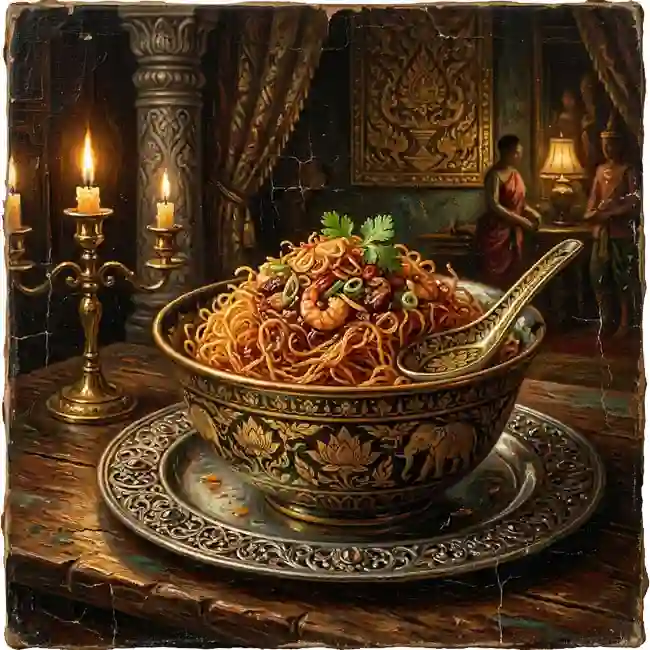
👑 Recipe: Golden Threads of the River — Mee Grob Chao Wang
📖 About this Royal Secret
This was not just a snack. “Mee Grob Chao Wang” was the personal favorite of Queen Si Suriyothai’s ladies-in-waiting, and it was served only during the Royal Kathin Ceremony, when the King presented new robes to monks.
Legend says the dish was created to represent the golden rays of the sun reflecting on the Chao Phraya River at dawn — a blessing for prosperity. The noodles had to be as fine as hair and as light as air. If they clumped, the chef faced demotion. If they sang, meaning they made a perfect crisp sound when bitten, she was rewarded with gold.
Serving this to guests was the ultimate signal of honor. You weren’t just feeding them. You were giving them a piece of sunshine, a taste of divine kingship. Today, it’s the perfect way to start a dinner party that you want people to remember for 1000 years.
🧺 Ingredients & The Aristocratic Touch
The Royal Pantry
In the palace, nothing was ordinary. The rice noodles were made from the first harvest of jasmine rice, pounded by hand and sun-dried on silk sheets so they wouldn’t pick up any dust. The palm sugar came from Phetchaburi and had to be the “Nam Tan Puek” variety — smoky, dark, and complex, not the simple sweet stuff. Even the shrimp were special: tiny river shrimp, dried for 7 days until they turned into umami crystals. The citrus wasn’t lime. It was “Som Sa”, a fragrant Thai orange that’s almost impossible to find now. Every element was chosen for its aroma, its color, and its story.
Modern Substitutes
Don’t panic. You don’t need a royal decree to get these ingredients. Here’s how we adapt without losing the soul:
• Som Sa Orange: Use a mix of 1 part fresh tangerine zest and 2 parts regular lime juice. It gets you 90 percent of the floral aroma.
• Nam Tan Puek Palm Sugar: Use dark, smoky palm sugar or mix coconut sugar with 1 teaspoon of molasses.
• Dried River Shrimp: Good quality dried shrimp from an Asian grocer works. Soak them in warm water for 10 minutes to soften, then pat dry.
• Handmade Rice Vermicelli: Buy the thinnest rice vermicelli you can find, often labeled “Wai Wai” or “rice stick size S”.
The Measurements
For 4 people as a royal starter:
• Rice vermicelli, super thin, 150 grams
• Vegetable oil for deep frying, 3 cups
• Dried shrimp, soaked and chopped fine, 1/2 cup
• Garlic, Thai variety, minced, 2 tablespoons
• Shallots, thinly sliced, 1/3 cup
• Palm sugar, finely shaved, 3/4 cup
• Tamarind paste, thick, 2 tablespoons
• Fish sauce, premium grade, 2 tablespoons
• Thin soy sauce, 1 tablespoon
• Fresh tangerine zest, 1 teaspoon
• Lime juice, fresh, 1 tablespoon
• Fried tofu, cut into tiny 0.5 cm cubes, 1/2 cup
• Pickled garlic, thinly sliced, 2 tablespoons
• Fresh red chili, deseeded and cut into threads, 1 piece for garnish
• Cilantro leaves, young, a small handful
🥣 The Chef’s Ritual
1.Prepare the Threads. Gently separate the dry rice vermicelli so there are no clumps. Do not soak them. The secret to “singing” noodles is frying them bone-dry.
2.The Golden Fry. Heat oil to 375F or 190C. It must be hot, but not smoking. Test with one strand — it should puff and float in 2 seconds. Fry the noodles in small batches for 5 to 8 seconds each. They cook fast. Lift them out the second they turn pale gold and before they brown. Drain on a wire rack, not paper towels, so they stay shatteringly crisp.
3.Build the Royal Sauce. In a brass or heavy pan, use 2 tablespoons of the frying oil. Sauté garlic and shallots over low heat until they are golden and sweet, not brown. This is the fragrance base. Patience here is everything.
4.Create Harmony. Add palm sugar, tamarind, fish sauce, and thin soy sauce. Simmer gently. Stir with a wooden spoon only in one direction — clockwise, as tradition says, to invite good fortune. Let it bubble slowly until it thickens into a glossy syrup that coats the spoon. This takes about 6 to 8 minutes. The scent should be sweet, sour, and salty all at once.
5.The Final Alchemy. Turn off the heat. Immediately stir in the tangerine zest, lime juice, dried shrimp, fried tofu, and pickled garlic. The residual heat will wake up their aromas without cooking them.
6.Dress the Gold. In a large, wide bowl, pour the warm sauce over the crispy noodles. Using two large spoons, toss with a light, lifting motion. You are not mixing. You are dressing each golden thread so it’s coated but still airy. Act fast. The noodles wait for no one.
7.Plate Like a Palace. Mound it high on a small dish. Garnish with chili threads and cilantro. Serve immediately. In the palace, a drum would sound to tell the King his Mee Grob was ready. In your house, just yell “It’s ready!” and watch people run.
🤫 Secrets of the Palace Kitchen
• The Sound Test: A Ton Krueang would close her eyes and listen when the King took a bite. If there was no crisp “krob” sound, the whole batch was discarded. Your goal is texture. If your noodles go soft in 5 minutes, your oil wasn’t hot enough or your sauce was too watery.
• No Stirring Backward: Superstition or science? Stirring the sauce in one direction prevents sugar crystals from forming and keeps it smooth. Never switch directions.
• The Tamarind Trick: If your tamarind paste is too sour, the palace fix was a tiny piece of “salted duck egg yolk”, mashed into the sauce. It adds richness and balances acid. Try 1/2 teaspoon if needed.
• Common Mistake — Soggy Noodles: Never pour hot sauce on noodles and let them sit. Always toss and serve immediately. In the palace, the chef would walk beside the servant carrying the dish to ensure it was served in under 60 seconds.
• Make Ahead Hack: You can fry the noodles and make the sauce 2 hours ahead. Keep them separate. Reheat the sauce until just warm, then toss when guests arrive.
❓ Royal FAQ
Q1. Can I make Mee Grob less sweet?
Absolutely. Palace food was about balance, not just sweetness. Reduce the palm sugar to 1/2 cup and add 1 extra teaspoon of lime juice. Taste the sauce before tossing. It should make your mouth water, not just your sweet tooth.
Q2. My noodles didn’t puff. What happened?
Two culprits: oil not hot enough, or noodles were damp. Make sure noodles are fully dry from the package. And use a thermometer. Guessing the oil temp is how palace chefs lost their jobs.
Q3. Is there a vegetarian version?
Yes. Skip the dried shrimp and fish sauce. Use 3 tablespoons of thin soy sauce plus 1 tablespoon of fermented soybean paste called “Tao Jiew” for umami. Add 1/4 cup of toasted, crushed peanuts for texture. The Queen Mother had a vegan chef, so it’s historically accurate.
Q4. How do I store leftovers?
Honestly? You won’t have any. But if you do, store noodles and sauce separately. Leftovers will never be as crisp as fresh. The palace solution was to give them to the temple. Your modern solution is to eat them cold at midnight. Still delicious.
🍽️ The Taste of History
When you take a bite of Mee Grob Chao Wang, here’s what happens. First, the shatter. It’s louder than you expect. Then the sauce hits — sweet from the palm sugar, tangy from tamarind, deep umami from shrimp, and a high floral note from the citrus. Then the textures: crisp noodles, chewy tofu, soft shallots. It’s not just a starter. It’s a complete story of Siamese trade routes in one mouthful. You taste the Chinese influence in the noodles, the Indian influence in the tamarind, and the absolute soul of Thailand in the balance. This is why kings loved it. It’s complex, but it feels like a celebration.
💭 Final Thoughts: Bringing History to Your Table
I know what you’re thinking. “This sounds incredible, but I’m not a royal chef trained since birth.” And you’re right. You’re not. You’re better. Because you have curiosity, and you have this guide.
The truth is, the Ton Krueang of Ayutthaya weren’t magicians. They were masters of patience, balance, and respect for ingredients. They didn’t have thermometers or food processors. They had their senses. So use yours. Smell the sauce. Listen to the fry. Taste and adjust.
These recipes survived war, fire, and 250 years of silence because they are worth it. They’re not just food. They’re a connection to the hands that made them centuries ago. And now, those hands are yours. You can absolutely recreate a legendary taste in your home kitchen. Start with Mee Grob. Master the crisp. Then you’re ready for the next secret.
✨ The Call to Action (The Golden Hook)
If you fell in love with this taste of history, you’re not alone. There’s a whole world of culinary secrets out there, waiting to be unlocked. Share your Mee Grob photos and tag us. Tell us what 1000-year-old flavor you want to see next. By cooking these dishes, you become part of the story. You’re not just making dinner. You’re keeping a culture alive, one golden thread at a time. Join us, and let’s preserve the world’s secret recipes together.
🙏 Credit to the Keepers of the Culture (The Legacy)
This recipe is inspired by the ancient culinary archives of the Royal Court of Ayutthaya, Siam, 17th Century. We have carefully adapted the techniques and measurements for modern kitchens while preserving its royal soul. Our deepest respect goes to the generations of Ton Krueang — the palace chefs and women of the Royal Kitchen — whose skill, artistry, and silent dedication kept these flavors alive through centuries of change. This is their legacy, and we are honored to share it with the world.
| 🇹🇭 👑🥪 < Back |