
🏠 Home > 🗺️ Recipes > 👑🍝 Imperial Mains (Main Dishes) > 🇹🇭 Thai Imperial Mains (Main Dishes) Recipes > 👑🍝 1.Royal Ayutthaya Imperial Massaman Curry
👑🍝 Discover the Hidden World of 500-Year Thai Imperial Main Dishes
Published by Supakorn | Updated: July 2026
🇹🇭 👑🏛️ The Forgotten Royal Legacy of Thailand: The Ayutthaya Royal Court
For centuries, Thailand's royal kitchens represented far more than places where meals were prepared. Hidden behind palace walls, these magnificent kitchens served as workshops of artistry, precision, and cultural identity. Every ingredient, every cooking method, and every presentation reflected the wisdom accumulated through generations of royal chefs whose names rarely appeared in history books but whose culinary influence shaped an entire civilization.
The royal cuisine of the Ayutthaya era remains one of Southeast Asia's most fascinating culinary treasures. During its golden age, the kingdom welcomed merchants, diplomats, scholars, and travelers from across Asia, the Middle East, and Europe. While new ingredients arrived through flourishing trade, palace chefs carefully blended foreign influences with local Thai traditions, creating dishes that were uniquely elegant without losing their cultural soul.
Unlike everyday village cooking, royal cuisine demanded extraordinary attention to detail. Vegetables were carved into delicate flowers, herbs were selected at their seasonal peak, and every serving was designed to delight not only the palate but also the eyes. A meal inside the palace symbolized harmony, prosperity, refinement, and respect for both guests and the kingdom itself.
Many of these culinary traditions were preserved only through oral teaching inside palace kitchens. Apprentice cooks spent years mastering techniques before they were trusted with preparing meals for royalty. Because these recipes were rarely written down in detail, countless variations gradually disappeared as dynasties changed and generations passed.
Today, historians, culinary researchers, and traditional Thai chefs continue piecing together fragments of this remarkable heritage. Ancient manuscripts, family traditions, historical records, and ceremonial practices offer glimpses into a sophisticated cuisine that deserves to be remembered not merely as food, but as an important chapter of Thailand's cultural legacy.
This article invites you to step beyond the familiar versions of Thai cuisine found around the world and discover the elegance, discipline, and timeless beauty that once defined the royal dining halls of old Siam.
📖 The Storyteller's Intro
Imagine walking through the polished wooden corridors of a royal palace nearly five centuries ago. Morning sunlight filters gently through carved windows, while the distant sound of temple bells echoes across peaceful gardens filled with jasmine, lotus ponds, and fragrant tropical blossoms.
Deep within the palace lies the royal kitchen—a place few outsiders would ever witness.
Large stone mortars rhythmically pound fresh herbs into fragrant pastes. Clay stoves burn steadily beneath gleaming bronze pots. Skilled palace cooks move gracefully between preparation tables, carefully trimming vegetables until each resembles blooming orchids and lotus petals. Every movement is calm, deliberate, and practiced through years of disciplined training.
Nearby, baskets overflow with freshly harvested lemongrass, galangal, kaffir lime leaves, turmeric, aromatic roots, and handpicked herbs gathered before sunrise. Coconut cream is pressed by hand until silky smooth. Premium seafood arrives from nearby rivers and coastal ports, while the finest rice is selected grain by grain for its fragrance and texture.
Nothing is rushed.
Every ingredient receives the respect it deserves.
Every dish tells a story.
These meals are not created simply to satisfy hunger. They celebrate diplomatic friendships, royal ceremonies, sacred festivals, victorious occasions, and moments that will become part of the kingdom's living history.
Within these walls, cooking is considered both a science and an art—a quiet expression of loyalty, craftsmanship, generosity, and cultural pride.
Although centuries have passed, the spirit of those palace kitchens continues to inspire modern Thai cooking, reminding us that true culinary excellence is built upon patience, balance, and respect for tradition.
🌏 The Global Value
Royal Thai recipes were never intended for public kitchens.
Many were prepared exclusively for kings, queens, princes, princesses, honored monks, distinguished ambassadors, and visiting dignitaries. Access to these dishes required exceptional ingredients, experienced palace cooks, and strict preparation methods that ordinary households could neither afford nor easily reproduce.
The secrecy surrounding palace cuisine helped preserve its prestige. Recipes were often shared only between trusted members of the royal kitchen, with measurements taught through observation rather than written instructions. Apprentices learned by repeating techniques thousands of times until perfection became second nature.
As political landscapes evolved and royal institutions changed, many culinary traditions slowly faded. Some recipes survived through noble families. Others remained hidden within temple communities or private handwritten collections. A considerable number vanished entirely, remembered only by brief descriptions in historical accounts.
Today, these forgotten techniques possess value far beyond Thailand's borders.
They offer historians insight into diplomacy, agriculture, international trade, seasonal farming, artistic presentation, and cultural exchange throughout Southeast Asia. They reveal how food connected kingdoms, welcomed foreign visitors, and expressed refinement without excessive luxury.
More importantly, these recipes remind us that cultural heritage is something living—not locked away inside museums but recreated each time someone prepares a traditional dish with genuine care and understanding.
By rediscovering royal cuisine, modern cooks become participants in preserving a remarkable chapter of global culinary history.
✨ The Collection
This guide is dedicated to bringing forgotten royal flavors back into today's kitchen while honoring their historical spirit.
Rather than treating palace cuisine as something distant or impossible to recreate, we explore how its timeless principles—balance, elegance, patience, freshness, and harmony—can inspire home cooks around the world.
Throughout this collection, you'll discover recipes rooted in centuries-old traditions, carefully adapted for modern kitchens without sacrificing their royal character. Every featured dish celebrates ingredients that have long been treasured in Thailand while explaining the cultural stories that make each recipe truly meaningful.
These are not simply old recipes.
They are windows into royal ceremonies, diplomatic banquets, seasonal celebrations, and the extraordinary craftsmanship that transformed everyday ingredients into unforgettable culinary masterpieces.
Whether you're passionate about Thai cuisine, fascinated by food history, or simply searching for authentic recipes beyond the ordinary, this collection invites you to experience the enduring elegance of Thailand's imperial kitchen.
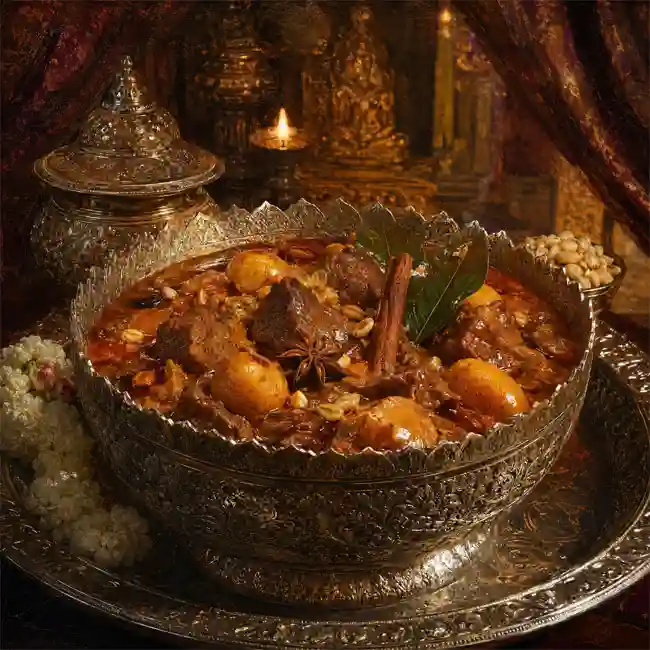
👑 Recipe: Royal Ayutthaya Imperial Massaman Curry
🍛 About This Royal Secret
Among the many celebrated dishes associated with Thailand's royal culinary heritage, few inspire as much admiration as the refined version of Massaman Curry prepared within the royal kitchens of the Ayutthaya Kingdom.
Unlike everyday interpretations enjoyed today, the palace version emphasized extraordinary balance rather than intensity. Every spice was measured with remarkable precision, every ingredient selected at its seasonal best, and every stage of cooking reflected the discipline expected inside the royal household.
Historical traditions suggest that richly prepared curry dishes were often served during important diplomatic banquets, welcoming distinguished foreign envoys, influential merchants, and respected nobles visiting the kingdom. Such meals showcased not only Thailand's agricultural abundance but also the remarkable skill of its palace chefs, who blended local ingredients with carefully adopted international influences.
Royal cooks refined the dish by creating exceptionally smooth curry paste, using freshly pressed coconut cream, premium cuts of meat, aromatic herbs, and perfectly balanced spices. The result was a luxurious meal that felt elegant without overwhelming the senses.
More than a recipe, this dish symbolized hospitality, cultural confidence, and royal generosity—qualities that helped define the prestige of the Thai court during one of Southeast Asia's most influential historical periods.
In the next section, we'll step inside the royal pantry to discover the carefully chosen ingredients that gave this legendary imperial dish its unforgettable character.
🍃 Ingredients & The Aristocratic Touch
🌿 The Royal Pantry
The greatness of an imperial Thai dish has never depended on rare ingredients alone. What truly separated palace cuisine from everyday cooking was the respect shown to every ingredient before it ever reached the cooking pot.
Royal chefs believed that each component possessed its own personality. Fresh herbs were picked early in the morning while their fragrance was at its peak. Coconut cream was pressed from mature coconuts by hand to achieve exceptional richness. Spices were toasted gently to awaken their natural oils, while roots and aromatics were carefully cleaned and sliced with remarkable precision.
Nothing was wasted.
Nothing was rushed.
Every ingredient played an equal role in creating harmony rather than competing for attention.
The famous balance of Thai royal cuisine comes from this philosophy. Sweetness should never dominate richness. Spice should enhance rather than overwhelm. Herbs should brighten the aroma without hiding the natural flavor of the main ingredient. Every spoonful should feel elegant, smooth, and complete.
Although modern kitchens are equipped with convenient appliances, the spirit of the palace remains the same: choose quality over quantity, prepare every ingredient with patience, and allow each flavor to contribute naturally to the final masterpiece.
🛒 Modern Substitutes
Fortunately, recreating this royal favorite at home is much easier than many people imagine. While the palace once relied on exclusive seasonal ingredients, excellent alternatives are widely available today.
• Beef chuck can be replaced with beef brisket or well-marbled stewing beef.
• Chicken thigh offers a lighter yet equally flavorful variation.
• Lamb shoulder creates a richer interpretation while preserving the luxurious texture.
• Fresh coconut cream is ideal, but high-quality canned coconut cream also produces excellent results.
• Palm sugar may be substituted with light brown sugar if necessary, although palm sugar provides a more authentic caramel sweetness.
• Tamarind paste offers the traditional gentle acidity. Fresh lime juice can be used in small amounts when tamarind is unavailable.
• Roasted peanuts may replace roasted cashews depending on personal preference.
• Sweet potato can substitute traditional waxy potatoes while adding a naturally creamy texture.
• Fresh shallots deliver the finest aroma, though yellow onions can work as an alternative.
• Whole spices are recommended because freshly toasted spices produce deeper fragrance than pre-ground versions.
Selecting fresh ingredients remains the most important secret. Palace cuisine values freshness above extravagance.
📜 The Measurements
The following measurements are designed for approximately four generous servings while remaining faithful to the elegant balance found in traditional Thai royal cooking.
For the Main Ingredients
• Beef chuck, cut into large cubes — 800 grams
• Coconut cream — 600 milliliters
• Coconut milk — 400 milliliters
• Waxy potatoes, peeled and quartered — 300 grams
• Yellow onion, cut into wedges — 200 grams
• Roasted peanuts — 80 grams
• Bay leaves — 2 leaves
• Cinnamon stick — 1 stick
• Green cardamom pods — 5 pods
• Whole cloves — 4 pieces
For the Royal Curry Paste
• Dried red chilies, softened — 8 pieces
• Shallots — 120 grams
• Garlic cloves — 8 cloves
• Galangal — 30 grams
• Lemongrass, tender inner stalks — 50 grams
• Coriander roots — 20 grams
• White peppercorns — 1 teaspoon
• Coriander seeds, toasted — 2 teaspoons
• Cumin seeds, toasted — 2 teaspoons
• Nutmeg — one quarter teaspoon
• Mace — one quarter teaspoon
• Shrimp paste — 1 teaspoon
For the Royal Seasoning
• Palm sugar — 2 tablespoons
• Tamarind paste — 2 tablespoons
• Fish sauce — 3 tablespoons
• Freshly squeezed coconut cream for finishing — 100 milliliters
👨🍳 The Chef's Ritual
Preparing this curry is not about speed. It is about allowing every ingredient to reveal its finest qualities through gentle cooking and careful attention.
• Step 1
Toast the coriander seeds, cumin seeds, white peppercorns, cloves, cardamom, cinnamon, nutmeg, and mace over gentle heat until fragrant. Allow them to cool before grinding into a fine aromatic powder.
• Step 2
Blend or pound the softened chilies together with shallots, garlic, galangal, lemongrass, coriander roots, shrimp paste, and the freshly ground spices until an exceptionally smooth curry paste forms. The finer the paste, the more elegant the finished curry becomes.
• Step 3
Heat half of the coconut cream over medium heat. Stir patiently until the natural coconut oil begins separating from the cream. This traditional technique creates the rich foundation characteristic of palace-style curries.
• Step 4
Add the curry paste and cook gently while stirring continuously. Allow the spices to bloom slowly until the kitchen becomes filled with deep aromatic fragrance.
• Step 5
Add the beef and coat every piece thoroughly with the fragrant paste. Continue cooking for several minutes so the meat absorbs the spices before adding any liquid.
• Step 6
Pour in the remaining coconut cream and coconut milk. Add the cinnamon stick, bay leaves, and cardamom pods. Simmer gently for approximately ninety minutes, allowing the beef to become beautifully tender.
• Step 7
Add the potatoes and onions. Continue simmering until both become soft without losing their shape.
• Step 8
Season carefully with palm sugar, fish sauce, and tamarind paste. Taste repeatedly while making small adjustments until sweetness, richness, saltiness, and gentle acidity reach perfect harmony.
• Step 9
Fold in the roasted peanuts during the final minutes of cooking.
• Step 10
Finish with a final splash of fresh coconut cream just before serving, creating the luxurious silky texture admired in royal kitchens for generations.
👑 Secrets of the Palace Kitchen (Tips & Mistakes)
✨ Palace Tips
• Choose fresh coconut cream whenever possible for the richest aroma.
• Toast whole spices immediately before grinding to maximize their fragrance.
• Simmer gently rather than boiling vigorously to keep the curry smooth and elegant.
• Prepare the curry one day in advance. Like many royal dishes, its flavors become even more harmonious after resting overnight.
• Taste frequently instead of adjusting seasoning only at the end.
• Allow the potatoes to absorb the curry naturally by adding them after the meat has already become tender.
• Use freshly ground spices rather than commercial spice blends whenever possible.
• Serve with freshly steamed jasmine rice to complement the curry's luxurious richness.
⚠️ Common Mistakes
• Cooking over high heat, which can split the coconut cream too aggressively.
• Burning the curry paste before its aromas fully develop.
• Using lean meat that becomes dry during long cooking.
• Adding too much sugar, masking the delicate spice profile.
• Skipping the spice-toasting stage, resulting in a flatter flavor.
• Rushing the simmering process instead of allowing the meat to become naturally tender.
• Overcooking the potatoes until they completely break apart.
• Adding all seasonings at once instead of building balance gradually.
❓ Royal FAQ
Q1.Can I prepare this curry ahead of time?
Absolutely. Many experienced chefs believe the flavors become deeper and more harmonious after resting overnight in the refrigerator.
Q2.Is beef the only traditional choice?
No. Royal kitchens also prepared refined versions using chicken, duck, and occasionally lamb depending on the season and the importance of the occasion.
Q3.Can I reduce the spiciness?
Yes. Simply decrease the number of dried chilies while keeping the aromatic spices unchanged to preserve the authentic royal character.
Q4.Why is palace-style Massaman curry smoother than many modern versions?
Royal chefs devoted extra time to grinding the curry paste until exceptionally fine, creating the luxurious texture that distinguished palace cuisine from everyday home cooking.
📜 The Taste of History (Summary)
Every spoonful of Royal Ayutthaya Imperial Massaman Curry carries more than remarkable flavor—it carries the legacy of a civilization that viewed cooking as an expression of wisdom, refinement, and hospitality.
Centuries ago, dishes like this represented the highest standards of the royal kitchen. Palace chefs devoted years to mastering the delicate balance between sweetness, richness, gentle spice, fragrant herbs, and aromatic spices. Their goal was never to overwhelm the palate but to create harmony, allowing every ingredient to contribute to a complete and memorable dining experience.
What makes this recipe timeless is not simply its historical roots but its philosophy. Patience, precision, and respect remain just as valuable in today's kitchen as they were hundreds of years ago inside the royal courts of Ayutthaya.
Modern cooks may have electric stoves, food processors, and convenient ingredients, yet the heart of the recipe remains unchanged. Selecting fresh ingredients, cooking with care, and tasting thoughtfully throughout the process are traditions that continue to honor the spirit of Thailand's imperial cuisine.
Whether served for a family gathering, a holiday celebration, or an elegant dinner with friends, this royal curry offers something beyond comfort food. It becomes a conversation about history, craftsmanship, and the remarkable culinary heritage that continues to inspire generations around the world.
Preparing this dish is, in many ways, an invitation to experience history through your own kitchen—one carefully crafted bowl at a time.
🏡 Final Thoughts: Bringing History to Your Table
Royal cuisine may appear mysterious at first glance, but its greatest lesson is surprisingly simple: extraordinary meals begin with thoughtful preparation and genuine respect for every ingredient.
The palace kitchens of old Thailand were never built upon unnecessary extravagance. Instead, they celebrated balance, discipline, and craftsmanship. These same principles are available to every home cook today.
You don't need a royal palace to recreate an imperial masterpiece.
You only need quality ingredients, patience, curiosity, and a willingness to slow down enough to appreciate the cooking process.
As you prepare this recipe, notice how each stage builds naturally upon the last—from gently toasting spices to patiently simmering the curry until every flavor settles into perfect harmony. These timeless techniques transform familiar ingredients into something truly memorable.
Perhaps that is the greatest gift left by Thailand's royal chefs: the understanding that remarkable food is created not through complexity alone, but through care.
By recreating recipes inspired by the royal kitchens, you become part of a living tradition that continues to preserve one of Southeast Asia's richest culinary heritages.
Every meal prepared with respect helps keep these stories alive for future generations.
✨ The Call to Action (The Golden Hook)
If you enjoy discovering the forgotten flavors of history, you're only beginning an extraordinary journey.
Across the royal kitchens of Thailand—and throughout the great courts of the world—countless legendary recipes remain waiting to be rediscovered. Each one tells a story of kings and queens, master chefs, ceremonial feasts, cultural exchange, and centuries of culinary artistry.
Join us as we continue exploring these remarkable traditions, carefully adapting ancient palace recipes for modern kitchens while honoring their historical origins.
Whether your passion lies in royal curries, ceremonial desserts, elegant soups, festive rice dishes, or forgotten imperial banquets, every recipe helps preserve a priceless piece of world culinary heritage.
Cook them.
Share them.
Pass them forward.
Together, we can ensure that these extraordinary traditions continue inspiring future generations of food lovers, historians, and home chefs around the globe.
History deserves to be remembered—not only through books, but also through the meals we lovingly prepare and enjoy around our own tables.
🏛️ Credit to the Keepers of the Culture (The Legacy)
This recipe is inspired by the rich culinary traditions of the Thai royal courts, particularly those associated with the Ayutthaya Kingdom and the continuing heritage preserved through generations of Thai palace cuisine.
Historical royal recipes often existed in multiple regional and family variations. Rather than following a single surviving manuscript, this adaptation respectfully draws upon established culinary traditions, historical research, and classic techniques that reflect the elegance and philosophy of Thailand's imperial kitchens.
Ingredient measurements and preparation methods have been thoughtfully adjusted for contemporary home kitchens while striving to preserve the balance, refinement, and spirit that have long distinguished authentic Thai royal cuisine.
We extend our deepest respect to the generations of royal chefs, court cooks, culinary historians, scholars, and cultural guardians whose dedication has helped preserve these remarkable traditions through centuries of change.
Their craftsmanship reminds us that food is far more than nourishment—it is a living archive of culture, identity, artistry, and shared human history.
Inspired by the enduring culinary heritage of the Royal Courts of Thailand. Carefully adapted for modern kitchens while honoring the elegance, craftsmanship, and timeless spirit of authentic Thai imperial cuisine.
👑 Thank You for Exploring Thailand's Royal Culinary Heritage
Thank you for taking the time to explore this remarkable chapter of Thai culinary history.
May this recipe inspire you not only to create an exceptional meal but also to appreciate the generations of knowledge, patience, and artistry that shaped one of the world's most refined royal cuisines.
Every carefully prepared dish helps preserve a story that deserves to be remembered.
Happy cooking—and may the timeless spirit of Thailand's imperial kitchen continue to enrich your table for years to come.
| 🇹🇭 👑🍝 < Back |