
🏠 Home > 🗺️ Recipes > 👑🍝 Imperial Mains (Main Dishes) > 🇱🇦 Laos Imperial Mains (Main Dishes) Recipes
🇱🇦 👑🍝 Laos Imperial Mains (Main Dishes) Recipes
Published by Supakorn | Updated: July 2026
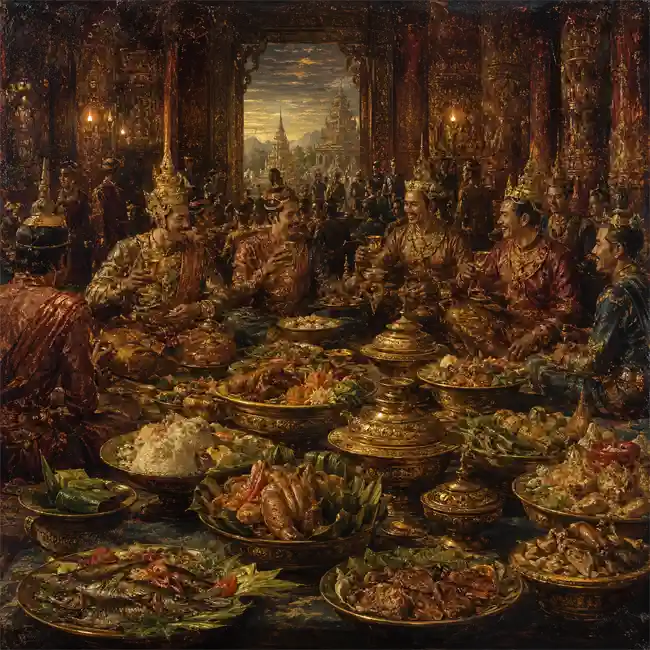
🇱🇦 📜 The Storyteller’s Intro: What the Old Lan Xang Courts Never Served to Commoners
This is the codex of aristocratic Lao cuisine. Because Laos had no formal “royal” designation after 1975, we honor the same lineage with the term aristocratic — the ruling families, court ministers, and high-ranking nobles of Lan Xang whose kitchens shaped Lao identity for nearly 1,000 years.
Lao aristocratic food culture spans three defining eras, each leaving a distinct fingerprint on the main dishes served only inside palace walls and noble compounds:
1. Lan Xang Golden Era 1353–1707: The Kingdom of a Million Elephants established Luang Prabang as the spiritual and culinary heart. Court kitchens blended indigenous Tai-Kadai techniques with Indianized Khmer influences. Meals were ceremonial, slow-cooked, and layered with wild aromatics. Only nobles ate “constructed” dishes — mains assembled from 10+ components to represent harmony and cosmic balance.
2. Fragmented Kingdoms Era 1707–1893: Luang Prabang, Vientiane, and Champasak each maintained separate courts. This created regional aristocratic styles. Luang Prabang favored refined, subtle broths and river fish. Vientiane leaned into bold forest herbs and game. Champasak nobles mastered lowland river cuisine with preserved techniques.
3. Colonial & Post-Royal Period 1893–1975: French protectorate years added plating rituals and preservation methods, but Lao nobles fiercely guarded core flavors. Dishes became “quieter” — less chili heat, more fragrant infusions — to distinguish aristocratic tables from street food. After the monarchy ended, many court chefs became keepers of these recipes, passing them only through family lines.
How did Lao aristocrats live and eat?
• The Kitchen Hierarchy: A Nai Khrua or master chef led the Haw Khua palace kitchen. Only trusted family members handled spice pastes. Recipes were memorized, never written, to protect lineage.
• The Eating Ritual: Nobles ate on low carved teak tables called pha khao. Mains arrived sequentially, not all at once. Each dish was tasted with sticky rice rolled by hand, but never directly from the communal plate — a silver tong or banana leaf scoop was used.
• The Philosophy: Food was medicine, status, and diplomacy. A main dish had to balance som sour, khem salty, waan subtle sweet from herbs, and khouen bitter aromatics. Heat was background, never dominant. Presentation mattered — carved vegetables, layered steam baskets, and gold-rimmed lacquerware signaled rank.
• The Secret Rule: “Common” ingredients like raw chili dip or fermented fish were transformed. Padaek was filtered 7 times for palace use. Herbs were harvested at dawn. River fish were kept live in court ponds for 3 days to cleanse flavor.
These main dishes weren’t “fancy” versions of street food. They were a completely different culinary language — one that almost disappeared.
🍲 Imperial Main Dishes of the Lao Aristocracy: The Names You’ve Never Heard
These are not on restaurant menus. They were reserved for Boun That Luang ceremonies, royal weddings, and visits from foreign dignitaries. Many require ingredients foraged only in specific micro-seasons.
• Or Lam Luang Prabang Saenkham: The “Golden Court” version of the iconic stew. Uses smoked wild boar from northern forests, 14 forest herbs including sakhan stem, and black sticky rice thickener. Served only to the king’s inner circle during cold season.
• Ping Pa Khang Khouang: Char-grilled Mekong fish marinated for 3 nights in a paste of black galangal, mak keng wild orange zest, and sacred well water. The fish bones were removed with silver needles so nobles never touched a bone.
• Khua Sen Chao: “Noble’s Stirred Noodles.” Not a stir-fry — wide rice noodles gently folded with hand-pounded pheasant, yanang leaf extract, and gold-thread mushroom found only near limestone caves.
• Awk Kai Sai Bua: Bamboo shoots stuffed with minced black chicken, steamed in lotus stems, then bathed in a clear court broth. The lotus had to be picked before sunrise from temple ponds.
• Mok Nor Mai Somdet: Banana leaf parcels of white bamboo tips, ant eggs, and river weed, but the aristocratic version adds smoked pa kheun fish and a secret court khao khua roasted rice powder blend with 9 spices.
• Sai Oua Champasak: Not the common sausage. This was made with wild deer, makwen pepper, and stuffed into silk-thin casings. It was air-dried in palace attics for 21 days.
• Keng Nor Mai Sai Nyod Mak Kha: Sour bamboo soup elevated with hand-caught snails from the Khan River and phak van leaves. Court version uses a double broth — first from game bones, second from wild mushrooms.
• Laap Pa Nang: “Princess’s Fish Laap.” Finely minced pa khao river carp, but “cooked” only by the acidity of nam mak nao lime from royal gardens. Mixed on a stone mortar that never touched garlic or chili.
• Uan Mak Kheua: Stuffed heirloom eggplants, but the filling was a mosaic of pigeon, young jackfruit, and dok khae flowers. Braised in clay pots buried under embers.
• Jeo Bong Chao Wang: While jeo bong is common today, the palace version was a main, not a dip. Thick, dark, and slow-simmered with water buffalo skin, wild ginger, and palm sugar from Attapeu. Served with steamed pa saw fish.
These dishes defined status. If you were served Or Lam Luang Prabang Saenkham, you were trusted. If you got Mok Nor Mai Somdet, you were family.
🗺️ The Royal Culinary Tourism: Mapping Flavors to Historic Landscapes
To understand Lao aristocratic mains, you have to walk the land. Each dish is a map. Court chefs didn’t source from markets — they had territories.
• Luang Prabang UNESCO Town: The entire city was once the palace’s pantry. The morning alms route wasn’t just spiritual; it passed herb gardens grown for the court. Wat Xieng Thong’s back ponds grew lotus for Awk Kai Sai Bua. Phu Si Hill forests gave sakhan for Or Lam. Today, walking the heritage lanes at dawn is the closest you get to the rhythm of palace foragers.
• Royal Palace Museum Route: The former Haw Kham still displays lacquerware and silver tongs used for these mains. The adjacent Heuan Chan Heritage House shows how noble families ate. Time your visit for Boun Ok Phansa in October — some families still cook court versions for ancestors.
• Vientiane’s That Luang Loop: Though the Vientiane court is gone, the That Luang Festival in November recreates noble processions. Old families in Ban Naxay quietly prepare Keng Nor Mai Sai Nyod Mak Kha using the double-broth method. The ingredients are sourced from the Nam Ngum reservoir, once a royal fishing ground.
• Champasak’s Wat Phou Circuit: This pre-Angkorian temple complex was Champasak’s spiritual seat. The court here perfected river preservation. Visit in February during Wat Phou Festival — elders serve Ping Pa Khang Khouang grilled over sugarcane stalks, a technique from 1800s river banquets.
Travel tip for food historians: Don’t ask for “royal food” in restaurants. Ask for “ahaan boran” or “ancient food” in homestays near these sites. The keepers of these mains are grandmothers, not chefs.
🚣 Cradle of Royal Delicacies - Mekong River & Tributary Basin
• The Mekong wasn’t just transport for Lan Xang nobles — it was the court’s refrigeration, spice route, and protein source. 80% of imperial mains came from water or within 500 meters of it.
• The Khan River in Luang Prabang: This tributary gave the “cleanest” fish. Court doctrine said pa khao from the Khan had no mud taste. Laap Pa Nang could only use Khan fish caught before noon. Today, take a sunrise long-tail boat from Wat Phon Phao — fishermen still use the same bamboo traps.
• The Nam Ou Gorge: Limestone cliffs here grow mak keng wild oranges and rare mushrooms. Khua Sen Chao’s gold-thread mushroom only fruits for 10 days after first rains. Trekking tours from Nong Khiaw to Muang Ngoi now pass these foraging paths once exclusive to court herb masters.
• The Siphandone 4,000 Islands: Champasak nobles built fish-drying platforms here. Pa kheun smoked fish for Mok Nor Mai Somdet was aged 30 days over tamarind wood. Don Khone island still has families who know the smoke timing. Visit in dry season when the islands emerge — it’s living court geography.
• The Sacred Wells of Vientiane: Palace Keng Nor Mai required water from Nam Phou fountain, believed to be purest. While the well is now decorative, the belief shaped flavor. Vientiane’s Chao Anouvong Park sits on old palace grounds — the river breeze here was said to cool broths correctly.
Tourism Keyword Connection: Mekong river cruise Laos, Luang Prabang food history tour, Nam Ou heritage trekking, 4000 Islands cultural travel, Vientiane ancient cuisine walk. These landscapes are edible archives.
⛰️ Kingdom of Wild Aromatics & Heritage - Northern Mountains & Phou Forest
If the Mekong was the court’s pantry, the northern highlands were its apothecary. Lao nobles believed altitude changed flavor. Anything above 800m was “ahaan phu” — mountain food, reserved for elite tables.
• Phou Khoun & Xieng Khouang Plains: The court’s hunting grounds. Sai Oua Champasak originally used deer from here. The makwen pepper that defines it grows wild at 1,200m. November’s That Ing Hang festival in Savannakhet still features mountain sausage, but the court version had no chili — only 7 aromatics.
• Luang Namtha Forest Canopy: Source of sakhan stem for Or Lam Luang Prabang Saenkham. Only harvested by court permission. The stem takes 20 years to mature. Eco-treks in Nam Ha NPA now follow old noble forager trails, though harvesting is restricted.
• Phongsaly’s Cloud Gardens: Black chicken, black galangal, and dok khae flowers for Uan Mak Kheua thrived here. The cool mist made eggplants less bitter. Homestays in Boun Neua district still grow these heirloom varieties. Staying here in March–April aligns with court harvest calendars.
• The Plain of Jars Region: Beyond archaeology, this was the court’s mushroom belt. Het Phor mushrooms for Keng Nor Mai broths appear after lightning storms. Local guides in Phonsavan know the “court spots” — north-facing slopes that nobles claimed.
Tourism Keyword Connection: Laos mountain food tour, Xieng Khouang heritage travel, Phongsaly culinary trekking, Nam Ha jungle aromatics, Plain of Jars cultural food route. This is where “wild” meant “royal.”
🤨 Royal FAQ: Unlocking Palace Kitchen Mysteries
Q1.Why don’t we see these Lao aristocratic main dishes in restaurants today?
Because they were never meant for commerce. Recipes were oral, guarded by Nai Khrua families. After 1975, many nobles fled or hid their status. Ingredients like 20-year sakhan, cave mushrooms, or live-cleansed river fish are impossible to source commercially. A true Or Lam Luang Prabang Saenkham takes 3 days and ingredients from 4 provinces. Modern restaurants use 1-day shortcuts. The real versions survive only in family homes during Boun Kin Chieng merit ceremonies.
Q2.What made a Lao main dish “aristocratic” vs. common folk food?
Three things: time, transformation, and taboo. Time — palace padaek was filtered 7 times; common padaek was once. Transformation — nobles ate bamboo, but as Awk Kai Sai Bua stuffed with lotus, not plain soup. Taboo — court food avoided “loud” flavors. No raw garlic, no bird’s eye chili bombs, no blood. Heat came from makwen or black galangal, which is aromatic, not burning. Also, nobles never ate offal except in Jeo Bong Chao Wang, where it was dissolved into silk.
Q3.Did French colonization change Lao imperial mains?
Yes, but not the flavors — the rituals. The French introduced course sequencing, silverware, and preservation. Lao nobles adopted plating: Mok Nor Mai Somdet went from banana leaf bundle to lotus-shaped fold. They learned to confit Sai Oua in lard. But they rejected cream, butter, and wine. Instead, they used coconut cream only for desserts, never mains. The biggest shift: French census-takers wrote recipes down. Some court families burned their notes in 1954 to keep secrets. That’s why “lost” is literal.
Q4.Are these dishes still cooked for special occasions in Laos?
Quietly, yes. In Luang Prabang’s Ban Xieng Mouane, three families still make Ping Pa Khang Khouang for Boun Haw Khao Padap Din. In Champasak, descendants of court ministers prepare Laap Pa Nang when a daughter marries — it’s a blessing for fertility. You won’t find them labeled “royal.” You’ll hear “ahaan phu yai” — elder’s food. The best chance to taste them: be invited to a baci ceremony in a heritage home between October–February. Bring sticky rice and respect, not a camera.
🧠 Final Thoughts: The Timeless Allure of Aristocratic Gastronomy
Lao imperial mains aren’t just food. They’re a memory system. Every Or Lam steam carries 1,000 years of forest management. Every Mok leaf fold is a peace treaty between provinces. These dishes survived wars, colonization, and revolution because they were never written — they were lived.
The allure isn’t luxury. It’s restraint. Lao nobles could have used gold and excess. Instead, they chose clarity: one perfect fish, one dawn-picked lotus, one broth simmered until it tells a story.
We’re documenting these mains to pin them on the cultural map before the last Nai Khrua generation passes. Next, we’ll release single-dish deep dives — starting with Or Lam Luang Prabang Saenkham — with heritage sourcing guides and ceremonial context.
Bookmark this codex. The palace kitchens are opening, one secret at a time.
👑 Credit to the Keepers of the Culture (The Legacy)
This knowledge belongs to the people of Laos. Deepest respect to:
• The Haw Kham Royal Palace Museum curators in Luang Prabang, for preserving court artifacts that decode ingredient use.
• The Heuan Chan Heritage House elders, who maintain oral histories of Luang Prabang noble families.
• The families of Ban Xieng Mouane, Ban Naxay, and Don Khone, who still practice these techniques without recognition.
• Dr. Souneth Phothisane and the Lao National Institute of Culture, whose ethnographic work protects intangible heritage.
• The Mekong River communities, whose sustainable foraging kept court ingredients alive.
We are guests. We transcribe, we don’t own. If you are a descendant of a Lao noble kitchen lineage and wish to correct or contribute, the door is open. Khop chai laay laay — thank you — for keeping the flame. 🇱🇦
👑🍝 When Aristocrats Dined: 1,000 Years of Lao Palace Flavors Revealed
👉 Discover Secret Lao Imperial Dishes
| 🌐 👑🍝 < Back | 🇱🇦 👑🥪 < Previous | Next > 🍨👑 🇱🇦 |