
🏠 Home > 🗺️ Recipes > 👑🥪 Royal Starters (Appetizers) > 🇦🇱 Albania Royal Starters (Appetizers) Recipes
🇦🇱 👑🥪 Albania Royal Starters (Appetizers) Recipes
Published by Supakorn | Updated: August 2026
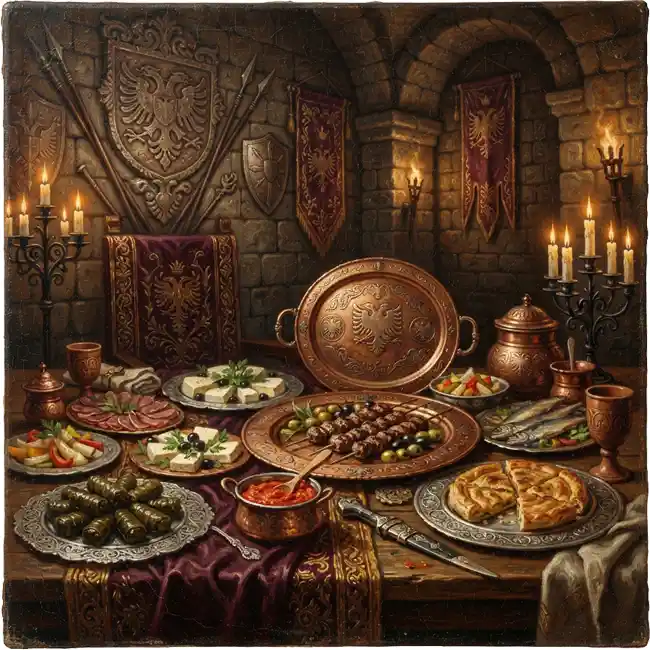
👑 📜 The Storyteller’s Intro: Secrets Behind Albania’s Aristocratic Table
Imagine walking through a stone gate in southern Albania, the afternoon light falling across old fortress walls, and wondering what might have appeared on the table of a powerful household centuries ago.
Not a modern restaurant table.
Not a carefully designed tourist tasting menu.
But a real household table belonging to an influential family, landowner, merchant, military leader, or regional nobleman.
What would guests have been offered first?
Perhaps a thin, crisp pastry filled with fresh cheese or greens. Perhaps small savory bites built around eggs, herbs, grains, dairy, vegetables, or preserved ingredients. Perhaps something as simple as bread and cheese—yet presented with enough care to announce that an important guest had arrived.
That is where the fascinating story of Albania Royal Starters and aristocratic appetizers begins.
There is one important historical detail to make clear from the start: Albania did not maintain a continuous royal dynasty throughout the entire 200–1,000-year period covered by this historical theme. Medieval Albania was instead shaped by regional principalities, noble families, fortified towns, landowning households, merchants, military elites, and later Ottoman-era urban notables. The modern Albanian monarchy under Zog belonged to a much later and very different period.
So, when we use the phrase “Albania Royal Starters,” the historically responsible interpretation is really a journey into the foods and hospitality traditions associated with Albania’s aristocratic, noble, elite, and influential households.
And honestly, that makes the story even more interesting.
Between the medieval period and the nineteenth century, Albanian food culture developed at a crossroads of the Balkans and the Mediterranean. Mountains, fertile valleys, rivers, Adriatic and Ionian coastlines, pastoral landscapes, trade routes, and fortified towns all influenced what people could place on a table.
The political landscape changed repeatedly, but food remained wonderfully stubborn.
Local cheese remained local cheese.
Fresh herbs remained fresh herbs.
Wild greens returned with spring.
Pastry traditions continued to evolve.
And hospitality remained one of the strongest ways to communicate respect.
Historic Berat and Gjirokastra provide especially valuable windows into these older lifestyles. UNESCO describes both as exceptionally preserved fortified historic centers reflecting centuries of Balkan, Christian, Islamic, Byzantine, medieval, and Ottoman influences. Gjirokastra, in particular, developed around its thirteenth-century citadel and became associated with substantial landowning households and distinctive tower houses.
So rather than pretending that a single “royal menu” survived intact, this culinary journey follows the aristocratic food environment surrounding Albania’s old elite.
🏰 The Four Historical Layers Behind the Table
For a 200–1,000-year perspective, it is useful to imagine Albanian aristocratic food culture as several overlapping layers:
• Medieval Principalities: powerful regional families and noble houses shaped local food traditions, estates, livestock keeping, agriculture, and hospitality.
• Fortified Town Culture: castles and citadels created communities where military households, craftsmen, merchants, religious institutions, and landowners interacted.
• Ottoman-Era Urban Life: from the fifteenth century onward, Albanian regions became part of a much larger imperial network, encouraging culinary exchange while preserving local identities.
• Late Aristocratic and Notable Households: wealthy landowners, merchants, administrators, and prominent families continued sophisticated hospitality traditions long after the medieval world had disappeared.
The result was never one standardized “palace cuisine.”
It was something more interesting—a collection of regional traditions that could become more elaborate when prepared for respected guests.
And that is the secret we are unlocking.
Not a fantasy royal cookbook.
A culinary landscape.
🗺️ The Royal Culinary Tourism: Mapping Flavors to Historic Landscapes
If you want to understand old Albanian aristocratic food, you cannot simply sit in a modern restaurant and order a plate.
You have to look at the landscape.
Albania is compact, but its geography changes dramatically. Mountains rise quickly from valleys. Rivers cut through historic settlements. Agricultural plains meet the sea. Old roads connect inland communities with coastal ports.
Every landscape helped determine what could appear in a household kitchen.
This is why Albanian culinary tourism works so beautifully when combined with historical tourism.
A visitor can explore a castle in the morning, walk through an old bazaar in the afternoon, and discover a regional food tradition in the evening.
The food becomes part of the geography.
🏛️ Berat: The City Where Food Meets Fortress Life
Berat is one of the most compelling destinations for anyone interested in historic Albanian gastronomy.
Its Kala, or castle district, contains architectural layers stretching across many centuries. UNESCO notes that much of the existing fortification dates from the thirteenth century, while the settlement itself has much older origins. Berat also developed as a center of craftsmen and merchants, creating a distinctive urban lifestyle rather than a purely military one.
This matters for food.
A city populated by merchants, craftsmen, landowners, religious communities, and travelers naturally develops a broader culinary vocabulary.
The table could absorb influences from different directions.
For visitors today, Berat offers the opportunity to connect:
• Fortress architecture
• Historic household traditions
• Local agricultural products
• Traditional pastries
• Cheese-based foods
• Seasonal vegetables
• Regional meat dishes
• Old-town hospitality
The experience is not about proving that a particular appetizer was served in a specific medieval palace.
It is about understanding the environment that made such culinary traditions possible.
🏘️ Gjirokastra: Stone Houses and the World of the Old Notables
If Berat feels like a living historical crossroads, Gjirokastra feels like a stone archive.
Its steep streets, fortress, bazaar, and distinctive tower houses create an extraordinary setting for exploring southern Albanian food heritage.
UNESCO describes Gjirokastra as a fortified town developed around a thirteenth-century citadel, with impressive tower houses associated with substantial landowners. Many of the surviving houses date from the seventeenth century onward.
That architectural setting gives us a fascinating glimpse into how elite hospitality worked.
A large household needed food systems capable of serving family members, workers, relatives, and guests.
The kitchen therefore was not simply a place where someone cooked dinner.
It was part of the social machinery of the household.
And one of the most intriguing foods associated with Gjirokastra is qifqi, a traditional regional dish recognized by Albania’s official tourism authority. Its identity is closely tied to the city and its distinctive southern culinary culture.
Today, qifqi is an excellent example of how a seemingly modest food can become a cultural signature.
It reminds us that “aristocratic” does not necessarily mean expensive.
Sometimes sophistication comes from technique, presentation, regional identity, and the ability to transform ordinary ingredients into something memorable.
🥧 Hidden Starters of the Albanian Aristocratic Table
Now we reach the part that makes this subject particularly fun.
We are not revealing the full recipes yet.
Instead, think of these as culinary clues—foods and food traditions that help us imagine the opening course of an old Albanian feast.
🥟 Byrek: The Layered Secret
Few foods better demonstrate the relationship between everyday Albanian food and more formal hospitality than byrek.
Thin pastry layers could surround fillings based on cheese, greens, meat, pumpkin, or other regional ingredients. Albania’s official tourism authority identifies byrek as one of the country’s most widespread traditional foods and particularly associates it with everyday culinary life in Tirana and other areas.
But imagine a beautifully prepared version appearing at the beginning of a gathering.
Golden pastry.
Fresh filling.
Crisp edges.
Warm aroma.
Cut into portions suitable for sharing.
Suddenly, an apparently humble food becomes a perfect aristocratic starter.
That is one of the great secrets of historical cuisine: elite food often depended on ordinary ingredients treated with extraordinary care.
🌿 Qifqi: Gjirokastra’s Mysterious Little Bites
Qifqi deserves special attention.
Official Albanian tourism material identifies it as a traditional food of Gjirokastra, associated with ingredients such as eggs, fresh cheese, flour, and aromatic herbs.
Its compact form makes it particularly interesting in the context of starters.
Small portions naturally encourage sharing.
And sharing is central to Albanian hospitality.
A plate of small savory pieces can become a social invitation:
“Try this.”
“Have another.”
“Let me bring you something else.”
The food keeps the conversation moving.
That is precisely what a good starter should do.
🧀 Fresh Cheese and Seasonal Greens
Another important clue is the combination of dairy and vegetation.
Fresh cheeses, curd-style cheeses, leafy greens, herbs, and seasonal vegetables fit naturally into Albania's varied agricultural landscapes.
These ingredients could appear in pies, pastries, small baked dishes, or simple composed plates.
For wealthy households, the distinction was not necessarily the ingredient itself.
It was often the freshness, preparation, timing, and presentation.
A bowl of greens harvested that morning could be more valuable to a household than a rare imported ingredient that had traveled for days.
🍖 Small Meat Preparations
Meat also had a place in celebratory and formal food traditions.
Lamb and other locally available meats were particularly important in Albanian cuisine, with dishes such as tavë kosi becoming strong regional symbols.
The official Albanian tourism authority describes tavë kosi as a representative traditional dish associated especially with central Albania and Tirana, while also linking it with hospitality and festive family occasions.
Although tavë kosi is not necessarily an “appetizer,” its cultural importance helps explain the broader structure of Albanian hospitality.
Food was rarely only about filling the stomach.
It was about the occasion.
🚣 Cradle of Royal Delicacies — Albania’s Rivers, Plains & Coast
Albania's water landscapes created another culinary world.
The Adriatic and Ionian coasts provided access to fish, shellfish, marine foods, salt, and coastal herbs, while inland rivers and fertile plains supported agriculture.
The coastal route from Vlora toward Saranda and Ksamil is today one of Albania's best-known tourism corridors. The official tourism authority describes the Albanian Riviera as a landscape where the Ionian coast meets steep mountain terrain, with villages such as Palasa, Dhërmi, Vuno, Himarë, Qeparo, Borsh, and Lukovë preserving distinctive cultural identities.
For culinary travelers, this creates an extraordinary route.
🌊 Vlora and the Coastal Pantry
Vlora sits at an important meeting point between inland Albania and the sea.
A historic household here could draw upon agricultural products from nearby land while also benefiting from maritime trade and coastal resources.
That combination naturally encouraged a lighter culinary style:
• Fresh vegetables
• Herbs
• Cheese
• Olive-based preparations
• Fish
• Seafood
• Thin pastries
• Seasonal produce
The coastal table was shaped by geography before it was shaped by fashion.
🏝️ The Albanian Riviera
Traveling south, the Riviera presents a completely different visual relationship between food and landscape.
Villages cling to hillsides.
Mountains descend toward the sea.
Old stone houses sit above narrow roads.
Terraced agriculture appears between rocky slopes.
And the sea is never far away.
The official tourism authority highlights the Riviera's combination of Mediterranean architecture, historic villages, mountain scenery, and coastal traditions.
For culinary tourism, that means the visitor can experience the food in the same landscape that produced it.
Instead of asking only, “What did the old nobles eat?”
Ask:
What could this landscape provide to their kitchens?
That question is much more revealing.
⛰️ Kingdom of Wild Aromatics & Heritage — Mountains and Deep Countryside
Now leave the coastline behind.
The Albanian mountains tell a different story.
Here, food had to work with altitude, seasons, pastoral life, forests, rugged terrain, and limited access to outside supplies.
That environment encouraged preservation.
It encouraged simplicity.
And it made herbs extremely important.
🌿 The Wild Herb Tradition
Mountain households could make use of aromatic plants and seasonal greens gathered from their surrounding environment.
These could influence:
• Cheese preparations
• Savory pies
• Vegetable dishes
• Meat seasoning
• Small fried or baked bites
• Pickled vegetables
• Household garnishes
The idea of “wild aromatics” is especially useful when thinking about old aristocratic kitchens.
Even wealthy households remained dependent on their regional agricultural base.
A noble family could own land, livestock, orchards, or vineyards, but the surrounding ecology still determined what was available.
🏔️ Northern Albania and Highland Hospitality
Northern Albanian food traditions are particularly interesting because hospitality developed within a rugged mountainous environment.
A guest arriving at a household was not merely someone to feed.
The guest became part of the household's social world.
That helps explain why simple foods can carry enormous cultural importance.
Bread.
Cheese.
Greens.
Preserved vegetables.
Meat.
Pastries.
Small savory preparations.
These could become symbols of generosity.
And when visitors today travel through Albania's mountain regions, the culinary experience becomes inseparable from the landscape.
The food tastes different when you know where it came from.
🏠 The Aristocratic Pantry: What Might Have Been Behind the Scenes?
Behind every impressive historical feast was a practical pantry.
And this is where the romantic image of the palace kitchen becomes much more interesting.
An influential Albanian household needed food that could survive changing seasons.
The pantry likely depended on combinations of:
• Grains and flour
• Fresh and preserved dairy
• Eggs
• Seasonal vegetables
• Leafy greens
• Herbs
• Fruit
• Nuts
• Meat
• Preserved foods
• Olive products in suitable regions
• Local spices and aromatic ingredients
The exact contents varied enormously by geography and period.
A household in a coastal settlement did not have exactly the same pantry as a mountain household.
A merchant family in a major town had different opportunities from a remote rural estate.
And a medieval noble household was not identical to an eighteenth-century Ottoman-era notable household.
That distinction matters.
There was never one frozen version of “Albanian aristocratic cuisine.”
Instead, the cuisine evolved continuously.
🍽️ How Did Aristocratic Guests Actually Eat?
The social side of food may be even more fascinating than the ingredients.
A formal meal was an opportunity to demonstrate generosity.
Guests could be introduced to foods associated with the household's region, agricultural wealth, or hospitality traditions.
Starters were especially useful because they allowed a host to offer several tastes without immediately committing the meal to one large centerpiece.
Imagine a long table.
Several small dishes.
Warm pastry.
Fresh cheese.
Greens.
Herbs.
Small savory bites.
Seasonal vegetables.
The host watches the guest's reaction.
Conversation begins.
The meal slowly unfolds.
This is where the idea of the “secret starter” becomes compelling.
The secret may not have been a mysterious ingredient.
It may have been the art of beginning a meal properly.
🕯️ The Secret Language of Hospitality
Food communicates status without needing words.
A carefully prepared pastry tells the guest that time was invested.
Fresh herbs suggest attention to seasonality.
Multiple small dishes suggest generosity.
Regional specialties demonstrate pride in place.
And serving food before the main course creates anticipation.
This is why aristocratic appetizers deserve their own historical category.
They were not simply “small foods.”
They were introductions.
They introduced the household.
They introduced the region.
They introduced the host.
And sometimes, they introduced the guest to flavors they had never experienced before.
🗝️ Forgotten Royal Recipes or Aristocratic Culinary Memories?
This is where we need to separate historical fact from romantic storytelling.
There is no reliable evidence for a single secret manuscript containing the complete “Albanian Royal Starter Menu” from the last thousand years.
It would be misleading to claim otherwise.
What we do have is something more valuable:
regional culinary continuity.
Traditional foods documented today can help us understand older foodways, while historic buildings, archaeological evidence, written sources, agricultural practices, and living traditions provide additional context.
Official Albanian tourism sources continue to identify foods such as byrek, qifqi, and tavë kosi as important elements of the country's culinary heritage.
So the “secret” is not that these foods were magically hidden inside a palace.
The secret is how ordinary Albanian ingredients became part of sophisticated traditions of hospitality.
That is a much more believable—and much more fascinating—story.
👑❓ Royal FAQ: Unlocking Palace Kitchen Mysteries
Q1.Did Albania actually have a royal cuisine 1,000 years ago?
Not in the modern sense of one unified Albanian royal court with a standardized national menu.
Medieval Albania consisted of shifting political territories and powerful regional families rather than a continuously unified Albanian kingdom. Therefore, “royal cuisine” is better understood as a creative historical label for the food traditions of noble, aristocratic, landowning, merchant, and other influential households.
Q2.What are some of the most interesting Albanian starters connected to this history?
Byrek and qifqi are particularly useful starting points.
Byrek represents the importance of thin pastry and regional fillings, while qifqi is strongly associated with Gjirokastra and demonstrates how compact savory foods can become regional cultural signatures.
Other foods involving fresh cheese, greens, herbs, eggs, vegetables, and small savory preparations also help reconstruct the broader culinary environment.
Q3.Which historic cities are best for exploring Albania's aristocratic food heritage?
Berat and Gjirokastra are among the strongest choices.
Both are UNESCO World Heritage historic centers, and both preserve remarkable architectural evidence of older urban societies. Gjirokastra's connection with substantial landowners and its distinctive tower houses makes it particularly fascinating for exploring elite household culture.
Q4.Can travelers experience this history through food today?
Absolutely.
A strong culinary-history journey could combine:
• Berat Castle and historic neighborhoods
• Gjirokastra's old town and bazaar
• Traditional food experiences in southern Albania
• Coastal villages along the Albanian Riviera
• Mountain communities and regional food traditions
• Local markets
• Family-run restaurants
• Traditional bakeries
• Heritage-focused culinary experiences
The goal is not simply to eat.
It is to understand why the food developed where it did.
🧠 Final Thoughts: The Timeless Allure of Aristocratic Gastronomy
There is something wonderfully mysterious about old Albanian food culture.
You can walk through Berat and see the fortress rising above the river.
You can climb the stone streets of Gjirokastra and imagine the households that once controlled estates and welcomed guests.
You can travel south toward the Riviera and watch mountains fall toward the Ionian Sea.
Or you can disappear into the northern highlands and discover how geography shaped generations of food traditions.
And suddenly, an appetizer is no longer just an appetizer.
A piece of byrek becomes a clue.
A handful of herbs becomes a clue.
Fresh cheese becomes a clue.
A small plate of qifqi becomes a clue.
Each one points toward a much bigger story about land, family, hospitality, status, trade, agriculture, migration, and cultural exchange.
That is the real allure of Albania Royal Starters.
The story is not about pretending that every old dish belonged to a palace.
It is about uncovering the culinary traditions that surrounded Albania's powerful households and discovering how those traditions survived through ordinary families and communities.
And this is only the beginning.
The next chapter can go deeper.
Instead of looking at the landscape, we can finally step inside the old kitchen.
We can explore the ingredients.
We can examine preparation methods.
We can investigate how regional foods may have been adapted for formal gatherings.
And, most importantly, we can begin reconstructing individual historical-style starter concepts while clearly separating documented tradition from modern historical interpretation.
That is where the real culinary secrets begin.
👑 Credit to the Keepers of the Culture (The Legacy)
The greatest credit belongs not to the storyteller, but to the people who kept these traditions alive.
Albanian culinary heritage survived because generations of families continued preparing food, growing ingredients, preserving seasonal produce, sharing meals, welcoming guests, and passing knowledge from one generation to another.
Historic places such as Berat and Gjirokastra are especially important because their surviving architecture preserves evidence of older ways of life. UNESCO recognizes these cities as exceptional examples of historic Balkan urban culture, with layers of medieval and Ottoman-era heritage still visible today.
Albania's culinary heritage also belongs to its bakers, farmers, shepherds, cooks, market sellers, home kitchens, local food producers, historians, archaeologists, heritage specialists, and communities.
No single family, city, dynasty, or social class owns the entire story.
It is a shared cultural inheritance.
So when we talk about Forgotten Royal Recipes, Ancient Palace Recipes, or Royal Culinary Secrets, the most respectful approach is to treat those phrases as invitations to explore history—not as claims that every surviving dish came directly from a royal kitchen.
The true treasure is the continuity.
A recipe survives because someone cared enough to make it again.
A food tradition survives because someone taught another person.
A regional dish survives because a community decided it was worth remembering.
And that is perhaps the most beautiful secret hidden inside Albania's old culinary world:
the table outlived the throne.
The castles changed hands.
The political borders changed.
The names of powerful families changed.
But people kept cooking.
They kept gathering around tables.
They kept offering food to guests.
And they kept turning the ingredients of their landscape into something worth remembering.
That living continuity is what makes Albania's aristocratic food heritage so compelling—and why the next journey into its forgotten starters deserves to begin not with a crown, but with a table.
👑🥪 Secret Aristocratic Albanian Appetizers: Forgotten Feasts
👉 Taste Rare Albanian Royal Starters
| 🌐 👑🥪 < Back | Next > 🍝👑 🇦🇱 |