
🏠 Home > 🗺️ Recipes > 👑🍷 Noble Elixirs & Teas (Drinks) > 🇦🇱 Albania Noble Elixirs & Teas (Drinks) Recipes
🇦🇱 👑🍷 Albania Noble Elixirs & Teas (Drinks) Recipes
Published by Supakorn | Updated: August 2026
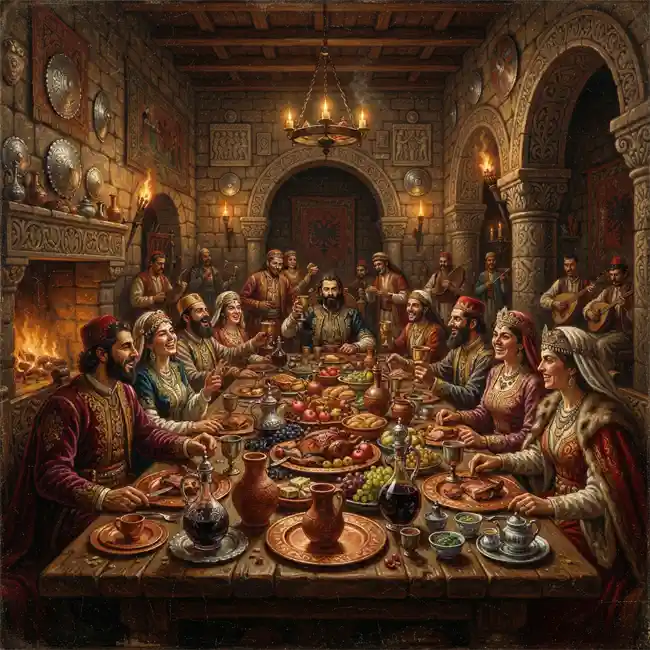
👑📜 The Storyteller’s Intro: Secrets Beneath the Noble Tea Table
Imagine stepping into an old stone house somewhere in Albania, perhaps in a mountain town where the walls have watched generations come and go. There is no need for a grand palace to make a drink feel aristocratic. A copper pot, a handful of mountain herbs, a carefully chosen cup, and the quiet ritual of welcoming a guest can tell an entire story.
That is the spirit behind Albania Noble Elixirs & Teas.
The phrase “royal” needs a little historical care here. Albania did not experience a continuous thousand-year royal court comparable to some European kingdoms. Its history was shaped by medieval noble families, regional lords, Ottoman-era urban elites, wealthy households, local chieftains, and, much later, the short-lived Albanian monarchy of King Zog I from 1928 to 1939. Albania officially became a monarchy in 1928, and that royal period lasted only eleven years before the country was occupied in 1939.
So, for the older centuries, “Noble” and “Aristocratic” are more historically appropriate than “Royal.” That distinction actually makes the story more fascinating.
For this imagined culinary chronicle, the timeline can be viewed through several overlapping eras:
• Medieval Albania, roughly 1000–1400: fortified settlements, noble households, mountain communities, and regional courts shaped food traditions around local herbs, dairy, grains, fruits, and preserved foods.
• The Ottoman-era centuries, roughly 1400s–1800s: Albania became part of a much larger cultural world, and urban households absorbed culinary influences moving through trade routes, towns, markets, and elite homes. Albania remained under Ottoman rule for more than four centuries.
• The National Renaissance and independence era, 1800s–early 1900s: traditional household foods became increasingly connected with ideas of Albanian identity and regional heritage.
• The Zog period, 1928–1939: Albania briefly had an actual monarchy, creating a genuine royal-era chapter in the country’s modern history.
• The modern heritage era: old household customs, mountain herbs, village hospitality, and regional foodways continue to inspire Albania’s culinary identity.
And this is where the drinks become especially interesting.
A noble household did not necessarily need an exotic imported ingredient to demonstrate refinement. Sometimes refinement meant knowing which herb to gather, when to dry it, how to preserve its fragrance, and when to place it before a guest.
Among the most evocative heritage drink names associated with Albanian traditions are:
• Çaj Mali — mountain tea, strongly associated with Albania’s upland landscapes.
• Çaj Mente — mint tea, fresh and aromatic.
• Çaj Sherebele — sage tea, connected with the Mediterranean and mountain herbal tradition.
• Çaj Bliri — linden blossom tea, a gentle floral infusion.
• Çaj Trëndafili — rose-based herbal infusion, representing the fragrant side of old household hospitality.
• Sherbeti i Trëndafilit — rose sherbet, part of the broader Ottoman-influenced tradition of fragrant non-alcoholic refreshments.
• Sherbeti i Limonit — lemon sherbet, representing the meeting of citrus, sugar, hospitality, and warmer southern landscapes.
• Pije me Mente dhe Bimë Mali — a modern heritage-style name for combinations of mountain botanicals and mint.
These names should not be treated as proof of a single secret manuscript locked inside an Albanian palace. Historical food traditions are rarely that simple. Many recipes survived through families, kitchens, oral memory, seasonal practices, and regional customs rather than through famous written royal cookbooks.
That uncertainty is part of the mystery.
🗺️ The Royal Culinary Tourism: Mapping Flavors to Historic Landscapes
If you want to understand Albania’s noble food heritage, the best approach is not simply to search for a “royal recipe.”
Instead, follow the landscape.
Albanian food culture changes dramatically as you move from the northern mountains toward central towns, inland valleys, southern highlands, and the Adriatic and Ionian coasts.
The country’s official tourism resources highlight destinations ranging from the Albanian Alps and historic cities to the Riviera and major natural landscapes.
For culinary travelers, that creates an extraordinary route.
You can imagine a heritage journey beginning in the north, moving through old Ottoman-influenced towns, continuing toward central Albania, and then following mountain roads toward southern villages.
At every stop, the question changes:
What did people gather here? What did they dry? What did they serve to visitors? What plants survived the winter? What flavors could be carried from a remote village to a wealthy household?
That is the real foundation of Albania’s noble beverage story.
Rather than focusing only on palace architecture, culinary tourism can connect:
• Ancient and medieval fortifications
• Historic town centers
• Traditional stone houses
• Mountain villages
• Local herb-growing regions
• Traditional markets
• Family food traditions
• Museums and cultural heritage sites
• Regional restaurants and heritage kitchens
• Walking routes through historic neighborhoods
This approach also helps separate historical evidence from romantic storytelling.
A modern visitor might taste mountain tea in a beautiful setting and imagine a medieval noble drinking exactly the same cup. That specific scene may be impossible to prove.
But the broader relationship between Albania’s mountain environment, herbs, hospitality, and food culture is much more defensible.
And honestly, that is even better.
🚣 Cradle of Noble Delicacies — Rivers, Valleys & Coastal Landscapes
Albania’s water routes and coastal landscapes created natural corridors for people, ingredients, and culinary influences.
The country has both Adriatic and Ionian coastlines, while rivers and inland valleys connect agricultural areas with mountain communities.
This geography matters because a traditional drink is never just a drink.
A cup of herbal tea can represent a mountain.
A citrus-based refreshment can evoke a warmer southern landscape.
A floral sherbet can suggest an urban household where hospitality was treated as an art.
A simple mint infusion can connect garden cultivation with everyday domestic life.
For culinary tourism, some of the most compelling historical landscapes include Shkodër, Berat, Durrës, Vlorë, and Gjirokastër, each offering a different doorway into Albania's layered cultural history.
🌊 Shkodër and the Northern Gateway
Shkodër has long occupied an important position in northern Albania, where mountain and lowland traditions meet.
Northern Albanian cuisine is particularly shaped by preservation, seasonal storage, grains, vegetables, dairy products, and mountain resources. Official Albanian gastronomy material describes the importance of household preservation traditions in northern and mountainous areas, including dried and stored foods prepared for winter.
That same seasonal mindset helps explain why herbal drinks are so culturally interesting.
If food must survive winter, herbs must also be thought about seasonally.
The imaginary noble pantry therefore begins not in the palace but in the countryside:
• Herbs gathered at the right season
• Leaves dried away from excessive moisture
• Flowers preserved for later use
• Fruits transformed into household refreshments
• Aromatic plants kept for hospitality
A culinary traveler exploring Shkodër can therefore look beyond restaurant menus and search for the relationship between mountain food traditions, historic homes, markets, and regional hospitality.
🏛️ Berat — The City of Stone and Household Hospitality
Berat offers another fascinating perspective.
Its historic architecture creates the perfect setting for imagining how food and hospitality might have been experienced across generations.
Here, the idea of an aristocratic beverage is less about luxury ingredients and more about presentation.
Picture a shaded courtyard.
A guest arrives after walking through narrow historic streets.
Someone brings a small tray.
The drink is fragrant rather than extravagant.
The conversation begins.
That simple moment captures something important about traditional food culture: hospitality itself can be a form of culinary prestige.
For visitors interested in heritage tourism, Berat can therefore become a place where architecture, food, household traditions, and regional ingredients are considered together rather than separately.
🌊 Vlorë and the Southern Coastal Flavor
Further south, the relationship between warm climate, Mediterranean ingredients, gardens, and coastal trade becomes more noticeable.
Citrus, aromatic plants, floral ingredients, and refreshing preparations naturally fit this environment.
Vlorë also carries enormous historical significance in modern Albanian history because Albanian independence was proclaimed there in 1912.
That makes it especially valuable for culinary storytelling.
A heritage food journey here can connect:
• Independence history
• Coastal landscapes
• Traditional households
• Southern agricultural products
• Herbal traditions
• Citrus-inspired refreshments
• Historic urban hospitality
The result is not simply a “royal drink tour.”
It becomes a living map of Albanian identity through flavor.
⛰️ Kingdom of Wild Aromatics & Heritage — Mountains and Deep Forests
If the coast gives Albania brightness, the mountains provide mystery.
The Albanian Alps, northern highlands, Korçë region, and other mountainous landscapes are especially important when discussing herbal traditions.
This is where Çaj Mali, or mountain tea, becomes an obvious symbol.
Mountain tea is associated with the genus Sideritis, plants that grow in mountainous parts of southeastern Europe and the Mediterranean region. In Albania, the idea of mountain tea fits naturally into a wider culture of gathering, drying, storing, and serving aromatic plants.
The historical significance is not necessarily that medieval nobles invented mountain tea.
It is more interesting than that.
The mountains already provided the ingredients.
Communities developed knowledge around them.
Households learned which plants were useful, which were fragrant, which were seasonal, and which could be stored.
Over generations, these practices became part of regional food culture.
🌿 The Noble Herbal Pantry
A heritage-inspired Albanian noble pantry might therefore evoke:
• Mountain tea
• Mint
• Sage
• Linden blossoms
• Rose petals
• Wild thyme
• Lemon
• Seasonal fruits
• Honey
• Dried aromatic leaves
• Floral ingredients
• Local spring water
The important point is that these ingredients should be viewed as cultural ingredients rather than automatically “royal ingredients.”
The distinction matters.
Many ingredients associated with old food traditions were available to ordinary households as well as wealthier ones. What could distinguish an elite setting was sometimes the quality of presentation, the serving ritual, the imported sugar or citrus available to the household, or the social context in which the drink was served.
That is where the word noble becomes useful.
It describes a culinary atmosphere rather than falsely claiming that every cup belonged to a king.
🕯️ The Hidden Language of Noble Hospitality
There is another side to the story that is easy to overlook.
Drinks communicate social relationships.
In an old household, offering something warm and aromatic to a visitor could mean:
You are welcome here.
The vessel, tray, serving order, temperature, fragrance, and accompanying sweets could all contribute to the experience.
That makes herbal tea particularly fascinating.
It is visually modest.
Yet it can become ceremonial through context.
A simple cup of Çaj Mali served in a historic stone house can feel more powerful than an expensive modern beverage because the landscape, architecture, memory, and hospitality are all part of the experience.
This is also why Albanian food tourism can be approached through stories rather than simply ingredient lists.
The traveler is not only tasting a plant.
They are tasting a place.
👑 The Names Behind the Hidden Menu
When discussing “forgotten royal recipes,” it is important not to invent historical evidence.
There is no need to claim that every attractive menu name below appeared in a documented palace cookbook.
Instead, these names work as heritage menu concepts inspired by traditional Albanian ingredients and historical culinary environments:
🍵 Çaj Mali — The Mountain Court Infusion
A symbolic mountain tea representing Albania's highland herbal heritage.
Its identity comes from the landscape itself: rocky slopes, alpine air, seasonal gathering, and the old habit of transforming wild botanicals into household infusions.
🌿 Çaj Mente — The Green Courtyard Tea
Mint brings an entirely different personality.
Fresh, bright, and instantly recognizable, it suggests cultivated garden herbs and warm-weather hospitality.
🌸 Çaj Bliri — The Linden Blossom Cup
Linden blossoms add a delicate floral character.
In a noble-household setting, this type of infusion fits beautifully into the idea of slow afternoon hospitality, where fragrance and atmosphere mattered as much as refreshment.
🌹 Sherbeti i Trëndafilit — The Rose Garden Sherbet
Rose-based refreshments belong to a broader culinary world in which flowers could become part of refined hospitality.
The rose is especially effective in storytelling because it connects gardens, fragrance, celebration, and elegance.
🍋 Sherbeti i Limonit — The Southern Citrus Refreshment
Lemon brings a bright contrast to mountain herbs.
As a heritage-inspired menu concept, it represents the movement between Albania's warmer southern landscapes and its historic urban food culture.
Again, these names should be understood as historically inspired culinary labels, not as claims that a specific palace archive preserved each exact preparation.
🍽️ Eating, Living and Entertaining in Old Albania
Food history becomes much more meaningful when we stop imagining noble cuisine as a collection of extravagant dishes.
Life was seasonal.
Households had to preserve ingredients.
Mountain communities depended heavily on what their environment could provide.
Urban households had access to markets and wider trade networks.
Wealthier families could sometimes demonstrate status through better ingredients, specialized utensils, elaborate hospitality, or the ability to host guests frequently.
Official Albanian gastronomy material emphasizes how regional climate and geography influenced household preservation, particularly in the north and mountainous areas.
That tells us something important about beverages too.
A noble household did not exist outside the agricultural world.
Its pantry depended on farmers, herders, gardeners, traders, gatherers, and household workers.
The elegant cup at the table represented an entire network of people and landscapes.
This is one of the most compelling ideas for anyone researching Albanian noble cuisine and forgotten culinary traditions.
The “secret” was never just the drink.
The secret was the system behind it.
👑 Royal FAQ: Unlocking Palace Kitchen Mysteries
Q1.Did Albania really have a royal culinary tradition?
Yes, but it needs to be placed in the correct historical context.
Albania became a monarchy under King Zog I in 1928, and the monarchy lasted until 1939. Before that, Albanian territories were shaped by medieval noble families, regional elites, Ottoman institutions, and powerful local households rather than one continuous Albanian royal dynasty.
So “Albanian noble cuisine” is often a more useful historical phrase than “Albanian royal cuisine” when discussing the broader 200–1,000-year period.
Q2.What is the most iconic Albanian herbal tea?
Çaj Mali, or mountain tea, is one of the strongest symbols of Albania's mountain herbal tradition.
Its importance comes from its connection to highland landscapes and traditional herbal knowledge rather than from evidence that it was exclusively reserved for royalty.
Q3.Were herbal drinks only consumed by wealthy families?
No.
Herbal infusions were not inherently aristocratic. Many plants were gathered or cultivated by ordinary households.
What could make them appear “noble” was the social setting: elegant presentation, hospitality, specialized ingredients, and the household's ability to entertain guests.
Q4.Where should food-history travelers explore?
A strong heritage route could include Shkodër, Berat, Vlorë, Gjirokastër, Korçë, and the Albanian Alps, while also exploring smaller villages and regional food traditions.
Albania's official tourism platform promotes destinations such as the Albanian Alps, the Riviera, historic cities, outdoor landscapes, and cultural attractions, making it possible to combine culinary exploration with broader heritage travel.
🧠 Final Thoughts: The Timeless Allure of Aristocratic Gastronomy
The most fascinating thing about Albania's noble beverage heritage is that it does not require a mythical palace cookbook.
In fact, the absence of one grand, universally recognized royal beverage archive makes the subject more mysterious.
The story survives in fragments.
A mountain herb.
A village garden.
A family tradition.
A historic town.
A fragrant tea.
A carefully served refreshment.
A memory passed from one generation to another.
And somewhere between the mountains and the coast, these pieces create a culinary landscape that feels much larger than any individual recipe.
If you are planning a food-focused journey through Albania, think of the country as a sequence of flavor territories.
Start with the Albanian Alps for mountain herbs and highland food culture.
Move toward Shkodër for northern culinary traditions and historic urban heritage.
Continue toward Berat for stone architecture, old neighborhoods, and the atmosphere of traditional hospitality.
Then travel south toward Vlorë and the Albanian Riviera, where warmer landscapes provide a different culinary personality.
Finish in places such as Gjirokastër and Korçë, where architecture, regional traditions, and food heritage create yet another layer of the story.
The result is a journey through Albania where food becomes a form of historical geography.
And this is only the beginning.
The next chapter can go deeper into the individual Albania Noble Elixirs & Teas, one forgotten heritage preparation at a time — exploring its historical setting, ingredient symbolism, noble-household atmosphere, traditional serving concept, and the modern interpretation that can bring the old story back to the table.
The recipes can wait.
For now, the door to the old pantry is open.
👑 Credit to the Keepers of the Culture (The Legacy)
Any exploration of Albania's culinary heritage deserves respect for the people who preserved these traditions long before food blogs, tourism campaigns, social media, or modern recipe collections existed.
This heritage belongs first to Albanian communities, families, farmers, gardeners, herbal gatherers, cooks, craftspeople, historians, and local cultural keepers who carried knowledge through everyday life.
The purpose of describing these traditions as “Noble” or “Aristocratic” is not to suggest that ordinary Albanians were excluded from their own food culture.
Quite the opposite.
Many foods and herbal traditions associated with elite hospitality were rooted in the knowledge of ordinary households and the landscapes surrounding them.
That is why historical accuracy matters.
Albania's culinary identity was shaped by mountains, valleys, coastlines, markets, migration, trade, changing political powers, local customs, and generations of household knowledge.
The country's official gastronomy material itself presents Albanian cuisine as strongly regional, with northern, central, southern, coastal, and mountainous traditions reflecting different environments and food practices.
So when we speak of Albania Noble Elixirs & Teas, we are really opening a window onto something broader:
the relationship between landscape, hospitality, memory, and taste.
The royal chapter may have been short.
The noble traditions were more complicated.
But the cultural legacy is far older than either.
And that is what makes Albania's old culinary world worth exploring — not as a fantasy palace menu, but as a living heritage whose deepest secrets may have survived not in royal vaults, but in the kitchens, gardens, mountains, and memories of the people who kept them alive.
👑🍷 Albania’s Hidden Noble Table: Forgotten Flavors from the Age of Aristocracy
👉 Sip Elite Albanian Noble Elixirs & Teas
| 🌐 👑🍷 < Back | 🇦🇱 👑🍨 < Previous | Next > 🍲👑 🇦🇱 |