
🏠 Home > 🗺️ Recipes > 👑🍝 Imperial Mains (Main Dishes) > 🇦🇱 Albania Imperial Mains (Main Dishes) Recipes > 👑🍝 1.Noble Albanian Lamb with Baked Yogurt
👑🍝 A Noble Feast from the Forgotten Kitchens of Albania
Published by Supakorn | Updated: August 2026
🏰 The Forgotten Royal Legacy of Albania: Medieval Principalities & Ottoman-Era Noble Households
📜 The Storyteller’s Intro
Imagine stepping through a heavy wooden door in old Albania, somewhere between the stone streets of Berat and the mountain landscapes surrounding Gjirokastër.
The afternoon light is fading.
Inside a large stone household, copper vessels hang above the hearth. A clay baking dish rests near glowing embers. The scent of slow-cooked lamb, cultured yogurt, herbs, garlic, and warm grain fills the kitchen.
There is no modern restaurant, no printed cookbook, and certainly no standardized recipe card.
Instead, culinary knowledge lives in memory.
A cook watches the fire. An older family member tastes the sauce. Someone brings in fresh dairy from the household animals. Another person prepares herbs gathered from the surrounding countryside.
This is the world that inspires our exploration of Forgotten Albanian Nobility Main Recipes.
There is an important historical distinction, though. Albania did not have a continuous modern-style royal dynasty comparable to the great centralized European royal courts. Medieval Albanian lands were shaped by principalities and powerful noble families, while later centuries were largely influenced by Ottoman rule. Official Albanian heritage materials describe the medieval principalities, including the Balshaj principality, and the later Ottoman expansion across the region.
So when we use the phrase “royal recipes” here, think of it as a storytelling term for the luxurious culinary world associated with noble households, fortified residences, wealthy families, and elite feasts—not as a claim that a surviving palace manuscript proves a particular dish was served to an Albanian monarch.
That distinction actually makes the story more fascinating.
Because the real treasure is not a mythical royal signature.
It is the culinary memory of Albania itself.
🌍 The Global Value
Traditional food becomes especially valuable when it tells us something about the people who prepared it.
Albanian cuisine reflects a landscape where mountains, fertile valleys, lakes, forests, livestock, orchards, dairy traditions, and Mediterranean influences meet. UNESCO's documentation of Albanian heritage recognizes the importance of living cultural traditions, including Albanian folk iso-polyphony, transhumance, and other practices that connect communities with their environment and history.
Food belongs to that same cultural conversation.
A dish prepared in a wealthy household could use ingredients that were also familiar to rural communities, but the difference might appear in the quality of the ingredients, the amount of meat used, the richness of the dairy, the presentation, and the patience given to the cooking process.
That is where the idea of an aristocratic touch becomes useful.
The luxury was not necessarily about rare imported ingredients.
Sometimes luxury meant having enough good lamb, fresh yogurt, eggs, fragrant herbs, quality grain, and time to let everything come together slowly.
Over generations, however, recipes naturally change. Ingredients become unavailable. Measurements disappear. Family cooks adapt techniques to new kitchens.
Some dishes survive.
Others survive only as memories.
And some can be respectfully reconstructed from the culinary traditions that remain.
🗝️ The Collection
This collection presents a historically inspired Albanian noble main dish built around one of the country's best-known culinary traditions: Tavë Kosi, a baked combination of lamb and a creamy yogurt-based mixture.
Tavë Kosi is now widely recognized as an Albanian culinary specialty, and official cultural documentation from Albania and UNESCO-related heritage materials demonstrates the broader importance of traditional foodways, local products, and culinary practices in Albanian cultural landscapes.
The recipe below is therefore best understood as a heritage-inspired noble interpretation, rather than a claim that this exact ingredient list survived unchanged from a medieval or Ottoman palace.
Think of it as opening a door into an old kitchen and asking:
What might a refined Albanian household have done with these ingredients?
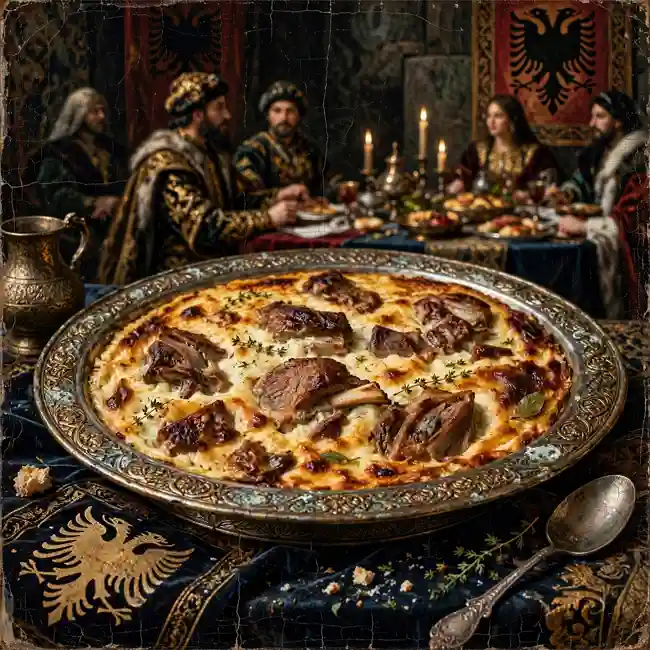
🍖 Recipe: Noble Albanian Lamb with Baked Yogurt — Tavë Kosi Style
👑 About this Royal Secret
Among Albania's most recognizable comfort foods, Tavë Kosi has the kind of character that feels naturally suited to a grand household table.
It is humble at heart, yet deeply satisfying.
Tender lamb is combined with a rich yogurt mixture and baked until the surface becomes beautifully golden while the interior remains soft and creamy.
For an aristocratic interpretation, the dish is not made extravagant simply by adding dozens of ingredients.
Instead, the emphasis is placed on excellent lamb, fresh yogurt, carefully balanced seasoning, gentle cooking, and elegant presentation.
Imagine it being carried from a traditional stone kitchen to a long dining table during a family gathering or important feast.
The dish arrives steaming in its earthenware vessel.
The top is golden.
The aroma is rich but comforting.
When the first spoon cuts through the baked surface, the creamy yogurt reveals tender pieces of lamb underneath.
That is the secret.
The dish feels luxurious because every simple element has been treated with respect.
🧺 Ingredients & The Aristocratic Touch
🌿 The Royal Pantry
An old Albanian noble kitchen would have been shaped by what the surrounding land could provide.
Lamb was especially important in pastoral cultures, while dairy products played a major role across Albanian food traditions. The country's mountainous geography and long pastoral traditions remain closely connected with livestock and seasonal movement; UNESCO recognizes Albanian transhumance as part of the country's living heritage.
For our modern heritage-inspired version, the pantry is deliberately focused.
The goal is not to create a complicated restaurant dish.
It is to make every ingredient count.
• Lamb: the centerpiece, preferably from the shoulder or leg, with enough natural fat to remain tender.
• Plain full-fat yogurt: provides the creamy character and gentle tang.
• Eggs: help the yogurt mixture set into a soft baked custard.
• Butter: adds richness and helps create the golden surface.
• Flour: gives the yogurt mixture enough body to bake successfully.
• Garlic: used carefully for warmth rather than overwhelming the dairy.
• Dried oregano or local-style herbs: adds an earthy aromatic layer.
• Salt: essential for bringing the lamb and yogurt into balance.
• Black pepper: provides gentle warmth.
• Warm stock or water: keeps the lamb moist during the initial cooking stage.
🔄 Modern Substitutes
You do not need access to an Albanian mountain farm to recreate the spirit of the dish.
• If lamb shoulder is unavailable, use lamb leg cut into generous pieces.
• If exceptionally thick traditional-style yogurt is unavailable, use full-fat Greek yogurt.
• If homemade yogurt is not practical, choose an unsweetened plain yogurt with a clean, mild flavor.
• If fresh local herbs are unavailable, dried oregano is a practical substitute.
• If you prefer a lighter result, reduce the butter slightly rather than replacing the yogurt with low-fat yogurt.
• For a gluten-free version, use a suitable gluten-free flour blend or cornstarch in a small amount to stabilize the yogurt mixture.
• If an earthenware baking dish is unavailable, use a heavy ceramic casserole dish.
⚖️ The Measurements
For approximately 4 generous servings:
• 900 g lamb shoulder or leg, cut into medium pieces
• 500 g full-fat plain yogurt
• 2 large eggs
• 45 g butter
• 25 g plain flour
• 2 garlic cloves, finely crushed
• 1 teaspoon dried oregano
• 1 teaspoon fine salt, divided
• ½ teaspoon freshly ground black pepper
• 180 ml warm lamb or vegetable stock
• 1 tablespoon olive oil
• 1 small onion, finely chopped
The proportions are designed for a home kitchen while keeping the classic balance of meat, dairy, and baked richness.
🔥 The Chef’s Ritual
1. 🥩 Begin with the Lamb
Pat the lamb dry before cooking.
Season it lightly with salt and black pepper.
Heat the olive oil in a heavy pan and brown the lamb in batches. Do not overcrowd the pan. The goal is not to cook it completely at this stage but to develop a deeper roasted aroma.
Add the chopped onion and cook gently until softened.
Add the crushed garlic toward the end so it becomes fragrant without burning.
2. 🍲 Create the Tender Base
Pour in the warm stock.
Lower the heat and allow the lamb to cook gently until it becomes tender.
Depending on the cut and size of the pieces, this can take roughly 35–50 minutes.
The lamb should be soft enough to bite easily, but it should not fall apart completely.
Keep some of the cooking liquid.
That flavorful liquid becomes part of the dish's foundation.
3. 🥣 Prepare the Yogurt Mixture
In a large bowl, whisk together the yogurt, eggs, flour, remaining salt, and black pepper.
Add the oregano.
Whisk until smooth.
The mixture should be thick but pourable.
This is one of the most important moments in the recipe.
Do not treat the yogurt mixture like an ordinary sauce.
It needs to bake gently and become creamy rather than splitting into watery curds.
4. 🌡️ Bring the Temperatures Together
Take a small amount of the warm lamb cooking liquid and slowly whisk it into the yogurt mixture.
Repeat gradually.
This helps prevent the cold yogurt from reacting too quickly when it enters the hot baking dish.
It is a simple technique, but it gives the final texture a much smoother finish.
5. 🏺 Assemble the Dish
Place the tender lamb into a greased ceramic or earthenware baking dish.
Pour the yogurt mixture over the lamb.
Gently shake the dish so the mixture settles around the meat.
Dot the top with small pieces of butter.
Do not stir aggressively.
The goal is to preserve layers of tender meat beneath a smooth creamy surface.
6. 🔥 Bake Until Golden
Preheat the oven to approximately 190°C.
Bake for around 30–40 minutes, or until the top becomes golden and the center is set but still tender.
If the surface browns too quickly, reduce the oven temperature slightly.
Once finished, allow the dish to rest for about 10 minutes.
That short pause matters.
The yogurt mixture continues to settle, making each serving easier to spoon.
7. 👑 Serve Like a Noble Household Would
Bring the baking dish directly to the table.
Serve generous portions while the dish is still warm.
For a refined presentation, add a small scattering of fresh herbs immediately before serving.
Keep the decoration restrained.
The golden crust and creamy interior should remain the stars of the plate.
🗝️ Secrets of the Palace Kitchen — Tips & Mistakes
🔥 Tip 1: Do Not Rush the Lamb
Tenderness comes from patient cooking.
Trying to brown and bake raw lamb in one short step can leave the meat firm while the yogurt mixture becomes overcooked.
🥣 Tip 2: Use Full-Fat Yogurt
The creamy structure of the dish depends heavily on the yogurt.
A watery low-fat yogurt can produce a thinner, less satisfying result.
🌡️ Tip 3: Avoid Temperature Shock
Never pour a large amount of cold yogurt mixture directly over extremely hot cooking liquid.
Gradually introducing warm liquid into the yogurt mixture gives you much better control.
🧈 Tip 4: Respect the Butter
The butter is there for richness and browning.
You do not need a huge quantity.
Too much can make the surface greasy rather than elegant.
🌿 Tip 5: Keep the Herbs Quiet
A noble-style version should not taste like a bowl of dried herbs.
Use oregano or another suitable herb as an accent.
The main conversation should remain between the lamb and yogurt.
❌ Mistake 1: Overcooking the Yogurt
If the oven is excessively hot, the dairy can separate.
A moderate temperature and patient baking create a much more attractive texture.
❌ Mistake 2: Cutting the Lamb Too Small
Tiny pieces can become dry.
Medium chunks are better because they retain moisture and remain visually impressive when served.
❌ Mistake 3: Skipping the Resting Time
Serving immediately can make the baked yogurt mixture appear loose.
Give the dish several minutes to settle.
❌ Mistake 4: Overloading the Recipe
Adding many modern spices may sound luxurious, but it can move the dish away from its recognizable Albanian character.
Sometimes restraint is the real aristocratic touch.
❓🤴 Royal FAQ
Q1.Is Tavë Kosi really an ancient Albanian royal recipe?
There is no reliable evidence that the exact modern recipe can be documented as an official royal palace recipe. Albania's historical political structure included medieval principalities and noble families rather than a continuous royal court in the modern sense. This article therefore presents the dish as a noble, heritage-inspired interpretation, not as a falsely authenticated palace manuscript recipe.
Q2.What makes this version “aristocratic”?
The aristocratic character comes from the treatment rather than extravagant ingredients: good lamb, rich yogurt, careful preparation, controlled seasoning, slow cooking, and elegant presentation.
Q3.Can I make this without an earthenware dish?
Absolutely. A heavy ceramic casserole works very well. The important thing is even heat distribution and sufficient depth for the lamb and yogurt mixture.
Q4.Is this dish suitable for a modern family dinner?
Yes. Although the story is inspired by historic noble kitchens, the recipe itself is designed for a contemporary home kitchen and uses ingredients that are widely available.
🏺 The Taste of History
The beauty of Albanian culinary heritage is that it does not need a fictional crown to become extraordinary.
Tavë Kosi-style cooking demonstrates something much more interesting: how a relatively focused group of ingredients can become a dish with enormous cultural character.
The lamb provides depth.
The yogurt brings brightness and creaminess.
The egg gives structure.
The herbs add an earthy note.
The oven transforms everything into a golden, comforting whole.
And that is exactly what makes the dish feel connected to history.
Across Albania, culinary traditions have developed alongside landscapes, seasonal work, livestock, agriculture, family gatherings, and community life. UNESCO's heritage records emphasize that food traditions around the world are valuable not simply because of individual recipes, but because culinary knowledge is transmitted through people, places, practices, and shared experiences.
Albania's heritage story fits beautifully into that larger picture.
The historic centers of Berat and Gjirokastër, for example, preserve important architectural evidence of the country's long cultural history, while Albanian heritage documentation also highlights traditional foods and local products as part of regional identity.
So when you taste this dish, you are not merely tasting lamb and yogurt.
You are tasting an idea of the old Albanian household:
stone walls,
wooden tables,
seasonal ingredients,
family knowledge,
and a kitchen where nothing good was wasted.
🏛️ Final Thoughts: Bringing History to Your Table
There is something wonderfully satisfying about recreating a dish inspired by an older culinary world.
You do not need a medieval castle.
You do not need a royal dining hall.
You do not need a collection of antique copper cookware.
You only need good ingredients, patience, and a little respect for the traditions behind the food.
This Albanian noble-inspired Tavë Kosi is a perfect example.
Its ingredients are approachable, but the final result feels special.
Serve it in the center of the table.
Let everyone take their portion.
Allow the golden crust to become part of the conversation.
And remember that the most valuable part of an old recipe is not always the exact measurement written on a forgotten page.
Sometimes it is the method.
Sometimes it is the memory.
Sometimes it is the simple understanding that good food deserves time.
✨ The Call to Action: The Golden Hook
If you love discovering the flavors hidden inside old culinary traditions, keep exploring the forgotten kitchens of the world with us.
Every region has its own stories.
Some were preserved in manuscripts.
Some survived through family kitchens.
Some remain connected to landscapes, seasonal work, festivals, and community traditions.
And some have disappeared almost completely.
By cooking respectfully inspired versions of these dishes, we can keep curiosity about culinary heritage alive without pretending that every modern reconstruction is an authenticated historical manuscript.
That balance matters.
We can enjoy the mystery while respecting the evidence.
We can recreate the atmosphere without rewriting history.
And most importantly, we can continue sharing the flavors that connect generations.
The old kitchen may be gone, but its story does not have to disappear.
🕊️ Credit to the Keepers of the Culture: The Legacy
The greatest credit belongs to the Albanian communities, cooks, families, farmers, pastoralists, cultural historians, heritage workers, and tradition bearers who have carried knowledge forward across generations.
Albanian cultural heritage is not frozen in the past. UNESCO's records show that Albania continues to safeguard living traditions, including folk iso-polyphony, transhumance, Xhubleta craftsmanship, K'cimi dancing of Tropojë, and the art of playing, singing, and making the lahuta.
That living continuity is important when discussing traditional food.
A recipe should never be presented as belonging to a mysterious “royal kitchen” simply because the wording sounds impressive.
The real heritage is more powerful than that.
It belongs to people.
It belongs to places.
It belongs to memory.
It belongs to the cooks who learned by watching another pair of hands.
So this recipe is offered as a respectful, modern heritage-inspired interpretation of Albanian culinary tradition, with the historical distinction clearly stated.
The forgotten royal legend may attract us to the table.
But the culture is what deserves to remain there.
| 🇦🇱 👑🍝 < Back |