
🏠 Home > 🗺️ Recipes > 👑🍱 Royal Court Side-Bites (Snacks) > 🇦🇱 Albania Royal Court Side-Bites (Snacks) Recipes > 👑🍱 1.Golden Albanian Aristocratic Byrek Bites
👑🍱 Rediscovering Albania’s Forgotten Royal-Inspired Snack Traditions
Published by Supakorn | Updated: August 2026
🤴👑 The Forgotten Royal Legacy of Albania: The Zog Era
Albania has a fascinating culinary story, but there is an important detail worth clearing up before we open our imaginary palace kitchen.
The country did have a modern royal era under Zog I, King of the Albanians, beginning in 1928 and ending in 1939. However, there is no reliable historical evidence that a specific snack recipe survived unchanged from an Albanian royal kitchen for exactly 1,000 years.
So, rather than pretending that an undocumented palace manuscript exists, this story takes a more honest and much more interesting approach.
We are going to explore the idea of a 1,000-year Albanian culinary heritage through ingredients, techniques, pastry traditions, and flavors that feel deeply connected to the country's long food culture, then give one of Albania's beloved traditional preparations an elegant royal-inspired presentation.
That distinction matters.
The history is real.
The culinary traditions are real.
The royal period is real.
The imaginative palace setting is a respectful reconstruction.
And that gives us plenty of room to enjoy the romance of forgotten recipes without turning a beautiful food story into a made-up historical claim.
🕯️ The Storyteller’s Intro
Imagine stepping into an old Albanian household as the evening light begins to disappear behind the mountains.
The kitchen is warm.
A wooden work surface is covered with flour.
A bowl of fresh cheese sits beside a bundle of green leaves, fragrant herbs, and a few simple pantry ingredients.
Someone is stretching pastry.
Not thick pastry.
Not something heavy and dense.
The dough is being transformed into delicate sheets, thin enough to catch the light.
Nearby, spinach is being prepared for the filling.
The cook works quietly, because good pastry doesn't respond well to impatience.
A little cheese.
A little green vegetable.
A touch of onion.
Fresh herbs.
Just enough seasoning.
Then the pastry is folded.
One layer becomes two.
Two become several.
Soon, small golden parcels are ready for the oven.
Now imagine taking the same humble ingredients and moving them into an elegant aristocratic dining room during Albania's royal era.
The ingredients may not have changed dramatically.
The presentation has.
Instead of placing one enormous family pie in the center of the table, the cook creates individual portions.
Each one is golden and delicate.
Each one is easy to pick up.
Each one reveals a creamy filling beneath crisp pastry.
That is the spirit behind today's recipe.
It isn't about pretending that we found a secret royal cookbook.
It is about asking a wonderfully simple question:
How could a traditional Albanian snack be transformed into something worthy of an elegant historic table?
🌍 The Global Value
The fascinating thing about traditional food is that recipes rarely remain confined to one social class.
A pastry may be prepared by farmers, merchants, travelers, wealthy households, and aristocratic families.
The ingredients might be humble, but technique can make them extraordinary.
This is particularly important when talking about Albanian cuisine.
Albanian food developed through generations of regional cooking, seasonal ingredients, family traditions, and cultural exchanges across the Balkans and Mediterranean world.
That means the true culinary treasure isn't necessarily a single secret formula.
It is the accumulated knowledge behind the food.
How thin should the pastry be?
How much filling is enough?
How do you prevent vegetables from making the pastry soggy?
When should the oven be hot?
How much cheese should be used?
When should the finished pastry be allowed to rest?
These are the kinds of secrets that are often passed from one cook to another without ever being written down.
And once a generation stops cooking a particular dish, those tiny details can disappear.
That is why recreating traditional recipes today can be more meaningful than simply copying a list of ingredients.
We are preserving a method of thinking about food.
📜 The Collection
This recipe is designed as a culinary bridge between Albania's traditional food culture and the elegance associated with an aristocratic table.
The centerpiece is a miniature cheese-and-spinach byrek, inspired by Albania's long-standing tradition of thin pastry filled with savory ingredients.
Byrek is especially suitable for this treatment because it can be rustic, generous, family-sized, or refined into small individual portions.
Our version takes the last approach.
The pastry becomes delicate.
The filling becomes balanced.
The seasoning remains restrained.
And the finished snack is small enough to serve as an elegant appetizer or historic-inspired party bite.
The result is not an invented “lost manuscript.”
It is something better:
a respectful culinary reconstruction inspired by Albanian tradition.
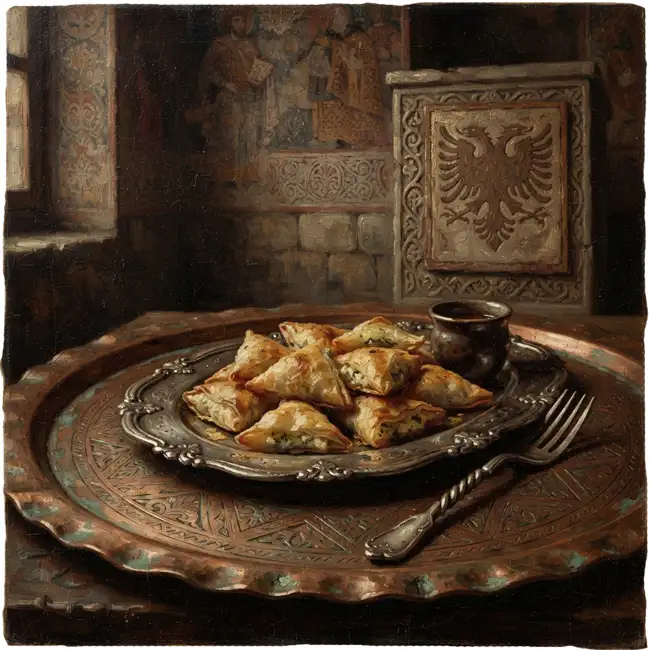
🥐 Recipe: Golden Albanian Aristocratic Byrek Bites
👑 About This Royal Secret
Picture a formal gathering during Albania's royal era.
Guests are seated around a long table.
The room is elegant, but the food doesn't need to be extravagant to impress.
A servant enters carrying a large tray.
On it are dozens of small golden pastries.
They are not oversized.
They are not messy.
Each one is carefully folded, brushed until golden, and arranged so that every guest can take one easily.
The first bite produces a delicate crackle.
Inside is a soft mixture of fresh cheese and spinach, with herbs adding a bright aromatic note.
This is the kind of snack that feels luxurious without depending on expensive ingredients.
There is no reliable evidence that this exact recipe was a personal favorite of King Zog or a documented dish from his palace.
Instead, we are imagining how a familiar Albanian food tradition could have been presented in a more aristocratic style.
And that is where the real charm lies.
The “royal secret” isn't a hidden ingredient.
It is restraint, balance, craftsmanship, and presentation.
🧺 Ingredients & The Aristocratic Touch
🏛️ The Royal Pantry
An elegant historical kitchen did not need to use every ingredient available.
In fact, the opposite could be true.
A skilled cook knew how to make a small number of ingredients work beautifully together.
For this recipe, fresh cheese provides the creamy foundation.
Spinach brings earthy sweetness.
Onion adds depth.
Parsley and dill provide freshness.
Thin pastry creates the dramatic contrast between crisp exterior and tender filling.
Butter gives the surface a rich golden finish, while a small amount of olive oil adds a subtle Mediterranean character.
The ingredients are simple.
The technique makes them special.
🔄 Modern Substitutes
You don't need access to a historical Albanian kitchen to make these.
A modern home cook can create an excellent version with easily available ingredients.
• Gjizë: Replace with ricotta or mild farmer cheese.
• Filo pastry: Use commercially prepared filo if making pastry from scratch isn't practical.
• Fresh spinach: Frozen spinach is perfectly acceptable when thoroughly thawed and squeezed dry.
• Butter: Use clarified butter for an especially crisp finish.
• Olive oil: Use a mild extra-virgin olive oil.
• Fresh dill: Replace with a smaller quantity of dried dill if necessary.
• Fresh parsley: Dried parsley can work in an emergency, although fresh herbs are preferable.
• Feta: A small portion can be blended with ricotta when you want a saltier, more pronounced cheese flavor.
• Shallot: A mild substitute for traditional onion.
The key is not to chase authenticity through impossible ingredients.
Chase it through texture and balance.
⚖️ The Measurements
This recipe makes approximately 12 elegant snack-sized byrek bites.
• Filo pastry: 6 large sheets
• Gjizë or ricotta: 250 grams
• Fresh spinach: 180 grams
• Small onion: 1
• Large egg: 1
• Fresh parsley: 2 tablespoons, finely chopped
• Fresh dill: 1 tablespoon, finely chopped
• Melted butter: 45 grams
• Olive oil: 1 tablespoon
• Black pepper: ¼ teaspoon
• Salt: ¼ teaspoon, adjusted according to the cheese
• Plain yogurt: 1 tablespoon, optional
• Sesame seeds: 1 teaspoon, optional
A useful filling ratio is:
• 2 parts fresh cheese
• About 1½ parts cooked spinach
• About ½ part onion and herbs
• 1 egg per 250 grams of cheese
This creates a filling that is creamy but firm enough to remain inside the pastry.
🔥 The Chef’s Ritual
🌿 Step 1: Prepare the Greens
Wash the spinach carefully.
Place it into a hot pan and cook until it collapses.
There is no need to drown it in water.
You simply want to soften it.
Once cooked, allow it to cool.
Then squeeze it firmly.
This is one of the most important steps in the entire recipe.
Spinach contains a surprising amount of water, and excess moisture is the enemy of crisp pastry.
Once dry, chop the spinach finely.
🧅 Step 2: Soften the Onion
Finely dice the onion.
Warm the olive oil in a small pan.
Cook the onion gently until soft and translucent.
Don't brown it heavily.
We want sweetness rather than a roasted flavor.
Allow it to cool before combining it with the cheese.
🧀 Step 3: Create the Filling
Place the cheese into a mixing bowl.
Add:
• spinach
• softened onion
• egg
• parsley
• dill
• black pepper
• salt
• optional yogurt
Mix gently.
The filling should feel moist but not watery.
If you lift a spoonful, it should hold together.
If it runs like a sauce, something has gone wrong.
🥐 Step 4: Prepare the Filo
Place one filo sheet on a clean surface.
Brush it lightly with melted butter.
Add another sheet.
Brush again.
Repeat until you have a delicate layered structure.
Don't soak the pastry.
A thin coating is enough.
Keep the unused filo covered with a clean, slightly damp cloth so it doesn't dry out.
✨ Step 5: Create the Individual Parcels
Cut the layered pastry into rectangular sections.
Place a small spoonful of filling near one end.
Fold the pastry over the filling.
Continue folding until you have a compact parcel.
Press the final edge gently.
The goal is to create a neat little package rather than a giant stuffed pastry.
🏺 Step 6: Prepare the Tray
Arrange the parcels on a parchment-lined baking tray.
Leave a little space between them.
Brush the tops with a very light layer of melted butter.
Add a few sesame seeds if you want a more decorative finish.
🔥 Step 7: Bake
Preheat the oven to approximately 375 degrees Fahrenheit ( 190 degrees Celsius ).
Bake for around 20–25 minutes.
Watch the pastry rather than relying entirely on the clock.
You are looking for:
• deep golden edges
• crisp visible layers
• a lightly puffed surface
• a warm, aromatic filling
When the pastry reaches that beautiful golden stage, remove the tray.
🕯️ Step 8: Rest Before Serving
Let the byrek bites rest for about five minutes.
This allows the filling to settle.
Serve them warm.
The exterior should remain crisp while the interior stays soft and savory.
🔐 Secrets of the Palace Kitchen (Tips & Mistakes)
✨ Secret 1: Dry the Spinach Properly
This is the most important technique.
Cooked spinach must be squeezed thoroughly.
If you skip this step, moisture will migrate into the pastry while baking.
The result can be soft rather than crisp.
✨ Secret 2: Keep the Filling Modest
Don't turn every parcel into a miniature mountain.
A thin layer of filling allows the pastry to cook evenly.
It also makes the finished snack look more refined.
✨ Secret 3: Taste Before Adding Salt
Cheese can vary enormously in saltiness.
Taste the mixture before seasoning aggressively.
If using feta, you may need almost no additional salt.
✨ Secret 4: Protect the Filo
Filo dries quickly once exposed to air.
Keep unused sheets covered.
Work steadily.
If a sheet tears, don't panic.
Layer another piece over it.
Traditional pastry doesn't have to look factory-perfect.
✨ Secret 5: Don't Over-Butter
Too much butter can make the pastry heavy.
The aristocratic touch is not excess.
It is precision.
Brush lightly and evenly.
⚠️ Mistake 1: Using a Watery Filling
This creates soggy pastry.
Always drain vegetables thoroughly.
⚠️ Mistake 2: Overstuffing
A generous filling may look tempting, but it can split the pastry.
Small portions create cleaner results.
⚠️ Mistake 3: Opening the Oven Too Often
Every time you open the oven, heat escapes.
Let the pastry bake undisturbed until it is visibly close to golden.
⚠️ Mistake 4: Serving Immediately
Fresh pastry can be fragile.
Give it a few minutes to rest.
⚠️ Mistake 5: Chasing Perfection
Don't worry if every parcel isn't identical.
Handmade food should look handmade.
Those tiny differences are part of its character.
👑❓ Royal FAQ
Q1.Is this an authentic 1,000-year-old Albanian royal recipe?
No. The “1,000-year” wording refers to the broader historical and culinary heritage inspiration. Albania's modern monarchy under Zog I existed from 1928 to 1939, and there is no reliable evidence that this exact recipe survived from a royal kitchen for 1,000 years.
Q2.Is byrek a traditional Albanian food?
Yes. Byrek is deeply established in Albanian food culture and appears in many regional forms with different fillings and techniques.
Q3.Can ricotta replace gjizë?
Yes. Ricotta is one of the easiest modern substitutes because it has a similar mild, creamy character. For additional depth, a small amount of feta can be added.
Q4.Can I use another filling?
Absolutely. Spinach and cheese are only one direction. Traditional Albanian-style byrek can inspire versions featuring leeks, pumpkin, meat, cabbage, herbs, or other seasonal ingredients.
🏺 The Taste of History
Now comes the best part.
Take one while it is still warm.
Hold it gently.
The pastry should feel light rather than heavy.
Break it open.
You should hear that satisfying little crack.
Inside, the cheese should be creamy.
The spinach should provide an earthy softness.
The onion adds subtle sweetness.
Dill and parsley brighten everything.
Black pepper stays in the background, quietly connecting the flavors.
It is not an aggressively seasoned snack.
It doesn't need to be.
The charm comes from contrast.
Crisp outside.
Tender inside.
Rich but not overwhelming.
Simple but elegant.
Rustic ingredients presented with aristocratic restraint.
And that's exactly why this recipe works so well for the theme of forgotten royal cuisine.
The real luxury isn't an exotic ingredient.
It's control.
Knowing when to stop adding.
Knowing when the pastry is ready.
Knowing how much filling belongs inside.
Knowing that a handful of good ingredients can become something memorable.
That knowledge is the kind of culinary secret that can survive for generations.
🏛️ Final Thoughts: Bringing History to Your Table
There is something wonderful about recreating historic-inspired food at home.
You don't need a grand dining hall.
You don't need silver serving dishes.
You don't need a palace chef.
You need patience.
A little curiosity.
And respect for the culinary tradition you're exploring.
These Albanian royal-inspired byrek bites demonstrate exactly that.
The ingredients are accessible.
The preparation is achievable.
The technique is where the magic happens.
When you stretch the pastry, squeeze the spinach, balance the filling, and wait patiently for the golden crust to appear, you're doing more than following a recipe.
You're participating in a culinary tradition that has survived because people kept making food by hand.
And that's something worth celebrating.
Even if your kitchen is a modern apartment rather than an old royal residence, you can still create a plate that feels connected to another time.
Serve the byrek bites at a family gathering.
Prepare them for guests.
Make them on a quiet weekend afternoon.
Or simply bake a batch because you want to taste something different.
History doesn't always need to live behind glass in a museum.
Sometimes you can taste it.
🗝️ The Call to Action: The Golden Hook
If you have fallen in love with the flavors of forgotten history, don't let the journey end with one Albanian pastry.
Every corner of the world has culinary traditions waiting to be rediscovered.
Some are preserved in family kitchens.
Some survive through regional celebrations.
Some appear in old handwritten notes.
Others live only in the memories of people who learned them from parents and grandparents.
That is what makes culinary history so exciting.
A recipe isn't just a list of ingredients.
It is a story about people.
It tells us what grew locally.
What could be preserved.
What families could afford.
What communities celebrated.
What cooks considered special.
And how one generation taught the next.
If you love the flavors of history, become part of the journey to preserve the world's culinary heritage—one forgotten recipe, one traditional technique, and one unforgettable bite at a time.
The next secret may be waiting in another country.
Another century.
Another old kitchen.
And perhaps another humble dish that deserves to be remembered.
🌿 Credit to the Keepers of Albanian Culture: The Legacy
The greatest credit for Albanian cuisine belongs to the people who have kept these traditions alive.
Not imaginary palace chefs.
Not modern storytellers.
Not food trends.
The real keepers are the generations of Albanian cooks who continued preparing traditional dishes in homes, villages, towns, celebrations, and family gatherings.
Their contribution is easy to underestimate.
A cook who stretches pastry by hand may not think of the technique as historical preservation.
A grandmother preparing a familiar filling may simply think she is making lunch.
A family changing a recipe slightly according to the season may not realize that they are contributing another branch to a culinary tradition.
But this is exactly how food culture survives.
It evolves without disappearing.
That is why we should approach traditional Albanian food with admiration rather than claiming ownership over it.
A royal-inspired interpretation can be fun.
A historic reconstruction can be fascinating.
But the living culture behind the dish deserves the greatest respect.
This recipe therefore stands as an Albanian-inspired culinary reconstruction, not a claim of an authenticated royal manuscript.
The palace atmosphere belongs to the storytelling.
The ingredients, techniques, and culinary inspiration belong to the much deeper Albanian food tradition.
And perhaps that is the most beautiful ending for our journey.
A forgotten recipe does not have to be perfectly preserved to be meaningful.
Sometimes it only needs someone willing to remember where the story began.
So bring the pastry from the oven.
Let the golden layers cool for a moment.
Place the little parcels on a plate.
Then take that first bite.
The crunch of the pastry.
The warmth of the cheese.
The green freshness of the spinach and herbs.
A simple snack suddenly becomes a doorway into history.
And somewhere between the old traditions and your modern kitchen, the past gets another chance to live.
| 🇦🇱 👑🍱 < Back |