
🏠 Home > 🗺️ Recipes > 👑🥘 Signature Royal Sauces (Sauces) > 🇺🇸 USA Signature Royal Sauces (Sauces) Recipes
🇺🇸 👑🥘 USA Signature Royal Sauces (Sauces) Recipes
Published by Supakorn | Updated: August 2026
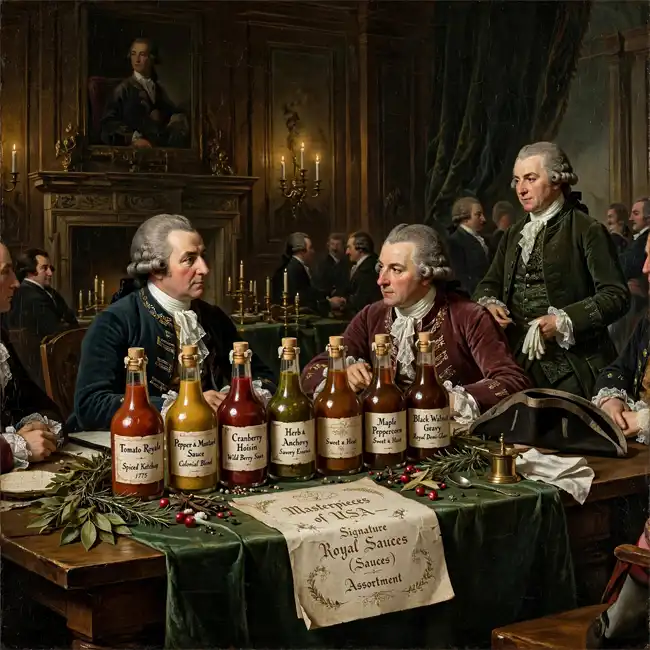
A historical note before we open the old kitchen door: The United States has never had a hereditary royal court comparable to the monarchies of Europe or Asia. So, for American history, the word “Royal” here is best understood as a literary title for the refined tables, elite households, historic estates, presidential-era kitchens, plantation kitchens, taverns, and influential culinary traditions that shaped American food culture. The United States can trace some foodways back several centuries, but it would not be historically accurate to claim that a specific American sauce recipe is literally 1,000 years old or belonged to an American royal dynasty. This chapter uses the “royal sauce” concept as a storytelling lens while keeping the historical foundation honest.
👑📜 The Storyteller’s Intro: Secrets Behind the Silver Sauceboat
Imagine walking into an old American manor just before dinner.
The dining room is quiet. Heavy wooden furniture surrounds a long table. Candles flicker against polished silver. Roasted meat is resting nearby, vegetables have just arrived from the kitchen garden, and somewhere behind a closed kitchen door, a cook is finishing the one thing that could transform the entire meal: the sauce.
This is where our story begins.
America never developed a traditional royal court, but it certainly developed wealthy households, influential families, plantation estates, presidential residences, grand hotels, coastal merchant communities, and formal dining traditions where food became a statement of refinement. In those kitchens, sauces could be far more than an afterthought.
They were the finishing signature.
They could make plain poultry seem luxurious, turn river fish into a formal dinner centerpiece, brighten roasted vegetables, balance rich meats, or give an otherwise simple meal the polished character expected at an elegant table.
And the fascinating part is that American sauce history is much older and more complicated than many people realize.
If we imagine the American culinary story as a series of historical “chapters,” several periods stand out:
◦ The Indigenous Foodways Era — long before European colonization, Native peoples developed sophisticated relationships with local plants, grains, fish, game, fruits, nuts, and seasonings. These foodways formed part of the environmental foundation upon which later American cuisines developed.
◦ The Colonial Kitchen Era — from the 1600s into the 1700s, European settlers brought culinary traditions that blended with local ingredients and Indigenous knowledge. British-style gravies, butter-based preparations, pickled foods, fruit accompaniments, and savory sauces gradually adapted to American conditions.
◦ The Colonial Elite and Estate Table — wealthy households began using food as a way to display hospitality, abundance, refinement, and social position. At places such as Mount Vernon, ingredients came from gardens, farms, fisheries, and imported supplies. Historical records show that food preparation was an enormous operation involving cooks, gardeners, farmers, fishermen, and other workers.
◦ The Early Republic — after independence, American cooks increasingly searched for ways to express a distinct national identity through food. Amelia Simmons’s American Cookery, published in 1796, is widely recognized as the first cookbook written and published in the United States. It combined inherited British culinary traditions with ingredients and dishes associated with American foodways.
◦ The Antebellum and Southern Culinary Era — elite Southern tables became associated with elaborate hospitality, while enslaved cooks supplied enormous amounts of culinary knowledge, labor, and technical skill. Their influence on sauces, gravies, preserves, vegetables, meats, and regional seasoning was profound and must be recognized as a central part of American culinary history.
◦ The Industrial and Modern American Era — sauces gradually moved beyond private kitchens into restaurants, commercial bottling, diners, barbecue culture, hotel dining rooms, and mass-market food production.
So when we call this collection “USA Signature Royal Sauces,” think of it as a culinary treasure chest rather than a literal royal cookbook.
And inside that treasure chest are some remarkably elegant names.
👑 The Hidden Sauce Cabinet
Here are the kinds of historic and heritage-inspired sauces that deserve a place in this imaginary American aristocratic kitchen:
◦ Virginia-Style Onion Sauce — a refined accompaniment associated with older English and American elite dining traditions, especially alongside poultry and other mild meats. A historical version connected with the Washington household survives today through Mount Vernon’s culinary research.
◦ Colonial Mushroom Cream Sauce — an old-fashioned sauce combining mushrooms with rich dairy and aromatic seasoning, representative of the sophisticated sauces appearing in elite household cookery.
◦ Early American Rémoulade — a sharper, more delicate ancestor of the thick modern versions many Americans recognize today. A Mount Vernon historical adaptation traces its lineage through an 18th-century English cookbook and the Washington family’s culinary collection.
◦ Virginia Pan Gravy — the kind of deeply savory finishing sauce that could turn roasted poultry or meat into the centerpiece of a formal country-house dinner.
◦ Colonial Cranberry Relish — a bright American interpretation of fruit-based accompaniments that eventually became strongly associated with holiday tables.
◦ Carolina Mustard Sauce — one of the clearest examples of regional American sauce identity, especially within South Carolina barbecue culture.
◦ North Carolina Vinegar Sauce — sharp, thin, and intensely regional, representing an entirely different philosophy from thick sweet barbecue sauces. Regional barbecue sauces developed through multiple cultural influences, including British, French, German, Caribbean, and African American foodways.
◦ Savannah Herb Butter Sauce — a heritage-inspired coastal interpretation built around herbs, butter, and seafood traditions.
◦ New England Oyster Sauce — a reminder of how important shellfish and coastal ingredients were to early American foodways.
◦ Frontier Berry Reduction — a modern heritage concept inspired by the practical American use of wild and cultivated fruits as accompaniments to savory foods.
The important point is not that every one of these sauces sat on a literal royal table.
The point is that American culinary history contains layers of prestige, regional identity, inherited techniques, forgotten preparations, and elite hospitality that can be explored through the language of the “secret sauce cabinet.”
And honestly, that makes the story even more interesting.
🗺️ The Royal Culinary Tourism: Mapping Flavors to Historic Landscapes
If you want to understand American sauces, don't just look inside a cookbook.
Look at the landscape.
America's culinary history is deeply connected to rivers, coastlines, forests, plantations, farms, ports, mountain valleys, and expanding cities. The ingredients available in each environment shaped the sauces people developed.
This makes culinary tourism especially fascinating.
Instead of simply asking, “Where did this sauce come from?” ask:
What landscape made this flavor possible?
That question opens an entirely different door.
🏛️ Virginia — The Estate Kitchen Route
Virginia is one of the most compelling destinations for exploring early American elite food culture.
Historic estates such as Mount Vernon provide a window into 18th-century food preparation, gardens, fisheries, preservation, and formal household dining. The Washington household's kitchen depended on locally produced foods as well as imported ingredients, creating a culinary world where European techniques met American resources.
For a culinary traveler, the experience is not simply about seeing an old building.
It is about imagining the entire food chain:
◦ gardens producing herbs and vegetables
◦ fields supplying grains and livestock
◦ the Potomac providing fish
◦ smokehouses preserving meat
◦ kitchens working from early morning
◦ cooks transforming raw ingredients into formal dishes
◦ servants carrying finished food toward the dining room
Historic Mount Vernon also documents sauces such as onion sauce, mushroom sauce, and early rémoulade, making the estate especially valuable for anyone interested in the forgotten sauce traditions of America's early elite households.
🌊 Chesapeake Bay — Water, Fish & Elegant Accompaniments
Move toward the Chesapeake and the relationship between food and water becomes even stronger.
Fish, oysters, shellfish, poultry, vegetables, grains, and preserved foods shaped the regional table. Sauces naturally developed around these ingredients because delicate seafood often benefits from something acidic, creamy, buttery, herbaceous, or sharply seasoned.
The historical dining table therefore becomes a map.
A fish sauce tells you something about the river.
An herb sauce tells you something about the garden.
A fruit relish tells you something about preservation.
A vinegar sauce tells you something about practicality.
A cream sauce tells you something about access to dairy and the traditions of formal cookery.
That's why culinary tourism in historic American regions can be so rewarding: the sauce becomes a small edible history lesson.
🚣 Cradle of Royal Delicacies — Rivers, Plantations & Coastal Tables
America's eastern rivers and coastal settlements created some of the earliest environments where European, African, Indigenous, and American foodways collided.
This is particularly important when discussing the Southern United States.
Large plantation households and wealthy estates developed elaborate dining cultures, but the history must be told honestly: the impressive meals enjoyed by elite households were often produced through the forced labor of enslaved people.
At Mount Vernon, for example, enslaved cooks and workers played essential roles in producing food for the household. Historical documentation describes demanding kitchen schedules and extensive agricultural and fishing operations.
That reality changes how we should understand the phrase “aristocratic cuisine.”
The elegance belonged to the dining room.
The expertise often belonged to people whose names were not written on the menu.
African American cooks contributed enormously to Southern culinary traditions, bringing techniques, ingredients, flavor combinations, and knowledge that became inseparable from American cuisine. Smithsonian historical research emphasizes how enslaved cooks helped shape the Southern food tradition and how African, European, and Indigenous influences became intertwined.
That legacy can be tasted in the broader world of sauces.
Think about:
◦ vinegar-forward barbecue sauces
◦ mustard-based Carolina sauces
◦ pepper-rich Southern preparations
◦ savory pan gravies
◦ vegetable-based sauces
◦ fruit relishes
◦ thickened meat gravies
◦ seafood accompaniments
These aren't simply “old recipes.”
They are evidence of cultural exchange, adaptation, survival, labor, geography, and creativity.
For travelers, destinations across Virginia, the Carolinas, Georgia, Louisiana, and the wider Atlantic South can therefore be explored through historic foodways.
A visitor might build an entire culinary journey around:
◦ historic plantations and preserved estates
◦ colonial towns
◦ coastal seafood traditions
◦ Southern barbecue regions
◦ historic markets
◦ agricultural heritage sites
◦ museum kitchens
◦ regional food festivals
◦ traditional family-run restaurants
And suddenly, a sauce is no longer just something poured over dinner.
It becomes a souvenir of place.
⛰️ Kingdom of Wild Aromatics & Heritage — Forests, Mountains & Frontier Kitchens
Now travel inland.
The American culinary imagination changes dramatically when the landscape becomes forest, mountain, and frontier.
Here, sauces tend to become more practical, rustic, and intensely connected to available ingredients.
Wild berries, mushrooms, herbs, nuts, roots, apples, stone fruits, maple products, onions, and preserved vegetables could provide flavor when expensive imported ingredients were unavailable or difficult to obtain.
The frontier kitchen did not necessarily have the elaborate equipment of an elite urban dining room.
Yet resourcefulness created its own form of culinary sophistication.
Imagine a mountain table featuring:
◦ roasted poultry with wild mushroom sauce
◦ game accompanied by tart berry relish
◦ root vegetables with herb butter
◦ roasted meat with apple reduction
◦ corn-based dishes with savory gravy
◦ forest mushrooms enriched with cream
◦ preserved fruit served beside rich meat
These combinations reveal a different definition of luxury.
In a grand estate, luxury might mean imported spices, fine tableware, multiple courses, and highly trained cooks.
On the frontier, luxury could mean having enough preserved fruit, fresh herbs, cream, mushrooms, or carefully stored ingredients to create something memorable.
This is why American sauce history cannot be reduced to famous bottled brands.
The deeper story lives in the forgotten kitchens.
The family notebook.
The handwritten “receipt.”
The estate pantry.
The smokehouse.
The garden.
The coastal market.
The mountain forest.
Even the language of old American cookbooks tells us something about this transition. As the United States developed, cookbooks increasingly attempted to standardize and preserve culinary knowledge for a mobile and changing population. The late 19th century brought increasingly precise recipes, reflecting America's growing need to preserve culinary knowledge in written form.
That means the sauce itself became a historical document.
🔐 The Secret Menu: Sauces Worth Watching
If this were a fictional aristocratic archive hidden beneath an old American manor, these would be the pages I'd mark with a red ribbon:
◦ The Virginia Garden Onion Sauce — elegant, mild, creamy, and deeply connected to early American elite cookery.
◦ The Washington-Era Mushroom Sauce — an old-world-style preparation preserved through American historical interpretation.
◦ The Chesapeake Fish Rémoulade — sharp, aromatic, and much lighter than many modern bottled versions.
◦ The Carolina Mustard Heritage Sauce — a regional signature built around tangy mustard traditions.
◦ The Old North Carolina Vinegar Sauce — proof that a sauce does not need to be thick or sweet to become iconic.
◦ The Colonial Cranberry Accompaniment — tart fruit used to bring contrast to rich foods.
◦ The Southern Pepper Relish — fiery, bright, and strongly connected to regional preservation traditions.
◦ The Appalachian Wild Berry Sauce — a heritage-inspired expression of forest fruits and mountain cooking.
◦ The New England Herb Butter Sauce — restrained and elegant, designed to complement delicate seafood and vegetables.
◦ The Old American Pan Gravy — perhaps the simplest-looking entry in the cabinet, yet one of the most important expressions of the traditional roast dinner.
These names are best treated as heritage-inspired categories and historical culinary concepts, not as claims that a secret American royal dynasty preserved them for a thousand years.
That distinction matters.
It makes the story stronger, not weaker.
🍽️ How the Old Elite Table Was Really Experienced
The most fascinating part of historical food is not always what people ate.
It is how they ate.
In wealthy households, formal meals could communicate status through abundance, presentation, hospitality, service, and access to ingredients.
A dining table could quietly announce:
“We have a garden.”
“We have livestock.”
“We have fish.”
“We have skilled cooks.”
“We have enough food to entertain guests.”
“We know how to serve it properly.”
Sauces were part of that performance.
A sauceboat placed beside a roast gave diners control over the richness and flavor of the meal. A carefully prepared accompaniment could also demonstrate culinary knowledge.
But there was another side to this world.
The people preparing these meals worked extremely hard.
At Mount Vernon, historical evidence shows that enslaved cooks could begin working before dawn and continue long after sunset.
So the romantic image of an “old aristocratic kitchen” should never erase the human beings who actually made the food possible.
The true legacy belongs not only to wealthy families who hosted grand dinners, but also to cooks, gardeners, farmers, fishermen, Indigenous communities, African American food traditions, immigrant communities, and generations of ordinary families who preserved techniques long after elite dining fashions disappeared.
😱❓ Royal FAQ: Unlocking Palace Kitchen Mysteries
Q1.Did the United States actually have royal sauces?
No. The United States did not develop a hereditary royal court comparable to European monarchies. “Royal sauces” in this article is a storytelling term for sauces associated with historic elite households, formal dining, influential estates, and refined American culinary traditions.
Q2.Are any American sauces really 1,000 years old?
There is no sound historical basis for claiming that a named American sauce recipe is 1,000 years old. Indigenous food traditions in North America are far older than the United States itself, while documented colonial American sauce traditions generally belong to the last several centuries. The “200–1,000 years” concept works best as a dramatic historical range for the broader culinary landscape, not as a literal age claim for individual American recipes.
Q3.What makes an American sauce historically important?
Usually, it is the combination of ingredients, regional identity, cooking technique, cultural exchange, and historical documentation. Some sauces reveal connections to British cookery; others reflect French, German, African, Caribbean, Indigenous, or later immigrant influences. American cuisine became distinctive precisely because these traditions interacted.
Q4.Where should food-history travelers begin?
Virginia is an excellent starting point for early American elite food history, especially around historic estates such as Mount Vernon. The Chesapeake, Carolinas, Georgia, New England, the Appalachian region, and the broader Southern United States each offer different culinary landscapes and sauce traditions.
🧠 Final Thoughts: The Timeless Allure of Aristocratic Gastronomy
The greatest secret hidden inside America's historic sauce traditions is not one mysterious ingredient.
It is the story behind the table.
America had no traditional royal palace, yet it had grand estates, influential households, historic kitchens, presidential-era dining traditions, coastal merchants, plantation communities, immigrant neighborhoods, frontier families, and generations of cooks who transformed ingredients into something distinctly American.
The sauce became a bridge between them.
From Virginia's formal estate kitchens to Chesapeake seafood tables, from Carolina barbecue country to Appalachian forests, American sauces tell stories about geography, migration, agriculture, preservation, hospitality, wealth, inequality, creativity, and cultural exchange.
And that is why the phrase “USA Signature Royal Sauces” can be so much fun when used carefully.
Think of this page as the grimoire's first unlocked chamber.
Not a fake claim that America had medieval kings.
Not a fabricated 1,000-year-old American recipe book.
Instead, imagine a beautifully preserved culinary archive containing fragments from centuries of American food history — some documented, some adapted, some nearly forgotten, and some transformed into modern regional classics.
The next chapters can go much deeper.
One page might open the door to an old Virginia onion sauce.
Another might reveal an early mushroom preparation.
Another could follow the sharp trail of Carolina vinegar sauce.
Another might explore mustard traditions.
Another could uncover forgotten cranberry, herb, berry, seafood, or pan-gravy accompaniments.
And when those individual pages are finally opened, the focus can shift from history and mystery to the actual ingredients, proportions, preparation techniques, serving traditions, and modern kitchen adaptations.
For now, though, the sauce cabinet remains closed.
The labels are visible.
The keys are on the table.
And the most intriguing recipes are still waiting behind the door.
👑 Credit to the Keepers of the Culture (The Legacy)
The legacy of American sauce culture belongs to far more people than the famous names usually printed in cookbooks.
It belongs to Native communities whose foodways existed long before the United States.
It belongs to colonial cooks who adapted European traditions to unfamiliar American landscapes.
It belongs to enslaved African and African American cooks whose expertise profoundly shaped Southern and national cuisine.
It belongs to farmers, fishermen, gardeners, preservationists, bakers, household cooks, tavern keepers, immigrant families, restaurant chefs, cookbook writers, and culinary historians.
It belongs to the people who remembered.
And it belongs to the people who wrote those memories down.
Historic institutions such as George Washington's Mount Vernon continue to preserve and interpret early American foodways, including historical recipes connected with the Washington household and 18th-century elite women.
At the same time, modern scholarship reminds us that historical food should be studied with context. A beautiful dining room does not tell the whole story; the labor behind the kitchen door matters just as much as the silverware on the table.
That is the standard worth carrying forward.
Respect the source.
Name the people behind the food.
Separate documented history from creative reconstruction.
Celebrate regional traditions without turning them into myths.
And above all, remember that American cuisine was never created by one royal family.
It was created by many peoples, many landscapes, many kitchens, and many generations.
That is the real treasure.
And perhaps that is the most fascinating “royal secret” of all.
The kitchen was never truly owned by the people sitting at the head of the table. The knowledge belonged to everyone who kept the fire alive.
👑🥘 Unveiling Early American Aristocratic Sauces: The Lost Culinary Secrets of High Society
👉 Indulge in Elite American Signature Royal Sauces
| 🌐 👑🥘 < Back | 🇺🇸 👑🍱 < Previous |