
🏠 Home > 🗺️ Recipes > 👑🍱 Royal Court Side-Bites (Snacks) > 🇺🇸 USA Royal Court Side-Bites (Snacks) Recipes > 👑🍱 1.Luxury Colonial Chesapeake Oyster & Herb Bites
👑🍱 Lost Aristocratic Flavors: Luxury Bites from Early America
Published by Supakorn | Updated: August 2026
👑🏛️ The Forgotten Aristocratic Legacy of the USA: Early American Colonial Kitchens
🕯️ The Storyteller’s Intro
Travel back with me to the candlelit kitchens of 18th-century America, when meals were prepared slowly, fires burned inside great brick hearths, and the finest ingredients were often reserved for prosperous households.
There was no American royal court in the European sense, so the language of aristocratic dining is more historically appropriate here. Wealthy landowners, prominent merchants, political families, estate owners, and influential colonial households could maintain kitchens where food preparation became an important expression of hospitality and status.
Imagine stepping quietly into one of those kitchens.
The room is warm from the hearth. Copper and iron cookware hang along the walls. Fresh herbs rest beside baskets of garden produce. A cook works patiently over the fire while servants arrange small portions of carefully prepared food for an evening gathering.
This is where the inspiration for our Luxury USA Palace Bites begins.
Rather than presenting a modern appetizer disguised as an ancient royal recipe, this recipe takes inspiration from genuine features of early American cooking: local seafood, garden herbs, rustic grains, fragrant vegetables, carefully preserved ingredients, and the practical creativity of colonial cooks.
The result is a sophisticated little bite with an old-world character—something that feels equally at home on a modern dinner table or beside a roaring hearth in an imagined colonial manor.
Our featured creation is:
Luxury Colonial Chesapeake Oyster & Herb Bites
It combines tender oysters, aromatic herbs, finely crushed grains, gentle seasoning, and a crisp golden exterior. The concept is deliberately small and elegant, reflecting the tradition of serving carefully portioned savory foods during formal gatherings.
And the best part?
You do not need an enormous estate kitchen to recreate the experience.
🌎 The Global Value
Historic food is more than a collection of ingredients.
It is a record of movement, adaptation, geography, agriculture, trade, social customs, and family traditions.
Early American cooking developed from many culinary influences. Indigenous food knowledge, European traditions, African culinary expertise, and ingredients available in the North American environment all contributed to the evolving food culture of colonial America.
That makes the story much richer than simply calling something an “old royal recipe.”
The phrase aristocratic recipe can be useful when describing dishes associated with affluent households, formal entertaining, and elite dining traditions. But we should also remember that many of the techniques used in impressive household kitchens came from cooks whose names were never recorded.
A wealthy household might have owned the pantry, but skilled cooks were the people who transformed those ingredients into memorable meals.
Small savory bites are particularly fascinating because they sit between everyday cooking and formal hospitality. A humble ingredient could become something visually elegant when carefully seasoned, shaped, baked, or fried.
Over generations, recipes could disappear.
Ingredients changed. Families moved. Handwritten cookbooks were lost. Oral instructions were forgotten.
That is why recreating historical-inspired food today can be meaningful.
We are not claiming to possess a single secret manuscript from an American palace. Instead, we are rebuilding the culinary atmosphere and ingredient logic of the period while making the recipe practical for a modern kitchen.
📜 The Collection
This article brings one such historical-inspired creation back to the table.
Luxury Colonial Chesapeake Oyster & Herb Bites celebrates the relationship between America's coastal ingredients and the refined hospitality associated with prosperous early households.
The recipe focuses on balance rather than extravagance.
You will find:
• Briny oysters for a deep coastal character
• Fresh herbs for fragrance
• Finely ground cornmeal or breadcrumbs for structure
• Aromatic vegetables for sweetness
• A little butter for richness
• Gentle seasoning rather than an overwhelming spice mixture
• A crisp exterior surrounding a tender center
The goal is not to make the dish complicated.
The goal is to make simple ingredients feel special.
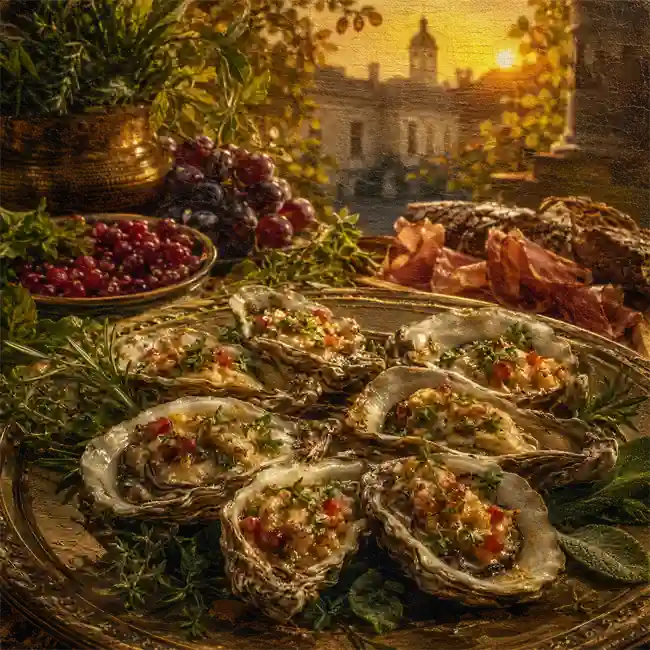
🍽️ Recipe: Luxury Colonial Chesapeake Oyster & Herb Bites
🗝️ About This Aristocratic Secret
Picture an elegant colonial gathering in a prosperous coastal household.
Guests have arrived, the dining room has been prepared, and the kitchen is sending out small savory portions before the main meal.
There is no need for enormous servings.
Instead, the cook presents delicate bites that can be eaten easily while guests talk, move between rooms, or wait for the larger meal.
Oysters are a particularly natural choice for this historical-inspired recipe because coastal communities had access to abundant shellfish, while oysters eventually became associated with both everyday meals and sophisticated dining.
Our version transforms them into compact golden bites with herbs and grains.
Rather than claiming that this exact combination was the documented favorite of a particular historical figure, it is more accurate—and more respectful—to describe it as a modern reconstruction inspired by Early American aristocratic kitchen traditions.
That distinction matters.
Historical food should be fascinating without inventing evidence.
The result is a recipe that feels old-fashioned, elegant, and believable while remaining completely practical for today's home cook.
🌿 Ingredients & The Aristocratic Touch
🧺 The Royal Pantry
Although the United States did not have a royal pantry, prosperous colonial households could maintain impressive food stores.
A well-managed kitchen might rely on preserved grains, butter, garden herbs, vegetables, seafood, dried seasonings, and other ingredients available through local farms and coastal markets.
For this recipe, luxury comes from quality and balance rather than excessive ingredients.
Fresh oysters provide the centerpiece.
Herbs bring a garden-like fragrance.
Cornmeal or fine breadcrumbs provide texture.
Butter gives the mixture a rich, rounded character.
A small amount of onion and celery creates an aromatic foundation without overpowering the seafood.
The aristocratic touch is restraint.
Every ingredient should have a purpose.
🔄 Modern Substitutes
If you want to prepare this recipe with ingredients that are easier to find today, use these practical alternatives:
• Fresh shucked oysters can be replaced with high-quality canned oysters, thoroughly drained.
• Fine cornmeal can be replaced with plain breadcrumbs.
• Homemade breadcrumbs can be used instead of packaged crumbs for a more rustic texture.
• Fresh parsley can replace less familiar historical herbs while keeping the flavor bright.
• Fresh thyme can be substituted with a smaller quantity of dried thyme.
• Celery can be replaced with finely chopped fennel for a slightly sweeter aroma.
• Unsalted butter is ideal because it gives you better control over seasoning.
• A small amount of lemon zest can provide brightness if you prefer a fresher modern finish.
📏 The Measurements
For approximately 18–20 elegant bites, prepare:
• 300 grams fresh shucked oysters, drained
• 80 grams fine cornmeal
• 50 grams plain breadcrumbs
• 45 grams unsalted butter
• 40 grams finely minced onion
• 30 grams finely minced celery
• 2 tablespoons finely chopped fresh parsley
• 1 teaspoon fresh thyme leaves
• 1 large egg
• 1 teaspoon finely grated lemon zest
• ½ teaspoon ground black pepper
• ¼ teaspoon salt, adjusted according to the oysters
• 1 tablespoon finely chopped spring onion
• 1–2 tablespoons additional breadcrumbs if the mixture feels too moist
• 1 tablespoon butter or neutral cooking oil for preparing the pan
The mixture should be moist enough to hold together but firm enough to shape.
That texture is important.
Too wet, and the bites may collapse.
Too dry, and the oysters lose the delicate texture that makes the recipe special.
🔥 The Chef’s Ritual
1. Prepare the Oyster Base
Drain the oysters thoroughly.
Place them on a clean board and chop them into small pieces.
Do not turn them into a paste.
A little texture gives each bite more character and allows the seafood to remain recognizable.
2. Build the Aromatic Foundation
Melt the butter in a skillet over medium-low heat.
Add the minced onion and celery.
Cook slowly for approximately 4–5 minutes.
The vegetables should become soft and fragrant without developing a dark color.
This gentle cooking creates the foundation of the dish.
3. Add the Herbs
Add the parsley, thyme, and spring onion.
Stir for approximately 30 seconds.
The purpose is simply to release their aroma.
You want the kitchen to smell like a fresh garden rather than a heavily seasoned seafood restaurant.
4. Combine the Ingredients
Transfer the aromatic mixture to a bowl.
Add the chopped oysters, cornmeal, breadcrumbs, lemon zest, pepper, and salt.
Mix gently.
Add the egg and stir until everything is evenly combined.
If the mixture feels loose, add one tablespoon of breadcrumbs at a time.
Give the mixture a few minutes to rest.
The cornmeal and breadcrumbs will absorb some of the moisture.
5. Shape the Bites
Use approximately one tablespoon of mixture for each bite.
Shape them into small rounds or slightly flattened oval portions.
Do not make them too large.
The charm of this recipe comes from its small, elegant size.
6. Chill Before Cooking
Place the shaped bites on a plate and refrigerate them for approximately 20–30 minutes.
This simple step helps them hold their shape during cooking.
It also gives the ingredients time to come together.
7. Create the Golden Exterior
Heat a skillet over medium heat.
Add a small amount of butter or neutral cooking oil.
Place the bites carefully into the pan.
Cook for approximately 3–4 minutes on the first side.
Turn gently.
Continue cooking for another 3–4 minutes until both sides are golden and the center is fully cooked.
Avoid extremely high heat.
A beautiful golden crust should develop gradually.
8. Serve with Restraint
Transfer the finished bites to a warm serving plate.
Arrange them in a simple circular pattern or place them individually on small plates.
For a historical-inspired presentation, use ceramic, stoneware, wooden serving boards, or understated metal trays.
A few fresh herbs can provide the final touch.
You do not need elaborate decoration.
The food itself should remain the centerpiece.
🏰 Secrets of the Palace Kitchen
🌿 Secret 1: Treat Herbs as Perfume
Do not overwhelm the oysters with herbs.
The herbs should rise gently from the dish rather than dominate it.
A small amount of fresh thyme can create an impressive aroma.
🔥 Secret 2: Keep the Heat Moderate
One of the easiest mistakes is cooking the bites over excessive heat.
The outside may become dark before the center is properly cooked.
Medium heat gives the exterior enough time to become golden while allowing the interior to cook evenly.
🦪 Secret 3: Drain the Oysters Properly
Excess liquid can destroy the texture of the mixture.
After draining the oysters, allow them to sit briefly in a fine strainer.
This small step can make a major difference.
🧈 Secret 4: Butter Should Support, Not Dominate
Butter provides richness, but too much can make the mixture heavy.
Use enough to create a rounded flavor without masking the oysters.
🌽 Secret 5: Texture Matters
The ideal bite should have contrast.
The exterior should be lightly crisp.
The inside should remain tender.
If the mixture becomes too compact, the final result can feel dense.
Mix only until the ingredients come together.
❌ Common Mistake: Making the Bites Too Large
Large portions take longer to cook and are more likely to break.
Small portions are easier to control and also look more elegant when served.
❌ Common Mistake: Over-Seasoning
Oysters already have a distinctive natural flavor.
Heavy seasoning can hide it.
Start conservatively.
You can always adjust the seasoning in future batches.
❌ Common Mistake: Turning the Oysters Into Paste
Some texture is desirable.
Finely chopped oysters create a much more interesting eating experience than completely puréeing them.
❌ Common Mistake: Skipping the Resting Period
A short resting period allows the dry ingredients to absorb excess moisture.
It also makes shaping much easier.
👑❓ Royal FAQ
Q1.Is this an authentic 18th-century royal recipe?
No. The United States did not have a royal court in the European sense. This recipe is a historical-inspired reconstruction based on ingredients, cooking techniques, and dining traditions associated with prosperous Early American households.
Q2.Why use the word “Aristocratic” instead of “Royal”?
“Aristocratic” is more appropriate for this American context because colonial America had wealthy and influential households but no hereditary American monarchy.
Q3.Can I use canned oysters?
Yes. Choose good-quality canned oysters, drain them thoroughly, and chop them finely. The flavor will be slightly different from fresh oysters, but the recipe remains practical.
Q4.Can these bites be prepared ahead of time?
Yes. Shape the uncooked mixture and refrigerate it for several hours before cooking. For the best texture, cook them relatively close to serving time.
📖 The Taste of History
The first impression is gentle.
You notice the golden crust before the oyster flavor arrives.
Then comes the subtle sweetness of onion, the freshness of parsley, the earthy fragrance of thyme, and finally the unmistakable coastal character of the oyster.
It is rich without being heavy.
Rustic without looking ordinary.
Elegant without requiring expensive ingredients.
That balance is what makes the recipe interesting.
The beauty of historical-inspired cooking is not necessarily about reproducing a meal exactly as someone ate it centuries ago.
Sometimes the more valuable experience is understanding why certain ingredients belonged together.
Coastal seafood made sense in communities near the water.
Grains were practical.
Herbs could come from household gardens.
Butter added richness.
Small portions suited social occasions.
When those ideas come together, the dish begins to tell a story.
And that story continues every time you prepare it.
🕯️ Final Thoughts: Bringing History to Your Table
There is something wonderfully satisfying about preparing food inspired by an earlier world.
You do not need a colonial mansion.
You do not need a gigantic hearth.
You do not need a collection of antique cookware.
A simple skillet, fresh ingredients, patience, and a little curiosity are enough.
The Luxury Colonial Chesapeake Oyster & Herb Bites are designed to bring that feeling into an ordinary modern kitchen.
The recipe may be inspired by aristocratic dining traditions, but it is not meant to create distance between historical food and today's home cook.
Quite the opposite.
The whole idea is to make history approachable.
Take your time.
Let the herbs release their aroma.
Let the oysters remain recognizable.
Allow the exterior to become beautifully golden.
Then serve each bite slowly.
That is where the real luxury begins—not in extravagance, but in attention.
✨ The Call to Action: The Golden Hook
If you love discovering forgotten flavors and culinary traditions from the past, keep exploring with us.
Every historical-inspired recipe is another doorway into a different world—a world of old kitchens, handwritten instructions, regional ingredients, family traditions, and cooks whose contributions deserve to be remembered.
Perhaps the most exciting part is that culinary history is never truly finished.
There are always more forgotten ingredients to rediscover.
More traditional techniques to understand.
More stories hidden inside old kitchens.
And more flavors waiting to return to the table.
If you love the taste of history, join us in preserving the world's culinary memories—one remarkable recipe at a time.
🌎 Credit to the Keepers of the Culture: The Legacy
Food history belongs to people.
It belongs to the cooks who prepared meals without receiving recognition, the families who passed techniques from one generation to another, the farmers who cultivated ingredients, the fishers who brought food from the coast, and the communities whose culinary knowledge shaped American food culture.
Early American cuisine was never created by one group alone.
It developed through encounters between Indigenous food traditions, European settlers, African culinary knowledge, regional agriculture, coastal communities, and generations of cooks adapting to new environments.
For that reason, historical-inspired recipes should be approached with curiosity and respect.
The goal is not to claim ownership of a culture's food.
The goal is to learn from it, acknowledge its complexity, and keep its stories alive.
Our Luxury Colonial Chesapeake Oyster & Herb Bites are therefore best understood as a respectful modern interpretation rather than a claim that one unchanged “secret palace recipe” survived intact from the 18th century.
That distinction makes the story stronger, not weaker.
Because culinary heritage does not need fictional legends to be fascinating.
The real history is already remarkable.
From coastal oyster beds to colonial kitchens, from garden herbs to carefully prepared household meals, these ingredients tell us something about the people who lived, worked, traveled, cooked, and gathered around tables centuries ago.
And now, centuries later, we can bring a small piece of that culinary spirit into our own homes.
Not as a museum piece.
Not as a fantasy.
But as food inspired by history, prepared with modern care, and shared with the people around our own table.
That is perhaps the finest way to preserve a culinary legacy:
cook it, understand it, respect its origins, and pass the story forward.
| 🇺🇸 👑🍱 < Back |