
🏠 Home > 🗺️ Recipes > 👑🍝 Imperial Mains (Main Dishes) > 🇺🇸 USA Imperial Mains (Main Dishes) Recipes > 👑🍝 1.The Ancestral Three Sisters Hearth Stew
👑🍝 Ancient American Main Dishes Inspired by a Lost Aristocratic Table
Published by Supakorn | Updated: August 2026
🤴🏛️ The Forgotten Aristocratic Legacy of the Land Now Called the USA: Ancient North American Foodways
📜 The Storyteller’s Intro
Imagine stepping backward through time, far beyond colonial America, before the United States had a flag, a constitution, or even a name.
It is a cool evening somewhere in the vast landscapes of what is now the United States. A fire glows beneath a darkening sky. Smoke rises slowly through trees while people gather around a carefully prepared communal meal. Nearby, baskets hold corn, beans, squash, nuts, herbs, roots, berries, and other foods gathered or cultivated according to the season.
There is no modern kitchen.
There are no polished restaurant plates.
There is no written cookbook sitting on a shelf.
Yet there is something remarkably sophisticated happening here: food is being prepared with knowledge passed from one generation to another.
That is where our story begins.
The phrase “1,000-Year USA Main Dishes” needs an important historical clarification. Around 1,000 years ago, the United States did not exist as a country. Instead, the lands that are now part of the USA were home to many distinct Indigenous peoples and societies, each with their own agricultural systems, hunting traditions, ingredients, cooking techniques, ceremonies, and food cultures.
So this article does not claim to uncover a literal royal American recipe book from 1,000 years ago.
Instead, it explores a historically inspired interpretation of an ancient North American main dish, presented with an aristocratic culinary atmosphere while respecting the cultures that created these food traditions.
And honestly, that makes the story even more fascinating.
🌎 The Global Value
Ancient food history is often misunderstood because people imagine that a recipe only becomes important when it was served in a palace.
But culinary sophistication does not require a palace.
Across ancient North America, food knowledge could represent survival, seasonal wisdom, agriculture, trade, ceremony, hospitality, and community identity. Ingredients that seem ordinary today could have carried enormous cultural importance.
Corn, beans, squash, nuts, berries, roots, wild greens, game, fish, and seeds were not simply ingredients. They were connected to landscapes and seasons.
The knowledge of when to plant, when to harvest, how to preserve food, how to roast it, how to simmer it, and how to combine different foods was a form of culinary heritage.
Some foods disappeared from everyday tables. Others changed as ingredients, technology, migration, colonization, and modern agriculture transformed regional diets.
That is why the idea of “lost recipes” is so compelling.
Sometimes a lost recipe is not a single forgotten page.
It is a method.
A flavor combination.
A seasonal tradition.
A way of gathering around a fire.
A memory carried through generations.
🥘 The Collection
In this collection, we revive that atmosphere through one carefully constructed main dish inspired by ancient North American foodways.
The centerpiece combines hearty protein with corn, beans, squash, aromatic herbs, and roasted seeds.
Rather than pretending that one exact recipe survived unchanged for 1,000 years, we create a modern kitchen interpretation based on ingredients and cooking principles associated with longstanding Indigenous food traditions.
The result is rustic, nourishing, deeply earthy, and surprisingly elegant.
Think of it as an ancient hearth dish dressed for an aristocratic table.
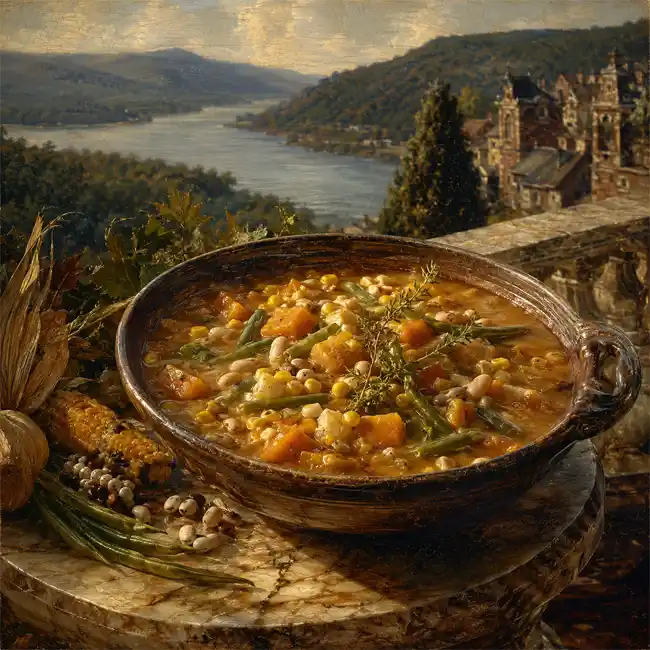
🍲 Recipe: The Ancestral Three Sisters Hearth Stew
📖 About This Aristocratic Secret
The Three Sisters—corn, beans, and squash—are among the most recognizable crops associated with Indigenous agriculture in parts of North America.
They are traditionally discussed together because of the complementary way these crops can be grown and because they provide different nutritional and agricultural benefits.
For our modern interpretation, they become the heart of a rich hearth stew.
Imagine a ceremonial gathering where the finest available ingredients are brought together after harvest.
A substantial portion of meat is slowly cooked until tender. Sweet squash melts into the broth. Corn contributes gentle sweetness and texture. Beans provide body and nourishment. Roasted seeds add a subtle nutty finish.
There is no need for extravagant imported spices.
The luxury comes from quality, patience, balance, and abundance.
That is the “aristocratic touch” in this recipe—not a claim that an ancient Indigenous society called the dish aristocratic, but a modern culinary presentation inspired by the idea of a distinguished historic feast.
The dish works beautifully as a centerpiece for an autumn dinner, heritage-inspired gathering, harvest celebration, or quiet weekend meal.
🌾 Ingredients & The Aristocratic Touch
🧺 The Royal Pantry — Reimagined as an Aristocratic Pantry
The original phrase “royal pantry” does not accurately describe the historical setting here, so we will call it the Aristocratic Pantry.
The beauty of this pantry is that its ingredients are humble.
That is precisely the point.
Ancient food traditions often demonstrate how ordinary ingredients can become extraordinary through technique.
For this interpretation, choose:
• Tender beef, venison, turkey, or another suitable lean meat as the principal protein
• Winter squash for sweetness and richness
• Corn for gentle sweetness
• Beans for texture and substance
• Pumpkin or sunflower seeds for a toasted finish
• Onion for aromatic depth
• Fresh herbs for brightness
• Root vegetables for additional earthiness
• Stock or water as the cooking liquid
The final dish should taste substantial rather than heavily seasoned.
The goal is to let the ingredients speak.
🔄 Modern Substitutes
If certain ingredients are difficult to find, there is no need to abandon the recipe.
Use these practical alternatives:
• Venison → lean beef or turkey
• Fresh corn → frozen corn
• Dried beans → cooked beans
• Winter squash → pumpkin or butternut squash
• Sunflower seeds → pumpkin seeds
• Wild greens → kale, spinach, or another mild leafy green
• Fresh herbs → dried herbs in smaller quantities
• Homemade stock → low-sodium vegetable or meat stock
The most important principle is balance rather than historical perfection.
⚖️ The Measurements
For approximately 6 generous servings:
• 700 g lean meat, cut into bite-sized pieces
• 300 g winter squash, peeled and cubed
• 250 g cooked beans
• 250 g corn kernels
• 1 medium onion, finely chopped
• 150 g root vegetables, diced
• 1.2 liters unsalted or lightly salted stock
• 2 tablespoons toasted pumpkin or sunflower seeds
• 1 tablespoon cooking fat or neutral oil
• 1 teaspoon dried sage or another suitable herb
• 1 teaspoon dried thyme
• 1 small handful fresh herbs, finely chopped
• 1/2 teaspoon ground black pepper
• Salt, adjusted gradually to taste
The proportions are intentionally flexible.
Ancient cooking was rarely governed by modern measuring spoons. The cook worked with seasons, available ingredients, vessel size, and experience.
That flexibility is part of the charm.
🔥 The Chef’s Ritual
1. Prepare the Hearth Ingredients
Begin by cutting the meat into evenly sized pieces.
This is more important than it sounds.
Uniform pieces cook at a similar rate, giving the finished stew a consistent texture.
Prepare the squash, onion, root vegetables, corn, and beans separately.
Think of this stage as preparing a small culinary treasury.
2. Build the Aromatic Foundation
Warm a heavy pot over medium heat.
Add the cooking fat and gently soften the onion.
Do not rush.
The onion should become fragrant and lightly golden without becoming deeply burned.
This is the first secret of the dish: depth begins quietly.
3. Give the Meat a Proper Sear
Add the meat in batches rather than overcrowding the pot.
Allow each piece to develop a browned surface.
That browned layer creates a deeper savory character that will eventually become part of the broth.
If using lean meat such as turkey, reduce the cooking time and avoid excessive browning.
4. Awaken the Herbs
Add the dried herbs and stir briefly.
The warmth of the pot helps release their aroma.
At this moment, the kitchen should begin to smell earthy, smoky, and deeply savory.
5. Add the Stock
Pour in the stock.
Use a wooden spoon to loosen any flavorful browned pieces from the bottom of the pot.
Bring the mixture gently toward a simmer.
Avoid a violent boil.
A slow simmer creates a more graceful texture.
6. Introduce the Root Vegetables
Add the diced root vegetables.
Cover partially and allow them to cook with the meat.
Depending on the protein used, simmer until the meat begins to become tender.
For beef or venison, this may require considerably more time than turkey.
7. Bring in the Three Sisters
Now add the squash, beans, and corn.
This is the defining moment.
The squash should soften enough to enrich the broth without completely disappearing.
The corn should retain some texture.
The beans should become tender and creamy without turning entirely mushy.
8. Let the Pot Become One Dish
Continue simmering gently until the flavors are integrated.
Taste the broth.
Adjust salt gradually.
Add black pepper only as needed.
The finished stew should feel naturally rich rather than aggressively seasoned.
9. Finish with Fresh Herbs
Turn off the heat.
Add the fresh herbs.
Give the stew several minutes to rest.
This small pause allows the flavors to settle.
10. The Aristocratic Presentation
For a historic-inspired presentation, use a deep ceramic bowl or simple earthenware serving dish.
Spoon the stew generously into the center.
Scatter toasted seeds over the top.
Finish with a small amount of fresh herbs.
Do not overcrowd the plate.
The beauty comes from the contrast between the rustic ingredients and the elegant presentation.
🗝️ Secrets of the Palace Kitchen — Tips & Mistakes
Although this is not literally a palace recipe, these are the kinds of culinary principles that give the dish its refined character.
• Secret 1: Never Rush the First Stage
If the onion is burned, the entire broth can develop bitterness.
Cook slowly until aromatic and lightly golden.
• Secret 2: Brown the Meat in Batches
Overcrowding creates steam instead of browning.
If your pot is small, brown the meat in two or three rounds.
• Secret 3: Protect the Texture of the Corn
Corn should not become completely soft.
Add it later in the cooking process so that some natural sweetness and texture remain.
• Secret 4: Let Squash Thicken Naturally
Do not automatically add flour or artificial thickeners.
As squash softens, it naturally contributes body and richness to the broth.
• Secret 5: Be Careful with Beans
Already-cooked beans should not be simmered aggressively for hours.
Add them during the later stage to preserve their structure.
• Secret 6: Fresh Herbs Belong Near the End
Long cooking can flatten delicate herbal aromas.
A small amount added after cooking creates a much brighter finish.
• Secret 7: Salt in Layers
Do not add all the salt at the beginning.
As the liquid reduces, the flavor becomes more concentrated.
Taste near the end and adjust carefully.
❌ Mistake to Avoid: Over-Seasoning
This dish should not taste like a modern heavily spiced stew.
Its character comes from meat, vegetables, herbs, corn, beans, and slow cooking.
❌ Mistake to Avoid: Boiling Too Hard
A violent boil can make meat tough and cause delicate vegetables to break apart.
Keep the heat gentle.
❌ Mistake to Avoid: Treating Historical Food as a Costume
The biggest mistake is assuming that anything labeled “ancient” automatically represents an authentic historical recipe.
Ancient North American food cultures were diverse.
There was no single “Native American cuisine.”
There were countless regional traditions shaped by geography, climate, community, and available resources.
Respecting that diversity is more meaningful than inventing a fictional palace history.
🏟️ Royal FAQ
Q1.What makes this a 1,000-year-old USA recipe?
It is better understood as a 1,000-year-old-inspired American main dish, not a documented recipe from the United States. The United States did not exist as a nation 1,000 years ago. The recipe draws inspiration from ancient North American ingredients and foodways associated with the lands that are now part of the USA.
Q2.Were there royal chefs in ancient America?
There was no single American royal court comparable to European monarchies. Different Indigenous societies had different social, political, and ceremonial structures. Using “aristocratic” here is a modern storytelling framework, not a claim about a specific historical royal kitchen.
Q3.What are the Three Sisters?
The Three Sisters traditionally refer to corn, beans, and squash. These crops are strongly associated with Indigenous agricultural traditions in parts of North America and are valued for their complementary agricultural and nutritional characteristics.
Q4.Can I make this dish with modern ingredients?
Absolutely.
Modern beef or turkey, canned or cooked beans, frozen corn, pumpkin or butternut squash, and supermarket herbs can create a delicious interpretation while keeping the core ingredient philosophy intact.
🕯️ The Taste of History
The first spoonful is earthy.
The meat provides the savory foundation.
Then comes the gentle sweetness of squash and corn.
The beans give the broth a satisfying fullness, while the toasted seeds add a subtle crunch that contrasts with the soft vegetables.
The herbs appear quietly rather than dominating the dish.
And that is what makes this recipe interesting.
It does not depend on dozens of expensive ingredients.
It depends on balance.
There is something deeply appealing about a dish built around foods that have fed communities for generations.
Modern cooking often tries to create luxury by adding more.
Ancient food traditions can teach us another lesson:
Sometimes luxury comes from knowing how to make simple ingredients extraordinary.
The result is a main dish that feels rustic enough for a fireside meal but elegant enough to place at the center of a heritage-inspired dining table.
🌎 Final Thoughts: Bringing History to Your Table
There is a temptation when discussing ancient cuisine to create dramatic stories about secret royal chefs, forbidden kitchens, lost manuscripts, and legendary rulers.
Those stories certainly make good headlines.
But the real history of food can be even more fascinating.
Long before the United States existed, people across North America developed sophisticated relationships with crops, animals, forests, rivers, seasons, and landscapes.
They learned how to grow food.
They learned how to preserve it.
They learned how to cook it.
They learned which ingredients worked together.
And they passed that knowledge forward.
Our Ancestral Three Sisters Hearth Stew is therefore best viewed as a respectful modern reconstruction inspired by those enduring food traditions.
You do not need an ancient castle kitchen to experience its spirit.
A heavy pot, good ingredients, patience, and a little curiosity are enough.
And once the stew reaches the table, something remarkable happens.
History stops feeling distant.
It becomes something you can smell.
Something you can taste.
Something you can share.
✨ The Call to Action: The Golden Hook
If you love discovering forgotten flavors, ancient food traditions, and the fascinating stories hidden behind historic ingredients, keep exploring with us.
Every traditional dish has a story.
Sometimes that story lives in an old manuscript.
Sometimes it survives through farming traditions.
Sometimes it is preserved through family cooking.
And sometimes it survives simply because people continue preparing the food.
That is the real secret worth protecting.
Not a fictional royal recipe book, but the living culinary knowledge of the people and cultures who shaped the food history of North America.
So bring this ancient-inspired dish to your table, share it with friends and family, and let the conversation begin.
Because the best culinary discoveries are not simply eaten.
They are remembered.
🏺 Credit to the Keepers of the Culture: The Legacy
Any discussion of ancient North American cuisine deserves respect for the Indigenous peoples whose agricultural knowledge, food traditions, and relationships with the land existed long before the United States became a nation.
This article should not be interpreted as an authentic Indigenous recipe, nor should it be presented as belonging to one specific Nation or community without appropriate historical evidence.
The Three Sisters tradition, along with many other Indigenous foodways, represents a broad and diverse history rather than a single universal cuisine.
For that reason, this recipe is intentionally presented as a modern historical-inspired interpretation.
The goal is not to claim ownership of an ancient tradition.
The goal is to encourage curiosity, respect, and appreciation.
When exploring historic foods, the most important ingredient is context.
A recipe becomes more meaningful when we understand the people, land, seasons, agricultural knowledge, and cultural traditions behind it.
That is how culinary history stays alive.
And perhaps that is the greatest lesson hidden inside this so-called “lost recipe.”
The past does not always need to be recreated perfectly to be remembered.
Sometimes, we simply need to approach it with respect.
The table is ready. The fire is warm. The story continues.
| 🇺🇸 👑🍝 < Back |