
🏠 Home > 🗺️ Recipes > 👑🍱 Royal Court Side-Bites (Snacks) > 🇱🇦 Laos Royal Court Side-Bites (Snacks) Recipes > 👑🍱 1.Khao Nom Kuu — The Royal Sticky Rice & Black Sesame Jewels
👑🍱 Unearthing the Taste of Lan Xang: Aristocratic Lao Snacks You Can Make Today
Published by Supakorn | Updated: July 2026
🇱🇦 👑 The Forgotten Royal Legacy of Lao: The Lan Xang Dynasty Era
For over 300 years, the Kingdom of Lan Xang — "Land of a Million Elephants" — shaped what we now know as Laos. But while temples and manuscripts survived, one treasure nearly vanished: the private snack culture of Lao nobility.
Unlike grand ceremonial banquets recorded by court scribes, these delicate midday bites were whispered from cook to apprentice inside the royal kitchens of Luang Prabang. They were never meant for commoners. Only high-ranking phakhu, royal consorts, and visiting dignitaries tasted them. After the monarchy dissolved in 1975, many of these recipes scattered with palace staff who fled or stayed silent.
This isn’t just food. It’s edible archaeology.
📜 The Storyteller’s Intro: Stepping Into the Royal Pantry
Picture this: It’s the late 19th century. Monsoon clouds hang low over the Mekong. Inside the Luang Prabang royal compound, the air smells of toasted rice, pandan, and slow-simmered coconut cream. A master chef, barefoot on cool teak floors, grinds black sesame in a heavy stone mortar. No rush. No noise. Every motion is a ritual. Outside, guards stand still. In here, time bends. The only sound is the soft tok tok of the pestle — the heartbeat of a snack meant for the Chao Fa Nying, the royal princess, during her afternoon reading.
That snack was Khao Nom Kuu — "Couple’s Sweet Rice Cake." And we’re bringing it back.
🌏 The Global Value: Why These Recipes Almost Disappeared
In aristocratic Lao culture, knowledge was power. Court recipes were political currency. Chefs swore loyalty oaths. Writing them down was forbidden. The French colonial period and later wars disrupted oral traditions. Most surviving "Lao recipes" today are village dishes — beautiful, but not the refined, labor-intensive bites that defined palace life.
These nobility snacks used rare ingredients from tribute trade: wild honey from the Bolaven Plateau, jasmine rice from Xieng Khouang, and forest cardamom hand-carried from the Annamite Range. If a chef died without an apprentice, the recipe died too. We’re not just cooking. We’re reversing cultural erosion.
✨ The Collection: Reviving the Crown’s Afternoon Plate
This article revives Khao Nom Kuu, a jewel of Lao aristocratic snacking. It reflects the Lan Xang era’s peak — where simplicity met luxury. No gold leaf. No excess. Just balance, patience, and ingredients treated like royalty. I’ve adapted it for home kitchens without losing its soul. Ready to taste history?
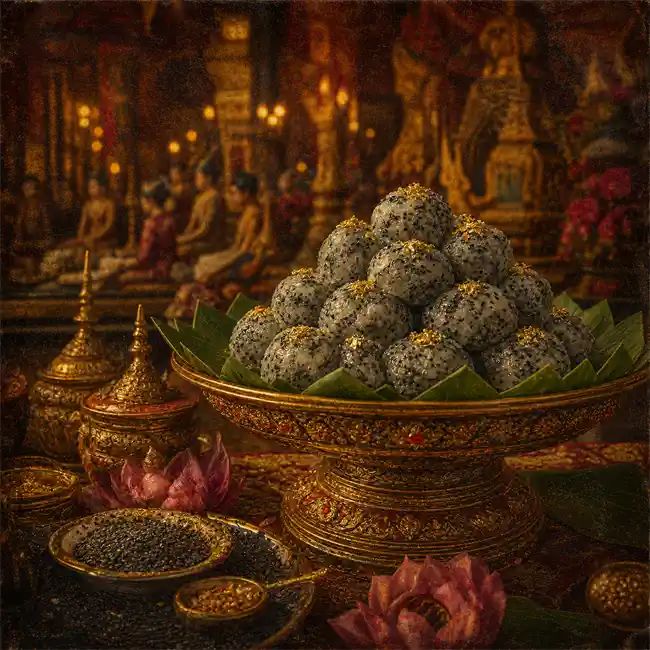
🍘 Recipe: Khao Nom Kuu — The Royal Sticky Rice & Black Sesame Jewels
📖 About this Royal Secret
Khao Nom Kuu translates to “Couple’s Dessert” because they were always served in pairs — two bite-sized cylinders bound with a strip of banana leaf, symbolizing harmony. Court records from King Sisavang Vong’s reign note it as the favored afternoon snack of Queen Khamphoui during poetry readings in the 1930s. Served only between 2–4 PM with hot nam saa herbal tea, it was believed to restore focus and grace. Making it was a test for apprentice chefs: if the rice wasn’t glassy or the sesame cracked, you’d be demoted to chopping firewood.
🥥 Ingredients & The Aristocratic Touch
• The Royal Pantry
The soul of Lao palace snacks lies in restraint. Lan Xang nobility prized aroma over spice, texture over richness. Sticky rice wasn’t just food — it was served in silver tip khao baskets. Black sesame came from mountain plots fertilized with river silt. Coconut cream was pressed fresh hourly, never canned. Even the banana leaves were chosen at dawn for flexibility and fragrance. This recipe honors that ethos: every ingredient has a purpose, a story, and a standard.
• Modern Substitutes
We’ll keep it real — you don’t need a Mekong-side garden. Here’s how to honor the past with what you have:
◦ Black glutinous rice flour: Use Thai or Vietnamese brands. If unavailable, blend regular glutinous rice flour with 1 teaspoon activated charcoal powder for color only, not flavor.
◦ Palm sugar: Coconut sugar works 1:1. Brown sugar is last resort — it lacks the smoky depth.
◦ Fresh banana leaves: Find frozen at Asian markets. In a pinch, parchment paper strips work for binding, but you’ll lose the signature aroma. Steam 1 pandan leaf with the rice to compensate.
◦ Bolaven wild honey: Use raw wildflower honey. Avoid clover honey — too light.
• The Measurements
For 12 pairs, about 24 pieces. Serves 4–6 as a noble snack:
◦ Glutinous rice flour, black variety — 2 cups
◦ Warm water — 3/4 cup plus 2 tablespoons
◦ Palm sugar, finely shaved — 1/2 cup
◦ Toasted black sesame seeds, finely ground — 1/3 cup
◦ Coconut cream, full-fat and well-stirred — 1/2 cup
◦ Sea salt — 1/4 teaspoon
◦ Wild honey — 2 tablespoons
◦ Banana leaves — 6 large leaves, cut into 24 strips of 1 inch by 5 inches, softened over flame
◦ Pandan leaf — 1 fresh leaf, knotted, optional for steaming
🧑🍳 The Chef’s Ritual
1.Awaken the flour. In a wide clay or ceramic bowl, pour the black glutinous rice flour. Make a well in the center. Slowly stream in warm water while mixing with your fingertips. The dough should feel like a soft earlobe — pliable, never sticky. Rest it under a damp cloth for 20 minutes. Palace chefs called this “letting the rice breathe.”
2.Create the sweet heart. In a small brass pan, melt palm sugar with 1 tablespoon water over low flame. Once liquid gold, add ground black sesame and a pinch of salt. Stir until it clumps like damp sand. Off heat, drizzle in honey. Cool until you can roll it. Shape into 24 small marble-sized balls. This is the hua jai — the heart.
3.Wrap the soul. Pinch off a walnut-sized piece of dough. Flatten into a 2-inch disc in your palm. Place one sweet heart in the center. Gently pull the edges up, sealing it like a secret. Roll between your palms until smooth and seamless. No cracks — cracks mean shame in the old kitchen.
4.Steam with respect. Line a bamboo steamer with softened banana leaves. Place the jewels 1 inch apart. Tuck the knotted pandan leaf beside them. Steam over medium heat for 15 minutes, until the skins turn glossy and slightly translucent. The aroma should be nutty, floral, and calm.
5.Bathe in cream. While steaming, warm coconut cream with a tiny pinch of salt until it just shivers — never boil. To serve, place two Khao Nom Kuu on a strip of banana leaf, tie gently, and spoon warm coconut cream over the top. Eat while whispering.
💡 Secrets of the Palace Kitchen
◦ The water test: Palace apprentices dropped a pea-sized dough ball in water. If it floated in 10 seconds, the hydration was perfect. Sinking meant too wet.
◦ Toast sesame yourself: Pre-ground sesame loses oil in days. Toast seeds in a dry pan until they pop, then grind while warm. The aroma difference is aristocratic vs. average.
◦ Never rush the rest: That 20-minute dough rest aligns the starches. Skip it and your skins will tear during steaming. The old chefs would rather delay the Queen than serve a broken cake.
◦ Steam, don’t boil: Boiling makes them waterlogged and dull. Steaming keeps the skin chewy-glassy — the texture that defined nobility snacks.
◦ Mistake to avoid: Using cold coconut cream. The court believed cold cream “shocked the stomach” of nobles. Always serve warm. It also helps the flavors marry.
◦ Banana leaf trick: Pass leaves over an open flame for 3 seconds per side. This makes them pliable and releases a sweet aroma that infuses the cakes. Skipping this is the #1 reason homemade versions taste “flat.”
🤴 Royal FAQ
Q1.Can I make Khao Nom Kuu ahead of time?
Yes, but with care. Steam them, cool completely, then refrigerate up to 2 days. Re-steam for 5 minutes before serving. Never microwave — it turns the skin rubbery. Palace chefs never served day-old snacks, but we adapt.
Q2.My dough keeps cracking when I wrap. Why?
Two reasons: your dough is too dry or your filling is too cold. Add water by 1/2 teaspoon at a time. And let the sesame filling come to room temp before wrapping. Patience is the aristocratic ingredient.
Q3.Is this dessert or a snack?
In Lan Xang court culture, the line blurred. Khao Nom Kuu was served at 3 PM with tea, not after dinner. It’s lightly sweet, meant to refresh, not overwhelm. Think “royal energy bite.”
Q4.Can I use white glutinous rice flour?
You can, but it becomes a different dish. The black rice was tribute from Xieng Khouang and symbolized soil and ancestry. White flour works, but you’ll lose the visual drama and nutty depth nobles expected.
🕰️ The Taste of History
Khao Nom Kuu isn’t loud. It doesn’t hit you with chili or sugar. It unfolds. First, the stretch of the sticky skin. Then the warm rush of sesame-honey heart. Finally, the silk of coconut cream. It’s quiet, deliberate, and balanced — just like the Lao aristocratic code. Eating it is how you remember a kingdom that valued grace over gold.
🌱 Final Thoughts: Bringing History to Your Table
These recipes survived wars, colonization, and silence because someone, somewhere, refused to forget. You don’t need a palace to cook like nobility. You need time, respect for ingredients, and the willingness to slow down. With this guide, you’re not just making a snack. You’re keeping a lineage alive. Your kitchen just became a court.
👑 The Call to Action: The Golden Hook
If you felt that shiver of history in your kitchen today, don’t stop here. The royal archives hold more — lotus stem salads for kings, smoked river-fish wrapped in lemongrass for queens. Join our free “Palace Table” letter. We send one revived aristocratic recipe each month, with the stories empires tried to hide. Because heritage shouldn’t be a secret. Become a keeper of flavor.
🙏 Credit to the Keepers of the Culture: The Legacy
This recipe is inspired by the oral traditions and culinary notes of the Luang Prabang royal kitchens during the Lan Xang era, 18th–20th century. We have carefully adapted the measurements for modern kitchens while preserving its royal soul. Deep gratitude to the elder chefs, cultural archivists, and families of Laos who safeguarded this knowledge through generations. This is not our invention — it’s our privilege to share.
| 🇱🇦 👑🍱 < Back |