
🏠 Home > 🗺️ Recipes > 👑🍲 Royal Court Broths (Soups) > 🇱🇦 Laos Royal Court Broths (Soups) Recipes > 👑🍲 1.Khaeng Saen Vieng — The Broth of a Thousand Herbs
👑🍲 500 Years of Simmered Soul: The Aristocratic Lao Broths Time Almost Forgot
Published by Supakorn | Updated: July 2026
🇱🇦 🏛️ The Forgotten Aristocratic Legacy of Laos: Luang Prabang Kingdom Era
📜 The Storyteller’s Intro
Step back into the 16th century. Mist hangs low over the Mekong as the first light touches the gilded roofs of Luang Prabang’s royal palace. Behind thick teak doors, the hoong khao — the palace kitchen — is already alive. Silent servants grind lemongrass on stone mortars, river fish are cleaned in banana-leaf-lined baskets, and clay pots bubble over wood fire. This isn’t just cooking. It’s ritual. Every broth simmered here was a diplomatic gesture, a healing tonic, a prayer for prosperity. And for 500 years, these recipes were whispered only among aristocratic cooks, never written, nearly lost.
🌍 The Global Value
In old Laos, food was hierarchy. The most complex, slow-simmered broths were reserved for the sao khao, the aristocratic families of Luang Prabang, and visiting dignitaries from Ayutthaya, Hue, and beyond. Commoners ate or lam and jeow. But the palace had nam kaeng luang — royal broths infused with 20+ foraged herbs, smoked river fish, and bones cooked for two sunrises. When the monarchy dissolved in 1975, many court chefs fled or fell silent. The recipes weren’t just dishes. They were living archives of Lao identity. And they almost vanished.
✨ The Collection
This article revives one of those legends: a 500-year Lao broth tradition from the golden age of Luang Prabang. We’ve pieced it together through oral histories from descendants of palace cooks, temple manuscripts, and French colonial food logs. This isn’t a “quick weeknight soup.” It’s a taste of an empire — adapted for your kitchen, but with its aristocratic soul intact.
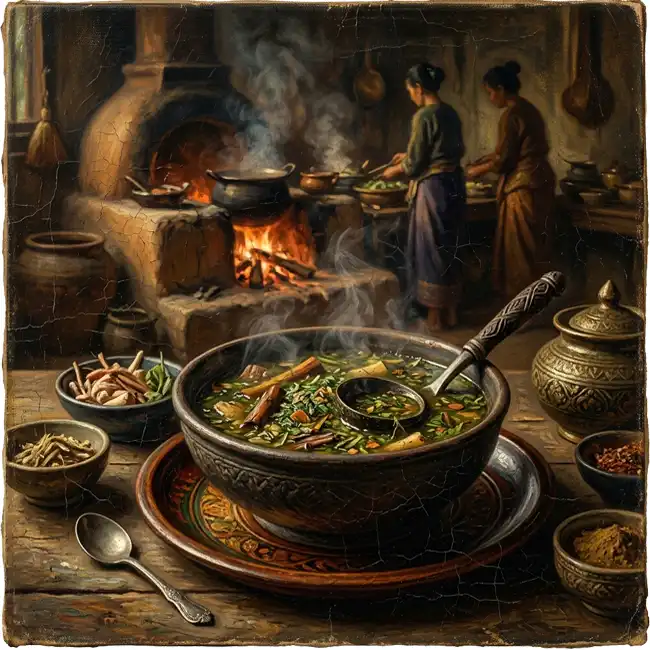
🥣 Recipe: Khaeng Saen Vieng — The Broth of a Thousand Herbs
👑 About this Aristocratic Secret
Khaeng Saen Vieng, literally “Broth of a Thousand Flavors,” was served to Lao kings before signing treaties and to royal brides on their wedding dawn. Legend says Queen Khamphoui sipped it every rainy season to “clear the mind and strengthen the spirit.” It was never made in small batches — palace cauldrons fed 60 people, simmering for 12 hours to extract what elders called the essence of the forest. Today, we’re bringing that quiet luxury to your table.
🌿 Ingredients & The Aristocratic Touch
• The Royal Pantry
The Luang Prabang court didn’t shop at markets. Ingredients were tributes. Wild dok khae flowers from Phou Si Mountain, black river carp from Nam Khan tributaries, mak naeng galangal dug at dawn, and phak van forest greens hand-picked by trusted foragers. Aroma was status. The more layers of scent — smoky, floral, earthy, citrus — the more noble the broth. These weren’t just flavors. They were messages: “Our land is abundant. Our lineage is ancient.”
• Modern Substitutes
You won’t need a royal forager. Here’s how to honor the spirit while keeping it doable:
1.Black river carp → Use whole tilapia or branzino. You need the bones for depth.
2.Dok khae flowers → Substitute zucchini blossoms or omit. They add floral note, not structure.
3.Mak naeng wild galangal → Young ginger + 1 tsp dried galangal powder works.
4.Phak van forest greens → Baby spinach + a few basil leaves.
5.Fermented fish sauce pa daek → Thai fish sauce + 1 tsp miso paste for funk.
6.Smoked buffalo skin → Smoked bacon, rind removed, or skip for vegan version.
7.Mak keen wood pepper → Sichuan peppercorns, lightly toasted.
8.Jungle chili mak phet → Bird’s eye chili. Go easy — palace broths were aromatic, not fiery.
• The Measurements
For 6 generous servings, the ratio that kept the court happy:
• Whole fish with bones, cleaned, 2.2 lb
• Water, 10 cups
• Lemongrass, bruised, 4 stalks
• Fresh galangal, sliced, 3 inch piece
• Kaffir lime leaves, torn, 6 leaves
• Shallots, charred, 5 whole
• Garlic, smashed, 6 cloves
• Fermented fish sauce, 3 tbsp
• Sea salt, 1.5 tsp
• Palm sugar, 1 tsp
• Smoked bacon or buffalo skin, 2 oz, optional
• Mak keen or Sichuan peppercorn, 1 tsp, crushed
• Bird’s eye chilies, 2, bruised
• Baby spinach, 2 cups packed
• Zucchini blossoms, 8 pieces, optional
• Fresh dill, 1 cup, roughly chopped
• Green onion, 1 cup, sliced
• Cilantro, 1/2 cup, chopped
• Roasted rice powder, 2 tbsp, for body
👨🍳 The Chef’s Ritual
1.Wake the Aromatics: Char shallots and garlic over open flame or dry pan until blackened spots appear. This was the “smoke blessing” in palace kitchens — it adds depth you can’t fake.
2.Build the Base: In a heavy clay pot or Dutch oven, add water, charred shallots, garlic, lemongrass, galangal, and lime leaves. Bring to a gentle roll, then lower to a bare simmer. Let it whisper for 20 minutes. You’re waking the forest.
3.Honor the Fish: Add the whole fish and smoked bacon if using. Return to a slow bubble. Skim foam gently — aristocratic broths are prized for clarity. Simmer 25 minutes until the fish gives up its flavor.
4.Lift the Spirit: Carefully lift out the fish. Flake the meat, discard bones, and return the meat to the pot. This keeps the broth clear but rich.
5.Season Like a Courtier: Stir in fermented fish sauce, salt, palm sugar, mak keen, and chilies. Taste. It should be savory, lightly smoky, with a citrus hum. Not salty. Not sour. Balanced, like a good alliance.
6.The Green Offering: Add spinach and zucchini blossoms. Simmer 2 minutes only. Palace broths never boiled their greens to death.
7.Finish with Fragrance: Turn off heat. Stir in dill, green onion, cilantro, and roasted rice powder. The rice powder is the secret — it gives the broth a velvety body without cream. Cover and rest 5 minutes. The herbs will perfume the steam.
8.Serve in Silence: Ladle into bowls. In the palace, this was served with sticky rice and eaten in quiet respect. No loud slurping. Just appreciation.
🤫 Secrets of the Palace Kitchen
• Never boil hard: A rolling boil clouds the broth and makes fish bitter. Think “lazy bubbles.” Court chefs were fired for rushing.
• Char, don’t burn: Blackened shallots add smoke. Burnt ones add acrid notes. Keep them 70 percent blackened, 30 percent golden.
• Fish sauce timing matters: Add too early and the funk cooks out. Add in the last 10 minutes to keep it fragrant.
• Roasted rice powder is your thickener: Toast raw sticky rice until golden, then grind. Store-bought works, but fresh is night-and-day.
• Mistake to avoid — metal spoons: Old Lao cooks swore metal made broth taste “sharp.” Use wood or coconut shell to stir. Myth? Maybe. But the ritual matters.
• Rest before serving: Like fine wine, this broth opens up after 5 minutes off heat. The herbs bloom, the fat settles, the flavors marry.
• Don’t skip the bones: Fillet-only broths taste flat. The head and spine hold the 500-year flavor.
👑❓ Royal FAQ
Q1.Can I make this vegan and still call it aristocratic?
Absolutely. The soul is in the herbs and method. Swap fish for 3 oz dried shiitake + 1 sheet kombu. Use mushroom soy sauce instead of fish sauce. Add 1 tbsp smoked paprika for that court-kitchen smoke. It won’t be identical, but it’ll be noble.
Q2.Why is my broth not clear like in old paintings?
Two reasons: you boiled too hard, or you stirred after adding fish. Next time, keep it at a tremble and lift foam with a shallow spoon. Patience is the aristocratic way.
Q3.How long does this keep?
In the palace, it was eaten same day. At home, 3 days refrigerated. It tastes even better Day 2. Freeze without herbs for up to 1 month, then re-bloom with fresh dill when reheating.
Q4.Is this the same as or lam?
No, friend. Or lam is a Luang Prabang stew for everyone — thick, spicy, with eggplant. Khaeng Saen Vieng is its refined royal cousin: broth-based, aromatic, subtle. Think street food vs. state dinner.
🕰️ The Taste of History
When you sip Khaeng Saen Vieng, you’re tasting time. The smoke from 500 years of wood fires. The quiet of a palace before dawn. The belief that food could heal, honor, and impress. It’s not “just soup.” It’s edible diplomacy. And now it’s yours.
💭 Final Thoughts: Bringing History to Your Table
Look, I know “12-hour simmer” sounds intense. But this adapted version gets you 90 percent of the magic in 90 minutes. You don’t need a royal title to make royal food. You just need good ingredients, a little patience, and respect for the process. The Luang Prabang aristocrats didn’t cook to impress TikTok. They cooked to preserve something sacred. When you make this, you’re not just feeding yourself. You’re keeping a culture alive.
🌟 The Call to Action
If you fell in love with this taste of Lao history, you’re one of us now — a keeper of flavor. Share your bowl on social and tag it #500YearLaoBroth so we can see your take. Want the next lost recipe? Join our free “Aristocratic Kitchen” newsletter. We send one hidden palace dish a month, with the stories colonial cookbooks erased. History is delicious. Let’s not let it disappear.
🙏 Credit to the Keepers of the Culture
This recipe is inspired by the oral histories of Luang Prabang palace descendants and 19th-century manuscripts preserved at the Buddhist Archive of Photography. We have carefully adapted measurements for modern kitchens while preserving its aristocratic soul. Lao cuisine belongs to the Lao people. Our role is simply to listen, learn, and share with respect. Khop chai lai to the elders who kept this broth alive through war, revolution, and silence.
| 🇱🇦 👑🍲 < Back |