
🏠 Home > 🗺️ Recipes > 👑🍨 Grand Finales (Desserts) > 🇱🇦 Laos Grand Finales (Desserts) Recipes > 👑🍨 1.Royal Sangkhaya Mak-U (The Noble Steamed Kabocha Custard)
👑🍨 The Rebirth of Luang Prabang’s Hidden Sweet: A Journey into Lao Aristocratic Culinary History
Published by Supakorn | Updated: July 2026
🇱🇦 🏛️ The Forgotten Aristocratic Legacy of Laos: The Golden Era of Luang Prabang
To truly appreciate the flavors we are exploring today, we need to take a quick trip back to the historic Kingdom of Lan Xang—the legendary "Land of a Million Elephants." For centuries, Luang Prabang wasn't just a scenic town on the Mekong River; it was the epicenter of high culture, high art, and incredibly sophisticated gastronomy.
The elite families and noble courts of Luang Prabang developed a culinary identity that was worlds apart from everyday village cooking. While the general public enjoyed simple, comforting staples, the aristocratic kitchens focused on painstaking precision, rare ingredients, and visual perfection. Sweets in the noble courts weren't just food; they were symbols of prestige, harmony, and cosmic balance.
📜 The Storyteller’s Intro: A Whisper of Pandan and Steaming Gold
Picture this: It is a humid evening in the mid-19th century. Inside the high-walled compound of a prominent Luang Prabang noble family, the air is thick with the sweet, comforting aroma of freshly cut pandan leaves and rich coconut cream. Charcoal embers glow softly beneath massive bronze steamers. A master chef, whose recipe book exists only in her mind, carefully cracks duck eggs into a polished brass bowl. Every movement is deliberate. She is preparing a delicate pumpkin custard, balancing sweetness and rich creaminess to perfection. This wasn't a dessert made to satisfy a casual craving; it was a culinary masterpiece crafted to impress visiting dignitaries and celebrate sacred royal festivals.
🌍 The Global Value: A Cuisine Kept Behind Closed Doors
For generations, these sophisticated recipes were fiercely guarded secrets. They weren't written down in mass-market cookbooks; instead, they were passed down orally from master chef to chosen apprentice, or kept within elite family journals. When historical shifts changed the political landscape of Laos, many of these noble culinary traditions quietly faded into the background. Some were nearly lost forever as families scattered across the globe. Today, finding an authentic, unaltered aristocratic recipe from Luang Prabang is like finding a rare gemstone. It represents a fragile piece of global food heritage that deserves to be celebrated by foodies everywhere.
🍯 The Collection: Reviving the Crown Jewel of Lao Confectionery
In this deep-dive guide, we are bringing one of the most magnificent historic Lao aristocratic sweets back to life: Sangkhaya Mak-U (The Aristocratic Steamed Pumpkin Custard). This isn't just a regular pumpkin pie or a standard everyday custard. This is a brilliant showcase of texture, balance, and natural presentation. By steaming a rich, velvety egg coconut custard directly inside a whole pumpkin, the historic chefs created a dish that looks like a work of art and tastes like absolute heaven. Let’s look at how you can recreate this exact masterpiece today.
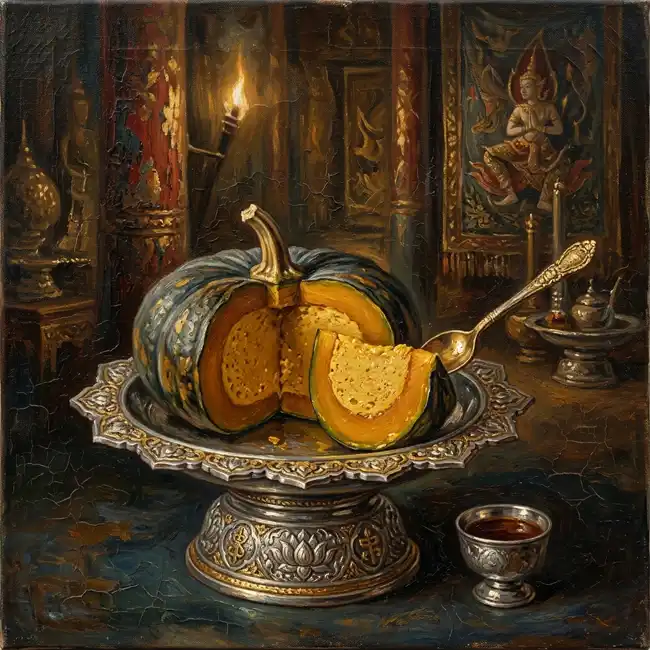
🎃 Recipe: Royal Sangkhaya Mak-U (The Noble Steamed Kabocha Custard)
👑 About this Aristocratic Secret
Sangkhaya Mak-U was the ultimate showstopper dessert at high-society Lao banquets. Historic records and family diaries indicate that this specific dish was a favorite centerpieces for the Baci ceremonies (traditional welcoming rituals) hosted by the elite of Luang Prabang. The presentation of a completely intact, beautifully carved pumpkin that sliced open to reveal a perfectly smooth, flawless custard interior never failed to amaze guests. Serving this meant you possessed both great wealth (as eggs and white sugar were luxury items at the time) and an incredibly skilled kitchen staff.
🥥 Ingredients & The Aristocratic Touch
• The Royal Pantry
In the historic courts of Luang Prabang, sourcing ingredients was a multi-day ritual. Chefs wouldn't just use any coconut; they selected mature coconuts harvested from specific groves near the riverbanks for optimal fat content. The eggs used were premium duck eggs, prized for their rich, dark yolks which gave the custard its iconic deep golden hue and velvety weight. The sugar used was unrefined palm sugar, which lent a complex, caramel-like undertone that modern white sugar simply cannot replicate.
• Modern Substitutes
Don't worry, you don't need to forage along the Mekong River to make this happen today! Here is how you can achieve that authentic aristocratic taste with ingredients from your local store:
◦ The Pumpkin: Authentically, a small, ribbed Kabocha squash (or Japanese pumpkin) is used. It has a beautiful dark green skin and a sweet, nutty flesh that holds its shape perfectly when steamed. Do not use standard Western jack-o'-lantern pumpkins; their flesh is too watery.
◦ The Eggs: If you can find duck eggs at an Asian market, definitely use them for that authentic, ultra-rich texture. If not, high-quality, organic extra-large chicken eggs work wonderfully too.
◦ The Aromatics: Fresh pandan leaves are essential for that signature sweet, herbal fragrance. If you absolutely cannot find fresh or frozen pandan leaves at your local Asian grocery store, you can use a drop of pure vanilla extract, though pandan provides the true Southeast Asian flavor profile.
• The Measurements
Here is the exact ingredient ratio you need for one medium-sized Kabocha squash (serving 4 to 6 people):
◦ 1 whole Kabocha squash (around 1 to 1.2 kilograms)
◦ 4 large duck eggs (or 5 large chicken eggs)
◦ 200 milliliters of high-quality, full-fat coconut cream
◦ 120 grams of premium palm sugar (finely shaved)
◦ A pinch of fine sea salt (approximately 2 grams)
◦ 4 fresh pandan leaves (washed and cut into pieces)
🥣 The Chef’s Ritual
1.Prepare the Vessel: Carefully wash the outside of your Kabocha squash. Using a small, sharp knife, cut a clean hexagon or circle around the stem to create a lid. Gently lift the lid off and set it aside. Using a spoon, meticulously scrape out all the seeds and stringy fibers from the inside of the pumpkin. Be extra careful not to puncture the bottom or sides of the squash. Rinse the inside quickly and flip it upside down on a clean towel to dry completely.
2.The Ancient Whisking Technique: In a large bowl, combine your eggs, shaved palm sugar, coconut cream, sea salt, and the pieces of pandan leaves. Instead of using a modern wire whisk or electric mixer—which introduces too many air bubbles—use your clean hands to bruise and squeeze the pandan leaves together with the liquid ingredients. Massage the leaves into the mixture until the palm sugar is completely dissolved. The friction from the pandan leaves acts as a natural emulsifier while infusing the liquid with a brilliant aroma.
3.Strain for Perfection: Pour the custard mixture through a fine-mesh strainer (or a layer of clean cheesecloth) into a pitcher. This removes the pandan fibers and any bits of egg white chalaza, ensuring your final custard is completely silky smooth without any lumps.
4.Fill the Squash: Place your dried pumpkin into a heatproof bowl that fits comfortably inside your steamer setup (this holds the pumpkin upright and catches it if it softens too much). Slowly pour the strained egg mixture into the pumpkin cavity, filling it up to about 85% full. Leave a little room at the top, as the custard will expand slightly as it steams.
5.The Gentle Steam: Bring the water in your steamer to a rolling boil over high heat, then immediately drop the heat down to low. You want a very gentle, steady steam. Place the bowl containing the filled pumpkin inside the steamer. Leave the pumpkin lid off (place it next to the squash in the steamer to cook separately).
6.Patience and Air Flow: Cover the steamer, but leave a tiny crack open (you can wedge a wooden chopstick under the lid) to allow excess steam to escape. Steam gently for 45 to 55 minutes. To check if it's done, insert a wooden skewer into the center of the custard; it should come out clean, and the custard should have a slight, jelly-like jiggle but not be liquid.
7.The Cool Down: Carefully remove the pumpkin from the steamer and let it cool completely at room temperature. The custard will finish setting as it cools. For the best slicing experience, chill it in the refrigerator for at least two hours before cutting it into wedges.
🤫 Secrets of the Palace Kitchen (Tips & Mistakes)
◦ Avoid the Bubble Trap: Never use a mechanical blender or whisk the egg mixture aggressively. Doing so whips air into the eggs, creating unsightly bubbles and a spongy, porous texture. The ultimate goal of Lao noble kitchens was a solid, glass-smooth custard cross-section.
◦ Control the Heat: The biggest mistake people make is steaming on high heat. If the water boils too violently, the custard will boil inside the pumpkin, causing it to separate, watery, and puff up unevenly. Low and slow heat keeps the eggs velvety.
◦ The Squash Collapse: If you pick a pumpkin with thin walls or steam it for too long, the outer shell can collapse into a sad puddle. Always choose a heavy, dense Kabocha squash, and use a supporting bowl during the steaming process to preserve its shape.
◦ Moisture Control: Wipe away any condensation that gathers on the inside of your steamer lid every 15 minutes to prevent heavy water droplets from falling directly onto the exposed custard surface.
🤴👸 Royal FAQ
Q1: Can I use light coconut milk instead of coconut cream?
A: For an authentic aristocratic texture, you really need full-fat coconut cream. Light coconut milk contains too much water, which will prevent the custard from setting firmly and will ruin the rich, luxurious mouthfeel.
Q2: Why did my custard separate and turn watery?
A: This is almost always caused by excessive heat. When egg proteins are cooked too quickly or at too high a temperature, they tighten up tightly and squeeze out the trapped water. Keep your steamer heat on low.
Q3: How long can I keep Sangkhaya Mak-U in the fridge?
A: It keeps beautifully in an airtight container in the refrigerator for up to 3 days. In fact, many people prefer eating it thoroughly chilled the next day, as the flavors meld together beautifully.
Q4: Can I eat the pumpkin skin?
A: Yes, absolutely! Once steamed properly, the skin of the Kabocha squash becomes incredibly tender, entirely edible, and adds a lovely texture contrast to the creamy interior.
🌾 The Taste of History
When you take your first bite of a perfectly executed Sangkhaya Mak-U, you immediately understand why this dish was kept behind closed palace doors. The earthy, nutty sweetness of the pumpkin flesh blends effortlessly with the rich, caramel-like notes of the palm sugar and the tropical fragrance of the pandan leaves. It’s a beautifully balanced dessert that is never cloyingly sweet, showing the incredible culinary restraint and sophistication of historic Lao noble chefs.
✨ Final Thoughts: Bringing History to Your Table
It is incredibly easy to look at historic recipes and feel intimidated. We often think that because a dish was served to elite noble families in the 1800s, it requires magical skills to recreate today. But that is simply not true. At its core, this traditional Lao sweet relies on patience, respect for the ingredients, and gentle cooking techniques.
By making this dessert in your home kitchen, you are doing something far greater than just baking a sweet treat; you are actively keeping a piece of forgotten global art alive. You are honoring the anonymous master chefs of Luang Prabang who poured their hearts into perfecting these flavors centuries ago.
📢 The Call to Action
If you fell in love with the rich history and delicate flavors of this recipe, don't keep the secret to yourself! Share this guide with your fellow food-loving friends, leave a comment below telling us how your pumpkin turned out, and subscribe to our newsletter for more deep dives into the world’s most fascinating, forgotten culinary traditions. Let’s protect and celebrate historic food culture together, one delicious bite at a time.
🕯️ Credit to the Keepers of the Culture
This recipe is deeply inspired by the preserved oral culinary traditions and historic family archives of the Luang Prabang aristocratic community. We have carefully calibrated the ingredient measurements and cooking methods for modern home kitchens while treating the authentic cultural heritage, spirit, and soul of traditional Lao gastronomy with the utmost respect.
| 🇱🇦 👑🍨 < Back |