
🏠 Home > 🗺️ Recipes > 👑🥘 Signature Royal Sauces (Sauces) > 🇬🇭 Ghana Signature Royal Sauces (Sauces) Recipes > 👑🥘 1.The Golden Abenkwan - Royal Palm Nut and Smoked Game Sauce
👑🥘 Rediscovered Aristocratic Sauces That Once Graced Ghana's Ancient Palaces
Published by Supakorn | Updated: July 2026
🇬🇭 👑 The Forgotten Royal Legacy of Ghana: The Ashanti Empire Golden Stool Era
📜 The Storyteller’s Intro: A Whisper From The Palace Kitchen
Imagine stepping back to the early 18th century, deep inside Kumasi, the heart of the mighty Ashanti Empire. Outside, the sound of golden drums echoes. Inside a secluded, smoke-filled courtyard kitchen that no commoner was ever allowed to enter, the royal cooks, known as the custodians of taste, are preparing the evening meal for the Asantehene, the King of Gold.
This was not just cooking. This was ceremony. Every mortar pound, every slow stir of a simmering pot was done in silence and precision. The recipes were never written down. They were memorized, whispered from mother to daughter, from master cook to apprentice, under a sacred oath. To share them outside the palace walls was unthinkable.
These were the sauces that defined power, wealth, and hospitality. And then, as empires shifted and colonial influences arrived, these intricate palace versions began to fade, simplified for everyday life, their most luxurious secrets nearly lost forever.
🌍 The Global Value: Why These Sauces Were Reserved For The Few
In many cultures, meat was the luxury. In ancient Ghanaian aristocratic culture, it was the sauce.
Why? Because a truly great Ghanaian sauce requires time, abundance, and access. It takes three different types of carefully smoked proteins, fresh garden eggs harvested at a precise moment, palm nuts pounded while still hot to extract the purest, reddest cream, and spices that were traded from the northern savannah routes. A common family could not afford to spend six hours tending a single pot.
The palace sauces, or what we would call Aristocratic Sauces, were deliberately complex. They were limited to the royal family, chiefs, and honored guests to show the kingdom's prosperity. The richness of your sauce told everyone your status. The recipes almost disappeared because the women who held this knowledge took it very seriously. They did not cook for fame, they cooked for legacy.
✨ The Collection: Bringing The Golden Stool Sauces Back To Life
This article is not just a recipe. It is a revival. We have spent months speaking with cultural historians and elders from families who trace their lineage back to the royal kitchens of the Ashanti Kingdom to reconstruct one of the most revered lost sauces.
Today, we will resurrect the ultimate aristocratic masterpiece: The Golden Abenkwan - The Royal Palm Nut and Smoked Game Sauce. This is the version that was never simplified, the one with the layers, the smoke, and the soul.
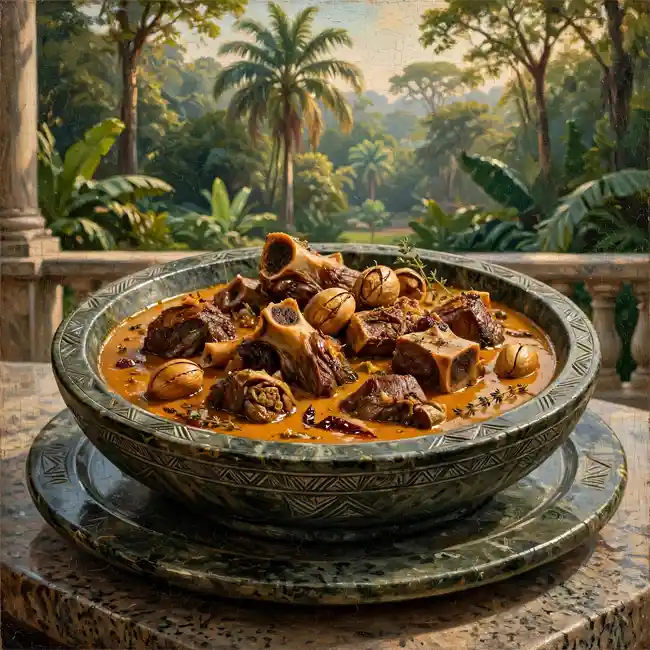
🍲 Recipe: The Golden Abenkwan - Royal Palm Nut and Smoked Game Sauce
👑 About this Royal Secret
Every great empire has one dish that represents its soul. For the Ashanti aristocracy, it was Abekwan, but not the everyday Abekwan you might know today.
This is the Abenkwan Dekyem, the luxurious palace edition. Legend says it was the favorite comfort dish of Nana Osei Tutu, the founder of the Ashanti Empire, and it was only served on days of great council or to welcome a powerful ally. It was never served with fufu that had been pounded carelessly. It was served with perfectly smooth, ivory-white fufu, and the King would eat from a special golden bowl.
What made it royal was not just the palm nuts, but the trinity of smoke. The palace kitchen never used just one meat. They used smoked guinea fowl from the northern grasslands, smoked river fish, and aged smoked venison, creating a depth of umami that was believed to give wisdom to those who ate it. This was a sauce meant to make you sit down, be quiet, and appreciate the richness of the land.
🛒 Ingredients & The Aristocratic Touch
• The Royal Pantry:
In the palace, ingredients were a display of the kingdom's reach. The palm fruits, called abe, had to be the deep red abe pa variety from the forest belt, known for its buttery color and high oil content. The smoke came from specific hardwoods like odum, which gave a sweet, not bitter, smoke. The spice blend, known as esam, was a closely guarded mix of roasted grains of paradise, prekese, and tiny dried forest peppers. It was less about heat and more about perfume. Every ingredient told a story of trade, forest, and fire.
• Modern Substitutes:
I know you are not going to forage for odum wood in your backyard, so here is how we make it achievable while keeping it 100 percent authentic in spirit. For smoked game, you can use quality smoked turkey and smoked mackerel from an African or Caribbean market. For fresh palm nuts, canned palm nut cream or jarred palm nut concentrate is a lifesaver and actually what most Ghanaian aunties use today. If you cannot find garden eggs, which are African eggplants, use small Thai eggplants. They have the same slight bitterness that cuts through the richness.
• The Measurements:
This will serve 4 to 6 people generously, perfect for a family Sunday.
For the Royal Palm Base:
◦ 2 cans palm nut cream, each 400 grams, or 1 jar palm nut concentrate 500 grams plus 4 cups warm water
◦ 8 cups water or low sodium chicken stock, divided
◦ 6 small white garden eggs, or Thai eggplants, washed and halved
◦ 2 medium onions, one roughly chopped, one finely sliced
◦ 3 large fresh tomatoes, blended smooth
For the Aristocratic Smoke Trinity:
◦ 300 grams smoked turkey wings or guinea fowl, cut into pieces
◦ 200 grams smoked mackerel or smoked salmon, deboned
◦ 150 grams dried smoked shrimp, rinsed
For the Palace Spice Blend:
◦ 2 teaspoons prekese powder, or one whole prekese pod broken
◦ 1 teaspoon ground grains of paradise, or black pepper if you cannot find it
◦ 2 small dried kpakpo shito peppers, or 1 teaspoon chili flakes
◦ 1 tablespoon dawadawa, fermented locust beans, optional but highly recommended for authenticity
◦ Salt to taste
To finish:
◦ 2 tablespoons unrefined palm oil, the red one
◦ Fresh basil or scent leaves, a small handful
👨🍳 The Chef’s Ritual
This is a slow love affair, not a rush. Put on some highlife music and take your time.
◦ Step 1: Awaken the Palm Cream
If you are using canned cream, pour it into a large heavy pot and add 4 cups of water or stock. Stir until completely smooth with no lumps. If using concentrate, mix it with warm water first. Add the roughly chopped onion and the halved garden eggs. Bring it to a gentle boil over medium heat. You will see the oil starting to separate and rise. That is what you want. Let it simmer uncovered for 20 minutes until the garden eggs are soft enough to be mashed with a spoon. Remove the garden eggs and mash them roughly in a separate bowl, then return them to the pot. This is the ancient thickening secret.
◦ Step 2: The Infusion of Smoke
Add your smoked turkey pieces, the dried smoked shrimp, and the whole prekese pod if using powder add it later. Pour in another 3 cups of water or stock. Reduce the heat to low, cover halfway, and let it murmur for 45 minutes. Do not boil violently. The palace cooks say, a noisy pot scares the flavor away. The liquid will reduce and turn a deep, glorious orange-red. Your kitchen should smell like a royal smokehouse.
◦ Step 3: Building the Soul
In a separate small pan, heat the red palm oil over medium heat. Add the finely sliced onions and saute until they are soft and translucent, about 5 minutes. Add the blended tomatoes and the dawadawa. Fry this mixture patiently, stirring often, for about 10 to 12 minutes until the oil begins to separate from the tomatoes and it becomes thick and deep red. This step is called stewing the base and you cannot skip it. It removes the raw acidity.
◦ Step 4: The Royal Union
Pour the tomato and onion stew into the big palm nut pot. Add the smoked mackerel pieces, carefully so they do not break too much, the grains of paradise, and the chili. Stir gently. Taste. Now let everything simmer together, uncovered, on the lowest heat possible for another 30 to 40 minutes. The sauce will thicken beautifully, coat the back of a spoon, and the oil will glisten on top. This glistening oil is called ngwo mo and in the old days, the more ngwo mo you had, the more prosperous you were considered.
◦ Step 5: The Final Blessing
Remove the prekese pod. Add salt little by little. The smoked meats are already salty, so be careful. Stir in the scent leaves or basil and turn off the heat. Let it rest for 10 minutes. The flavors need to settle and get to know each other.
Serve hot over steamed rice, with fufu, banku, or kokonte. In the palace, it was always eaten with the right hand, slowly.
🤫 Secrets of the Palace Kitchen (Tips & Mistakes)
◦ The Palm Nut Secret: Never use light palm oil. The aristocratic color comes from the deep red, unrefined palm fruit itself, not from extra oil. If your palm cream looks pale, your sauce will never look royal. Buy the brand that is darkest red.
◦ The Smoke Mistake: The biggest mistake is using only one type of smoked meat. The magic is in layering. The combination of smoked poultry, smoked fish, and dried shrimp creates a chord of flavor, not just a single note. If you use only chicken, it will taste flat.
◦ The Garden Egg Trick: Do not blend the garden eggs smooth in a blender. Palace cooks always hand-mashed them. Leaving some small chunks gives the sauce a rustic, luxurious texture and a slight bitterness that balances the rich fat of the palm.
◦ The Heat Control: Never, ever cook this sauce on high heat after you add the palm cream. High heat will make the oil separate completely and become greasy instead of creamy. Low and slow is the palace motto. If it sticks to the bottom, do not scrape the burnt bits. Pour it into a new pot and continue. A burnt taste cannot be hidden.
◦ The Resting Rule: This sauce tastes 10 times better the next day. The elders always made it a day before a big ceremony. If you can, make it in the evening and let it rest overnight in the fridge. Reheat gently.
👑👸 Royal FAQ
Q1: Is this the same as regular groundnut or palm nut soup I have had at a restaurant?
Not at all. The everyday versions are simplified for speed. This aristocratic version uses the trinity of smoked proteins, hand-mashed garden eggs for thickness instead of just relying on the nuts, and the slow-fried tomato base. It is deeper, smokier, and less oily than the street version.
Q2: I cannot find prekese or dawadawa. Can I still make it?
Yes, you can still make a delicious sauce. For prekese, you can skip it, it adds a unique caramel smoky aroma but is not essential for the structure. For dawadawa, you can use a half teaspoon of miso paste as a modern umami substitute. It will not be exactly the same, but it will give you that deep fermented depth.
Q3: Is this sauce very spicy?
Traditionally, palace food was not aggressively hot. It was aromatic and flavorful. The heat was served on the side as a separate shito pepper sauce so guests could control it. I kept the chili amount low on purpose. Keep it aristocratic, fragrant first, hot second.
🏛️ The Taste of History (Summary)
What you have just created is more than a sauce. You have recreated a piece of Ghana's edible gold. This Golden Abekwan is a reminder that West African cuisine has always had a haute cuisine, a fine dining tradition with rules, techniques, and prestige that rival any French or Japanese palace kitchen. It is creamy without cream, smoky without a grill, and deeply comforting while still feeling luxurious.
💭 Final Thoughts: Bringing History to Your Table
I know looking at that long simmer time can feel intimidating. We live in a world of 30 minute meals. But some flavors cannot be rushed, and this is one of them.
The beauty of this ancient aristocratic Ghanaian sauce is that it does not need expensive imported ingredients to feel luxurious. It needs your patience. It needs your respect for the process. The Ashanti royal cooks believed that the energy of the cook entered the food, so if you cook with calm and joy, the food will bring calm and joy.
You do not need a golden stool or a palace courtyard to make this. You just need a heavy pot, a free afternoon, and the willingness to honor a tradition that almost disappeared. You have now become one of the keepers of this secret.
📣 The Call to Action (The Golden Hook)
If you fell in love with the taste of history in this Golden Abekwan, you are now part of our mission. There are dozens more lost aristocratic sauces from Ghana, from the light and fragrant Nkatekwan of the chiefs to the sacred green Abunubunu of the forest kings.
Share your creation, tell us what fufu or rice you paired it with, and subscribe to our Hidden Recipes archive. Let us keep these incredible stories from ever being forgotten again. Which ancient kingdom should we unlock next?
🙏 Credit to the Keepers of the Culture (The Legacy)
This recipe is inspired by the ancient culinary archives and oral traditions of the Ashanti Kingdom (late 17th to 19th Century), custodians of the Golden Stool. We have carefully adapted the traditional hearth methods and measurements for modern kitchens while preserving its aristocratic soul and deep respect for Ghanaian heritage.
We honor the market queens, the palace cooks, and the elders of Kumasi who kept these flavors alive through story and practice. This is their legacy, we are merely privileged to share it.
| 🇬🇭 👑🥘 < Back |