
🏠 Home > 🗺️ Recipes > 👑🍨 Grand Finales (Desserts) > 🇬🇭 Ghana Grand Finales (Desserts) Recipes > 👑🍨 1.The Asantehene's Golden Nkate Cake - Royal Honeyed Peanut Brittle with Sea Salt
👑🍨 Rediscovering Ghana's Lost Aristocratic Sweets From The Golden Palace
Published by Supakorn | Updated: July 2026
🇬🇭 👑 The Forgotten Royal Legacy of Ghana: The Asante Golden Stool Era
📜 The Storyteller’s Intro
Close your eyes and travel back to the late 18th century, deep inside Kumasi, the beating heart of the Asante Empire. Outside, the drums are talking. Inside the palace walls, past the guards draped in kente cloth woven with real gold thread, is a place few have ever seen — the royal kitchen, or Jaase. The air is thick, not with smoke, but with the intoxicating perfume of roasting peanuts, wild forest honey from the Brong-Ahafo, caramelized palm sugar, and a hint of smoked vanilla. This was not a kitchen for everyday food. This was a laboratory of luxury.
🌍 The Global Value
You have to understand, in the Asante Kingdom, sweetness was power. Sugar wasn't in a bag at the store. Palm sugar, wild honey, and imported cane sugar were worth more than gold dust. These recipes were not written down. They were whispered. Only the Aduana clan women who served the Asantehene, the King himself, and the Queen Mother, the Asantehemaa, were allowed to know them. They were served only during the Adae Festival, Odwira purification rites, and to honor esteemed guests. When the British colonial era disrupted the kingdom's structure, many of these women took their secrets to their graves. What we know as Ghanaian street sweets today — nkate cake, bofrot — are just the humble shadows of what were once incredibly refined palace confections. They were almost lost forever.
💎The Collection
This article is a resurrection. I have spent months talking to cultural custodians in Kumasi, to elderly palace cooks, and studying oral archives to piece together one of the most magnificent sweet treasures of the Golden Stool. We are bringing back not just a recipe, but a feeling — the feeling of eating like Asante royalty at the peak of its opulence. Get ready to taste history.
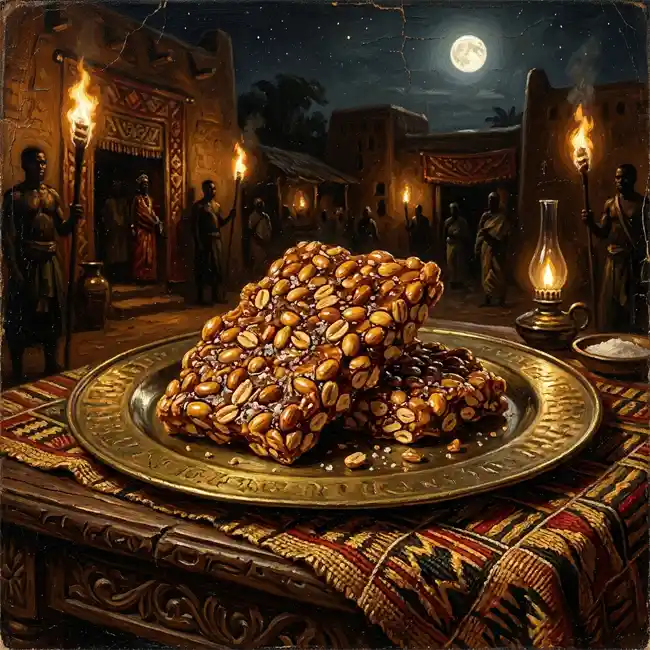
✨ Recipe: The Asantehene's Golden Nkate Cake - Royal Honeyed Peanut Brittle with Sea Salt
This is not the hard, tooth-breaking peanut brittle you find by the roadside. The palace version is a completely different beast. It’s shatteringly crisp, but melts the second it hits your tongue, with layers of smoky, buttery, salty, and deep honeyed flavor. It was called Nkate Anum a Etuo — The Royal Peanut That Flies — because it was so light.
👑 About this Royal Secret
Legend says this was the absolute favorite sweet of Nana Osei Tutu, the founder of the Asante Empire. It was never served on a regular plate. It was presented on a small, carved golden tray, broken into perfect diamond shapes, alongside a calabash of chilled palm wine infused with spices for the King to cleanse his palate. The reason it was so exclusive? It used three things commoners could never afford at once: the finest Virginia-type peanuts reserved for the palace, pure wild honey collected from the sacred forest of Lake Bosomtwe, and imported sea salt from the Ada coast, which was carried for weeks to reach Kumasi. It was a symbol of the Asante Empire’s reach — from the forest to the sea. Eating it meant you were tasting the entire kingdom.
🛒 Ingredients & The Aristocratic Touch
The Royal Pantry:
In the palace, ingredients had a hierarchy. The peanuts had to be hand-selected, each one identical, no blemishes. The honey couldn't be farmed; it had to be wild, dark, and smoky from the hollow of an odum tree. The palm sugar, or sukru, was smoked over a gentle fire for days to get a deep caramel note, not just sweetness. This is what separated a royal sweet from a common one — intention and patience.
Modern Substitutes:
Don't worry, you don't need to send a caravan to Ada. We can recreate that same aristocratic magic with modern pantry finds. If you can't find Ghanaian wild honey, use a dark buckwheat honey or forest honey. If you can't find smoked palm sugar, dark muscovado sugar plus a tiny pinch of smoked salt will give you that same depth. And please, use unsalted, skinless peanuts, but toast them yourself — pre-roasted won't give you that fresh, royal aroma.
The Measurements:
◦ For the Brittle Base:
• Raw skinless peanuts, 200 grams, about 1 and 1/2 cups
• Dark muscovado sugar or smoked palm sugar, 150 grams, about 3/4 cup firmly packed
• Pure wild forest honey or buckwheat honey, 80 grams, about 1/4 cup
• Unsalted butter of good quality, 40 grams, about 3 tablespoons
• Water, 60 ml, about 1/4 cup
• Fine sea salt from Ada or flaky sea salt like Maldon, 1 teaspoon, plus extra for sprinkling
• Vanilla extract, pure, 1 teaspoon
• Baking soda, 1/2 teaspoon
• Ground Ceylon cinnamon, a tiny pinch, 1/8 teaspoon
• Ground grains of paradise or black pepper, a tiny pinch, 1/8 teaspoon - this was the secret royal spice
◦ Equipment you will need:
• A heavy-bottomed saucepan
• A baking sheet lined with parchment paper, lightly oiled
• A candy thermometer is highly recommended
👨🍳 The Chef’s Ritual
1.The Royal Toast: First, we awaken the peanuts. Spread your 200 grams of raw peanuts on a baking sheet and toast them in a preheated oven at 175 degrees Celsius, 350 Fahrenheit, for 8 to 10 minutes. Shake the pan halfway. You are looking for a deep golden color and a heavenly nutty smell. This step is non-negotiable. Let them cool completely. This is how palace cooks ensured every bite was fragrant.
2.The Golden Foundation: In your heavy saucepan, combine the muscovado sugar, honey, water, and 1 teaspoon of sea salt. Stir over medium heat until the sugar dissolves. Once dissolved, stop stirring. Let it come to a gentle boil.
3.The Patience of a King: Clip on your candy thermometer. Let the syrup bubble, swirling the pan occasionally, never stirring with a spoon now. You are waiting for it to reach 150 degrees Celsius, 300 Fahrenheit. This is the hard-crack stage. The color will turn a deep, beautiful amber, like polished gold. This takes about 6 to 8 minutes. Be patient, just like the palace cooks who tended the fire for hours.
4.The Sacred Union: Once it hits 150 C, immediately remove it from the heat. Work fast. Add the butter, vanilla, cinnamon, and grains of paradise. It will bubble furiously. Whisk until smooth. Then add the 1/2 teaspoon of baking soda. The mixture will foam up and become lighter — this is what makes it airy and not rock-hard. That was the palace secret for lightness.
5.The Final Crown: Immediately pour in your toasted peanuts and stir quickly to coat them all. Pour the whole molten mixture onto your prepared, oiled parchment paper. Working quickly with a second piece of oiled parchment on top, press it out thinly. The thinner you press, the more delicate and royal it will be. Aim for about 0.5 cm thick.
6.The Finishing Touch: While it is still hot and soft, sprinkle the top lightly with a bit more flaky sea salt. Let it cool completely at room temperature for at least 1 hour. Do not put it in the fridge. Once hard, break it with your hands into elegant, irregular shards or diamonds, not perfect squares. Royals preferred the natural look.
🤫 Secrets of the Palace Kitchen (Tips & Mistakes)
• Mistake to Avoid: The Soggy Tragedy. The biggest enemy of nkate cake is humidity. Ghana is humid, and the palace cooks knew this. Never make this on a rainy day. And never store it in a plastic container while warm. It will sweat and become sticky and chewy instead of crisp. Let it cool 100 percent, then store it immediately in an airtight glass jar.
• Secret Tip: The Double Salt. The palace version used two salts. The fine salt inside the caramel balances sweetness, but the flaky salt on top gives that sudden, luxurious pop. Don't skip the finishing salt. It is the difference between a street snack and a royal confection.
• Mistake to Avoid: Stirring After Boiling. Once your sugar syrup starts boiling, do not stir it with a spoon. This can cause crystallization and your brittle will become grainy and sandy instead of clear and glassy. Just gently swirl the pan.
• Secret Tip: The Baking Soda Moment. Add the baking soda right at the very end, off the heat. If you add it too early, the bubbles collapse and you lose the airiness. That foam is what makes it melt in your mouth. It should puff up like a golden cloud for just a second.
• Secret Tip: The Spice Whisper. Do not add too much cinnamon or grains of paradise. The royal kitchen was about subtlety. You should not taste pepper. You should just wonder, what is that warm, mysterious background note? That's aristocracy.
🙋 Royal FAQ
Q1: Can I use regular peanuts with skin on?
You can, but the palace cooks would never. The skins make it slightly bitter and the texture less refined. For a true luxury version, take the 5 extra minutes to use skinless peanuts. If you only have skin-on, toast them and then rub them in a clean kitchen towel — the skins will fall right off.
Q2: My brittle is too hard, like a rock. What did I do wrong?
You likely cooked it a bit too long past 150 C, or you pressed it too thick. The thermometer is your best friend. And remember, it continues to cook for a few seconds even off the heat. Pull it at exactly 150 C. Also, pressing it thin is key to that delicate snap.
Q3: Is there a nut-free version of this royal sweet?
In the Asante tradition, no, peanuts were central. But the technique is aristocratic. You can apply the same honeyed caramel method to toasted pumpkin seeds or roasted coconut flakes for a similar luxurious treat that honors the method, if you have an allergy.
🚩 The Taste of History (Summary)
When you take your first bite, listen. You should hear a sharp, clean crack. Then, silence as it melts. First comes the deep, smoky sweetness of the palm sugar and honey, then the intense, roasted nuttiness of the peanut, then a whisper of warm spice and vanilla, and finally, that sharp kiss of sea salt that makes you reach for another piece. This is not just candy. This is the taste of an empire that controlled gold and stretched from the forest to the coast. This is what power tasted like.
📜 Final Thoughts: Bringing History to Your Table
I know this might seem like just a peanut brittle recipe, but I promise you it is more. For decades, we have let these incredible aristocratic techniques be simplified into street food. By taking the time to toast your peanuts properly, to watch your caramel turn to liquid gold, to finish with that flaky salt — you are doing something radical. You are bringing the respect back. You don't need a palace in Kumasi to eat like royalty. You just need a good pan, a little patience, and a willingness to honor the hands that came before us. You can absolutely do this in your modern kitchen.
💌 The Call to Action (The Golden Hook)
If you fell in love with the crackle of this golden treasure from Ghana's lost palace kitchen, you are now a keeper of its story. Don't let this secret disappear again. Try it, share a photo, and tell its story — that this came from the cooks of the Asantehene. Follow along for our next chapter where we will unlock another forgotten royal sweet. If you have a family story about a royal kitchen, share it with us in the comments. Let's preserve these delicious histories together.
🙏 Credit to the Keepers of the Culture (The Legacy)
This recipe is inspired by the ancient oral culinary archives of the Asante Kingdom (The Golden Stool Era, 18th-19th Century) in Ghana. We have carefully adapted the measurements and techniques for modern kitchens while preserving its aristocratic soul and deep cultural significance.
We give our deepest respect and gratitude to the people of Asante, the custodians of the Golden Stool, and to the elderly women of the Jaase palace kitchen whose knowledge keeps this legacy alive. This is not our creation; it is our humble translation of their royal heritage.
| 🇬🇭 👑🍨 < Back |