
🏠 Home > 🗺️ Recipes > 🔥🍗 First Flame Hearth (Primitive Roasted Meats)
🔥🍗 First Flame Hearth: Lower Paleolithic Nutrition & Early Hominid Feasts (300,000 - 2,500,000 B.C.)
Published by Supakorn | Updated: August 2026
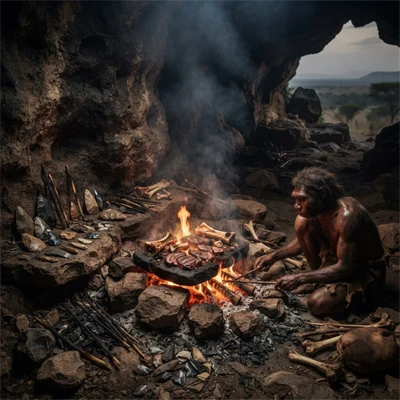
🔥 🦴 The Primordial Hearth: 2.5 Million Years of Early Hominid Survival
Hey friend, welcome to the very beginning. Before farms, before pots, before even modern humans — there was just fire, stone, and hunger. The Lower Paleolithic is not one single period, it's a massive saga of survival stretching from 2.5 million to 300,000 years ago.
We are talking about 3 epic chapters:
• The Oldowan Dawn (2.5M - 1.7M years ago): The first toolmakers. Homo habilis smashing bones with simple choppers. No real fire control yet, just opportunistic scavenging and the first taste of marrow.
• The Acheulean Expansion (1.76M - 500K years ago): The age of Homo erectus. The star of our story. They invent the iconic hand-axe, migrate out of Africa, and learn to keep and finally make fire.
• The Late Lower Paleolithic Transition (500K - 300K years ago): Hearth becomes home. Evidence of true controlled fire at sites like Zhoukoudian and Gesher Benot Ya'aqov. Cooking becomes culture.
Life was raw and real. You lived in limestone caves and savanna rock shelters. Your day was tracking megafauna, avoiding saber-toothed cats, gathering tubers, and keeping that one precious flame alive in the wind. This is where human cooking was born.
🥩 The Evolutionary Power of Early Hominid Carnivore Diets
Ever wonder why our brains got so big? It was meat. Pure, fatty, wild meat.
• Brain Fuel Fat: The savanna was tough, but animal fat and bone marrow were the ultimate superfoods. A single femur of a rhino could provide thousands of calories that no berry could match.
• The Marrow Secret: Early humans were not always the top hunters. They were smart marrow thieves. While lions left, Homo erectus came in with Acheulean hammerstones to crack bones no other animal could open.
• More Calories, Less Chewing: Roasting meat over flame pre-digested it. Less energy spent chewing and digesting meant more energy for brain growth. This is the true root of the ancestral Paleo diet.
🔥 Masters of the First Flame: Savanna Cave Culinary Rituals
This wasn't just eating. This was the first kitchen.
• The Basalt Slab Grill: Find a flat basalt stone, heat it in the heart of the hearth for hours, then sear strips of antelope directly on the screaming-hot rock. Natural, smoky, perfect sear.
• Ash-Baked Earth Treasures: Wild tubers, roots, and cycad rhizomes were buried deep in warm ash. The slow ash-baking removed toxins and turned bitter starch into sweet, soft energy.
• The Circle of Sharing: The fire was a magnet. For the first time, food was brought back to a central place. Meat was shared around the flame, stories were told in grunts and gestures, and humanity as a social species was forged.
🗺️ The Lower Paleolithic Realm Codex: Deep Dive into 3 Hominid Survival Zones
To understand the first menu, you need to know the territory. The taste of meat changed with the land. We have divided the secret codex into 3 rich survival zones.
🦴 1. Great Rift Valley & East Africa (Homo erectus Realm)
🦏 Savanna Sun & Homo Erectus Fire-Roasted Game Feasts
This is ground zero. Olduvai Gorge and Koobi Fora.
• The Signature Dish: Sun-scorched Antelope haunch roasted on open thornwood flame, finished with cracked marrow.
• The Secret Technique: Double-crack marrow extraction. Use the heavy Acheulean cleaver to first break the joint, then a rounded hammerstone to precisely split the shaft without shattering the precious marrow.
• Lifestyle Bite: Life here was nomadic but hearth-centered. Small bands followed the great herds. They mastered fire preservation using slow-burning elephant dung to carry embers across the savanna.
📜 2. Levant & Eurasian Corridor
🐎 Migratory Routes & Eurasian Corridor Bison Marrow Roasts
The great highway. Gesher Benot Ya'aqov, Ubeidiya, and Atapuerca. Where Africa meets Europe.
• The Signature Dish: Eurasian Bison rib rack slow-roasted over oak coals and wild lotus seed mash.
• The Secret Technique: Pit-roasting in loess soil. Dig a shallow pit, line it with hot stones, lay the bison meat wrapped in large oak leaves, and cover it with earth. The meat steams and roasts for hours, becoming incredibly tender.
• Lifestyle Bite: These were the ultimate seasonal migrants. They followed the mega-herds of bison and wild horses through mountain passes. Their diet was the most diverse, mixing large game with the first evidence of roasted wild grains and legumes.
🐉 3. East Asian Caves & Java Ridge (Peking & Java Man)
🦌 Zhoukoudian Hearth & Java Ridge Rainforest Venison Roasts
Deep, dark, and smoky. Zhoukoudian Cave in China and Sangiran on Java.
• The Signature Dish: Cave-hearth Sika deer leg charred directly on the cave fire and rainforest fern rhizome cakes.
• The Secret Technique: The Dome Hearth. Peking Man built thick, layered ash hearths inside the cave that functioned like a primitive oven, holding heat for days. They roasted whole small deer in the smoky dome, creating a natural smoked venison.
• Lifestyle Bite: Life was more settled here. The deep caves protected the sacred fire from monsoon rains. In Java, the diet included freshwater turtles, large fish from rivers, and bamboo shoots roasted until sweet.
🔥❓ Primordial Kitchen Mysteries: Lower Paleolithic Diet FAQ
Q1: Was the Lower Paleolithic diet just all meat?
Not at all, my friend. While meat and marrow were the prized calorie kings, it was about 40-60% gathered food. Think wild tubers, roots, honeycombs, wild berries, and nuts. But meat was what changed everything.
Q2: Why is bone marrow considered so important?
Marrow is pure survival gold. It is almost entirely fat, rich in stem cells and calories, and sealed inside a bone so it stays fresh and safe from bacteria for days. For Homo erectus, it was the original energy bar.
Q3: How did they cook without burning the meat?
They became masters of heat zones. They didn't throw meat in the fire. They used the edge of the fire. Hot stones for searing, warm ash for slow-baking, and smoke for preservation. It was surprisingly controlled.
Q4: How did Homo erectus digest raw-ish meat?
Their guts were stronger than ours, but fire was the game-changer. Even light roasting kills parasites and breaks down tough collagen. It allowed their intestines to shrink and their brains to grow. Fire literally made us human.
🧠 Echoes of the First Flame: Reclaiming Your Untamed Heritage
So here we are, millions of years later, still craving that smoky char, that juicy fat, that feeling of sharing food around a warm light. This wasn't just survival food. It was the cleanest, wildest, most chemical-free nutrition ever.
No processed sugar. No seed oils. No additives. Just fire, stone, and wild earth. The First Flame Hearth is your invitation to remember where you came from.
Ready to taste history? Dive into the full secret recipe scrolls for each cave below and start your own ancestral hearth journey.
🏛️ Credit to the Keepers of the Lower Paleolithic Heritage
This historical category index is compiled from Lower Paleolithic archaeological excavations, fossilized hearth deposits, and Acheulean lithic artifact studies across global prehistoric sites (300,000 - 2,500,000 B.C.). We honor the incredible resilience of early hominids and the dedicated researchers unearthing the origins of human gastronomy.
🔥🌐 Great Rift Valley & East Africa: First Flame Hearth (Primitive Roasted Meats)
👉 🦴 🔥🍗 Turkana Basin & Koobi Fora: First Flame Hearth Recipes
👉 🦴 🔥🍗 Olduvai Gorge & Laetoli: First Flame Hearth Recipes
🔥🌐 Levant & Eurasian Corridor: First Flame Hearth (Primitive Roasted Meats)
👉 📜 🔥🍗 Jordan Rift & Levantine Corridor: First Flame Hearth Recipes
👉 📜 🔥🍗 Caucasus Foothills & Dmanisi: First Flame Hearth Recipes
| 🏠 < Back | Next > 🧉🔥 🌐 |
| Next > 🌐 Recipes | Next > 👑 Royal Recipes | Next > 🏛️ Ancient Recipes |
| Next > 🧊 Prehistoric Recipes | Next > 🔥 Lower Paleolithic Recipes |