
🏠 Home > 🗺️ Recipes > 🔥🍗 First Flame Hearth (Primitive Roasted Meats) > 🦴 Turkana Basin & Koobi Fora: First Flame Hearth (Primitive Roasted Meats) Recipes
🦴 🔥🍗 Turkana Basin & Koobi Fora: First Flame Hearth (Primitive Roasted Meats) Recipes
Published by Supakorn | Updated: August 2026
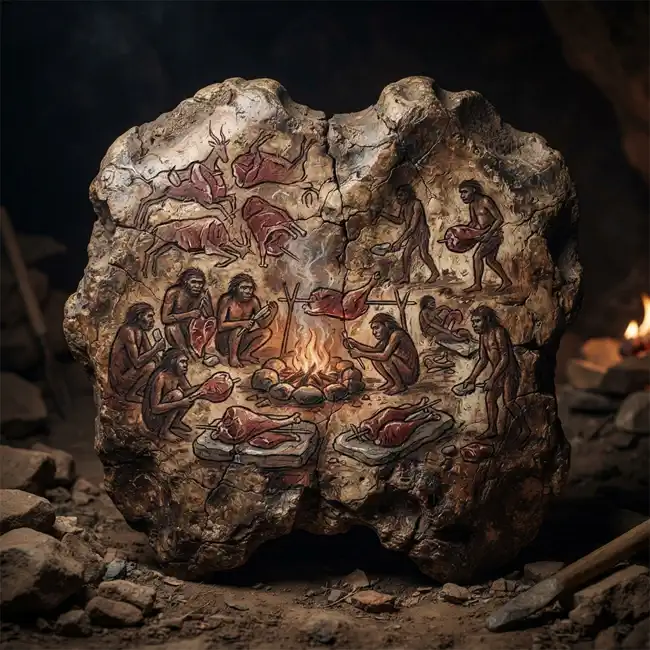
The smell of smoke. The crackle of acacia wood. A circle of early humans huddled close as fat drips and hisses into the flames for the very first time. This is not just cooking, my friend. This is the moment everything changed. Welcome to the Turkana Basin and Koobi Fora, the First Flame Hearth.
If you've ever wondered where our obsession with roasted meat really began, forget the backyard grill. We are going back way, way back to the cradle of human flavor.
🔥 📜 The Primordial Chronicles: 300,000 - 2,500,000 B.C.
Let's set the scene. We are talking about a time span so vast it's almost impossible to comprehend. From 2.5 million years ago to 300,000 years ago, the Earth was a completely different kitchen.
🌍 The Stage: A Harsh, Beautiful Savanna
• The Turkana Basin, in what is now northern Kenya, was not the desert you might picture today. It was a lush, volatile mosaic of open savanna, riverine forests, and shallow, fluctuating lakes. This was the supermarket for our ancestors.
• This region is part of the Great Rift Valley, a giant scar on the Earth that created perfect conditions for preserving bones, tools, and stories. Every flood, every volcanic ash fall, sealed history like a natural time capsule.
• Koobi Fora, on the eastern shore of Lake Turkana, is one of the most important archaeological treasure chests on the planet. It has yielded more evidence of early human life than almost anywhere else.
🧬 The Chefs: Meet Homo Erectus & Early Hominids
• Our main chefs here are not modern humans. We are talking about Homo habilis, the handy man, and more importantly, Homo erectus, the upright human. They were taller, leaner, smarter, and incredibly tough.
• These were not lone wanderers. They lived in tight-knit bands of 20-30 individuals, constantly communicating with grunts, gestures, and watchful eyes. Survival was a team sport.
• Their brains were growing, and fast. From about 600cc to over 900cc during this period. Why? Scientists now believe a huge part of the answer lies right here at the hearth. Cooked food equals more energy, less chewing, faster brain growth.
🔥 The First Spark: Taming the Flame
• For hundreds of thousands of years, fire was something to be feared. It came from lightning strikes and wildfires. Early hominids learned to follow the fire, scavenging animals killed by the flames.
• Then came the revolution at Koobi Fora. Archaeologists have found patches of reddened, baked earth and concentrations of burned animal bones dating back as far as 1.5 million years. This is not wildfire scatter. This is a hearth. A controlled, maintained fire.
• Imagine that first moment. Someone had the courage to pick up a smoldering branch and keep it alive. That act turned them from prey into masters of their environment. The night was no longer filled with predators. It had light, warmth, and the incredible smell of roasting meat.
• The technology that made it all possible was the Acheulean tool kit. Forget crude pebbles. We are talking about beautifully crafted, teardrop-shaped handaxes, cleavers, and scrapers, chipped with precision from basalt and chert. These were the first professional kitchen knives, designed to slice through hide, shatter bone, and butcher megafauna.
🦴 Excavated Hominid Relics & Primordial Ancestral Menus
This is where we get to the good stuff. What was actually on the menu at the First Flame Hearth? We are not guessing. We are reading the evidence left on fossilized bones and ancient stone.
🍖 The Star of the Hearth: Primitive Roasted Meats
• FxJj 20 Main Scavenged & Roasted Antelope Haunch: The most common find at Koobi Fora. Cut marks from stone tools overlaying tooth marks from lions tell us they were bold scavengers and opportunistic hunters. The haunch was placed directly on hot embers, singeing the hair and skin, sealing in the juices. A smoky, intensely gamey flavor.
• Koobi Fora Bone-Shattered Marrow Feast: This is pure Paleolithic energy. After the meat was stripped, the long bones of elephants, rhinos, and hippos were placed on an anvil stone and smashed with a hammerstone. Inside was the ultimate prize - rich, fatty, buttery marrow. Sometimes it was eaten raw, sometimes warmed by the fire until it melted like butter. This was ancient survival food at its finest.
• Savanna Warthog Ember-Roasted Whole: Complete warthog skeletons with charred extremities have been found. This suggests small, whole animals were tossed directly into the ash bed. The skin would char, the fat would render, and the meat inside would steam in its own juices. Simple, primal, and incredibly nourishing.
• Turtle & Crocodile Ash-Baked River Catch: The Turkana lakeshore offered more than meat. Fossilized turtle shells cracked open by tools show that reptiles were flipped onto their backs over hot coals. The shell became its own cooking pot. A primitive and ingenious technique still echoed in hunter-gatherer cultures today.
• Ostrich Egg Stone-Heated Broth: Ostrich eggshell fragments are abundant. These were not just food, they were the first cooking vessels. Water from the lake was poured inside with hot stones from the hearth dropped in, creating a gentle simmer. Roots, wild greens, and scraps of meat were added to make a nutrient-dense broth.
• Ash-Roasted Baobab Tubers & Wild Roots: It was not all meat. Paleobotanical evidence shows thick, starchy tubers were baked directly in the ash. The intense heat broke down indigestible fibers and made them sweet and soft, like a prehistoric baked potato. The original comfort food.
🌿 Fires of the Savanna: Lower Paleolithic Hominid Heritage & Cave Traditions
Life at the First Flame Hearth was about more than just eating. It was about what eating created: culture.
👨👩👧👦 The Social Circle Around the Fire
• The hearth was the first social network. Before fire, everyone ate where they found food and slept where it got dark. After fire, everyone had to come home. The hearth became the center of the band.
• Meat sharing became law. A single antelope could not be eaten by one hominid. It had to be shared, and sharing requires rules, language, and trust. The loudest arguments, the best stories, the first lessons for children, all happened around the glow of the flames.
• The fire also meant protection. For the first time, hominids could stay in one place after dark without fear of leopards and hyenas. They could sleep deeper, dream more, and wake up stronger. This sense of security allowed them to explore further the next day.
🗺️ The Pilgrimage: Where to Feel This History Today
• If this story gives you chills, you can actually walk where they walked. You don't need a time machine.
• Koobi Fora Museum & Research Base, Kenya: Still active today. You can see the actual hearth deposits and stand on beaches littered with stone tools that are over a million years old. You need a permit and a guide, but it is the ultimate foodie pilgrimage to the origin of cuisine.
• Olduvai Gorge, Tanzania: Often called the Cradle of Mankind. The layered cliffs show millions of years of occupation. The museum there displays the evolution from simple Oldowan choppers to elegant Acheulean handaxes. You can see the exact tools used to prepare the menus listed above.
• The Cradle of Humankind, South Africa: Home to the Wonderwerk Cave, which contains evidence of controlled fire dating back 1 million years. The cave itself is a natural cathedral, and standing inside, you understand why the hearth became a sacred place.
• These places are not just piles of rocks. They are our ancestral kitchens, and visiting them connects you to a chain of meals that stretches back 2.5 million years.
🏛️ Echoes of the Dawn Epoch: Rift Valleys & Ancient Cave Corridors
Why did all of this happen here? The answer is written in the landscape itself.
🏜️ The Rift Valley Pantry
• The Great Rift Valley is a 6,000-kilometer-long pantry. Its constant tectonic activity created every type of environment in a small area: lakes full of fish and turtles, savannas full of grazing animals, forests full of tubers and fruits, and volcanic hills full of perfect stone for tools.
• Early humans were not stuck with one diet. They were the ultimate flexible foragers. In the morning they could collect tubers, at noon scavenge a kill from the lakeshore, and in the evening roast it at the hearth. This dietary diversity is key to our success.
• The ancient migration corridors that followed the Rift Valley were the first food highways. As animals moved with the seasons, Homo erectus followed them, carrying with them the knowledge of fire and the Acheulean handaxe. This technology spread out of Africa and eventually into Asia and Europe, carrying the First Flame Hearth tradition with it.
🦴❓ Lower Paleolithic Secrets FAQ: Unraveling Hominid Kitchen Mysteries
Q1.Did eating cooked meat really make us smarter?
Absolutely, and this is one of the most exciting ideas in anthropology. Raw meat and raw tubers require enormous energy to chew and digest. Chimpanzees spend six hours a day chewing. When you roast meat, you pre-digest it. The heat denatures proteins and melts fat. Your gut has to do less work, which frees up massive amounts of energy. That energy was redirected to the most expensive organ in the body, the brain. The control of fire at Turkana Basin is directly linked to the brain growth spurt that made us human. Cooking made us smart.
Q2.How did they get marrow out without metal tools?
With pure, simple physics. They used what archaeologists call the hammer-and-anvil technique. A large, flat basalt cobble was the anvil. The bone was laid on it. Then a heavy, round hammerstone was brought down with force. The bone would spiral fracture, exposing the marrow cavity. The cut marks we find are incredibly precise, showing they knew exactly where to hit to get the most marrow with the least effort. It was a skill passed down for generations.
Q3.Were wild plants from 2 million years ago safe to eat?
Most were not, and that was a hard-learned lesson. The savanna is full of toxic tubers and bitter berries. Early hominids had to become expert botanists. The ash-roasting technique was actually a detoxification method. Many tubers contain harmful compounds that are destroyed by prolonged heat. The hearth was not just for flavor, it was a safety laboratory. Knowledge of which plants to eat, and how to cook them safely, was life-or-death information and was likely held by the elders of the group.
Q4.How do we know it was a real hearth and not just a wildfire?
Great question. Wildfires leave a random, widespread pattern of burned material. A hearth is different in three key ways. First, it is a concentrated, circular patch of reddened, oxidized soil, showing intense heat in one spot. Second, it is surrounded by a ring of artifacts - stone tools, butchered bones, and flaked debris, like a kitchen workspace. Third, the burned bones are clustered together and often show both cut marks and burning, meaning humans processed them before they were burned. At Koobi Fora site FxJj 20, all three are present together. That is not an accident. That is a home.
🧠 Final Thoughts: The Genesis of Human Flavor
So what does a meal from 1.5 million years ago have to do with us? Everything.
When you stand around a barbecue today and watch fat drip into the flames, when you crack open a bone to get to the marrow, when you feel that deep, primal comfort from food shared around a fire, you are not doing something new. You are echoing a ritual that began at the Turkana Basin.
The First Flame Hearth was not about fancy techniques or complex spices. It was about transformation. It turned scavenged meat into a feast. It turned fear of the dark into community. It turned a clever ape into a human.
This was the genesis of human flavor. Raw, smoky, unpretentious, and profoundly real. The original Primitive Roasted Meats were not just survival foods, they were the foods that made survival worth it and made us who we are.
Stick around, because in our next deep dive, we are going to take these excavated relics and reconstruct the actual step-by-step primitive methods, from knapping your own Acheulean cleaver to building your own savanna hearth.
🏛️ Credit to the Keepers of the Lower Paleolithic Heritage
Deep respect and immense gratitude to the researchers of the Turkana Basin Institute, the National Museums of Kenya, and the Koobi Fora Research Project. Their tireless work in one of the harshest environments on Earth has given us the gift of our own story.
This historical overview is compiled and re-interpreted from documented Lower Paleolithic archaeological findings, fossilized hearth analyses, and studies of Acheulean lithic traditions from key sites within the Turkana Basin. We honor the extraordinary endurance of our early Homo erectus ancestors and the brilliant dedication of the archaeologists, paleoanthropologists, and geologists who piece together the dawn of our culinary journey.
🔥🍗 West Turkana Stone-Seared Antelope Ribs: A Journey Into the First Human Feast
👉 Unearth Acheulean Turkana Basin & Koobi Fora First Flame Hearth
| 🌐 🔥🍗 < Back | Next > 🧉 🦴 |