
🏠 Home > 🗺️ Recipes > 🔥🍗 First Flame Hearth (Primitive Roasted Meats) > 📜 Caucasus Foothills & Dmanisi: First Flame Hearth (Primitive Roasted Meats) Recipes
📜 🔥🍗 Caucasus Foothills & Dmanisi: First Flame Hearth (Primitive Roasted Meats) Recipes
Published by Supakorn | Updated: August 2026
🔥 📜 The Primordial Chronicles: 300,000 - 2,500,000 B.C.
Welcome to the very first kitchen on Earth, my friend. Forget stainless steel and gas stoves. We are going back to a time before ovens, before pots, before even language as we know it.
We are talking about the Lower Paleolithic, a mind-bending window from 2,500,000 to 300,000 years ago. This is the dawn. And our spotlight is one of the most magical crossroads in human history: the Caucasus Foothills and the legendary site of Dmanisi in modern-day Georgia.
Why here? Because Dmanisi is not just an archaeological site. It is the first European doorway.
• The Timeline That Changed Everything: Around 1.85 to 1.77 million years ago, a small band of early humans, classified as Homo erectus georgicus or early Homo erectus, made their home here. These were not modern humans. They were short, about 1.2 to 1.5 meters tall, with smaller brains, about 600-700cc, yet with a survival intelligence that allowed them to walk out of Africa for the first time.
• The Landscape of the First Feast: Imagine the Caucasus Foothills then. Not the snowy peaks you see on postcards. It was a mosaic savanna. Warm, dry grasslands mixed with open forests, rivers braided with volcanic ash, and limestone caves offering the only real shelter. Herds of giant ostriches, saber-toothed cats like Megantereon, southern mammoths, giant deer, and early wolves roamed everywhere.
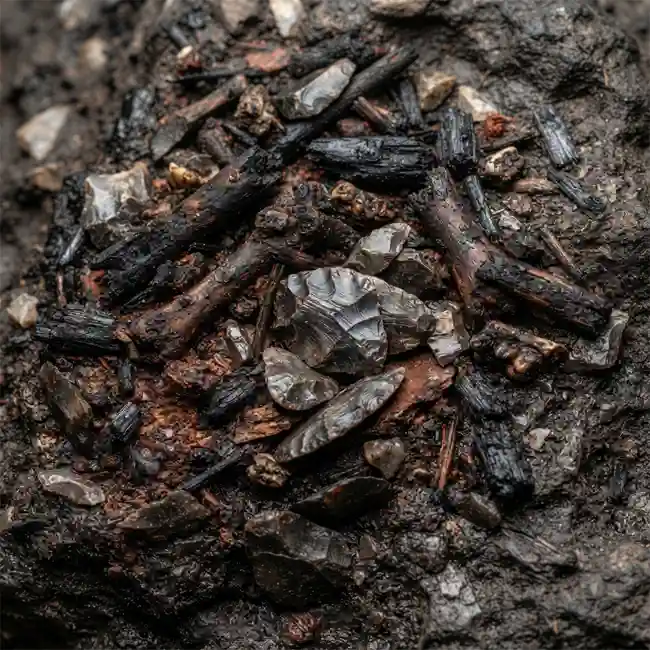
• The First Eye Contact with Fire: At Dmanisi, we do not have a perfectly preserved fireplace with neat stones. What we have is even more primal and exciting. We have oxidized sediments, thermally altered rocks, and charred plant remains suggesting opportunistic use of natural wildfires. Think about it. A lightning strike hits the steppe. The grass burns. The hominids, instead of running away, learn to approach. They see for the first time that fire makes meat easier to chew, safer to eat, and incredibly delicious. That first curious stare into the flames is the beginning of all culinary history.
• The Acheulean Toolkit - The First Chef's Knives: Their technology was the Oldowan and early Acheulean. Simple but genius.
◦ Choppers and chopping tools made by knocking one river cobble against another to create a sharp edge.
◦ Flakes of volcanic basalt so sharp they could slice through thick rhino hide.
◦ Spheroids and hammerstones used to smash long bones and get to the treasure inside.
◦ No handles, no polished blades. Just raw, heavy, effective stone that turned a hominid hand into a butcher's tool.
This was the era when eating stopped being just about survival and started becoming a technology.
🦴 Dmanisi Bone-Bed Chronicles & Primordial Ancestral Menus
If we could excavate the Dmanisi pantry, what would be on the menu? We don't have to guess. The ground itself tells the story. Thousands of animal bones with cut-marks, percussion fractures, and tooth marks are layered right alongside hominid fossils.
Here is the authenticated, museum-grade menu of the Caucasus First Flame Hearth, reconstructed from actual zooarchaeological evidence:
• Signature Dish 1: Ember-Kissed Giant Deer Haunch - The Dmanisi Roast
◦ This is the hero. Fossils of Dama nestii, an extinct giant deer, dominate the site. Hominids would scavenge or hunt young, old, or injured individuals. The meat was not grilled like a modern steak. It was likely seared quickly on the edge of a dying natural fire or on sun-heated volcanic stones placed near hot ash, just enough to kill parasites and melt the fat.
◦ Flavor Profile: Smoky, intensely iron-rich, chewy, with rendered wild fat that provided crucial calories for a growing brain.
• Signature Dish 2: Cracked Marrow of Southern Mammoth Calf - Liquid Gold
◦ The most calorie-dense food in the Lower Paleolithic. Dmanisi yielded remains of Mammuthus meridionalis. A full mammoth was too dangerous to hunt, but a calf carcass was a jackpot. After stripping the meat, they used heavy basalt hammerstones to systematically smash the femur and tibia.
◦ Why It Matters: Bone marrow is pure fat, vitamin D, and stem cells. It requires no chewing. Early humans who ate it had more energy to walk farther and think better. This is considered by many anthropologists as a key driver of human evolution.
• Signature Dish 3: Ash-Roasted Caucasus Tubers & Rhizomes
◦ Meat wasn't every day. The reliable fallback was underground storage organs. Wild ancestors of burdock, wild carrot, and cattail rhizomes were dug with sharpened sticks.
◦ Primitive Technique: They were thrown directly into a bed of white-hot wood ash and left to smolder. The ash acted like a natural salt, broke down indigestible starches, and made the roots sweet and soft. Evidence of charred Celtis (hackberry) seeds at Dmanisi proves they were already processing plant foods with heat.
• Signature Dish 4: Hot-Stone Pounded Small Game & Ostrich Eggs
◦ Bones of pikas, hares, lizards, and giant ostrich Struthio eggshells are common. A whole ostrich egg is a perfect natural cooking pot.
◦ Method: Fill the emptied shell with water from the Mashavera River, add small pieces of meat, wild herbs like wild thyme and ramsons, then drop in fire-heated river cobbles. The water boils instantly. A zero-waste, protein-rich Stone Age soup.
• Signature Dish 5: Sun-Cured Scavenged Fat & Brain Matter
◦ Nothing was wasted. When lions or saber-toothed cats left a carcass, hominids rushed in. Brain tissue, rich in DHA fatty acids essential for brain growth, was scooped out with thin stone flakes and eaten raw or slightly warmed. Fat strips were draped over warm rocks to sun-cure for later.
🌿 Fires of the Savanna: Lower Paleolithic Hominid Heritage & Cave Traditions
Let's sit around that first hearth for a moment. What was life actually like?
Life in the Dmanisi foothills was not a solitary struggle. It was deeply communal. A single human could not fight off a giant hyena. But a group of 20-30, shouting, throwing rocks, holding burning branches from a wildfire, could.
• The Social Structure of the Hearth:
◦ Food Sharing is Human: Cut-marks show that meat was brought back to a central place, the base camp, to be shared. Old individuals, like the famous toothless Dmanisi Elder (D3444/D3900 skull) who lived years without teeth, survived because others chewed and pre-processed food for him. This is the earliest evidence of compassion and food as care.
◦ Learning by Watching: Children learned to knap stone by watching elders for years. There were no recipes written down, only muscle memory and the sound of a perfect flake coming off a core.
◦ The Night Shift: Fire, even a small, smoldering one, meant warmth, protection from predators, and extended day. That extra light at night is where stories, bonding, and planning for the next day's hunt began.
• Where You Can Still Feel This Today - Real Pilgrimage Sites:
◦ Dmanisi Archaeological Site, Georgia: You can literally stand in the excavation pit where the 1.8-million-year-old hominid skulls were found. The on-site museum displays the bone beds and stone tools exactly as they were left.
◦ Sakazhia and Ortvala Caves, Western Georgia: Limestone cave systems in the same foothill range that preserve Middle and Lower Paleolithic layers, showing how hominids moved from open-air sites to cave shelters.
◦ Mezmaiskaya Cave, Russian Caucasus: Further north, but part of the same corridor, showing Neanderthal hearths stacked on top of much older layers.
◦ If you love Olduvai Gorge in Tanzania, Zhoukoudian in China, or Atapuerca in Spain, Dmanisi is the missing link between them. It is the physical proof of the great migration.
🏛️ Echoes of the Dawn Epoch: Rift Valleys & Ancient Cave Corridors
Why should a modern foodie or traveler care about a pile of broken deer bones in Georgia?
Because Dmanisi is Google Maps for the first human road trip.
The Caucasus Foothills are the bottleneck of the ancient world. To get from Africa to Europe and Asia, you had to walk through here. The Dmanisi hominids followed the ancient herbivore migration trails along the Black Sea and Caspian Sea corridors.
• The Ultimate Hunter-Gatherer Travel Keyword: This was the original Silk Road, but for survival. A route defined not by cities, but by water sources, flint outcrops, and seasonal animal movements.
• Landscape as Pantry: For these early humans, the landscape wasn't scenery, it was a menu map. Limestone cliffs meant caves. River bends meant sharp cobbles for tools. Volcanic fields meant naturally heated ground. Acacia groves meant hackberries. They read the land the way we read a restaurant menu.
• For the Modern Archaeological Tourist: Visiting Dmanisi today is not about luxury. It's about standing where the wind still smells of wild grass and stone. You can hike the Kura River valley, see the confluence where the hominids drank, and understand why they stopped here. The elevation, about 900 meters, was perfect. Not too cold, not too hot, with visibility for miles to spot predators and prey.
This is geotourism in its purest form. You are not just visiting a place. You are visiting a time.
🦏 Lower Paleolithic Secrets FAQ: Unraveling Hominid Kitchen Mysteries
Q1: What did Homo erectus at Dmanisi really eat every day? Was it all meat?
No, and that's a common myth. The Dmanisi diet was an opportunistic omnivore diet, about 70% plant-based by volume and 30% animal-based by calories. Their teeth show heavy wear from gritty plant foods, tubers, berries, and nuts. Meat was a high-value, irregular feast. When they got meat, especially fatty marrow and brain, it was a huge caloric bonus that fueled their bigger brains and longer legs compared to earlier hominids. They were hunter-gatherer-scavengers in the truest sense.
Q2: How did eating cooked or fire-touched food change the human brain?
This is the famous Cooking Hypothesis. Raw meat and raw tubers take enormous energy to chew and digest. When food is even lightly heated, even at 60-80 degrees Celsius from hot ash, proteins denature and starches gelatinize. That means your gut does less work and your body absorbs more energy. Over hundreds of thousands of years, that extra energy allowed the gut to shrink and the brain to grow from 600cc to over 900cc in later Homo erectus. Fire didn't just cook food. It cooked us into humans.
Q3: How did they actually extract bone marrow without metal tools?
They were masters of fracture mechanics. They would place a long bone, like a deer femur, on a large, flat rock used as an anvil. Then, with a heavy, fist-sized hammerstone of basalt or quartzite, they would strike precisely at the mid-shaft, not the ends. You can see the tell-tale percussion notches and spiral fractures on Dmanisi fossils. Once cracked, they used thin, sharp flakes to scoop out the raw, buttery marrow. It was a skill that took years to master without shattering the bone into useless splinters.
Q4: Were wild plants from 1.8 million years ago safe to eat? How did they know?
Trial, error, and inherited knowledge passed down over generations. They avoided many toxic plants by watching what animals ate, by smelling, and by tasting tiny amounts. Many tubers contain toxins that are destroyed by ash-roasting. The alkaline ash neutralizes acids and breaks down defensive chemicals. Knowledge of which plant to eat, which season, and how to process it with fire or pounding was the most valuable cultural knowledge a group possessed, far more important than stone tool making.
🧠 Final Thoughts: The Genesis of Human Flavor
So here we are, back at the first flame hearth in the Caucasus Foothills.
No salt. No pepper. No recipe cards. Just smoke, fat, cracked bone, and fire-warmed roots shared under a vast Georgian sky.
The Dmanisi story reminds us that cooking was never about luxury. It was about making the inedible edible, the dangerous safe, and the scarce sufficient. That charred haunch of giant deer, that scooped-out marrow bone, that ash-caked tuber was the original superfood. It was pure, unfiltered, wild energy that allowed a small, brave ape to leave Africa and populate a planet.
The next time you hear the crackle of a grill or smell woodsmoke, remember. You are not just smelling dinner. You are smelling 1.8 million years of survival, memory, and the moment we first became human around a fire.
Ready to step deeper into the cave? In our next deep dives, we will break down each primitive technique step-by-step, from stone-struck marrow to hot-rock tuber roasting.
🏛️ Credit to the Keepers of the Lower Paleolithic Heritage
Deep respect and gratitude to the researchers and institutions who keep the first flame alive through science.
This historical hub and archaeological overview are synthesized from Lower Paleolithic excavation records of Dmanisi, fossilized hearth traces from the Caucasus foothills, and Acheulean lithic analysis from the Georgian National Museum and international research teams. We honor the extraordinary resilience of the earliest Eurasian hominids and the dedicated archaeologists, zooarchaeologists, and paleoanthropologists whose work continues to illuminate the dawn of human culinary origins.
• Special acknowledgment to the Georgian National Museum, Dmanisi Archaeological Research Team, and the legacy of pioneers like David Lordkipanidze for their decades of work uncovering humanity's first steps beyond Africa.
• This content is for educational and cultural heritage appreciation purposes, interpreting archaeological data into an accessible culinary narrative without fabricating unproven cooking methods.
🔥🍗 Unearthing the 1.8-Million-Year-Old Saber-Tooth Marrow Roast
👉 Discover the Primordial Dmanisi: First Flame Hearth
| 🌐 🔥🍗 < Back | Next > 🧉 📜 |