
🏠 Home > 🗺️ Recipes > 🔥🍗 First Flame Hearth (Primitive Roasted Meats) > 📜 Jordan Rift & Levantine Corridor: First Flame Hearth (Primitive Roasted Meats) Recipes
📜 🔥🍗 Jordan Rift & Levantine Corridor: First Flame Hearth (Primitive Roasted Meats) Recipes
Published by Supakorn | Updated: August 2026
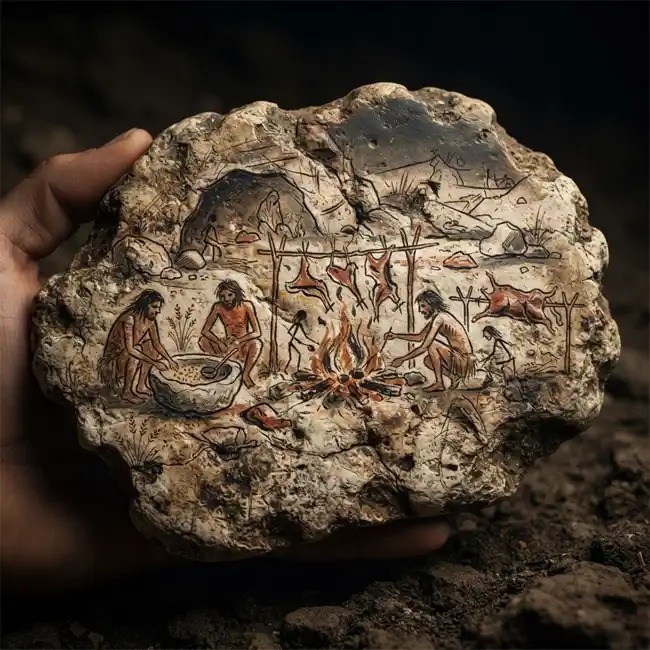
Welcome to the deepest kitchen in human history, my friend. Forget everything you know about recipes, because we are going back to a time before pots, before salt, before farms. We are talking about the Jordan Rift and the Levantine Corridor between 2,500,000 and 300,000 years ago. This wasn't just a place, it was humanity's first great highway and its first restaurant row.
If you have ever stared into a campfire and felt something primal wake up, you are feeling the echo of this exact place and time. This is where wandering bands of Homo erectus and other early hominids first learned to tame fire not just for warmth, but for flavor, survival, and community. Let's dive into the smoke.
🔥 📜 The Primordial Chronicles: 300,000 - 2,500,000 B.C.
Picture this. You are standing in the Great Rift Valley, a colossal scar stretching from Africa right up through the Jordan Valley. To your left is the vast, sun-baked savanna, to your right, cool limestone caves hidden in the Levantine hills. This corridor was the original superhighway for life migrating out of Africa.
• Who Lived Here? This was the undisputed kingdom of Homo erectus, our incredibly tough, clever, long-lived ancestors, alongside early Homo heidelbergensis. They were not the brutish cavemen cartoons show you. They were master survivalists with brains about 60-70% the size of ours, and they invented something that changed everything: the Acheulean handaxe.
• The Technology That Made Dinner Possible: The iconic tear-drop shaped Acheulean handaxe was the Swiss Army Knife of the Lower Paleolithic. One beautifully knapped stone tool could butcher a fallen giant deer, crack open bones for marrow, chop tubers, and defend the group. Without it, there is no feast.
• The First Light That Cooked: For hundreds of thousands of years, humans watched wildfires with terror and awe. Then, somewhere in this corridor, in a place like Gesher Benot Ya'aqov in modern Israel, something shifted. Around 780,000 years ago, we find the earliest undeniable evidence of controlled fire - clusters of burnt flint, seeds, and wood in the same spot, over and over again. They weren't just borrowing fire from lightning anymore. They were keeping it alive. They were bringing it home to the cave. That first deliberate hearth was the Big Bang of cuisine.
🦴 Unearthed Hearth Relics & The First Roasted Meat Menus
Archaeologists don't find recipe books, they find clues. Burnt bone fragments, cut marks under a microscope, ash layers as old as mountains. And from those clues in the Jordan Rift and Levantine caves, we can reconstruct the most ancient menu board on Earth. This is not fantasy, this is forensic gastronomy.
Here are the star dishes that actually left their mark in the soot:
• 🔥 The Signature: Ember-Kissed Aurochs & Giant Deer Haunch: The ultimate trophy meal. Evidence from 'Ubeidiya, Israel (approx. 1.5 million years old) and Gesher Benot Ya'aqov shows massive herbivores like extinct aurochs, giant deer, and ancient elephants were butchered. The meat wasn't grilled like a modern steak. It was placed directly on hot stones and smoldering embers inside the hearth pit. The outside would char instantly, sealing in blood and juice, while the inside stayed rare and warm. The char itself was a flavor and a preservative.
• 🦴 The Survival Superfood: Stone-Cracked Marrow & Brain Extract: This was the most prized, calorie-dense food for early humans. Long bones of rhinos and bovids were smashed open with heavy hammerstones to reveal the glowing, fatty marrow inside. Skulls were carefully opened for the brain. These were often eaten raw immediately after a kill, or gently warmed by the fire's edge. This fat is what fueled the massive growth of our brain.
• 🌰 The Hidden Staple: Ash-Roasted Wild Tubers & Rhizomes: Meat gets the glory, but plants kept them alive. Charred remains of wild barley ancestors, acorns, and deep-rooted tubers have been found in hearths. The technique? Throw them directly into the ash. The ash acts like a natural oven, slow-roasting them while leaching out bitter tannins. Soft, smoky, and starchy.
• 🥚 The Opportunist's Prize: Fire-Sealed Ostrich Eggs & Small Game: Piles of tortoise shells with burn marks, hare bones, and ostrich eggshell fragments tell a story of daily foraging. Small game would be tossed whole onto the coals, feathers and all, then peeled. Ostrich eggs were the Stone Age canteen - a hole punched at the top, contents slurped or mixed with hot stones to scramble inside the shell.
• 🍃 The Stone-Boiled Infusion: Hot-Rock Woodland Broth: No pots? No problem. Early humans used tightly woven skin bags or hollowed-out large herbivore stomachs filled with water, then dropped in fire-heated stones. The water would boil in seconds. Into it went wild herbs like wild thyme, sage, and mallow leaves, plus bone fragments and scraps. The result was a smoky, gelatin-rich, mineral-packed primitive broth. It is the ancestor of all soups.
🔥 Why This Menu Matters For Your Ancient Soul
• Zero processing, zero waste philosophy - every part of the animal and plant was used
• The original high-protein, high-fat, nose-to-tail diet that shaped our DNA
• Fire unlocked 3x more calories from the same food, which is why we outlasted other hominids
🌿 Fires of the Savanna: Lower Paleolithic Hominid Heritage & Cave Traditions
Life back then was not solitary. It was all about the circle. The hearth was the first social network, the first living room, the first school.
• The Circle of Flame Ritual: As the sun set over the savanna, the band - maybe 20-30 individuals of all ages - would huddle around the low, smoky fire in the mouth of a cave. The elders, who kept the fire knowledge, were the most respected. Meat was shared strictly by status and need, children and nursing mothers first. Stories, warnings, and tool-making lessons happened in the flickering light. The hearth was security from lions and hyenas.
• Hunt, Scavenge, Share - The Daily Grind: There was no daily grocery run. Mornings were spent tracking. Homo erectus was an endurance hunter - they would literally jog a gazelle to exhaustion under the Levantine sun. They were also power-scavengers, using numbers and noise to chase lions off a fresh kill. Everything was brought back to the hearth to be divided. This cooperation is the root of human culture.
• Where You Can Still Feel It Today - Real Travel Destinations:
◦ Gesher Benot Ya'aqov, Israel: The holy grail of early fire. Walk the Jordan River banks where the oldest controlled hearths in Eurasia were found. The museum displays the actual clusters of burnt flint.
◦ 'Ubeidiya Prehistoric Site, Jordan Valley: One of the earliest human sites outside Africa. You can see the savanna landscape that Homo erectus saw.
◦ Qesem Cave & Tabun Cave, Israel: Part of the Nahal Me'arot UNESCO World Heritage site. These caves show the later evolution of that first hearth into organized, deep cave living with distinct cooking zones.
◦ Azraq Oasis, Jordan: An ancient green jewel in the desert that served as a vital water stop for migrating herds and humans. Perfect for understanding the corridor route.
🏛️ Echoes of the Dawn Epoch: Rift Valleys & Ancient Cave Corridors
If you are a traveler who loves to feel history under your boots, the Jordan Rift and Levantine Corridor is not just a trip, it is a pilgrimage.
This is geo-tourism at its most profound. You are hiking the same limestone corridors that early humans used to cross continents. Think about these keywords when you plan: Ancient Human Migration Trails, Prehistoric Cave Dwellings Jordan, Early Human Fire Sites Israel, Rift Valley Archaeological Trek.
• What to Look For: Look for the layered ash - called anthropogenic sediment. Look for the dark, sooty ceilings of shallow caves. Look for the scatter of Acheulean handaxes on a wadi floor. Guides in the region now offer "First Fire" experiences where they demonstrate how to knap flint and keep a reed-fueled fire alive for hours, just like it was done 780,000 years ago.
• The Vibe: It is silent, vast, and incredibly spiritual. Standing in a cave that sheltered humans for half a million years, with blackened rocks still in place, you realize that our desire to gather, cook, and tell stories over fire is not a habit. It is an inheritance.
📝❓ Lower Paleolithic Secrets FAQ: Unraveling Hominid Kitchen Mysteries
Q1.Was the early human diet all meat?
Was it like modern keto?Not at all, friend. This is a huge myth. The Jordan Rift menu was what scientists call "broad-spectrum." Meat and marrow were the high-value prize, but up to 60-70% of daily calories often came from gathered foods - tubers, nuts, wild seeds, fruits, and honey when they could find it. It was high-fat when they had a kill, high-fiber and plant-based when they didn't. It was about flexibility, not a single diet rule.
Q2.How did eating cooked food make our brains bigger?
This is my favorite part. Raw food takes enormous energy to digest. Cooking is essentially pre-digestion outside the body. Roasted meat and ash-baked tubers gave Homo erectus way more calories for less digestive work. Plus, rendered animal fat and marrow are pure fuel for brain tissue. The energy saved from the gut was re-routed to grow the brain. The hearth literally built the modern human mind. We are who we are because someone learned to roast.
Q3.How did they get marrow out without metal tools?
With brutal elegance. They used a large, flat stone as an anvil and a round, heavy cobble as a hammerstone. The long bone was placed on the anvil and struck at a precise angle near the middle. A skilled hominid could crack it clean in one or two blows. We find thousands of these hammerstones with tiny pits from repeated use. The marrow was then scooped with fingers or a thin flint flake. No waste.
Q4.Were wild plants safe? Didn't they eat poisonous stuff?
They absolutely had to be botanical geniuses. Knowledge was passed down for generations about what to eat, what to roast to remove toxins, and what to avoid. Many wild legumes and acorns are toxic raw but become edible after roasting in ash and leaching in water. The elderly women of the band were likely the walking encyclopedias of this life-saving plant knowledge. One mistake could be fatal, so this knowledge was sacred.
🧠 Final Thoughts: The Genesis of Human Flavor
So here we are, at the end of our time travel. The Jordan Rift and Levantine Corridor wasn't just about survival. It was the first time a creature looked at fire and saw not danger, but dinner, not darkness, but home.
The crackle of fat hitting hot stone, the earthy smell of tubers baking in ash, the shared silence of a band watching flames dance on a cave wall - this is the genesis of all flavor, all family dinners, all restaurants. Every barbecue you have ever been to is an echo of this first flame hearth.
This food was raw, smoky, bloody, and real. No artificial anything. Just fire, stone, and gratitude for the day's hunt. It reminds us that deep in our blood, we still crave that simplicity.
Stay hungry for history, my friend. In our next deep dive, we will actually reconstruct one of these primitive hearth recipes step-by-step, with safe modern methods you can try in your own backyard pit.
🏛️ Credit to the Keepers of the Lower Paleolithic Heritage
This culinary chronicle is built with deep respect for the tireless work of the archaeologists, geoarchaeologists, and anthropologists of the Israel Antiquities Authority, the Hebrew University of Jerusalem, and the Jordanian Department of Antiquities. We especially honor the excavation teams of Gesher Benot Ya'aqov and the UNESCO Nahal Me'arot Caves, whose discovery of fossilized hearths and Acheulean lithic assemblages illuminated the dawn of human cooking.
"This historical hub and culinary overview is curated from Lower Paleolithic excavation data, fossilized hearth residues, and Acheulean tool-use studies across the Jordan Rift and Levantine Corridor. We pay tribute to the endurance of early hominids and to the field researchers who continue to reveal how fire forged our shared human taste."
🔥🍗 How Homo Erectus Cooked: The 1.4-Million-Year-Old Fallow Deer Roast
👉 Unearth Rare Jordan Rift & Levantine Corridor: First Flame Hearth
| 🌐 🔥🍗 < Back | Next > 🧉 📜 |