
🏠 Home > 🗺️ Recipes > 🔥🍗 First Flame Hearth (Primitive Roasted Meats) > 🦴 Olduvai Gorge & Laetoli: First Flame Hearth (Primitive Roasted Meats) Recipes
🦴 🔥🍗 Olduvai Gorge & Laetoli: First Flame Hearth (Primitive Roasted Meats) Recipes
Published by Supakorn | Updated: August 2026
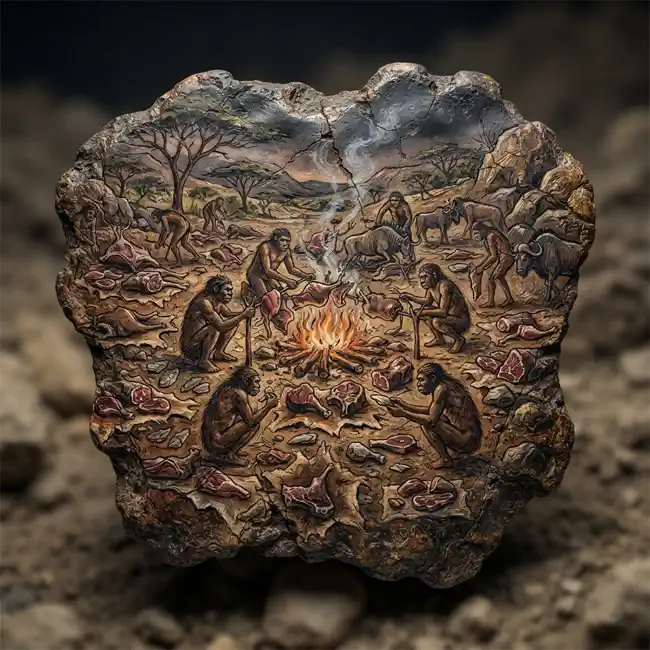
🔥 📜 The Primordial Chronicles: 300,000 - 2,500,000 B.C.
Imagine stepping back through the mists of time into a world untamed, raw, and roaring with wild vitality. Between 300,000 and 2,500,000 years ago, during the vast expanse of the Lower Paleolithic epoch, the East African Rift Valley was not just a breathtaking landscape—it was the biological and cultural crucible of humankind. Here, across the golden, sprawling savannas and rugged limestone outcrops of modern-day Tanzania, early hominids like Homo habilis and our daring, upright ancestor Homo erectus embarked on an extraordinary evolutionary journey. This wasn't merely about surviving; it was about transforming from vulnerable scavengers into master strategists of the ancient wild.
Picture the African landscape millions of years ago. Colossal prehistoric megafauna—giant elephants, prehistoric buffaloes with massive sweeping horns, saber-toothed cats, and agile ancestral antelopes—roamed the lush floodplains surrounding ancient paleolakes. Survival required quick thinking, sharp senses, and seamless group communication. In this high-stakes environment, our ancestors developed groundbreaking technology: the Acheulean stone tool kit. Crafting double-faced tear-drop handaxes from volcanic basalt and quartz wasn't just a technical skill; it represented a massive leap in cognitive evolution. These primitive handaxes became the ultimate multi-tools of the prehistoric world, perfect for butchering game, cracking open heavy marrow bones, and digging up nutritious underground tubers.
Yet, the ultimate turning point in our species' chronicle occurred when early hominids first engaged with fire. Long before controlled, built hearths became standard campsites, early humans witnessed the terrifying yet thrilling force of wild savanna fires sparked by lightning strikes. Instead of fleeing in panic, curious early hominids approached the smoking embers. They discovered something revolutionary: animals trapped in the blaze yielded meat that was tender, intensely flavorful, easy to chew, and far easier to digest.
This dramatic shift from consuming raw, tough tissues to savoring fire-kissed roast meats lit the sparks of modern humanity. Cooking acted as an external metabolic engine. By pre-digesting complex proteins and fats over heat, our ancestors unlocked a massive flood of dense caloric energy. This nutritional windfall fueled the dramatic expansion of the hominid brain while simultaneously shrinking the energy-demanding digestive tract. Around the flickering light of these early open-air hearths in Olduvai Gorge and Laetoli, the social fabric of humanity was woven. Gathering around the embers created safe zones protected from nocturnal predators, fostering bond-building, shared visual signals, and the very first primitive storytelling traditions of our ancient kin.
🦴 Relics of the Rift Valley: Excavated Hominid Relics & Primordial Ancestral Menus
When modern archaeologists dig through the deep, stratified sediment layers of Olduvai Gorge and the ash beds of Laetoli, they aren't just uncovering fossilized bones—they are unlocking the world's oldest culinary archives. Microscopic analysis of stone tool wear, cut marks on fossilized animal skeletons, charcoal trace deposits, and dental calculus from ancient hominid remains give us a vivid picture of what was on the menu millions of years ago. Rather than structured culinary recipes in the modern sense, these ancient "menus" represent brilliant, highly opportunistic survival feasts centered around high-energy, nutrient-dense wild resources.
Here is a curated look at the iconic ancestral food traditions recovered from Lower Paleolithic excavation layers:
• Acheulean Ash-Roasted Savanna Ungulate: Deep cut marks made by sharp quartzite flakes on fossilized ribs and limb bones of ancestral wildebeest and prehistoric gazelles reveal systematic butchery. Early hominids placed prime slabs of game meat directly onto glowing acacia embers or hot volcanic stone slates, searing the outer fats while locking in rich, iron-heavy juices.
• Cracked Marrow & Brainstem Delicacy: Long before hunting large animals became routine, early hominids excelled at high-value scavenging. Using heavy basalt hammerstones and anvils, Homo erectus shattered the thick marrow cavities of giant ungulate femur bones and cracked skull bases to extract pure, calorie-rich marrow and brain tissues—a massive boost of essential fatty acids like DHA and EPA that directly powered brain growth.
• Pit-Embers Underground Tubers & Rhizomes: Chemical signatures in fossilized teeth prove that early humans didn't rely solely on meat. They harvested wild savanna roots, starch-heavy tubers, and water lily rhizomes using pointed wooden digging sticks. Smothering these tough roots under hot river gravel and wood ash softened complex carbohydrates, transforming tough wild plants into sweet, comforting primitive staples.
• Wild Ostrich Egg & Avian Feast: Fossilized eggshell fragments found near ancient ash concentrations indicate that early hominids frequently raided wild avian nests. Rich in bioavailable proteins and healthy fats, wild eggs were likely cooked directly in their thick shells near gentle heat or eaten raw during foraging treks.
• Wild Clay & Botanical Infusions: While early hominids lacked pottery or metal kettles, archaeological evidence suggests they used natural basalt rock hollows filled with rain water heated by dropping fire-hot volcanic stones into the pool. Infusing water with wild mint, bark, and mineral-rich clay created soothing, medicinal thermal tonics that aided digestion and rehydrated weary hunters.
• Fires of the Savanna: Lower Paleolithic Hominid Heritage & Cave Traditions
Life during the Lower Paleolithic epoch was defined by an intimate connection with the natural landscape. The daily rhythm of early hominids was governed by sunrise and sunset, seasonal water movements, and the migratory tracks of wild herds. Living in nomadic social groups ranging from 15 to 30 individuals, cooperation was the ultimate survival mechanism. Every member of the band played a crucial role: agile hunters and scavengers scouted the open grasslands, while gatherers collected seasonal berries, wild seeds, bird eggs, and nutrient-rich roots along riverbanks and lake margins.
At the heart of daily life was the communal fire. The hearth was far more than a tool for cooking food; it served as a multifunctional survival sanctuary. In an environment teeming with fearsome apex predators like giant hyenas (Pachycrocuta) and saber-toothed cats (Homotherium), the bright glow and smoky scent of fire provided an impenetrable defense shield during dark savanna nights.
Around these primordial flames, early hominids shared raw materials, sharpened wooden spears, knapped stone handaxes, and distributed gathered food among the group. This communal sharing of rich roasted meats and extracted marrow reinforced social bonds, reduced intra-group tension, and fostered empathy and cooperative breeding.
For modern travelers, history enthusiasts, and adventure seekers wanting to experience the authentic roots of human heritage, visiting these legendary Lower Paleolithic landscapes in East Africa is an unforgettable journey:
• Olduvai Gorge (The Cradle of Mankind, Tanzania): Situated within the Ngorongoro Conservation Area, this dramatic 30-mile-long steep-sided ravine is one of the most important prehistoric sites on Earth. Visitors can explore the world-class Olduvai Gorge Museum, overlooking the exact geological strata where Louis and Mary Leakey unearthed world-famous hominid fossils (Homo habilis and Paranthropus boisei) along with millions-of-years-old stone tool kits and butchered animal bones.
• Laetoli Footprint Site (Tanzania): Located just south of Olduvai Gorge, Laetoli offers one of the most breathtaking glimpses into early human history. Here, over 3.6 million years ago, three early hominids (Australopithecus afarensis) walked across a wet bed of volcanic ash erupted from the Sadiman volcano. The ash hardened into stone, preserving their remarkable human-like footprints for eternity.
• Zhoukoudian Cave System (China): Across the Asian continent, the famous "Dragon Bone Hill" near Beijing revealed extensive evidence of Lower Paleolithic human occupation, including the iconic remains of "Peking Man" (Homo erectus), along with thick charcoal layers, burned animal bones, and heat-altered stones dating back over 400,000 to 700,000 years.
• Atapuerca Archaeological Site (Spain): Nestled in northern Spain, the caves of Gran Dolina and Sima de los Huesos represent the richest Lower Paleolithic sites in Europe. Discoveries here provide profound insights into early human species like Homo antecessor, showcasing primitive meat butchering, tool creation, and early shelter utilization over 800,000 years ago.
🏛️ Echoes of the Dawn Epoch: Rift Valleys & Ancient Cave Corridors
To truly understand how early human food culture evolved, one must look at the dramatic geological forces that shaped our planet during the Lower Paleolithic era. The formation of the Great Rift Valley in East Africa acted as a powerful evolutionary accelerator. Volcanic eruptions, tectonic shifts, and fluctuating climate cycles transformed dense tropical rainforests into vast, open grassland savannas interspersed with alkaline lakes and river channels.
This shifting environment presented early hominids with both immense challenges and unprecedented opportunities. As dense forest canopy gave way to open terrain, tree-dwelling habits were replaced by bipedalism—walking upright on two legs. Bipedal locomotion freed up hominid hands, allowing early humans to carry stone raw materials over long distances, transport harvested foods back to base camps, and wield protective wooden branches and throwing stones.
The ancient cave corridors and open-air river basins served as biological highways for early human migration. Driven by the constant search for abundant water, seasonal plant harvests, and migrating herds of game, Homo erectus became the ultimate prehistoric explorer. They were the very first hominid species to expand beyond the African continent, trekking across the Sinai Peninsula, spanning the vast corridors of the Middle East, and eventually populating Eurasia—from the sun-drenched valleys of Southern Europe to the lush, riverine landscapes of East Asia.
Every step along these transcontinental migration routes required adaptable survival tactics and flexible dietary strategies:
• Savanna Floodplain Foraging: Navigating seasonal water basins allowed hominids to harvest high-yield aquatic resources, including freshwater clams, turtles, juvenile crocodiles, and catfish trapped in shallow drying pools.
• Limestone Cave Shelters: Natural cave openings provided natural protection against severe weather, cold nights, and predatory beasts, becoming the earliest seasonal base camps where fire technology could be safely maintained.
• Transcontinental Game Tracking: Following megafauna migratory routes across vast continent corridors allowed early hunters to adapt their stone tool toolkits to tackle diverse prey, ranging from steppe mammoths in Europe to wild boars and cervids in Asia.
🔥 Lower Paleolithic Secrets FAQ: Unraveling Hominid Kitchen Mysteries
Q1: How do scientists know that early hominids ate roasted meat millions of years ago if wood and meat don't preserve well?
Answer: While soft tissue and wood decay quickly, archaeologists rely on a powerful combination of indirect physical evidence. Fossilized animal bones discovered at Olduvai Gorge display distinct, microscopic cut marks made by sharp stone tools, often overlapping with gnaw marks from carnivores, proving hominids butchered meat first. Furthermore, high-resolution chemical testing reveals thermal alterations on bone surfaces and localized concentrations of microscopic wood ash, burned seeds, and heat-fractured stones within specific hominid occupation layers.
Q2: What role did bone marrow play in early human brain development?
Answer: Bone marrow was arguably the most crucial survival superfood for early hominids like Homo habilis and Homo erectus. Bone cavities are natural biological vaults that protect rich, lipid-dense fat stores from rotting or being consumed by scavengers with weaker jaws. Marrow is packed with essential fatty acids, vitamins, and high-density calories. By using stone handaxes and hammerstones to crack open large limb bones, early humans secured a clean, nutrient-dense food source that directly fueled brain growth and tissue repair.
Q3: How did cooking with fire physically change human anatomy over evolutionary time?
Answer: The regular use of fire for roasting meat and cooking tough tubers dramatically altered human anatomy. Because fire pre-digests food by breaking down tough collagen fibers and complex plant starches, early humans no longer needed massive, heavy jawbones, large chewing muscles, or giant grinding molars. Over hundreds of thousands of years, hominid faces became flatter, jaws shrank, teeth grew smaller, and the digestive tract shortened significantly. The energy saved from reduced digestive effort was redirected directly to expanding brain capacity.
Q4: Did early hominids consume wild herbs and plants for health or digestive balance?
Answer: Yes, evidence from fossilized dental calculus (calcified plaque on ancient hominid teeth) reveals that early humans consumed a surprisingly diverse variety of wild botanical resources. Beyond starchy roots and wild fruits, early hominids chewed on aromatic wild herbs, bitter roots, tree bark, and mineral clays. Many of these wild plants possessed natural anti-parasitic, antimicrobial, and soothing digestive properties, suggesting early humans possessed an intuitive, observational understanding of their local plant ecosystems.
🧠 Final Thoughts: The Genesis of Human Flavor
Looking back across millions of years at the open-air hearths of Olduvai Gorge and Laetoli, we discover something deeply profound: our modern culinary world was born around those first primitive flames. Long before gourmet spices, complex cooking techniques, or fine dining existed, the simple act of sharing fire-roasted meat and mineral-rich wild foods laid the foundational bedrock of human culture, social connection, and biological evolution.
There is something innately grounding about reconnecting with our ancestral roots. Emphasizing whole, unprocessed foods—rich wild proteins, high-value healthy fats, nutrient-dense organ meats, and natural subterranean starches—aligns closely with the evolutionary blueprint that nurtured our species for millions of years. Stripping away modern synthetic additives and returning to simple, flame-kissed ingredients awakens a primal taste intuition that sits deep within our biological makeup.
As we continue to explore the breathtaking historical landscapes of the East African Rift Valley and uncover new archaeological wonders hidden beneath ancient soils, we honor the incredible resilience, clever adaptability, and spirit of our early hominid ancestors. Stay tuned for our upcoming deep-dive exploration, where we will unlock specific primitive campfire roasting methods, ancestral stone-cooking techniques, and wild botanical pairings inspired by the legendary caves of the Paleolithic world!
🏛️ Credit to the Keepers of the Lower Paleolithic Heritage
This historical overview and prehistoric food culture synthesis are compiled from extensive Lower Paleolithic excavation records, fossilized hearth sediment studies, lithic analysis of Acheulean artifact assemblages, and peer-reviewed anthropological research across global hominid sites. We express our deepest gratitude and respect to the dedicated archaeologists, paleontologists, evolutionary biologists, and local heritage guardians—especially the National Museum of Tanzania and international research teams—whose tireless work continues to illuminate the dawn of human civilization and the ancient origins of human gastronomy.
🔥🍗 The Laetoli Ember: How We Grilled Wild Ostrich Before We Were Fully Human
👉 Unlock Primordial Flame: Olduvai Gorge & Laetoli
| 🌐 🔥🍗 < Back | Next > 🧉 🦴 |