
🏠 Home > 🗺️ Recipes > 👑🍲 Royal Court Broths (Soups) > 🇧🇷 Brazil Royal Court Broths (Soups) Recipes > 👑🍲 1.Imperial Brazilian Golden Broth with Chicken, Roots and Garden Herbs
👑🍲 Rediscovering 200 Years of Aristocratic Brazilian Broth Secrets
Published by Supakorn | Updated: September 2026
🇧🇷 👑 The Forgotten Aristocratic Legacy of Brazil: The Imperial Era
Brazilian food history is far more than a collection of famous modern dishes. Behind the vibrant markets, tropical ingredients, family kitchens, and regional specialties lies a fascinating culinary story shaped by Indigenous traditions, African knowledge, Portuguese influence, immigration, agriculture, trade, and the changing tastes of wealthy households.
During the nineteenth century, especially throughout Brazil's Imperial period, food could become an important expression of hospitality, social position, and cultural identity. Large urban homes and rural estates often maintained elaborate kitchens where cooks transformed local ingredients into refined meals. European culinary ideas mixed with ingredients from Brazil's forests, farms, rivers, and coastlines.
Broths held a particularly interesting place in this culinary world.
A carefully prepared broth could appear simple at first glance, but a clear, fragrant, deeply flavored broth required patience, knowledge, and excellent ingredients. In affluent households, the quality of a broth could demonstrate the skill of the kitchen. Bones had to be simmered gently, vegetables carefully selected, herbs added with restraint, and every ingredient allowed enough time to contribute its flavor.
This is why historic Brazilian broth traditions deserve attention today.
They remind us that luxurious cooking does not always mean complicated cooking. Sometimes, refinement begins with a humble pot, good ingredients, and the patience to let time do the work.
🕯️ The Storyteller's Intro: A Journey Back to the Old Kitchen
Imagine stepping into a Brazilian kitchen nearly two centuries ago.
The morning is still cool. Copper pots hang from walls darkened by years of heat and smoke. Fresh herbs arrive from the garden. Root vegetables are carried in from nearby farms. Poultry, beef, vegetables, and bones are prepared for the day's cooking.
The kitchen is already alive.
Someone chops onions. Another cook washes greens. A large pot begins its slow journey over the heat. There is no rush. A great broth cannot be hurried.
In wealthy Brazilian households, the kitchen was often a place where several culinary worlds met. Portuguese cooking traditions influenced techniques and seasonings. Indigenous food knowledge contributed ingredients and local understanding. African culinary traditions brought powerful methods, flavors, and creativity. Over generations, these influences helped create the diverse food culture we now recognize as Brazilian.
Our journey into forgotten aristocratic Brazil broths is inspired by that historical meeting point.
Rather than pretending that every old recipe belonged to one exact palace or one famous historical figure, this collection celebrates the broader culinary atmosphere of nineteenth-century Brazil: patient kitchens, formal hospitality, regional ingredients, and recipes shaped by generations of cooks.
🌍 The Global Value: Why These Historic Broths Matter
Many historic recipes were never written down in a modern cookbook format.
They were taught through observation.
A cook learned how long to simmer a broth by watching the surface of the pot. They learned when vegetables were ready by touching them. They understood seasoning through experience rather than measuring spoons.
Because of this, many traditional cooking methods risk disappearing.
Some recipes survived in family notebooks. Others continued through regional home cooking. Many evolved over time as ingredients became more available or cooking technology changed.
The value of historic Brazilian broth recipes is not simply about recreating the past exactly. It is about understanding how food connects people across generations.
For centuries, refined meals were often associated with privileged dining rooms, formal gatherings, and wealthy households. Yet the foundations of those meals frequently came from ordinary ingredients grown, raised, harvested, and prepared by local communities.
A broth is a perfect example.
The ingredients may be humble.
The technique can be sophisticated.
The result can be unforgettable.
📜 The Collection: Bringing Forgotten Flavors Back to Life
This article brings together the spirit of historic Brazilian aristocratic cooking through one premium broth recipe designed for the modern home kitchen.
Our featured dish is:
Imperial Brazilian Golden Broth with Chicken, Roots and Garden Herbs
It is inspired by the cooking traditions of nineteenth-century Brazil and by the timeless practice of transforming carefully selected ingredients into a rich, nourishing, aromatic broth.
This is not presented as a verbatim recipe copied from a specific royal archive. Instead, it is a historically inspired reconstruction designed to honor Brazilian culinary traditions while remaining practical, transparent, and enjoyable for modern cooks.
So tie on your apron.
Take out your largest pot.
And let us bring a little taste of history back to the table.
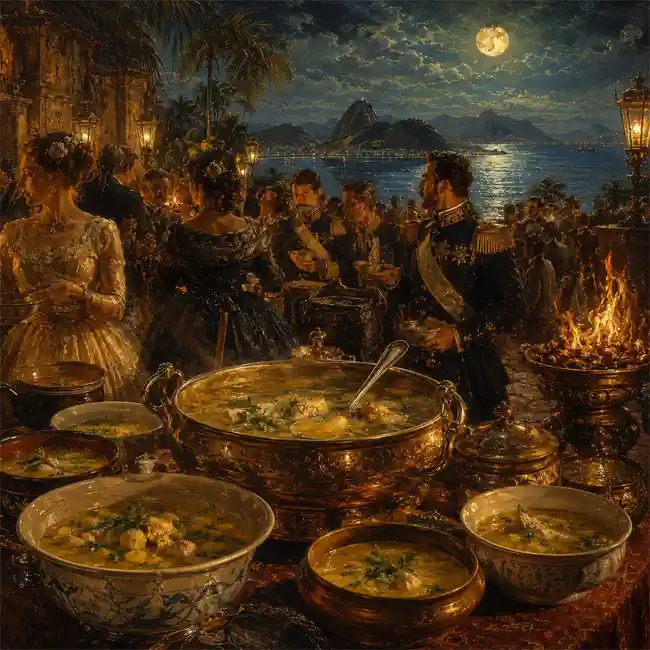
🍲 Recipe: Imperial Brazilian Golden Broth with Chicken, Roots and Garden Herbs
👑 About This Aristocratic Secret
Imagine a formal afternoon meal in nineteenth-century Brazil.
Guests have gathered in a grand residence. The dining table is carefully arranged. The kitchen has been working since early morning. Before the main meal begins, a warm and aromatic broth is served to awaken the appetite.
A broth like this would have represented care rather than extravagance alone.
The finest kitchens understood that great flavor required time. The chicken needed to simmer gently. The vegetables needed to soften without disappearing completely into the liquid. Herbs had to complement the broth rather than overpower it.
Our Imperial Brazilian Golden Broth follows that philosophy.
It combines chicken, root vegetables, onion, garlic, herbs, and gentle seasoning into a clear yet deeply satisfying broth. The ingredients reflect the agricultural richness that has long shaped Brazilian cooking, while the preparation celebrates the slow and patient methods associated with traditional kitchens.
Think of it as comfort food dressed for an aristocratic table.
Elegant enough for guests.
Simple enough for a family dinner.
And rich enough to make your kitchen smell absolutely wonderful.
🥕 Ingredients & The Aristocratic Touch
🏛️ The Aristocratic Pantry
The beauty of this recipe begins with ingredients that might look familiar but become extraordinary when treated with care.
Chicken provides the foundation and body of the broth. Root vegetables bring natural sweetness and color. Onion and garlic create depth. Fresh herbs brighten the finished flavor.
The aristocratic touch is not about using rare ingredients simply for the sake of luxury.
It is about selecting the best available ingredients and respecting every stage of preparation.
Choose fresh chicken.
Use vegetables with good natural flavor.
Avoid rushing the simmer.
Taste as you cook.
That is where the elegance begins.
🔄 Modern Substitutes
You do not need to live near a Brazilian market to enjoy this recipe.
Here are practical substitutions:
• Use chicken thighs and drumsticks if you cannot find a whole chicken.
• Use sweet potato or regular potato if another preferred root vegetable is unavailable.
• Use carrot for natural sweetness and golden color.
• Use celery if you enjoy a more classic aromatic broth profile.
• Use parsley if fresh Brazilian-style herbs are difficult to find.
• Use scallions as an alternative to part of the onion.
• Use fresh garlic whenever possible, but good-quality prepared garlic can work when necessary.
• Use homemade chicken stock only if you want an even deeper flavor, but reduce added salt accordingly.
• Use filtered water when possible for a cleaner broth flavor.
The goal is not perfection.
The goal is balance.
A historic-inspired recipe should still work in a modern kitchen.
📏 The Measurements
For approximately 6 generous servings:
• 1.2 kilograms chicken pieces, preferably bone-in
• 2.5 liters water
• 2 medium onions, roughly chopped
• 5 garlic cloves, lightly crushed
• 3 medium carrots, cut into large pieces
• 2 medium potatoes or sweet potatoes, peeled and cut into large pieces
• 1 small celery stalk, chopped
• 1 medium tomato, roughly chopped
• 2 bay leaves
• 1 teaspoon black pepper
• 1½ teaspoons salt, then adjust to taste
• 1 small handful fresh parsley
• 2 tablespoons chopped scallions
• 1 tablespoon fresh herbs of your choice, such as oregano or thyme
• 1 tablespoon olive oil, optional
• 1 small piece of ginger, optional for a gentle aromatic note
The quantities do not need to become a source of stress.
Traditional cooks often adjusted broths according to the size of the pot and the ingredients available.
Use these measurements as your foundation, then allow your own taste to guide the final balance.
🔥 The Chef's Ritual
1. Prepare the ingredients
Wash and prepare the vegetables.
Pat the chicken dry.
Chop the onion and vegetables into large pieces rather than tiny cubes. Remember, they will spend a long time in the pot.
Large pieces are easier to remove later and help create a cleaner broth.
2. Build the aromatic foundation
Place the optional olive oil in a large heavy pot over medium heat.
Add the onions and cook gently until they begin to soften.
Add the garlic and stir briefly.
Do not allow the garlic to burn. Burned garlic can make a delicate broth taste bitter.
This first step creates the warm aromatic foundation of the entire dish.
3. Add the chicken
Place the chicken into the pot.
Turn the pieces gently so they are coated with the aromatics.
Allow them to cook for several minutes.
You are not trying to create a dark crust. The goal is simply to begin developing flavor before adding the water.
4. Add the vegetables and water
Add the carrots, potatoes or sweet potatoes, celery, tomato, bay leaves, and optional ginger.
Pour in the water.
Add the black pepper and most of the salt.
Bring the liquid slowly toward a gentle boil.
Then reduce the heat.
This is one of the most important moments in the entire recipe.
Do not aggressively boil the broth.
A gentle simmer is your friend.
5. Simmer patiently
Allow the broth to simmer gently for approximately 1½ to 2 hours.
Skim excess foam from the surface during the early stages if necessary.
Watch the pot occasionally.
A beautiful broth should look alive, not angry.
Small, gentle movements in the liquid are ideal.
As time passes, the chicken becomes tender, the vegetables release their sweetness, and the broth develops its golden color.
6. Add the fresh herbs
During the final 15 minutes, add the parsley, scallions, and other fresh herbs.
This gives the finished broth a fresher aroma.
Taste carefully.
Add additional salt only when necessary.
7. Serve with intention
Remove the bay leaves.
You may serve the broth in several ways.
For a lighter presentation, strain the liquid and serve it as a clear aromatic broth.
For a heartier meal, serve pieces of chicken and vegetables with the broth.
For an elegant presentation, arrange shredded chicken in warm bowls and pour the golden broth over it.
Finish with fresh herbs.
Then pause for a moment.
You have just created something that modern life often forgets to appreciate:
A dish that took time.
🔐 Secrets of the Palace Kitchen (Tips & Mistakes)
Historic kitchens relied heavily on observation, patience, and experience. Here are the most important secrets for making this broth truly special.
• Never rush the simmer. A violent boil can create a cloudy broth and make delicate flavors feel harsh.
• Use bone-in chicken whenever possible. Bones contribute body and deeper flavor to the finished broth.
• Start with cold water. Allowing the ingredients to gradually heat together can help develop a fuller flavor.
• Do not over-season too early. As water evaporates, flavors become more concentrated. Adjust the final seasoning near the end.
• Keep the vegetables large. Tiny pieces may break apart too quickly and make the broth difficult to clarify.
• Use fresh herbs near the end. Adding delicate herbs too early can cause their brighter flavor to disappear.
• Skim gently. Remove unwanted foam without stirring the entire pot aggressively.
• Do not throw away the chicken. Once tender, it can be shredded and served with the broth or used in another meal.
• Rest the broth before serving if time allows. A short resting period helps the flavors settle together.
• Avoid excessive ingredients. A great broth does not need everything in your kitchen. Too many competing flavors can hide the character of the main ingredients.
⚔️❓ Aristocratic FAQ
Q1.Is this an authentic historical recipe?
This recipe is best described as a historically inspired Brazilian aristocratic-style broth. It draws inspiration from nineteenth-century Brazilian culinary traditions and traditional broth-making methods while using practical modern measurements and preparation techniques.
Q2.Can I make this recipe ahead of time?
Yes. In fact, the flavor often develops beautifully after resting. Cool the broth safely, refrigerate it, and reheat gently before serving.
Q3.Can I make the broth clearer?
Yes. Maintain a gentle simmer rather than a strong boil. Avoid excessive stirring and strain the finished broth through a fine sieve.
Q4.Can I use only vegetables?
Absolutely. Replace the chicken with additional root vegetables, mushrooms, beans, or other plant-based ingredients. The result will have a different character but can still be rich and comforting.
🏺 The Taste of History (Summary)
The first spoonful is warm and gentle.
Then come the deeper flavors.
Chicken provides richness.
Root vegetables add natural sweetness.
Onion and garlic create warmth.
Fresh herbs bring brightness.
The result is not designed to overwhelm your palate.
Its beauty lies in balance.
That may be one of the greatest lessons from historic kitchens.
Luxury is not always loud.
Sometimes it is quiet.
Sometimes it is a carefully prepared broth served at exactly the right temperature.
Sometimes history can be tasted in the patience behind the recipe.
✨ Final Thoughts: Bringing History to Your Table
Historic aristocratic cooking can sometimes sound distant from everyday life.
Grand houses.
Formal dining rooms.
Old traditions.
Forgotten kitchens.
But the truth is that the most meaningful part of food history belongs to everyone.
A recipe survives because someone cooks it.
A tradition continues because someone shares it.
An old technique remains alive because a new generation decides it is worth trying.
You do not need a grand kitchen to make a historically inspired Brazilian broth.
You need a good pot.
Fresh ingredients.
A little patience.
And the willingness to slow down.
This Imperial Brazilian Golden Broth is a reminder that food can connect us with people who lived long before us. Their exact kitchens may be gone. Their utensils may have disappeared. Their handwritten notes may have faded.
But the basic magic remains.
Heat.
Water.
Ingredients.
Time.
And human hands.
🌟 The Encouragement
Do not be intimidated by the words “aristocratic” or “historic.”
You can create legendary flavors in your own kitchen.
Start with this broth.
Listen to the gentle simmer.
Taste the ingredients as they come together.
Make adjustments according to your own family and preferences.
And most importantly, enjoy the process.
History does not belong only in museums.
Sometimes, history belongs in a warm bowl on your dinner table.
🔔 The Call to Action (The Golden Hook)
If you have fallen in love with the flavors of history, become part of the journey to preserve the world's forgotten culinary traditions with us.
Every old recipe carries a story.
Every traditional ingredient carries generations of knowledge.
Every time we cook with curiosity and respect, we help keep culinary heritage alive.
Explore more forgotten aristocratic recipes.
Rediscover the kitchens of past centuries.
Learn the stories behind traditional dishes.
And bring those remarkable flavors into your modern home.
Because some of the world's greatest culinary treasures are not hidden behind locked doors.
They are waiting to be remembered.
🌎 Credit to the Keepers of the Culture (The Legacy)
Brazilian cuisine belongs to a vast and diverse cultural landscape shaped by Indigenous peoples, African communities, Portuguese traditions, immigrants, farmers, fishermen, home cooks, professional chefs, and countless families across generations.
No single recipe can represent the full richness of Brazilian food culture.
This article respectfully celebrates the inspiration of Brazil's historical culinary traditions while recognizing that living food cultures continue to evolve.
Historic recipes should never be treated as frozen museum objects.
They are living stories.
They change.
They travel.
They adapt.
They survive because people continue to cook them.
The deepest respect we can offer to the keepers of culinary culture is to learn with humility, acknowledge the communities behind the traditions, avoid exaggerated historical claims, and encourage readers to explore authentic regional Brazilian food and its many cultural roots.
May every bowl remind us that behind every great recipe stands a much larger story.
A story of land.
A story of people.
A story of memory.
And a story worth preserving for the generations still to come.
| 🇧🇷 👑🍲 < Back |