
🏠 Home > 🗺️ Recipes > 👑🥗 Aristocratic Garden Greens (Salads) > 🇦🇩 Andorra Aristocratic Garden Greens (Salads) Recipes > 👑🥗 1.Pyrenean Garden Greens with Rustic Cheese, Toasted Grains & Mountain Herb Dressing
👑🥗 500-Year Andorran Garden Greens: A Forgotten Aristocratic Feast
Published by Supakorn | Updated: August 2026
🏰 The Forgotten Aristocratic Legacy of Andorra: Medieval Mountain Cuisine
📜 The Storyteller’s Intro: A Salad Hidden in the Pyrenees
Imagine stepping backward through time, leaving the modern roads of Andorra behind and entering a small mountain settlement surrounded by steep valleys, stone houses, forest paths, and terraced gardens.
There is no modern kitchen here. No electric refrigerator. No supermarket shelves filled with imported vegetables. Instead, the pantry depends on the seasons, the garden, nearby forests, mountain pastures, and whatever can be preserved through the long cold months.
Inside a stone household, a wooden table is being prepared for an important gathering.
The centerpiece is surprisingly simple.
A large earthenware bowl holds freshly gathered garden greens, tender leaves, mountain herbs, crisp vegetables, rustic cheese, toasted grains, and a bright dressing made from ingredients that would have been practical for a mountain household. The colors are natural: deep green leaves, pale cheese, golden grains, and small flashes of red from seasonal produce.
This is the atmosphere behind our 500-Year Ancient Andorran Garden Greens Salads concept.
There is one important historical clarification, though. Andorra did not have a conventional royal dynasty comparable to the great European kingdoms. Its political and social history developed through the Co-Principality, local communities, parish institutions, landholding families, and Pyrenean traditions.
So rather than pretending that a documented royal chef prepared this exact salad for an Andorran monarch, it is more historically responsible to describe this as an aristocratic-inspired reconstruction.
The recipe below is therefore a culinary interpretation inspired by the ingredients, mountain environment, preservation traditions, and food culture associated with historic Andorra and the wider Pyrenean region.
In other words, this is not a claim that a surviving manuscript contains this exact ingredient list.
It is a way of imagining what an elegant seasonal garden dish might have looked and tasted like when mountain hospitality met the refined table of a prosperous household.
🌍 The Global Value: Why Forgotten Mountain Recipes Matter
Some of the most fascinating historic foods are not extravagant feasts.
They are humble dishes created from whatever was available.
In mountain regions, cooks learned to turn ordinary ingredients into something memorable. A handful of greens could become a carefully composed dish. A small quantity of cheese could add richness. Toasted grains could provide texture. Herbs could transform a simple bowl into something aromatic.
That approach is especially valuable today because it reminds us that historical cuisine was shaped by resourcefulness rather than luxury alone.
For prosperous or aristocratic households, the difference was often not that they had completely different foods. Instead, they could sometimes gain access to better-quality ingredients, more carefully selected produce, skilled household cooks, attractive serving vessels, and time-consuming preparation.
A seasonal salad could therefore become a symbol of hospitality.
The greens might be selected for tenderness rather than simply gathered at random. Herbs could be balanced carefully. Cheese might be crumbled in precise portions. Bread or grains could be toasted to add contrast.
What appears simple on the plate could actually represent considerable culinary knowledge.
And that is why forgotten recipes are worth exploring.
They connect us with the practical intelligence of earlier generations.
📚 The Collection: Bringing an Old Culinary Idea Back to Life
This recipe collection concept focuses on the forgotten aristocratic food traditions of Andorra and the Pyrenees, while clearly separating historical inspiration from documented fact.
Our featured dish, Pyrenean Garden Greens with Rustic Cheese, Toasted Grains & Mountain Herb Dressing, is designed around a simple principle:
Let the garden do most of the talking.
Instead of drowning the greens in a heavy dressing, the recipe uses a restrained combination of acidity, natural sweetness, herbs, cheese, and toasted grains.
The result is fresh, earthy, slightly tangy, nutty, and surprisingly elegant.
It feels old-fashioned without being difficult to prepare.
And best of all, you do not need a castle kitchen to recreate it.
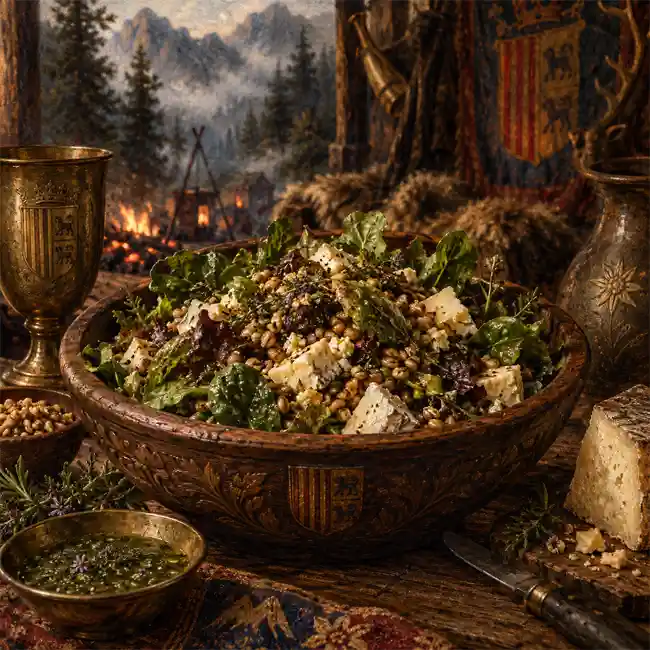
🥗 Recipe: Pyrenean Garden Greens with Rustic Cheese, Toasted Grains & Mountain Herb Dressing
🕯️ About this Aristocratic Secret: The Legend of the Garden Bowl
Picture an important household gathering in a historic Pyrenean settlement.
The main meal has been prepared, but before the heavier dishes arrive, the household cook brings out a large communal bowl of fresh greens.
It is not presented as a modern restaurant salad with perfectly identical leaves.
It is rustic.
It is abundant.
It looks as though the garden itself has been brought directly to the table.
Tender lettuce and young leafy greens form the foundation. Fresh herbs add fragrance. Small pieces of rustic cheese provide a creamy, salty contrast. Toasted grains or coarse bread crumbs bring a warm, nutty texture.
The dressing is intentionally restrained.
A little olive oil carries the herbs. A touch of vinegar or natural acidity brightens the leaves. A small amount of honey adds balance without making the salad sweet.
For an aristocratic household, presentation could turn simple ingredients into something impressive. The salad might have been arranged in a large ceramic or wooden serving vessel, with the most delicate leaves placed toward the top and the cheese and toasted elements scattered carefully across the surface.
This recipe recreates that spirit.
Rather than claiming that this exact dish was served in a particular Andorran palace, think of it as a historically inspired Andorran mountain salad—a dish built around the kind of ingredients and culinary logic that make Pyrenean food traditions so fascinating.
🌿 Ingredients & The Aristocratic Touch
🧺 The Royal Pantry Becomes the Aristocratic Pantry
The word “royal” may sound dramatic, but Andorra's historical reality calls for a more accurate term: aristocratic.
A prosperous mountain household would have valued ingredients that were fresh, seasonal, carefully stored, or difficult to obtain at certain times of year.
The beauty of this salad comes from combining modest ingredients thoughtfully.
The greens provide freshness.
The herbs provide aroma.
The cheese supplies richness.
The toasted grains or crumbs create texture.
The dressing brings everything together.
The aristocratic touch is not about adding dozens of expensive ingredients.
It is about balance, restraint, freshness, and presentation.
🔄 Modern Substitutes
You can easily adapt this historic-inspired salad to a modern kitchen.
• Use young romaine, butter lettuce, or mixed baby greens if traditional garden leaves are unavailable.
• Replace rustic Pyrenean-style cheese with a firm sheep's cheese, mild goat cheese, or aged farmhouse cheese.
• Use toasted barley, rye crumbs, or whole-grain bread crumbs when traditional grains are difficult to find.
• Substitute fresh mountain herbs with parsley, chives, thyme, or a small amount of mint.
• If you do not have a mild natural vinegar, use apple cider vinegar.
• Replace honey with a small amount of naturally sweet fruit if you prefer a less traditional dressing.
• Walnuts can be added for additional texture, especially when using ingredients commonly associated with mountain cuisine.
• Fresh seasonal vegetables can be included, but keep them secondary so the garden greens remain the focus.
⚖️ The Measurements
For 4 generous servings:
• 200 grams young mixed garden greens
• 80 grams rustic sheep's cheese or firm farmhouse cheese
• 50 grams toasted barley, rye crumbs, or coarse toasted bread crumbs
• 40 grams walnuts, lightly toasted
• 1 small crisp apple, thinly sliced
• 2 tablespoons finely chopped fresh parsley
• 1 tablespoon finely chopped chives
• 1 teaspoon fresh thyme leaves
• 4 tablespoons extra-virgin olive oil
• 1 tablespoon apple cider vinegar or mild wine vinegar
• 1 teaspoon honey
• ½ teaspoon fine salt
• ¼ teaspoon freshly ground black pepper
• 1 small garlic clove, finely grated or crushed
• 1 teaspoon finely chopped fresh onion or shallot
Basic ratio for the dressing:
• 4 parts olive oil
• 1 part vinegar
• ¼ part honey
• A small amount of garlic, herbs, salt, and pepper
This ratio is more important than obsessing over exact measurements.
Historic cooks rarely had modern measuring spoons sitting beside the fire. They relied heavily on experience, proportion, sight, smell, and taste.
That is part of the charm.
👨🍳 The Chef’s Ritual: Preparing the Mountain Garden Bowl
🌱 Step 1: Prepare the Greens
Wash the garden greens carefully in cold water.
Remove damaged leaves and keep the smaller, tender leaves intact.
Drain them extremely well.
This step matters more than many people realize. Wet greens dilute the dressing and prevent the oil and vinegar from coating the leaves properly.
For the best texture, gently dry the leaves and allow them to rest for a few minutes before assembling the salad.
🔥 Step 2: Toast the Grains or Bread Crumbs
Place the barley, rye crumbs, or coarse bread crumbs in a dry pan over medium-low heat.
Toast them slowly.
Do not rush.
You want a warm golden aroma and a crisp texture, not burnt crumbs.
Once fragrant, remove them from the heat and let them cool.
This small step creates one of the biggest differences between an ordinary salad and a memorable one.
🌰 Step 3: Prepare the Walnuts
Toast the walnuts briefly until they become aromatic.
Allow them to cool before roughly chopping them.
The goal is not to turn them into powder.
You want small pieces that create occasional bursts of nutty flavor.
🍎 Step 4: Prepare the Seasonal Fruit
Slice the apple thinly.
The fruit should provide a gentle sweetness and crispness rather than dominate the dish.
If using another seasonal fruit, choose something that is firm enough to maintain its texture.
🌿 Step 5: Make the Mountain Herb Dressing
Add the olive oil, vinegar, honey, garlic, parsley, chives, thyme, salt, and black pepper to a small bowl.
Whisk gently.
Taste it.
If it feels too sharp, add a tiny amount more honey.
If it tastes flat, add a few drops of vinegar.
If the herbs disappear, add a little more fresh herb rather than simply increasing the salt.
The dressing should taste lively but balanced.
🥣 Step 6: Build the Aristocratic Garden Bowl
Place the greens into a large serving bowl.
Add the apple slices, toasted grains, walnuts, and most of the herbs.
Crumble the rustic cheese over the top.
Do not toss everything aggressively yet.
A beautifully arranged salad should look inviting before anyone takes the first bite.
✨ Step 7: Dress at the Last Moment
Drizzle the dressing slowly around the bowl.
Gently toss from underneath using two large spoons.
Lift rather than crush.
The leaves should remain airy.
Finish with the remaining herbs, a few toasted crumbs, and a final crumble of cheese.
Serve immediately.
🔐 Secrets of the Aristocratic Kitchen: Tips & Mistakes
🌿 Secret 1: Freshness Was the Real Luxury
Do not underestimate the importance of freshly picked greens.
If your leaves are tired, the finished salad will taste tired too.
Choose crisp leaves and herbs with strong natural aromas.
🧂 Secret 2: Salt Carefully
Cheese already contributes salt.
The dressing should therefore be seasoned lightly before the cheese is added.
Taste after combining everything.
It is much easier to add salt than to rescue an over-salted salad.
🍯 Secret 3: Honey Is for Balance
The honey should not make the dressing taste sweet.
Its job is to soften the sharp edge of the vinegar.
If you can clearly taste “sweet salad dressing,” you have probably added too much.
🥄 Secret 4: Do Not Drown the Greens
One of the biggest modern salad mistakes is using too much dressing.
Historic-inspired mountain cuisine works better when the ingredients remain recognizable.
Start with a modest amount.
Add more only if necessary.
🔥 Secret 5: Toast Slowly
Whether using grains, bread crumbs, or nuts, low and steady heat gives better flavor.
High heat can burn the outside while leaving the inside bland.
🧀 Secret 6: Choose Cheese With Character
The cheese should be noticeable but not overpowering.
A mild sheep's cheese or farmhouse cheese is ideal.
If your cheese is very strong, reduce the quantity.
🍎 Secret 7: Keep Sweetness Natural
Fresh apple works beautifully because its sweetness is restrained.
The idea is to create contrast rather than dessert-like sweetness.
🚫 Mistake 1: Cutting Everything Too Small
Do not turn the ingredients into tiny pieces.
The dish should have texture.
Large leaves, irregular cheese pieces, and coarse toasted crumbs create a more rustic and authentic appearance.
🚫 Mistake 2: Dressing Too Early
If you dress the salad 30 minutes before serving, the leaves can become soft.
Dress immediately before eating.
🚫 Mistake 3: Using Too Many Flavors
It can be tempting to add every herb and vegetable in the kitchen.
Resist that temptation.
A successful historical-inspired dish should have a clear identity.
Greens first.
Herbs second.
Cheese and toasted elements provide contrast.
The dressing ties everything together.
🚫 Mistake 4: Treating Rustic Food as Inferior Food
This is perhaps the biggest mistake of all.
Rustic does not mean careless.
A dish can be simple while still being precise.
The aristocratic touch comes from choosing ingredients carefully and respecting them.
🛕 Royal FAQ: The Questions Behind the Forgotten Recipe
Q1.Was this exact salad really served 500 years ago in Andorra?
There is no reason to present this exact modern recipe as a documented 500-year-old manuscript recipe. It is a historical culinary reconstruction inspired by Andorran and broader Pyrenean food traditions, seasonal mountain ingredients, and the cooking logic of prosperous households.
That distinction matters.
The goal is to recreate the spirit of historic cuisine, not invent false archival evidence.
Q2.Did Andorra have a royal dynasty?
Not in the conventional sense of a hereditary Andorran royal dynasty. Andorra developed its distinctive political system as a co-principality, historically associated with the Bishop of Urgell and the French head of state.
That is why “aristocratic” is the more appropriate term for this culinary concept.
Q3.Can I make this salad with modern supermarket ingredients?
Absolutely.
Young lettuce, parsley, chives, thyme, farmhouse cheese, apples, walnuts, olive oil, vinegar, and whole-grain bread crumbs are all practical modern substitutes.
The important thing is to preserve the balance of fresh greens, herbs, richness, acidity, and crunch.
Q4.Can this be served as a complete meal?
Yes.
For a more substantial modern meal, increase the cheese and toasted grains, or add additional seasonal vegetables.
The original concept is best understood as a garden-centered dish that could accompany a larger mountain meal.
🕰️ The Taste of History: What This Ancient-Inspired Salad Feels Like
The first bite is crisp and green.
Then the herbs arrive.
The cheese adds a gentle richness, while the toasted grains create a warm, nutty contrast against the fresh leaves.
The apple brings a small flash of sweetness.
Finally, the dressing ties everything together with a clean acidity that keeps the salad lively.
There is nothing overwhelmingly heavy about it.
That is exactly what makes the dish interesting.
The flavor feels connected to the landscape.
You can imagine the freshness of a garden, the aroma of mountain herbs, the texture of rustic bread or grains, and the richness of farmhouse cheese coming together in one bowl.
It is not a recipe that depends on complicated culinary techniques.
Instead, it depends on quality, proportion, timing, and restraint.
Those qualities are timeless.
And perhaps that is the most interesting lesson hidden inside this forgotten aristocratic kitchen.
Historic food does not always need to be extravagant to feel special.
Sometimes the most sophisticated dish is the one that knows when to stop.
🌄 Final Thoughts: Bringing History to Your Table
A recipe inspired by a centuries-old mountain culture should never feel like a museum exhibit that cannot be touched.
It should invite you into the story.
This Andorran garden salad does exactly that.
You can prepare it in a modern kitchen, using ingredients that are easy to find, while still embracing the spirit of an earlier culinary world.
The greens represent the garden.
The herbs represent the mountain landscape.
The cheese represents the practical richness of pastoral food traditions.
The toasted grains or crumbs represent the importance of using every useful ingredient.
The dressing brings everything together.
And the presentation transforms these everyday foods into something worthy of a special table.
That is the real aristocratic touch.
Not extravagance.
Care.
When you prepare this recipe, take your time.
Taste the dressing before serving.
Toast the grains slowly.
Choose the freshest greens you can find.
And do not be afraid to keep the dish simple.
You are not trying to imitate a modern restaurant.
You are trying to capture the feeling of a mountain table where ingredients were valued because they came from somewhere nearby and because the person preparing them understood exactly how to make them shine.
Even without a royal palace, that kind of culinary sophistication can still be brought back to life.
🗝️ The Call to Action: The Golden Hook
If you love discovering forgotten flavors and stories hidden inside historic food traditions, keep exploring with us.
Every old recipe has a story.
Sometimes that story is written in an old manuscript.
Sometimes it survives through family kitchens.
Sometimes it is preserved through local ingredients, seasonal habits, traditional cooking techniques, and memories passed from one generation to another.
And sometimes we have to carefully reconstruct the culinary world from the evidence that remains.
That is where the adventure begins.
The goal is not simply to make an old-looking recipe.
It is to understand why people cooked the way they did, what ingredients mattered to them, and how food connected households to their landscape and culture.
If you have ever wondered what a forgotten Andorran mountain table might have looked like centuries ago, this garden greens salad is a delicious place to begin.
Bring the bowl to your table.
Share it with friends.
Taste the contrast between fresh leaves, herbs, rustic cheese, toasted grains, and bright dressing.
Then imagine the Pyrenees beyond the window.
That is how history becomes personal.
And that is how forgotten food traditions can continue living.
🏛️ Credit to the Keepers of the Culture: The Legacy
Historic-inspired recipes should always be approached with respect.
Andorra's culinary heritage belongs to its people, its mountain communities, its parishes, its families, its farmers, its food traditions, and the wider Pyrenean cultural landscape that shaped generations of everyday cooking.
This recipe should therefore be understood as an interpretive culinary reconstruction, not as a claim of exclusive ownership over an ancient recipe or as proof that a specific aristocratic household prepared this exact dish.
The phrase “aristocratic recipe” is used here to describe the atmosphere of refined historical dining rather than to suggest that a surviving noble manuscript definitively records this preparation.
That distinction makes the story stronger, not weaker.
Real culinary heritage does not need exaggerated claims.
It deserves careful storytelling.
The most meaningful way to honor traditional food is to acknowledge its cultural roots, appreciate the communities that preserved related ingredients and techniques, and remain honest about what is historically documented versus what has been creatively reconstructed.
Andorra's mountain cuisine reminds us that food can preserve a sense of place.
The gardens, forests, pastures, valleys, stone houses, seasonal harvests, and family tables all contribute to that story.
So when you prepare this 500-Year Andorran Garden Greens Salad, think beyond the recipe.
Think about the landscape.
Think about the generations of mountain households that learned to make something satisfying from what the seasons provided.
Think about how a simple bowl of greens could become part of hospitality.
And remember that the most valuable culinary secrets are not always secret ingredients.
Sometimes they are the principles behind the cooking:
• Use what the land provides.
• Respect the season.
• Balance every flavor.
• Waste as little as possible.
• And serve simple food with genuine care.
That philosophy can survive centuries.
And perhaps that is the true forgotten recipe.
The art of making humble ingredients feel extraordinary.
| 🇦🇩 👑🥗 < Back |