
🏠 Home > 🗺️ Recipes > 👑🥘 Signature Royal Sauces (Sauces) > 🇦🇱 Albania Signature Royal Sauces (Sauces) Recipes > 👑🥘 1.Salca e Bardhe e Pashait - The Pasha's White Velvet Sauce
👑🥘 Rediscovering Albania's Lost Aristocratic Sauces: The Pasha's White Velvet Secret
Published by Supakorn | Updated: August 2026
🏯👑 The Forgotten Aristocratic Legacy of Albania: The Era of Pashas and Beys
📖 The Storyteller’s Intro
Close your eyes and step back to the late 18th century. We are not in a castle with kings and queens, because Albania never really had them. Instead, we are in the stone-walled kitchen of a grand Saray in Shkodra or Ioannina, the court of a powerful Albanian Pasha. The air is thick with the scent of wood smoke, browned butter, and mountain herbs. Outside, guards stand watch. Inside, a head chef, the Ashcibashi, works in total silence. On the fire, a small copper pot trembles. This is not just a sauce. This is power in liquid form, a recipe so guarded that only three people in the entire palace knew it by heart.
For centuries, that is how it was. While the world talked about French mother sauces, the Albanian aristocracy had their own.
💎 The Global Value
This is what makes Albanian high cuisine so fascinating. These were not everyday village sauces. These sauces were a symbol of status. The best yogurt came from the highlands, the butter was clarified three times, the walnuts were hand-picked from Dibra, and the herbs were foraged before sunrise. Common people ate simply. The Pashas and Beys, the aristocratic families who ruled the region, demanded complexity, smoothness, and subtlety.
Because these recipes were never written down, they were passed by whisper from master to apprentice, they almost vanished completely during the turbulent 20th century. Wars, isolation, and political change erased the palaces and the chefs with them. What we are left with are fragments, memories from old family notebooks, and oral stories from grandmothers who once worked in the big houses. They were almost lost forever.
📜 The Collection
Today, we are bringing one back to life. This article resurrects the most elegant and elusive of them all, a sauce that defined the peak of Albanian aristocratic dining. It is creamy, tangy, nutty, and incredibly sophisticated. This is not the heavy garlic yogurt you find in restaurants today. This is the original, the court version. The one they called Salca e Bardhe e Pashait, The Pasha's White Velvet Sauce.
Get ready to cook history.
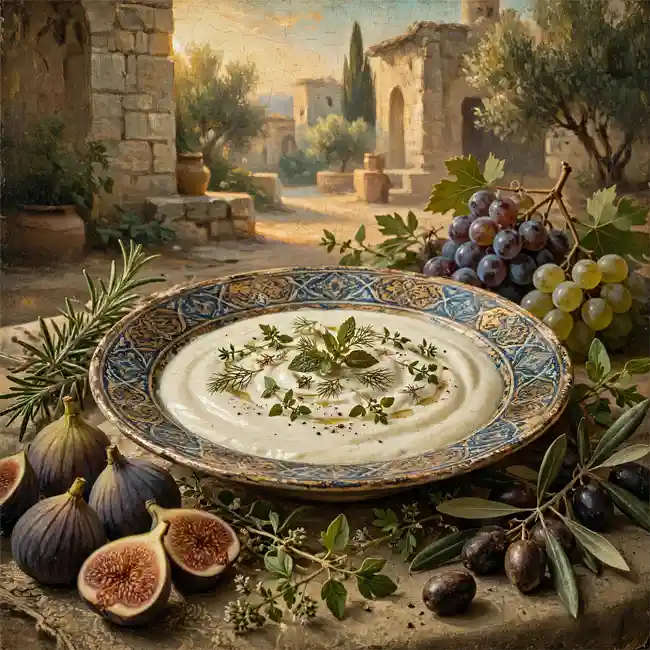
🍽️ Recipe: Salca e Bardhe e Pashait - The Pasha's White Velvet Sauce
This is the signature sauce of the northern Albanian aristocracy, served over slow-roasted lamb, grilled quail, or by itself with warm, fresh pita to honor a guest. If you were invited to a Pasha's table, this sauce would be on it.
👑 About this Royal Secret
Every great court had its signature dish, and for the Bushati family of Shkodra, one of the most powerful Albanian noble families who ruled for over a century, it was this sauce.
Legend says the Pasha of Shkodra was a difficult man to please. He disliked the sharp, acidic sauces common in the Ottoman court. He wanted something that represented Albania, white as the snow on the Albanian Alps, rich as its pastures, but refined enough for a diplomat. His Ashcibashi, after weeks of failure, finally created this velvet white sauce using aged sheep yogurt, browned walnut butter, and wild mountain mint.
It was served only on two occasions: when a peace treaty was signed, and when a first son was born. It symbolized purity, prosperity, and peace. Guests would dip a piece of bread into it before any meat was served, as a sign of trust. If you were offered the White Velvet Sauce, you were family. That is why this recipe is so special. You are not just making a sauce, you are recreating a ritual of honor.
🛒 Ingredients & The Aristocratic Touch
🌿 The Royal Pantry
In the aristocratic kitchen, ingredients were not just bought, they were curated. The yogurt had to be from sheep that grazed above 1000 meters, giving it a naturally thick, less sour profile. The butter was not ordinary butter. It was clarified slowly until it turned nut brown, a technique they called gjalpe e pjekur. The walnuts were stored for six months to deepen their flavor, and the mint was not garden mint, but wild mountain mint, Menta e Eger, which is far more aromatic and less sharp than common mint.
We will honor that spirit, but make it possible for your modern kitchen.
🔄 Modern Substitutes
You do not need to climb a mountain. Here is how we translate the aristocratic pantry for today.
Sheep yogurt can be replaced with full-fat Greek yogurt strained overnight, or a mix of Greek yogurt and sour cream for that same rich tang. If you can find real sheep yogurt at a Mediterranean store, use it, it is worth it.
Gjalpe e pjekur is essentially brown butter ghee. You can make it at home in five minutes or buy good quality ghee and brown it slightly.
Wild mountain mint is hard to find. The closest substitute is a combination of fresh spearmint and a tiny pinch of dried oregano. Do not use peppermint, it will be too aggressive.
📋 The Measurements
This makes enough sauce for 4 to 6 people as a main sauce.
• Full-fat strained Greek yogurt, very thick - 2 cups or 500 grams
• Good quality ghee or unsalted butter - 4 tablespoons or 60 grams
• Finely ground walnuts, almost like flour - 1/2 cup or 60 grams
• All-purpose flour - 1 tablespoon or 10 grams
• Cold water - 1/2 cup or 120 ml
• Fresh garlic, grated to a puree - 1 small clove
• Fresh spearmint, finely chopped - 2 tablespoons
• Dried wild oregano or Greek oregano, crumbled - 1/4 teaspoon
• Sea salt, fine - 3/4 teaspoon, plus more to taste
• Freshly ground white pepper - 1/4 teaspoon
• A tiny pinch of freshly grated nutmeg
👨🍳 The Chef’s Ritual
Follow this order exactly. The old chefs believed the ritual was as important as the recipe. Patience is the secret ingredient here.
◦ Step 1: Awaken the Walnuts
In a dry, small pan over medium-low heat, toast your finely ground walnuts for about 2 to 3 minutes. Keep stirring constantly. You are not trying to brown them deeply, you just want them to become fragrant, like warm earth. As soon as you smell that nutty aroma, remove them from the pan and set aside. This step removes any bitterness.
◦ Step 2: Create the Brown Butter Base
In the same pan, melt the ghee or butter over medium heat. Let it melt, then continue cooking. It will foam, then the foam will subside, and you will see tiny golden-brown specks at the bottom. The smell will change from buttery to nutty and biscuit-like. This is your aristocratic butter. Immediately remove from heat so it does not burn. This brown butter is the soul of the sauce.
◦ Step 3: The Velvet Foundation
In a separate, heavy-bottomed saucepan, whisk together the cold water and the flour until there are absolutely no lumps. This is crucial. Place the pan over low heat. Add half of your brown butter, leaving the brown specks in the pan. Whisk slowly for about 2 minutes until the mixture just starts to thicken slightly into a very light, almost translucent paste. Think of it as a delicate bechamel. Do not let it boil.
◦ Step 4: The Gentle Union
Remove the saucepan from the heat completely. Let it cool for 1 minute. Now, add the strained yogurt one large spoonful at a time, whisking vigorously after each addition. Never dump it all in at once, or it will split. You are tempering it, teaching the yogurt to accept the heat. Continue until all the yogurt is incorporated and the mixture is completely smooth and silky.
◦ Step 5: Return to the Flame
Put the pan back on the lowest heat possible. Add the toasted walnut flour, grated garlic puree, salt, white pepper, and nutmeg. Stir constantly with a wooden spoon in one direction only, the old chefs insisted this kept the sauce calm. Heat for 4 to 5 minutes, stirring, until the sauce is warm and coats the back of a spoon. It should never, ever boil. If you see even one bubble breaking the surface, pull it off the heat instantly. Boiling will curdle the yogurt.
◦ Step 6: The Final Blessing
Turn off the heat. Stir in the remaining brown butter with all its golden specks, the chopped spearmint, and the oregano. Taste and adjust salt. Let the sauce rest for at least 15 minutes off the heat. This resting time is mandatory. It allows the walnuts to soften into the velvet and the herbs to perfume the entire sauce. Serve it lukewarm, not hot. In the palace, it was served at body temperature.
🤫 Secrets of the Palace Kitchen
◦ The Never-Boil Rule: The number one mistake that ruins this sauce is boiling. Aristocratic yogurt sauces are emulsions, not cooked sauces. The old Ashcibashi would hold his hand over the pot. If he could not hold it there for 5 seconds, the fire was too hot. Keep it below a simmer.
◦ Strain Your Yogurt Overnight: Even Greek yogurt has too much water. Place it in a cheesecloth over a bowl in the fridge for 8 hours or overnight. The thicker your yogurt, the more luxurious and stable your sauce will be. This was the original aristocratic trick.
◦ Grind Walnuts with Flour: To get that super-fine, flour-like texture without turning it into walnut butter, grind the walnuts together with the 1 tablespoon of flour in a spice grinder. The flour absorbs the oil and keeps it powdery.
◦ Garlic as Perfume, Not Flavor: Do not mince the garlic. Grate it on a microplane into a puree and use only one small clove. You should not taste garlic. You should only feel a mysterious warmth at the back of your throat. If you can taste garlic, you used too much.
◦ The Wooden Spoon Direction: It sounds superstitious, but stirring constantly in one direction prevents the yogurt proteins from tangling and splitting. Use a wooden spoon, not a whisk, after you add the yogurt.
🤴🏯 Royal FAQ
Q1: Can I make this sauce vegan?
A: Yes, you can create a beautiful version. Use a very thick, unsweetened cashew yogurt and use a high-quality olive oil browned with a few walnuts instead of ghee. The taste will be slightly different but still very aristocratic and creamy. The straining step is even more important for plant-based yogurts.
Q2: What do I serve this with?
A: Traditionally, it was poured over slow-roasted lamb shoulder or grilled chicken. For a modern, vegetarian approach, it is absolutely stunning with roasted cauliflower steaks, grilled zucchini, or as a dip for warm flatbread and crudites. It also makes a fantastic base for a cold summer soup if you thin it with a little water.
Q3: My sauce split or became grainy, what happened?
A: This almost always means the heat was too high or you added cold yogurt to a hot base too quickly. Do not throw it away. Remove it from heat, and whisk in one tablespoon of very cold water vigorously. In many cases, you can bring it back together. Next time, lower your heat and temper more slowly.
Q4: How long does it keep?
A: This sauce is best eaten the day it is made, within 4 hours, just like in the palace. You can store it in an airtight glass jar in the refrigerator for up to 2 days, but it will thicken considerably. To serve, bring it to room temperature and whisk in a tablespoon of lukewarm water to return it to its velvety consistency. Never reheat it in a microwave.
🏺 The Taste of History
When you taste this, you are tasting something that has not been served in a palace for over a hundred years. It is not sharp. It is not heavy. It is incredibly balanced. The first note is the nutty warmth of the brown butter, followed by the creamy, tangy depth of the sheep yogurt, then the earthy, almost meaty finish of the walnut, all lifted by that cool whisper of mountain mint at the end.
It is subtle, which is exactly why the aristocracy loved it. It did not shout. It whispered luxury.
✨ Final Thoughts: Bringing History to Your Table
I know what you are thinking. This is a lot of care for a sauce. But that is the point. In our fast world, taking 20 minutes to stir a sauce slowly, in one direction, over low heat, is a revolutionary act. It connects you to those anonymous chefs who stood in cold stone kitchens and believed that feeding someone beautifully was a form of respect.
This recipe was once locked behind palace walls. It was reserved for Pashas and Beys. Now it is yours. You do not need a title to make it. You just need patience and good ingredients. You can absolutely recreate this legendary flavor in your own kitchen tonight, and trust me, once you taste it, you will never look at a yogurt sauce the same way again.
🔔 The Call to Action
If you fell in love with the taste of this hidden history, join us on our mission to save the world's culinary secrets. This White Velvet Sauce is just one of dozens of forgotten aristocratic sauces from the Balkans that are waiting to be rediscovered.
Share your creation with us, leave a comment below telling us what you served it with, and let us know which lost culinary empire you want us to explore next. Should we dive into the forgotten banquet sauces of the Illyrian highlands or the lost spice sauces of the southern bazaars?
Let us keep these stories alive, one sauce at a time.
🙏 Credit to the Keepers of the Culture
This recipe and its story would not have been possible without the incredible cultural custodians of Albania. Our deepest respect and gratitude go to the Albanian families of Shkodra, Prizren, and Gjirokaster who preserved these oral traditions in their private kitchen notebooks, the ethnographers at the Centre for Albanological Studies in Tirana, and the village elders who still remember the Saray kitchens.
This is not our recipe. This is their heritage. We are merely honored translators, attempting to present it with the dignity and respect it deserves. All credit belongs to the Albanian people, the true keepers of this magnificent, aristocratic culinary culture.
| 🇦🇱 👑🥘 < Back |