
🏠 Home > 🗺️ Recipes > 👑🍲 Royal Court Broths (Soups) >🇦🇱 Albania Royal Court Broths (Soups) Recipes > 👑🍲 1.Highland Lamb, Wild Herb & Root Broth
👑🍲 Forgotten Albanian Aristocratic Broths and the Secrets of the Old Balkan Kitchen
Published by Supakorn | Updated: August 2026
🏰 The Forgotten Aristocratic Legacy of Albania: Ottoman-Era Albania and the Old Noble Households
🕯️ The Storyteller’s Intro
Imagine stepping back into an old Albanian household sometime around the late eighteenth or early nineteenth century.
Outside, the mountain air is cold. Stone walls hold the warmth of the kitchen fire, copper cooking vessels hang above the hearth, and the scent of slow-simmered meat, onions, wild herbs, and freshly ground spices drifts through the house.
There is nothing flashy about the meal.
And yet, this is exactly where the magic begins.
Before modern restaurants, printed cookbooks, refrigerators, and carefully measured recipe cards, important Albanian households depended on cooks who understood something much more valuable than written instructions: judgment.
A good cook knew when a broth needed another hour.
They knew when the fire was too fierce.
They knew which herbs could survive a long simmer and which should be added at the end.
They knew how to turn humble ingredients into something worthy of a respected household.
That is the world behind this exploration of 200-year-old Albanian aristocratic broth traditions.
One important historical distinction should be made from the beginning. Albania did not have a continuous royal culinary court tradition stretching back 200 years in the way some European kingdoms did. The modern Albanian monarchy under King Zog belongs to the twentieth century. For that reason, the phrase “aristocratic” is more historically appropriate here.
Rather than pretending that one surviving bowl of broth was literally served to a particular Albanian king or noble family, this article reconstructs a historically inspired dish from the broader culinary landscape of old Albanian and Balkan households.
That distinction makes the story more interesting, not less.
Because the real story is about how food survived.
🌍 The Global Value: Recipes That Nearly Disappeared
Across the Balkans, culinary traditions were often passed from one generation to another through memory, repetition, observation, and household practice.
A recipe did not necessarily need a name written in a famous cookbook to matter.
Sometimes the recipe lived in the hands of a grandmother.
Sometimes it belonged to a household cook.
Sometimes it was remembered simply as the broth made when winter arrived, when guests came to the house, or when a large family gathered around the table.
This is why historical Albanian cuisine can be fascinating for modern food lovers.
The culinary heritage is not built only around luxurious ingredients. It is also about resourcefulness.
Meat could be stretched through a long simmer.
Bones could provide body and richness.
Mountain herbs could transform a simple broth.
Onions could create sweetness.
Sour ingredients could brighten a heavy dish.
And a patient cook could turn all of those elements into something deeply satisfying.
The aristocratic kitchen, therefore, was not necessarily defined by extravagance.
It was defined by control, timing, quality, and presentation.
A household with access to better livestock, fresher herbs, superior spices, and skilled cooks could transform everyday ingredients into a more refined version of food enjoyed throughout the region.
Over generations, however, many old household techniques became harder to trace.
Modern cooking became faster.
Packaged foods replaced long preparations.
Traditional knowledge moved from kitchens into family memories.
And some old culinary customs were never formally recorded.
That is where historical food reconstruction becomes valuable.
It allows us to ask:
What might an old Albanian household have cooked?
Which ingredients would have been available?
How would a skilled cook have balanced richness, acidity, herbs, and salt?
And perhaps most importantly, what did the food taste like before modern convenience changed the kitchen?
📜 The Collection: Bringing an Old Albanian Broth Back to the Table
This article focuses on a historically inspired preparation we can call:
Highland Lamb, Wild Herb & Root Broth
The English name is modern and descriptive rather than a claim that this exact title appeared in an eighteenth-century Albanian manuscript.
The concept draws from long-standing Balkan cooking principles: slowly cooked meat, aromatic vegetables, herbs, broth, and the careful use of acidity.
The result is a rustic but elegant bowl of soup.
It is rich without being heavy.
Herbal without becoming bitter.
Comforting without requiring an enormous ingredient list.
Most importantly, it captures something essential about old Albanian cooking: simple ingredients handled with patience.
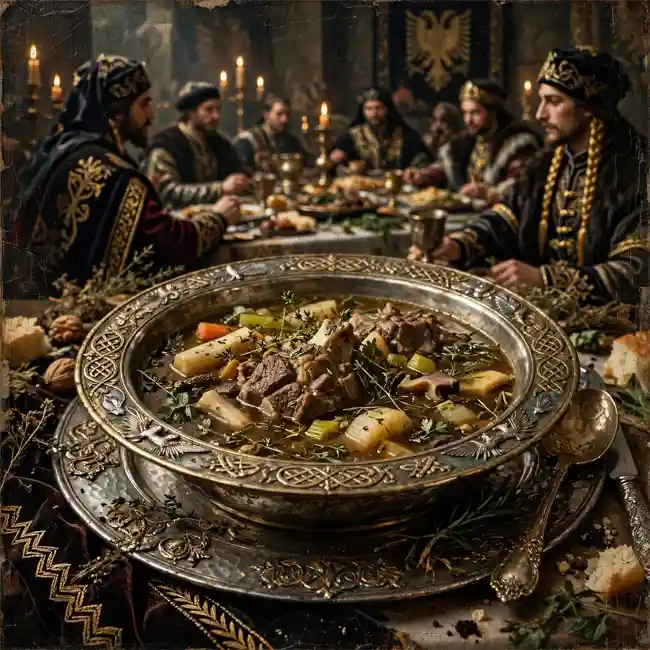
🍲 Recipe: Highland Lamb, Wild Herb & Root Broth
🏺 About this Aristocratic Secret
Picture a respected Albanian household preparing for an important winter gathering.
The kitchen begins early.
A piece of lamb is placed into a heavy pot. The cook adds onion, root vegetables, herbs, and water, then allows the fire to do the work.
There is no rush.
The broth slowly develops as the meat releases its natural richness and the vegetables soften into the cooking liquid.
For an aristocratic household, the difference would have been in the details.
The best available lamb would be selected.
Fresh herbs would be preferred when available.
The broth would be skimmed carefully.
The final seasoning would be adjusted by taste rather than blindly following a written measurement.
And before serving, the cook would make one final decision:
Should the broth remain clear and delicate, or should it be given more body through additional vegetables and carefully broken-down meat?
This reconstructed version follows the first approach.
It is designed as a clear, deeply flavored Albanian-inspired broth, where every ingredient has a purpose.
It is not presented as a proven surviving palace recipe.
Instead, it is a respectful culinary reconstruction inspired by the ingredients, techniques, and food traditions associated with historical Albanian and wider Balkan kitchens.
🌿 Ingredients & The Aristocratic Touch
🧺 The Royal Pantry
The pantry of an old prosperous Albanian household would have depended heavily on what the surrounding landscape could provide.
Lamb was particularly valuable because the animal could supply several useful parts of the kitchen, while bones and connective tissue could contribute richness to a long-cooked broth.
Onions were essential.
Root vegetables added sweetness and substance.
Herbs brought the character of the countryside into the pot.
A little acidity could transform the entire dish.
The aristocratic touch was not about throwing expensive ingredients into the pot.
It was about choosing good ingredients and respecting them.
A refined cook understood that too much spice could hide the flavor of good meat.
Too many herbs could make a broth medicinal.
Too much salt could flatten everything.
The best broth was often the one where nothing shouted louder than everything else.
🔄 Modern Substitutes
You can recreate this style of broth without searching for rare historical ingredients.
• Lamb shoulder or neck: Use lamb shank, shoulder, or another bone-in lamb cut if preferred.
• Wild mountain herbs: Use parsley, thyme, oregano, or a small amount of fresh mint.
• Root vegetables: Carrot and parsnip work well when traditional local varieties are unavailable.
• Leek: Substitute with additional onion or a mild spring onion.
• Traditional sour element: A small amount of lemon juice can provide the brightness needed at the end.
• Coarse salt: Ordinary sea salt works perfectly.
• Stone-ground pepper: Freshly ground black pepper is an accessible modern alternative.
• Fresh herbs: If fresh herbs are unavailable, use dried herbs in smaller quantities because their flavor is more concentrated.
⚖️ The Measurements
The following proportions are designed for approximately 6 generous servings.
• Bone-in lamb: 1.2 kilograms
• Water: 2.5 liters
• Yellow onions: 2 medium, roughly chopped
• Carrots: 2 medium, sliced into thick pieces
• Parsnip: 1 medium, sliced
• Leek: 1 medium, cleaned and sliced
• Garlic: 3 cloves, lightly crushed
• Fresh parsley: 30 grams
• Fresh thyme: 5 to 6 small sprigs
• Fresh oregano: 1 tablespoon, finely chopped
• Fresh mint: 1 teaspoon, finely chopped
• Black pepper: 1 teaspoon, freshly ground
• Sea salt: approximately 1½ teaspoons, adjusted to taste
• Lemon juice: 1½ to 2 tablespoons
• Olive oil: 1 tablespoon, optional for gently softening the vegetables
• Bay leaf: 1 leaf
The proportions are deliberately balanced.
The lamb provides the foundation.
The vegetables provide sweetness.
The herbs create the aromatic character.
The lemon prevents the finished broth from becoming too rich.
🔥 The Chef’s Ritual
1. Prepare the Lamb
Rinse and pat the lamb dry.
Trim away only excessive surface fat. Do not remove everything.
A good broth needs some natural richness.
Place the lamb into a heavy pot and cover it with the measured water.
Bring the pot slowly toward a gentle simmer.
Do not immediately blast it with high heat.
The slower beginning helps you control the clarity of the broth.
2. Skim the Surface
As the water warms, foam and impurities may rise to the surface.
Use a spoon to remove them carefully.
This small step makes a surprisingly large difference.
A clear historical-style broth should look clean and inviting rather than cloudy and greasy.
Take your time here.
3. Build the Aromatic Base
Add the onions, carrots, parsnip, leek, garlic, and bay leaf.
Keep the heat low.
The broth should barely bubble.
This is one of the most important ideas in traditional slow cooking:
A broth should simmer, not aggressively boil.
A violent boil can break ingredients apart too quickly and make the liquid cloudy.
4. Add the Herbs
Add the thyme and oregano during the main simmer.
Reserve most of the parsley and mint for later.
This creates layers of flavor.
The herbs cooked for a long time become part of the broth itself, while the fresh herbs added near the end retain their brighter aroma.
5. Let Time Do the Work
Cover the pot partially and simmer for approximately 1½ to 2½ hours, depending on the cut of lamb.
The meat should become tender enough to separate easily from the bone.
If the broth reduces too quickly, add a little hot water.
Never allow the pot to dry out.
The goal is a concentrated but graceful broth, not a stew.
6. Remove and Rest the Meat
Lift the lamb from the pot.
Allow it to rest briefly before separating the meat from the bones.
Remove large bones, excess connective tissue, and any pieces that are not pleasant to eat.
Return the tender lamb meat to the broth.
7. Finish with Freshness
Taste the broth.
Add salt gradually.
Then add the lemon juice.
This is the moment when the character changes.
The acidity should not make the broth taste obviously sour.
Instead, it should make the lamb taste cleaner and the herbs taste brighter.
Finally, stir in the fresh parsley and mint.
Give the broth another two or three minutes over very low heat.
Then turn off the fire.
8. Serve Like an Old Household Table
Ladle the broth into warm bowls.
Place tender lamb pieces in each serving.
Add a little fresh parsley over the top.
Serve immediately.
The first impression should be aromatic and gentle.
The second should reveal the lamb.
Then come the herbs, vegetables, and subtle brightness of lemon.
That progression is what makes a simple broth feel surprisingly sophisticated.
🔐 Secrets of the Palace Kitchen: Tips & Mistakes
🥄 Secret 1: Never Rush the First Simmer
The first thirty minutes establish the foundation.
Keep the heat moderate and skim patiently.
A hurried boil can produce a rougher, cloudier broth.
🌿 Secret 2: Separate Deep Herbs from Fresh Herbs
Long cooking is excellent for sturdy herbs such as thyme.
Delicate herbs such as parsley and mint are better used toward the end.
This creates a more complex aroma.
🧂 Secret 3: Salt in Stages
Do not add all the salt at the beginning.
As water evaporates, the broth becomes more concentrated.
Seasoning gradually gives you much better control.
🍋 Secret 4: Acidity Is the Hidden Key
A small amount of lemon juice can make a rich lamb broth feel dramatically lighter.
But do not overdo it.
The broth should taste balanced, not sour.
🥕 Secret 5: Cut Vegetables Large
Large pieces survive a long simmer better.
Tiny pieces can dissolve too early and turn the broth muddy.
🔥 Secret 6: Gentle Heat Beats Fierce Heat
The most common mistake is cooking too aggressively.
If the surface is violently bubbling, reduce the heat.
You want a quiet simmer.
❌ Mistake 1: Using Too Many Spices
This is not a dish that needs a crowded spice cabinet.
The lamb, vegetables, herbs, and acidity should remain recognizable.
❌ Mistake 2: Overloading the Pot
More ingredients do not automatically create a better broth.
Too many vegetables can make the flavor confused.
❌ Mistake 3: Adding Lemon Too Early
Long cooking can dull fresh acidity.
Add most of the lemon near the end.
❌ Mistake 4: Ignoring the Fat
A little lamb fat provides richness.
Too much, however, can overwhelm the broth.
If necessary, allow the broth to rest briefly and remove excessive fat from the surface.
❌ Mistake 5: Serving It Too Cold
Broth loses much of its aromatic character as it cools.
Warm the bowls before serving if possible.
That small detail creates a noticeably better experience.
🤴👸 Royal FAQ
Q1.Is this an authentic 200-year-old Albanian palace recipe?
Not in the sense of being a surviving recipe manuscript with a verified palace provenance.
This is a historically inspired reconstruction based on traditional Albanian and broader Balkan cooking principles associated with old household kitchens. The “200-year” framing refers to the historical culinary era and traditions being explored rather than claiming that this exact written recipe has survived unchanged for two centuries.
Q2.What makes this broth distinctly Albanian-inspired?
The combination of lamb, vegetables, fresh herbs, slow simmering, and a restrained acidic finish reflects cooking ideas found across Albanian and neighboring Balkan food traditions.
The precise ingredients and methods varied between regions, families, seasons, and economic circumstances.
Q3.Can I make it without wild mountain herbs?
Absolutely.
Fresh parsley, thyme, oregano, and a small amount of mint provide an accessible modern interpretation.
The important principle is balance rather than obtaining one supposedly magical herb.
Q4.Can another meat be used?
Yes.
Lamb gives the broth its strongest character, but similar slow-broth principles can be adapted to other meats.
If using another meat, adjust the cooking time according to the cut.
🏺 The Taste of History
The most fascinating thing about this broth is that it does not need to taste extravagant.
In fact, its elegance comes from restraint.
The first spoonful carries the gentle richness of lamb.
Then the sweetness of onion and carrot appears.
The herbs follow with a green, mountain-like freshness.
Finally, the lemon provides a small spark that keeps the broth from feeling heavy.
It is warm, rustic, aromatic, and deeply comforting.
And that tells us something important about historical aristocratic cuisine.
Luxury was not always about rare ingredients.
Sometimes luxury meant having enough time to cook properly.
It meant having skilled hands in the kitchen.
It meant choosing the best available ingredients.
It meant refusing to rush.
A humble bowl of broth could therefore represent something much larger than food.
It could represent hospitality, household status, seasonal knowledge, family memory, and the relationship between people and the landscape around them.
That is why old Albanian culinary traditions deserve attention.
They show us that sophisticated cooking does not always require complicated recipes.
Sometimes the greatest culinary secret is simply knowing when to stop interfering with the ingredients.
🏡 Final Thoughts: Bringing History to Your Table
Cooking a historical-inspired Albanian broth today is not about pretending that we can perfectly recreate a meal from two centuries ago.
We cannot.
The original kitchens had different livestock, different vegetables, different fires, different cookware, and different local ingredients.
Even measurements were often based on instinct rather than grams and teaspoons.
But that does not mean the tradition is lost.
We can still recreate the spirit of the cooking.
Choose good lamb.
Use fresh herbs.
Cook slowly.
Taste continuously.
Respect acidity.
Keep the seasoning balanced.
And most importantly, give the food enough time.
That is how an old culinary idea can become meaningful again in a modern kitchen.
You do not need a stone castle.
You do not need an aristocratic dining room.
You only need a heavy pot, honest ingredients, patience, and a willingness to cook slowly.
The result is a bowl of Albanian-inspired broth that feels connected to a much older world.
And perhaps that is the real secret hidden inside these forgotten recipes.
They were never truly about luxury.
They were about care.
🔥 The Call to Action: The Golden Hook
If you love discovering forgotten flavors and the culinary traditions hidden inside old cultures, keep exploring with us.
Every historical food tradition carries clues about how people lived, traveled, celebrated, survived, and shared their tables.
From mountain kitchens to old merchant households, from family hearths to aristocratic dining rooms, these recipes form part of a much larger story.
So the next time you prepare a bowl of slow-cooked broth, do not think of it as just another soup.
Think of it as a small culinary time machine.
One spoonful can connect the modern kitchen with generations of cooks who understood the value of patience.
If you love the taste of history, join us in keeping the world's forgotten food traditions alive—one recipe, one story, and one kitchen at a time.
🌍 Credit to the Keepers of the Culture: The Legacy
Albanian cuisine belongs first and foremost to the people and communities who have carried its traditions through generations.
Historical food writing should therefore be approached with respect.
There is no single “ancient Albanian cuisine” that represents every region.
Albania has diverse landscapes, including mountains, valleys, plains, and coastal areas, and each environment has influenced local food traditions.
Households also differed according to geography, period, religion, trade connections, wealth, and access to ingredients.
For that reason, this article does not claim that every Albanian family prepared broth in exactly the same way, nor does it present a modern reconstruction as a verified aristocratic manuscript.
Instead, the recipe is offered as a culinary interpretation inspired by historical Albanian and Balkan foodways.
That distinction matters.
Preserving culinary heritage is not about inventing a glamorous story and attaching it to a culture.
It is about appreciating the real traditions, acknowledging what is documented and what is reconstructed, and giving credit to the communities whose knowledge made those traditions possible.
The old cooks may never have measured their ingredients with digital scales.
They may never have written down every step.
They may simply have known.
They knew how much meat belonged in the pot.
They knew when the broth was ready.
They knew which herb belonged in the kitchen that season.
They knew when a guest needed another bowl.
And that practical knowledge is part of the cultural legacy.
So when this 200-Year Albanian Aristocratic Broth is prepared today, the most meaningful ingredient is not the lamb, the herbs, or even the carefully balanced lemon.
It is respect for the people and culinary communities who kept these traditions alive.
The kitchen may have changed.
The cookware may have changed.
The measurements may have changed.
But the fundamental idea remains remarkably familiar:
Good food is made with patience, shared with generosity, and remembered through stories.
And that is a culinary secret worth preserving.
| 🇦🇱 👑🍲 < Back |