
🏠 Home > 🗺️ Recipes > 🏛️🍲 Clay-Pot Broths & Stews > 🏟️ Mycenaean Greek: Clay-Pot Broths & Stews Recipes
🏟️ 🏛️🍲 Mycenaean Greek: Clay-Pot Broths & Stews Recipes
Published by Supakorn | Updated: September 2026
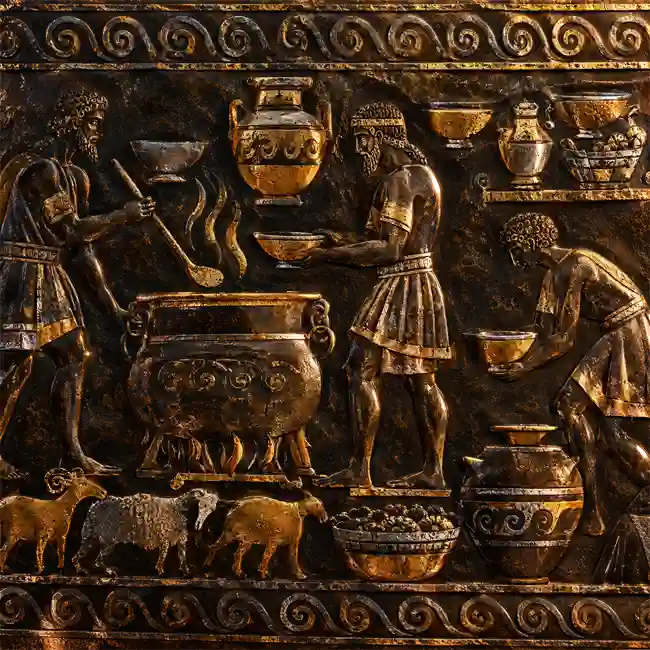
🕍📜 The Storyteller's Intro: 5,000 Years of Ancestral Flavors
Okay, let's just picture it for a second. Before the Parthenon, before Socrates, before anyone had ever heard the word "democracy," there was a much rougher, much hungrier Greece — one ruled by warrior-kings out of fortified hilltop palaces, cooking their dinners in soot-blackened clay pots over open hearths. That's the world we're diving into today, and honestly, it's one of the coolest culinary rabbit holes you can go down.
We're talking about Mycenaean Greece, the Late Bronze Age civilization that flourished roughly 3,600 to 3,150 years ago (around 1600–1100 BCE), give or take a century depending on which archaeologist you ask. That puts us squarely in that magical "5,000 years ago" bracket of human history when civilizations everywhere — Egypt, Mesopotamia, the Indus Valley — were figuring out palaces, writing systems, and yes, sophisticated food culture.
A quick timeline so you're not lost:
✦ 🏺 Early Helladic period (c. 3200–2000 BCE) — small farming villages, simple pottery, the seeds (literally) of what's to come.
✦ 🏺 Middle Helladic period (c. 2000–1600 BCE) — the rise of chieftain societies, shaft graves, early trade with Crete's Minoans.
✦ 🏺 Late Helladic / "Mycenaean" period (c. 1600–1100 BCE) — the golden age. Massive palaces at Mycenae, Pylos, Tiryns, and Thebes. This is the era of the Trojan War legends, of Agamemnon and Nestor, and of the clay administrative tablets that accidentally preserved a snapshot of what people actually ate.
✦ 🏺 Collapse and the "Greek Dark Ages" (c. 1100–800 BCE) — the palaces burn, writing disappears, and the food culture gets passed down orally until Homer eventually writes it into legend centuries later.
Here's the thing that makes Mycenaean food so fascinating: we don't have a single cookbook from this era. What we have instead are Linear B clay tablets — bureaucratic inventory records, basically ancient spreadsheets — that list rations of grain, cheese, figs, and spices being distributed to palace workers. Pair that with charred seeds found at excavation sites, animal bones from feasting pits, and pottery still coated in food residue, and archaeologists have slowly reconstructed a surprisingly detailed picture of the Mycenaean table.
And at the center of it all? The humble clay pot. No fancy ovens, no metal cookware for the average household — just a round-bottomed ceramic vessel nestled into hot coals, quietly turning grains, legumes, wild greens, and whatever meat was available into deeply savory broths and stews. It's comfort food in its most ancient form, and it's honestly kind of beautiful how much it still resembles what ends up in a Greek kitchen today.
📜 Iconic Excavated Menus: Dishes Documented from the Bronze Age Table
This is the fun part — the actual names and categories of food that show up again and again in the archaeological and textual record. These aren't full recipes (we're saving that for another day), just the documented building blocks of the Mycenaean diet that historians and archaeobotanists have confirmed.
✦ 🌾 Barley Groat Porridge (chondros) — coarsely crushed barley simmered into a thick porridge, one of the most frequently rationed grains on the Pylos tablets.
✦ 🥣 Lentil and Pulse Pottage — charred lentils, vetch, and chickpeas recovered from Bronze Age storage jars point to a simple, hearty pulse-based stew that's basically the great-great-grandparent of modern Greek fakes soup.
✦ 🐐 Goat and Wild Herb Stew — animal bone deposits at palatial sites show goat and sheep were the everyday proteins, almost always slow-cooked rather than roasted, bulked out with foraged greens.
✦ 🐟 Fish Broth with Coriander and Cumin — coastal sites reveal fish bones alongside traces of coriander (koriadnon in Linear B) and cumin, suggesting a light, herb-forward broth.
✦ 🧀 Cheese and Barley Posset (an early "kykeon") — Linear B references to "tu-ro" (cheese) alongside grain rations hint at a thick, filling grated-cheese-and-barley mixture, the ancestor of the ritual drink later described in Homeric poetry.
✦ 🍯 Fig and Honey Compote — figs (suza) and honey (meri) appear constantly in the tablets, often tied to religious offerings and sweet endings to a meal.
✦ 🐖 Sacrificial Offal Stew (splanchna-style) — feasting deposits show organ meats were cooked quickly in communal pots right after ritual sacrifice, a practice that echoes all the way into later Greek festival cooking.
✦ 🥬 Olive Oil–Enriched Vegetable Stew — olive oil (elaiwo) rations were common palace commodities, almost certainly used to finish and enrich simmered vegetable dishes.
What's striking is how these aren't fantasy dishes dreamed up by food writers — every single one of them is tied to an actual charred seed, an animal bone pile, or a word inked onto a 3,000-year-old clay tablet. That's about as close to "verified ancient menu" as food history gets.
🗺️ Walking the Argolid: Food, Palaces, and Modern-Day Pilgrimage
If you ever find yourself in the Peloponnese, this whole cuisine becomes a lot more real. You can literally stand where these stews were cooked.
• 🦁 Mycenae itself — the Lion Gate citadel is still standing, and the storage magazines where grain and oil jars (pithoi) were kept are visible right there in the ruins. Standing in that space, it's easy to imagine the smoke curling up from hearth fires.
• 🏰 Tiryns — famous for its "Cyclopean" walls, this palace had its own domestic quarters where cooking hearths and storage rooms have been excavated almost intact.
• 📜 The Palace of Nestor at Pylos — this is the jackpot site for food historians. A fire destroyed the palace around 1180 BCE, but that same fire baked and preserved hundreds of Linear B tablets, many of which detail food rations, banquet supplies, and religious feast offerings.
• 🍽️ Nafplio and the surrounding villages — modern Greek tavernas in this region still serve slow-simmered legume stews, wild greens (horta), and goat dishes that carry an uncanny family resemblance to what the tablets describe. Food tourism here isn't just about eating well — it's about tasting continuity.
• 🏺 Archaeological museums in Nafplio and Athens — many display actual cooking vessels, storage pithoi, and even reconstructed hearths, giving you a genuinely tactile sense of Bronze Age kitchen life.
Traveling through this part of Greece today, you start noticing the pattern: legumes, wild herbs, goat, olive oil, honey. It's not a coincidence — it's a 3,000-year-old culinary thread that never really broke.
🚣 The Springs and River Valleys That Fed the Palaces
Mycenaean Greece wasn't a river civilization in the way Egypt or Mesopotamia was, but water sources still shaped everything about how and what people cooked.
• 💧 The Perseia Spring at Mycenae — this natural spring, along with an ingeniously engineered underground cistern, supplied the citadel with water even during sieges, and almost certainly fed the kitchens that kept those clay pots simmering.
• 🌊 The Inachos River in the Argolid — this seasonal river watered the fertile plain surrounding Mycenae and Argos, supporting the barley and legume fields that show up so often in the Linear B ration lists.
• 🌾 The Pamisos River Valley near Pylos — one of the most fertile valleys in the Peloponnese, this river system likely irrigated the grain fields that fed the massive Palace of Nestor and its dependent villages.
• 🐟 Coastal estuaries and lagoons — many Mycenaean settlements were built near river mouths and coastal wetlands, giving access to freshwater fish and shellfish that show up in the archaeological bone record.
It's a gentler, more Mediterranean version of a "river valley civilization" story — less about massive annual floods, and more about small, precious water sources that made the difference between a thin gruel and a properly hearty stew.
🏰 Ancient Civilization FAQ: Unlocking Palace Kitchen Mysteries
Q1: Did Mycenaean palace elites eat differently from ordinary farmers?
A: Almost certainly, yes. The Linear B tablets show large-scale meat distribution tied to religious feasts and royal banquets, which suggests everyday commoners ate mostly grain- and legume-based stews, while the elite enjoyed meat-heavy feasting on special occasions.
Q2: How do we even know what was cooked if there's no cookbook?
A: It's genuinely detective work. Archaeologists cross-reference Linear B ration lists (which name specific foods and quantities), charred plant remains found in storage rooms, animal bone piles from feasting pits, and residue analysis on pottery shards to piece together the diet.
Q3: Is modern Greek lentil soup really connected to Mycenaean cooking?
A: The lineage is compelling. Charred lentils and pulses show up repeatedly at Bronze Age sites, and the basic method — simmer legumes low and slow in a clay or ceramic vessel with herbs — is essentially unchanged in the modern Greek fakes soup tradition thousands of years later.
Q4: Were exotic spices actually used in Mycenaean cooking, or is that a stretch?
A: It's real. Linear B tablets specifically record coriander, cumin, and sesame as palace commodities, meaning these weren't rare luxuries reserved for myth — they were genuinely part of the flavor profile of Bronze Age Greek food.
🧠 Final Thoughts: The Timeless Allure of Antique Gastronomy
There's something genuinely moving about tracing a bowl of stew back 3,000+ years and finding it's built from the exact same instincts we still have today: take what the land gives you, simmer it patiently in a simple vessel, and let time do the flavor work. Mycenaean cooking wasn't fancy by our standards — no ovens, no elaborate techniques — but it was resourceful, deeply tied to the seasons, and shaped by a palace economy that carefully tracked every grain of barley and drop of oil.
What strikes me most is how legible this cuisine still is. Lentils, goat, wild herbs, honey, figs, olive oil — these aren't exotic ingredients lost to history, they're literally sitting in a modern Greek kitchen right now. That continuity is rare, and it's part of why this particular slice of ancient food history feels less like a museum exhibit and more like meeting a very, very old relative.
We're holding off on the full step-by-step recipe for now — but if this glimpse into clay-pot broths and stews has you curious, stick around, because we're planning to bring one of these documented Bronze Age dishes back to life in a future post.
🏛️ Credit to the Keepers of the Culture (The Legacy)
Huge respect is owed here to the people who made this knowledge possible. To Michael Ventris, who deciphered Linear B script in 1952 and unlocked an entire lost bureaucratic — and by extension, culinary — world. To the archaeobotanists and zooarchaeologists who patiently sift through charred seeds and animal bones to reconstruct ancient diets one fragment at a time. To the generations of Greek families whose kitchen traditions — legume stews, wild greens, goat dishes, honey-sweetened treats — have unknowingly carried forward techniques and flavors first recorded on clay tablets over three millennia ago. This isn't just food history; it's a living inheritance, and it deserves to be told with care and respect.
🏛️🍲 Bronze Age Flavors Reborn: The Lost Mycenaean Goat Stew Recipe
👉 Taste Mycenaean Greek: Clay-Pot Broths & Stews
| 🌐 🏛️🍲 < Back | 🏟️ 🍖 < Previous | Next > 🍯 🏟️ |