
🏠 Home > 🗺️ Recipes > 🏛️🍲 Clay-Pot Broths & Stews > 🏟️ Mycenaean Greek: Clay-Pot Broths & Stews Recipes > 🏛️🍲 1.Mycenaean Clay Goat Meat Stew
🏛️🍲 Bronze Age Flavors Reborn: The Lost Mycenaean Goat Stew Recipe
Published by Supakorn | Updated: September 2026
⚔️🏰 Ancient Civilization Origins: Mycenaean Greece
📜 The Storyteller's Intro: 3,500 Years of Ancestral Flavors
Picture a hillside palace overlooking the Aegean Sea, sometime around 1400 BCE. Smoke curls up from a cooking pit tucked behind the great hall. Somewhere inside, a scribe presses a wedge-shaped stylus into wet clay, jotting down how many goats were delivered to the palace kitchens that week. He has no idea that thousands of years later, someone on the other side of the world would read his grocery list and try to recreate the meal it was meant for.
That's the beautiful accident of Mycenaean Greece. This was the civilization that later inspired Homer's tales of Achilles and Odysseus — the actual Bronze Age society whose warriors, feasts, and palace economies quietly became legend. Long before marble temples and painted vases became the symbol of "Ancient Greece," Mycenaean cooks were already simmering meat over open flames in thick clay pots, using techniques so practical they never really disappeared.
🌍 The Global Value of Antique Heritage
Here's the thing people forget: food history is human history. Every civilization that ever mattered left a fingerprint in its kitchen. The Mycenaeans weren't just warriors and traders — they were meticulous record-keepers. Their Linear B clay tablets, found at sites like Pylos, Knossos, and Mycenae itself, list olive oil deliveries, honey rations, grain allotments, and livestock counts down to the animal. These aren't recipes in the modern sense, but they're something arguably better: proof. Proof of what people actually had in their pantries, what they raised, what they traded, and what they served during sacred feasts tied to kings and religious ceremonies.
When historians and archaeologists piece together animal bones, pottery residue, and these administrative tablets, they're essentially reconstructing a menu that time tried to erase. That's a heritage worth protecting, and honestly, worth tasting.
🔥 The Culinary Resurrection
For centuries, dishes like this one existed only as fragments — a few charred bones here, a soot-covered pot there. But food archaeology has changed the game. Researchers studying Mycenaean feasting sites have confirmed that goat and lamb meat played a major role in Bronze Age diets, especially in coastal and island communities where cattle were less practical to raise. Combine that with known staples like olive oil, wild herbs, legumes, and grains, and suddenly a forgotten stew starts writing itself back into existence.
This is what we mean by "culinary resurrection." We're not inventing a fantasy ancient meal — we're rebuilding one from the ground up using real evidence, then adapting it just enough to work in a modern kitchen.
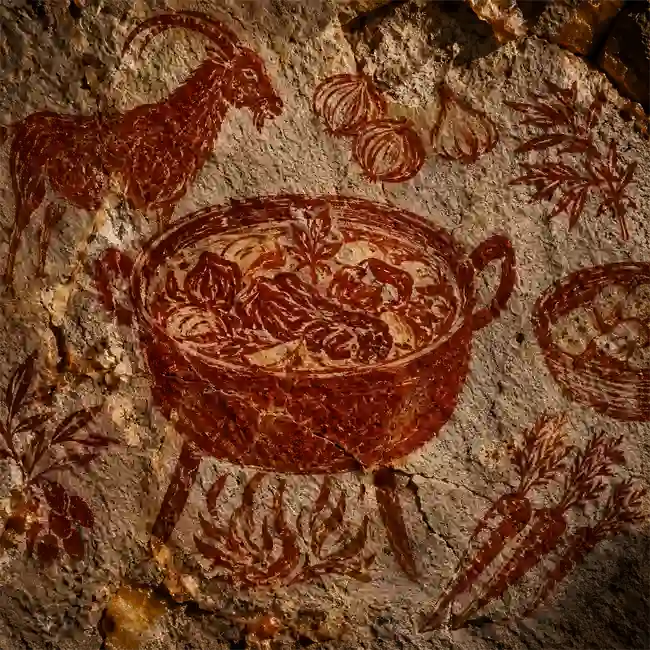
🍲 Recipe: Mycenaean Clay Goat Meat Stew
🗿 Legends Behind This Excavated Secret
Somewhere in the hills of the Peloponnese, archaeologists uncovered fragments of a thick-walled clay cooking pot, still coated in a dark, greasy residue after thousands of years. Bone fragments nearby told the rest of the story: goat, cracked for marrow, slow-cooked alongside legumes and wild greens. Nearby tablets recorded a "commensal ceremony" — essentially, a shared community feast tied to a royal or religious occasion, where dozens of animals were slaughtered and cooked to feed an entire settlement.
It's easy to imagine the scene: smoke rising from dozens of clay pots, the smell of stewed goat and herbs drifting through a palace courtyard, and a community coming together the way humans have for millennia — around food. This stew isn't just a meal. It's a fossil you can eat.
🌾 Ingredients & The Noble Pantry
🌟 The Ancestral Staples
Long before supermarkets, Mycenaean cooks worked with what the land and their palace stores provided. Goat meat was abundant, especially in rocky, hilly regions where cattle struggled to graze. Olive oil was already a treasured commodity, recorded meticulously on clay tablets as a valuable trade good. Grains like emmer wheat and barley formed the backbone of daily meals, while wild herbs, legumes, and foraged greens rounded out the flavor. Honey, figs, and onions added richness on special occasions, and sea salt — harvested from coastal flats — was used both for flavor and preservation.
This wasn't peasant food or royal food exclusively — it was adaptable, resourceful cooking built around whatever the season and the land offered.
🌟 Modern Substitutes
If you don't have easy access to true Bronze Age ingredients (understandable), here's how to bring this dish into your kitchen without losing its soul:
• Goat meat can be swapped for lamb shoulder or bone-in lamb shank if goat isn't available locally
• Emmer wheat can be replaced with farro, spelt, or pearled barley
• Wild greens can be substituted with kale, dandelion greens, or Swiss chard
• Fresh herbs like oregano, thyme, and bay leaf stand in beautifully for foraged Mediterranean herbs
• Honey should be raw and unfiltered if possible, to mimic the unrefined sweetness of ancient honey
• Olive oil should be extra virgin, cold-pressed, ideally a robust Greek or Mediterranean variety
• Dried legumes like chickpeas or fava beans replace ancient stored pulses
• Sea salt is preferred over table salt for a closer flavor profile
🌟 Ancient Proportions
Here's how to build the stew in balanced, easy-to-follow ratios:
• 2 pounds goat meat or lamb shoulder, bone-in, cut into large chunks
• 3 tablespoons extra virgin olive oil
• 1 large onion, roughly chopped
• 3 cloves garlic, crushed
• 1 cup dried chickpeas or fava beans, soaked overnight
• 1 cup pearled barley or farro
• 4 cups chopped leafy greens such as kale, chard, or dandelion greens
• 6 cups water or unsalted broth
• 2 tablespoons fresh oregano, chopped
• 1 tablespoon fresh thyme
• 2 bay leaves
• 1 tablespoon honey
• 1 teaspoon sea salt, adjusted to taste
• Optional: a handful of dried figs, chopped, for subtle sweetness
This ratio makes a hearty stew for about 6 people, which mirrors the communal, feast-style nature of the original dish.
🕯️ The Chef's Ancient Ritual
Think of this less like following a recipe card and more like performing a small ceremony, the way Mycenaean cooks might have approached a communal feast.
Start by warming the olive oil in a heavy pot — ideally something with thick walls, like a Dutch oven, to mimic the heat retention of ancient clay cookware. Brown the goat or lamb chunks on all sides, working in batches so the meat sears rather than steams. This step matters more than people think — it's where the deep, savory base flavor begins.
Once the meat has color, add the onion and garlic, letting them soften and turn fragrant. This is the moment your kitchen starts to genuinely smell like something ancient and comforting.
Add the soaked chickpeas or fava beans, along with the barley or farro. Pour in the water or broth, making sure everything is just covered. Toss in the bay leaves, and let the pot come to a gentle simmer — never a hard boil. Ancient cooks relied on slow, steady heat, and this stew rewards patience.
Let it simmer, mostly covered, for about two hours, stirring occasionally and topping up with water if it reduces too much. About thirty minutes before it's done, stir in the leafy greens, oregano, and thyme. Let them wilt down into the stew, softening completely.
In the final ten minutes, stir in the honey and adjust with sea salt to taste. If you're using dried figs, this is the moment to add them, letting their sweetness melt gently into the broth.
Once the meat is fork-tender and practically falling off the bone, it's ready. Ladle it into bowls, and if you really want to honor tradition, serve it with warm flatbread for scooping, just like it likely would have been eaten thousands of years ago.
🔑 Secrets of the Ancestral Hearth
• Never rush the browning step — a slow, deep sear on the meat builds the entire flavor foundation of the stew
• Avoid boiling the stew aggressively; ancient clay pots cooked low and slow, and modern pots should mimic that gentleness
• Soak your legumes overnight without skipping this step, or the stew will take far longer to reach the right texture
• Add greens toward the end of cooking, not the beginning, so they don't turn mushy or bitter
• Use bone-in meat whenever possible — the marrow adds richness that boneless cuts simply can't replicate
• Don't oversalt early; Mycenaean cooks adjusted salt gradually, tasting as they went, since salt was a valuable, carefully rationed resource
• If the stew tastes flat, a small spoonful of honey often balances it better than extra salt
• Let the stew rest for ten minutes off the heat before serving; the flavors settle and deepen
• Reheated the next day, this stew tastes even better, much like modern slow-cooked stews and braises
🗡️ Ancient Civilization Origins FAQ
Q1.Did the Mycenaeans really eat goat meat regularly?
Yes. Archaeological bone analysis and Linear B tablets confirm that goat and lamb meat were common, especially in island and hillside regions where cattle were less practical to raise compared to lowland farming areas.
Q2.What made this dish special enough to serve at feasts?
Communal feasts recorded on clay tablets describe large-scale animal slaughter tied to royal or religious ceremonies. A stew like this, made with dozens of animals, grains, and stored goods, would have fed entire communities during significant occasions.
Q3.Is this recipe historically exact, or an educated recreation?
It's an educated recreation. No literal ancient recipe survives — the tablets recorded inventories, not cooking instructions. This dish is carefully rebuilt using known ingredients, feasting records, and food archaeology research to stay as authentic as possible.
Q4.Can I make this dish vegetarian while keeping it historically inspired?
You can substitute the meat with extra legumes and mushrooms for umami depth, though it will move away from the documented meat-heavy feasting tradition of the Mycenaean elite.
🏺 The Taste of Archeology
There's something almost humbling about eating a dish this old. It's rustic, it's deeply savory, and it doesn't try to impress with complexity — because it didn't need to. The Mycenaeans built flavor through patience, quality ingredients, and communal cooking, not fancy technique. One spoonful, and you're tasting the same comfort that fed warriors, farmers, and kings alike thousands of years before written history as we know it even began.
🍽️ Final Thoughts: Bringing Antiquity to Your Modern Table
You don't need a palace, a clay oven, or a Bronze Age pantry to make this stew work in your own kitchen. All you really need is a good pot, a little patience, and a willingness to slow down. Cooking this dish is less about following exact steps and more about connecting with something incredibly human — the instinct to gather, cook, and share a meal with people you care about.
Try it on a slow weekend. Let the smell fill your kitchen for a couple of hours. Serve it with warm bread, and maybe tell whoever you're eating with the story behind it. Food history has a funny way of making a Tuesday night dinner feel a little bit sacred.
✨ The Golden Hook (The Sacred Union)
Here's the truth: recipes like this only survive because people keep cooking them. Every time someone recreates an ancient dish and shares it, they become part of an unbroken thread stretching back thousands of years. So if you make this stew, don't just eat it quietly — share it. Tell someone where it came from. Post about it, talk about it, pass it on. You're not just cooking dinner. You're helping keep a 3,500-year-old story alive for one more generation.
🙏 Credit to the Keepers of the Culture
None of this would exist without the archaeologists, historians, and food researchers who spend years piecing together burnt bone fragments, faded clay tablets, and ancient pottery residue just to answer one simple question: what did people actually eat? Deep respect goes to the scholars behind Linear B decipherment, the excavation teams working across Mycenae, Pylos, and Knossos, and the modern-day historians of Greek gastronomy who continue translating administrative records into genuine cultural understanding. This dish exists because they refused to let the past stay silent.
| 🏟️ 🏛️🍲 < Back |