
🏠 Home > 🗺️ Recipes > 🏛️🍯 Wild Earth Sweets & Foraged Bites > 🏟️ Mycenaean Greek: Wild Earth Sweets & Foraged Bites Recipes
🏟️ 🏛️🍯 Mycenaean Greek: Wild Earth Sweets & Foraged Bites Recipes
Published by Supakorn | Updated: September 2026
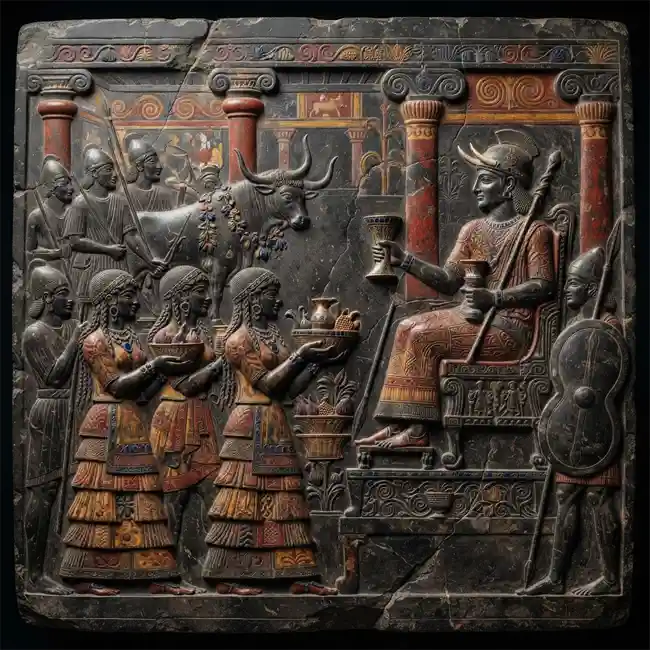
🏟️ The Storyteller’s Intro: 5,000 Years of Ancestral Flavors
Imagine walking across the rocky landscape of Bronze Age Greece.
The air is warm. Dry grasses move gently in the Mediterranean wind. Olive trees grow across the hills, figs ripen under the summer sun, and wild plants appear between stones, fields, paths, and woodland edges. Somewhere beyond the landscape stands a fortified Mycenaean palace, its massive stone walls rising above the surrounding countryside.
Inside that world, food was much more than something placed on a plate.
It was agriculture, seasonal survival, household knowledge, palace administration, religious practice, trade, storage, and connection with the landscape.
There is one important historical detail to clear up first. The Mycenaean world was not literally a 5,000-year-old civilization. The Mycenaean civilization belongs mainly to the Late Bronze Age, roughly from the seventeenth to the eleventh centuries BCE, with its palatial culture flourishing especially during the second millennium BCE. The famous palace centers and Linear B records belong principally to the later part of this story.
So why does the phrase “5,000 years of ancestral flavors” still feel appropriate?
Because the food traditions surrounding Mycenaean Greece grew from much older Aegean farming and foraging traditions. Long before the Mycenaean palaces, people in Greece were already cultivating grains, legumes, fruits, and other useful plants while gathering resources from the wild. Archaeobotanical evidence from earlier Greek communities demonstrates a surprisingly broad relationship between people and the plant world.
The Mycenaeans inherited and developed this long agricultural story.
And that is where Wild Earth Sweets & Foraged Bites becomes fascinating.
This is not a story about elaborate modern desserts. It is about sweetness discovered in nature, fruit preserved for later seasons, grains transformed into simple foods, nuts and wild resources gathered from the landscape, and ingredients that could move between everyday meals, palace stores, and sacred contexts.
The archaeological record does not give us a neat ancient cookbook with numbered recipes.
Instead, it gives us clues.
Clay tablets, charred seeds, fruit remains, storage vessels, ovens, animal bones, botanical remains, pottery, palace rooms, and religious records all contribute pieces to the larger puzzle.
The result is something much more interesting than a recipe book.
It is a food landscape.
🏛️ From Early Aegean Farming to the Mycenaean World
The Mycenaean food tradition did not suddenly appear when the great palaces were built.
It developed from earlier Aegean communities and was influenced by interaction with neighboring cultures, particularly Minoan Crete. The Mycenaeans eventually established powerful centers across mainland Greece, including Mycenae, Pylos, Tiryns, and other important settlements.
Their world was highly organized.
Palace centers were not simply grand residences. They functioned as administrative and economic hubs where goods, labor, land, craft production, and agricultural resources were managed.
This matters enormously when we talk about food.
A fig, a measure of grain, a jar of oil, or a quantity of honey could become part of a much larger system.
Food could be:
• grown by agricultural communities
• gathered from the landscape
• stored for later use
• distributed through administrative systems
• prepared for communal meals
• associated with religious offerings
• exchanged through regional and Mediterranean networks
• consumed within households
The famous Linear B tablets provide some of the clearest evidence.
These records were written in an early form of Greek and were primarily administrative documents. They list commodities, livestock, personnel, land, offerings, and distributions. Food-related entries include items such as grain, figs, olives, and olive oil, while religious records also refer to offerings including grain and honey.
That distinction is important.
When we talk about “ancient recipes,” we should not pretend that an archaeological tablet gives us a modern recipe card.
It usually does not.
Instead, the evidence allows historians and archaeologists to reconstruct what ingredients existed, where they appeared, how they were managed, and what roles they may have played.
That is where the real culinary mystery begins.
🍯 Why Honey Matters in the Story of Ancient Sweetness
If we imagine a Bronze Age Greek sweet flavor, honey is one of the most intriguing ingredients to place at the center of the story.
Before refined sugar became a common ingredient, natural sweetness had a very different character.
Honey was concentrated, aromatic, seasonal, and valuable.
Linear B evidence includes references to honey in connection with religious offerings, making it particularly interesting for understanding the cultural importance of sweetness in Mycenaean society.
Honey also makes sense within a landscape where people lived closely with flowering plants, cultivated fields, orchards, woodland, and Mediterranean vegetation.
That does not mean every sweet dish contained honey.
It means honey belonged to a culinary world in which natural sweetness could carry social and ritual meaning.
When combined conceptually with grains, dried fruits, nuts, or seeds, honey helps us imagine a type of food very different from modern confectionery.
Think rustic rather than refined.
Earthy rather than sugary.
Seasonal rather than industrial.
A small portion of grain or fruit could become something satisfying simply through drying, grinding, roasting, combining, and preserving.
That is the spirit behind the phrase Wild Earth Sweets.
🍇 The Sweet Pantry of the Mycenaean Landscape
🍯 Honey and Grain
Grain was fundamental to Bronze Age food systems.
At Mycenaean Tiryns, archaeobotanical research identifies barley as an important cereal, followed by einkorn and emmer wheat. These cereals appear alongside legumes, fruits, nuts, and other plant resources.
Grain could be ground into flour or processed into other staple foods.
For a modern reader, it is easy to think of grain only as bread.
But ancient grain foods could take many forms.
Porridge-like preparations, coarse grain foods, flatbreads, roasted grains, and other simple preparations would have offered practical ways to turn harvested cereals into daily nourishment.
When natural sweetness entered the picture, honey and fruit could transform otherwise plain grain into something more celebratory.
The exact combinations remain uncertain.
And that uncertainty is worth respecting.
Rather than inventing a “lost Mycenaean honey cake recipe,” it is more historically responsible to describe these foods as reconstructed culinary possibilities based on documented ingredients.
🍯 Figs: One of the Great Ancient Sweet Foods
Figs are especially important to the Mycenaean food story.
Linear B records include references interpreted as figs, while archaeobotanical research at Mycenaean sites has also recovered fig remains. At Tiryns, figs appear alongside grapes and olives among the plant remains identified from archaeological contexts.
Figs are naturally suited to preservation.
Fresh figs are delicate, but drying concentrates their sweetness and allows them to remain useful beyond the short fresh-fruit season.
That makes dried figs an ideal example of ancient food intelligence.
Nothing about the idea requires complicated technology.
The sun does much of the work.
Fruit is harvested.
Moisture is reduced.
Sweetness becomes concentrated.
The result becomes portable, storable, and useful across seasons.
For a Bronze Age household, this is not simply a dessert concept.
It is preservation technology.
🌰 Nuts, Seeds, and the Texture of the Wild
The archaeological plant record also reveals the importance of nuts and other plant resources.
At Mycenaean Tiryns, archaeobotanical remains include almond, while the wider Late Bronze Age food record includes evidence for a range of fruits, nuts, and wild resources.
Nuts could add richness and texture to otherwise simple foods.
This is another reason the phrase Foraged Bites works so well as a modern description of the culinary theme.
Ancient Mediterranean food was not divided as sharply as modern supermarket categories suggest.
The boundary between cultivated and gathered resources could be flexible.
People could farm grain and olives while also collecting useful plants, fruits, nuts, berries, or other resources from the surrounding landscape.
The countryside itself functioned as part of the pantry.
📜 Iconic Excavated Menus: Archaeological Names Behind the Mystery
One fascinating problem with Mycenaean food history is that we do not possess a surviving ancient menu written like a restaurant list.
So the following names are modern descriptive labels for historically attested ingredients and food traditions, not claims that Mycenaean cooks used these exact dish names.
🍯 Honey & Grain Sweet
A modern archaeological reconstruction concept based on the combination of documented grain resources and honey references.
The evidence supports the presence of cereals and honey, but not a surviving recipe specifying the exact proportions or cooking method.
🍇 Preserved Fig Bites
A descriptive name inspired by the strong evidence for figs in the Mycenaean food environment and the broader ancient Mediterranean practice of preserving fruit.
Figs were recorded in Linear B contexts and have been recovered archaeobotanically at Mycenaean sites.
🌰 Almond & Wild Fruit Gatherer’s Bite
A modern descriptive reconstruction inspired by archaeobotanical evidence for almonds and a wider collection of cultivated and wild plant resources.
The exact combination should be treated as an interpretation rather than a documented ancient recipe.
🍈 Olive & Fruit Pantry Foods
Olives were a major agricultural resource in the Mycenaean world. Archaeobotanical evidence at Tiryns records olive remains, while Linear B documentation also records olive-related commodities.
The olive therefore belongs firmly inside the story of Mycenaean food culture, even though it should not automatically be transformed into a sweet dish.
🌿 Wild Greens & Foraged Plant Foods
The wild plant component of Bronze Age diets is one of the most difficult areas to reconstruct.
Wild plants often leave less obvious archaeological traces than cultivated crops.
Research on Mycenaean plant use emphasizes that collected plants can be archaeologically underrepresented because they do not necessarily leave large seed surpluses.
That makes the wild-food story one of the most intriguing parts of ancient Greek gastronomy.
🗺️ Eating, Living, and Following the Mycenaean Food Landscape
Food culture makes much more sense when we step outside the kitchen.
Mycenaean society was deeply connected to its landscape.
The great palace centers depended on agricultural territories and organized systems of production and storage. Research on the Aegean Bronze Age emphasizes the importance of understanding how palatial states managed agricultural commodities and production.
For ordinary households, daily life was likely much more practical.
People needed to:
• cultivate fields
• harvest cereals
• process grain
• tend useful trees
• preserve seasonal fruits
• collect wild resources
• care for livestock
• store food
• cook with available fuel
• adapt meals to seasonal availability
The palace and household worlds were connected, but they were not identical.
The palace records show administrative control and redistribution.
Archaeological households show us storage spaces, cooking equipment, tools, and evidence of daily activity.
Together, these clues suggest that Mycenaean food culture was both centralized and local.
A palace could organize resources on a large scale.
A family still had to eat dinner.
That simple contrast gives the ancient food story its human character.
🏛️ Mycenae: The Citadel Behind the Culinary Myth
If you want to follow the food story physically, Mycenae is one of the most powerful places to begin.
The citadel is famous for its monumental fortifications, elite architecture, tombs, and association with the wider Mycenaean world.
The landscape around Mycenae helps explain why agriculture and food storage were so important.
The archaeological remains show a society capable of monumental construction, complex administration, craft production, and long-distance exchange. Mycenaean goods circulated widely around the Mediterranean.
Walking through the ruins today, it is tempting to imagine a palace kitchen filled with finished dishes.
But archaeology tells a subtler story.
What we can actually recover are fragments:
• storage vessels
• plant remains
• animal bones
• hearths and ovens
• pottery
• administrative tablets
• architectural spaces
• residues and deposits
Each one is a small piece of the culinary puzzle.
🏺 Pylos: Where Food Records Become Especially Valuable
Pylos is particularly important because its palace archive produced a large body of Linear B documentation.
The tablets provide evidence for administration, commodities, personnel, land, and religious activity.
This is one of the clearest places to see how food was connected to bureaucracy.
Imagine the difference between saying:
“People ate figs.”
and discovering administrative records showing that figs were part of a system in which commodities were counted, allocated, or recorded.
The second tells us something much larger.
Food was not simply consumed.
It was managed.
The Pylos evidence also contributes to our understanding of religious offerings and palace organization.
For anyone interested in ancient food history, this is where gastronomy meets archaeology.
🌿 Tiryns: A Window into Plants and Everyday Food
Tiryns offers another fascinating perspective.
Archaeobotanical studies have identified cereals, legumes, figs, grapes, olives, almonds, and numerous wild plant taxa in Mycenaean contexts.
This evidence is especially useful because seeds and plant remains can reveal something that palace records cannot.
They show what physically existed in the archaeological environment.
At Tiryns, researchers identified barley, einkorn, emmer, bitter vetch, lentils, chickpeas, peas, figs, grapes, olives, almonds, and other plant remains across different contexts.
Some wild plant remains may reflect natural vegetation, fuel, construction, or other activities rather than food.
That is another important archaeological lesson:
Finding a plant at an ancient site does not automatically prove that people ate it.
Context matters.
This is why serious ancient-food reconstruction combines written records, archaeobotany, archaeology, environmental evidence, and comparative research.
🚣 The Aegean Sea: A Food Highway of the Bronze Age
The Mycenaean world cannot be understood as an isolated mountain civilization.
The Aegean Sea connected communities.
Mycenaean goods and cultural contacts extended across the Mediterranean, with archaeological evidence showing connections reaching as far as the Levant and western Mediterranean.
That maritime environment mattered for food culture.
Ideas could travel.
Agricultural products could travel.
Ceramic containers could travel.
Seeds, spices, luxury commodities, and culinary habits could move between communities.
The sea was therefore not simply a geographical boundary.
It was a communication network.
This helps explain why Mycenaean cuisine should be imagined as part of a wider Bronze Age Mediterranean food system rather than as an isolated “Greek recipe tradition.”
🏜️ Dry Hills, Rocky Fields, and the Ancient Mediterranean Pantry
The Mycenaean landscape was not an endless field of fertile farmland.
Much of Greece is mountainous, rocky, and environmentally diverse.
This shaped food culture.
Agriculture had to work with local geography.
Wild plants occupied hillsides, woodland edges, uncultivated spaces, and seasonal environments.
Fruit trees could thrive in suitable locations.
Olive cultivation became increasingly important.
Cereals and legumes provided dependable staples.
Dried foods helped bridge seasonal gaps.
The result was a culinary system built around adaptation.
Modern food culture often celebrates abundance.
Ancient food culture often celebrated usefulness.
A food that could survive storage mattered.
A fruit that could be dried mattered.
A seed that could be stored mattered.
A plant that could be gathered when cultivated crops were limited mattered.
That practical relationship with the landscape is at the heart of Wild Earth Sweets & Foraged Bites.
⛪❓ Ancient Civilization FAQ: Unlocking Palace Kitchen Mysteries
Q1.Did the Mycenaeans really have written recipes?
Not in the way we understand recipes today.
Linear B documents are overwhelmingly administrative. They record commodities, allocations, personnel, land, offerings, and other economic information rather than giving step-by-step cooking instructions.
So it is more accurate to say that the tablets help identify ingredients and food-related systems rather than providing complete recipes.
Q2.Was honey important in Mycenaean culture?
Yes, honey appears in Linear B records, including religious offering contexts. This makes it particularly significant when discussing ancient Mycenaean sweetness and ritual food culture.
However, the evidence does not allow us to claim that every sweet food was honey-based.
Q3.Were figs actually eaten by the Mycenaeans?
Figs are supported by both textual and archaeological evidence.
Linear B records include references interpreted as figs, while archaeobotanical studies have recovered fig remains at Mycenaean sites such as Tiryns.
Q4.Did Mycenaeans eat wild plants?
The evidence suggests that wild plant resources formed part of the broader plant-use environment, but archaeologists must be careful when deciding whether a particular wild plant was actually consumed.
Some wild remains may represent fuel, natural vegetation, construction material, or other activities.
This is why archaeological context is essential when reconstructing ancient diets.
🧠 Final Thoughts: The Timeless Allure of Antique Gastronomy
The most fascinating thing about Mycenaean food is not that we can perfectly recreate a 3,500-year-old dessert.
We cannot.
And honestly, that uncertainty makes the story even more compelling.
The Mycenaean world left us fragments.
A tablet here.
A fig seed there.
A storage vessel.
An oven.
An almond shell.
A handful of grain.
A record of honey.
A palace room.
A landscape filled with olive trees, wild plants, fields, hills, and pathways.
When these fragments are placed together carefully, they begin to reveal an ancient relationship between people and food.
The sweetness was often natural.
The pantry was seasonal.
The landscape was part of the kitchen.
And preservation was a form of culinary wisdom.
Wild Earth Sweets & Foraged Bites therefore represents more than a collection of ancient ingredients.
It represents the idea that some of humanity's oldest culinary knowledge began with simply paying attention to what the land provided.
Honey.
Figs.
Grain.
Nuts.
Olives.
Wild plants.
Seasonal fruit.
These ingredients may look humble today, but within the Bronze Age Aegean they belonged to a sophisticated network of farming, storage, administration, ritual, household life, and exchange.
The next step is where the mystery becomes even more exciting: taking the documented ingredients and carefully exploring what historically responsible modern reconstructions might look like—without pretending that an invented recipe is an original Linear B recipe.
🏛️ Credit to the Keepers of the Culture: The Legacy
The story of Mycenaean food belongs first to the ancient communities who cultivated, gathered, prepared, stored, exchanged, and preserved these foods thousands of years ago.
Modern researchers only see fragments of their world.
Archaeologists, archaeobotanists, epigraphers, historians, conservators, museum professionals, and local heritage communities continue to piece those fragments together.
Their work reminds us that ancient cuisine should be approached with both imagination and restraint.
Where evidence is strong, we can speak confidently.
Where evidence is incomplete, we should say so.
Where a modern reconstruction is inspired by archaeological evidence, it should be presented as a reconstruction—not falsely labeled as an original ancient recipe.
That respect matters.
The ruins of Mycenae, Pylos, Tiryns, and other Bronze Age sites are not simply backgrounds for food stories.
They are cultural heritage.
They represent real communities, real landscapes, and generations of people whose everyday choices helped shape the ancient Aegean world.
And perhaps that is the most beautiful culinary secret of all.
Long before modern cookbooks, people were already learning how to turn the gifts of the earth into food worth remembering.
The palace walls may be silent, but the ancient pantry still has stories to tell.
🏛️🍯 Mycenaean Fig & Honey Bites: A Taste of Bronze Age Greece
👉 Unlock Mycenaean Greek: Wild Earth Sweets & Foraged Bites
| 🌐 🏛️🍯 < Back | 🏟️ 🍲 < Previous | Next > 🧪 🏟️ |