
🏠 Home > 🗺️ Recipes > 🏛️🌾 Primitive Grains & Flatbreads > 🧱 Ancient Egyptian: Primitive Grains & Flatbreads Recipes
🧱 🏛️🌾 Ancient Egyptian: Primitive Grains & Flatbreads Recipes
Published by Supakorn | Updated: July 2026
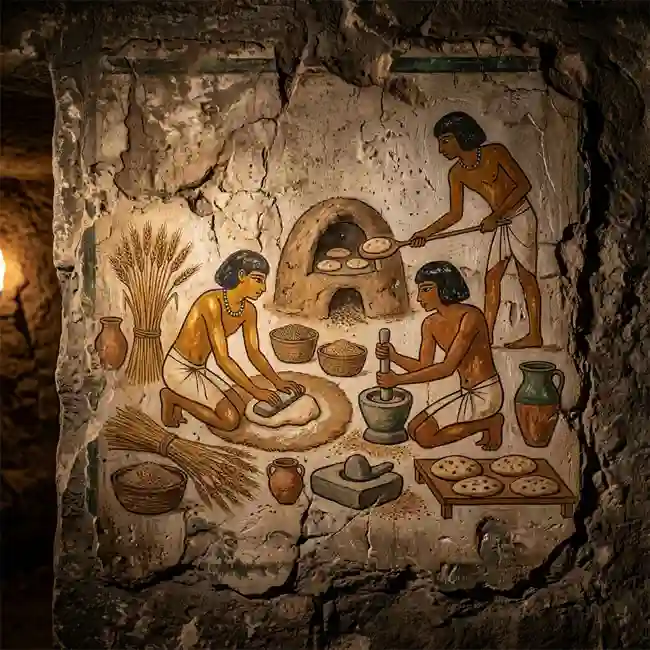
🧱 📜 The Storyteller’s Intro: 5,000 Years of Ancestral Flavors
Imagine stepping out of a time machine and right onto the sun-baked, muddy banks of the Nile River exactly five millennia ago. The air is thick with the scent of woodsmoke, river silt, and something undeniably comforting—the rich, nutty aroma of freshly baked flatbread. To the ancient Egyptians, bread wasn’t just a side dish or a convenient wrapper for a sandwich. It was the absolute epicenter of existence, the literal fuel that built the pyramids, and a divine gift from the gods themselves.
When we look back at the three grand eras of this majestic civilization—the Old Kingdom (the age of the great pyramid builders), the Middle Kingdom (a golden era of art and literature), and the New Kingdom (the empire-building age of Tutankhamun and Ramesses II)—one golden thread ties them all together. That thread is grain. Specifically, primitive grains like emmer wheat and barley. While dynasties rose, fell, and merged, the daily ritual of grinding grain and stoking the clay ovens remained an unbroken sacred rhythm.
In the Old Kingdom, breadmaking was already a highly specialized craft. Workers were paid directly in loaves of bread and jugs of non-alcoholic malted grain drinks, making food the actual currency of the state. By the time the Middle Kingdom flourished, baking techniques had evolved from simple ash-baked cakes to sophisticated molds shaped like cones and animals. When the New Kingdom arrived, the royal kitchens in Thebes were turning out dozens of distinct shapes and flavored varieties of flatbreads, proving that the ancient Egyptians were arguably the world's first true master bakers.
Every single grain of emmer wheat harvested along the Nile told a story of survival, reverence, and profound culinary innovation. The Egyptians mastered the art of working with wild yeasts, capturing the natural sourdough starters floating in the desert air to create breads that were light, chewy, and capable of keeping an entire empire satisfied. It is a legacy carved in stone, painted on tomb walls, and left behind in dry ceramic vessels waiting for us to uncover their secrets.
📜 Iconic Excavated Menus: From Clay Tablets to Pharaoh Tombs
Archaeologists poking around the dust of Giza, Amarna, and Luxor haven't just found gold and mummies; they’ve uncovered remarkably well-preserved bakeries and petrified remains of food. These findings, cross-referenced with hieroglyphic inscriptions and offering lists on tomb walls, give us a vivid picture of the exact menus enjoyed by both peasants and pharaohs. Here are some of the most iconic, historically documented ancient Egyptian bread types that have been rescued from the sands of time.
🌾 Ta-Ten (The Primordial Daily Flatbread)
This is the foundational bread of the ancient Nile valley. Ta-Ten translates roughly to "bread of the earth," and it was the daily staple for the common citizen. Made from roughly ground emmer flour, water, and a bit of wild sourdough starter, it was slapped directly onto the scorching hot inner walls of conical clay ovens. It was rustic, hearty, and packed with dense nutrition.
🌾 Kak-en-Shen (The Sacred Honey and Date Ritual Loaf)
Found explicitly listed in the offering inventories of elite New Kingdom tombs, Kak-en-Shen was a luxury bread reserved for the gods and the deceased nobility. This dough was enriched with precious ingredients like wild desert honey, mashed tiger nuts, and chopped dates. It was often shaped into intricate braids or geometric symbols before being baked.
🌾 Pessu (The Pyramidal Workers' Rations)
If you were a laborer working on the megalithic stones of the Giza Plateau, Pessu was your fuel. This was a thick, heavy, cone-shaped bread baked inside heavy ceramic pots nestled directly into hot embers. It had a thick, protective crust that prevented the interior from drying out in the intense desert heat, making it the perfect portable lunch for an ancient construction worker.
🌾 Heb-Sed Twists (The Royal Jubilee Celebration Bread)
Named after the Heb-Sed festival—a massive pan-Egyptian celebration where the Pharaoh would run a ritual course to prove his continued physical fitness—these breads were highly ornamental. Bakers would twist the emmer dough into complex animal shapes, lotus blossoms, or spirals, flavoring them with wild coriander and cumin seeds to delight the royal court.
🌾 Shat (The Layered Pastry Flatbread)
Arguably the ancestor of modern puff pastry or flaky flatbreads like feteer, Shat is depicted in the tomb of Rekhmire in Thebes. The process involved rolling emmer dough incredibly thin, slathering it with animal fat or clarified tiger nut oil, folding it multiple times, and baking it on flat stones. It was a decadent, flaky treat enjoyed during high-society banquets.
🗺️ Ancient Culinary Tourism: Mapping Flavors to Historic Landscapes
If you were to travel through ancient Egypt as a culinary nomad, your palate would change drastically depending on the landscapes you traversed. The geography of Egypt dictated exactly what arrived on your plate, creating a fascinating tapestry of regional flavors that mapped perfectly onto the historic kingdom.
◦ The Bustling Streets of Memphis: As the old administrative capital, Memphis was a melting pot of cultures. Here, the flatbreads were cosmopolitan. You would find bakeries experimenting with imported spices from early trade routes, blending emmer flour with ground fenugreek seeds to create aromatic, golden loaves that fueled merchants, scribes, and foreign diplomats.
◦ The Spiritual Heart of Abydos: Traveling south to the sacred city of Osiris, food took on a deeply spiritual tone. The flatbreads here were baked with absolute ritual purity. Travelers visiting the temples would partake in communal meals featuring plain, unblemished barley flatbreads meant to symbolize rebirth and the eternal cycle of vegetation.
◦ The Worker Villages of Deir el-Medina: Located on the west bank of the Nile across from Thebes, this was home to the artisans who cut and painted the Valley of the Kings. Walking through this ancient neighborhood, the smell of domestic baking would be everywhere. Families shared communal outdoor ovens, baking large batches of flatbreads infused with local wild herbs gathered from the valley edge.
◦ The Royal Palaces of Amarna: During Akhenaten’s brief religious revolution, the capital shifted to the desert sands of Amarna. Archaeological digs here revealed massive palace bakeries capable of producing thousands of loaves a day. The elite cuisine here focused on hyper-refined emmer flour, creating delicate, paper-thin flatbreads that accompanied lavish feasts under the open sun.
🚣 The Fertile Crescent & Nile Sovereignty: Riverbed Agriculture
You cannot talk about Egyptian bread without talking about the Nile. The ancient Egyptians called their land Kemet, meaning "the black land," a direct reference to the rich, dark, fertile soil left behind by the annual flooding of the river (the Inundation or Akhet). While the rest of the Middle East relied on sporadic rainfall within the Fertile Crescent, Egypt enjoyed a predictable, river-powered agricultural sovereignty that made it the breadbasket of the ancient world.
◦ The Miracle of the Black Silt: Every summer, monsoon rains in the Ethiopian highlands caused the Nile to overflow its banks, depositing millions of tons of nutrient-rich mineral silt across the valley. This natural fertilizer meant that Egyptian farmers didn't need complex plowing techniques; they simply scattered their primitive grains directly into the receding mud.
◦ The Domination of Emmer Wheat (Triticum dicoccum): Unlike modern wheat, which is easy to thresh, emmer is a hulled grain. The kernel is tightly locked inside a tough husk that protects it from pests and drought. Processing it required immense physical effort—soaking, parching, and pounding it with heavy pestles before it could be milled into flour. This grain gave ancient Egyptian flatbreads a distinctly nutty, dense, and incredibly nutritious profile.
◦ Barley as the Resilient Alternative: Alongside emmer, hulled barley (Hordeum vulgare) was widely grown. It tolerated saltier soils and drier conditions better than wheat. Barley flatbreads were coarser and heavier, representing the true, unpretentious food of the soil that sustained the pastoral communities and herdsmen along the delta borders.
◦ The Shadoof Innovation: As the centuries progressed, Egyptians mastered water management using the shadoof—a counterweighted lifting device that allowed farmers to irrigate higher fields during the dry season. This allowed for multiple grain crops a year, ensuring that the country’s flatbread production never ground to a halt, even during periods of low river flow.
🏜️ Oasis & Desert Trade Route Banquets: Caravan Luxuries
Beyond the lush green ribbon of the Nile valley lay the unforgiving, vast expanses of the Eastern and Western Deserts. Yet, these arid landscapes were far from empty. They were crisscrossed by bustling caravan trade routes that connected Egypt to the heart of Africa, the Red Sea, and the Levant. At the center of these routes were the isolated oases—pockets of green paradise that developed their own unique culinary identity.
◦ The Outpost Bakeries of Bahariya and Farafra Oases: These deep-desert sanctuaries were famous for their date palms and mineral-rich well water. The flatbreads baked here differed from the river valley varieties; they were often made by mixing emmer flour with sun-dried, pulverized dates, creating a long-lasting, sweet energy bread essential for desert survival.
◦ Caravan Bread Tech: Traveling across the Sahara required food that wouldn't spoil. Traders developed a technique of double-baking small, dense flatbread biscuits until they were bone-dry. Before eating, these rock-hard rations would be rehydrated in wild herb broths, stews, or water, acting as the ultimate survival food.
◦ The Influx of Exotic Trade Luxuries: When a wealthy caravan arrived from the trade routes, the local kitchens went into overdrive. Nomadic traders exchanged rare desert truffles, aromatic resins, and wild seeds for the Nile's abundant grain. Palace kitchens along the border zones would incorporate these exotic finds, creating limited-edition flatbreads flavored with mastic, fenugreek, and wild desert coriander.
◦ The Nomad-Settler Food Exchange: The borders of the desert were places of intense cultural exchange. Libyan nomads and Bedouins traded their sheep and goat cheeses with Egyptian farmers for emmer grain. This led to the creation of early "stuffed" flatbreads, where rustic dough was wrapped around fresh, salty curds and baked over open campfires under the desert stars.
✋ Ancient Civilization FAQ: Unlocking Palace Kitchen Mysteries
Q1.Was ancient Egyptian flatbread anything like the pita bread we eat today?
It was a direct ancestor, but with a few major differences. While it was a flat, yeast-leavened or unleavened bread baked at high heat (similar to modern pita or baladi bread), the texture was much denser and heartier. Because emmer wheat has a lower and different type of gluten structure compared to modern hybridized wheat, the bread didn't puff up into a perfectly hollow pocket as easily. It was thicker, coarser, and possessed a rich, nutty flavor profile that modern processed breads simply cannot replicate.
Q2.How did archaeologists find out the exact ingredients used 5,000 years ago?
Archaeology is secretly a bit like forensic food science. Scientists use a mix of archaeobotanical analysis, scanning electron microscopy (SEM) on petrified loaf fragments found in tombs, and chemical analysis of organic residues left inside ancient ceramic baking pots. By examining the cell structures of the ancient grains, starch granules, and even the fossilized yeast cells trapped in the pottery pores, they can piece together the exact strains of grain and the fermentation methods used by ancient bakers.
Q3.Did they use any sweeteners or spices in their daily bread making?
For the average everyday citizen, bread was kept simple—just flour, water, salt, and wild starter. However, for special occasions, religious festivals, or royal consumption, bakers got incredibly creative. They used wild desert honey, date syrup, and crushed figs for sweetness. For savory depths, they mixed in whole seeds like coriander, cumin, fenugreek, and fennel, which not only added incredible flavor but also helped preserve the bread.
Q4.Why was breadmaking considered a dangerous job in ancient Egypt?
While looking at tomb paintings makes baking look like a peaceful, artistic endeavor, the reality was grueling. Grinding emmer grain required women and workers to kneel on the floor for hours, rubbing grain against a flat stone called a saddle quern, which caused severe knee and spinal damage over time. Furthermore, the ancient clay ovens were heated with wood or dried animal dung inside enclosed, poorly ventilated spaces, exposing the bakers to intense heat, smoke, and accidental burns on a daily basis.
🧠 Final Thoughts: The Timeless Allure of Antique Gastronomy
There is something profoundly magical about realizing that the simple act of baking a flatbread connects us directly to a kitchen worker who lived 5,000 years ago. When we strip away the golden masks, the monumental stone temples, and the complex hieroglyphs, we find a culture of human beings who sat around fires, laughed, shared stories, and broke bread together.
The ancient Egyptians understood that food was life, art, and spirit all rolled into one. By exploring their primitive grains and understanding how they worked with the rhythms of nature, we don’t just learn about history—we learn how to reconnect with the pure, unadulterated roots of human sustenance.
Are you feeling inspired to channel your inner royal Egyptian baker? Keep your apron handy and your senses primed. In our upcoming guides, we will finally step into the kitchen, dust off our countertops, and reveal the step-by-step, authentic modern adaptations of these ancient recipes. Get ready to learn how to cultivate your own wild Nile-style sourdough starter, grind ancient grains, and bake genuine, aromatic emmer flatbreads right in your modern oven. Stay tuned, because the true secrets of the Pharaoh's kitchen are about to be unlocked!
🏛️ Credit to the Keepers of the Culture (The Legacy)
This culinary exploration would not be possible without the incredible, tireless work of global historians, experimental archaeologists, and Egyptian Egyptologists who have spent decades under the blazing sun uncovering the domestic side of ancient history. We owe an immense debt of gratitude to the curators of the Grand Egyptian Museum and worldwide institutions who preserve the delicate, petrified loaves of bread rescued from antiquity.
By studying the tomb paintings of Rekhmire, the ancient texts of Herodotus, and the biological discoveries made in the worker villages of Giza, these dedicated researchers have ensured that the culinary heritage of the Nile Valley was not lost to the sands of time. They have proven that history isn't just written by the sword; it is baked in the oven, preserved in the soil, and passed down through the eternal legacy of the human kitchen.
🏛️🌾 Unlocking the Secrets of the Pharaohs: The Resurrection of Egypt’s Sacred 5,000-Year-Old Imperial Grain Feast
👉 Unlock Authentic Ancient Egyptian: Primitive Grains & Flatbreads
| 🌐 🏛️🌾 < Back | Next > 🍖 🧱 |