
🏠 Home > 🗺️ Recipes > 🏛️🌾 Primitive Grains & Flatbreads > 🏯 Sanxingdui: Primitive Grains & Flatbreads Recipes > 🏛️🌾 1.Ancient Millet Hearth Flatbreads
🏛️🌾 Recreating the Ancient Flatbread Traditions of Sanxingdui
Published by Supakorn | Updated: September 2026
🐉🏺 Ancient Civilization Origins: Ancient Sichuan, China
🕯️ The Storyteller’s Intro: Echoes of Ancestral Flavors
Imagine standing beside an ancient settlement in what is now Sichuan, China.
The air is cool. Smoke drifts upward from a simple hearth. Somewhere nearby, grain is being crushed between stone surfaces. Hands shape a rough dough into small rounds, pressing them flat before laying them onto a heated surface.
There is no modern oven.
No measuring cup.
No printed cookbook.
No recipe card waiting beside the fire.
Instead, there is memory.
A handful of grain. A little water. Heat from the hearth. And knowledge passed from one generation to another.
This is the world that makes ancient Chinese food history so fascinating.
The Sanxingdui civilization, associated with the Chengdu Plain of present-day Sichuan, is one of the most remarkable archaeological traditions in ancient China. Its spectacular bronze masks, ritual objects, jade artifacts, pottery and other discoveries have revealed a society with a distinctive artistic and ritual culture.
But archaeology does not give us a complete cookbook.
That distinction matters.
The dramatic phrase “5000-Year Sanxingdui Flatbreads” works beautifully as an invitation into the ancient world, but there is currently no securely identified Sanxingdui clay tablet containing a flatbread recipe that allows us to say, “This is exactly what they ate.”
Instead, we can take what archaeology tells us about ancient grains, food processing and flat baked foods in prehistoric China and create a careful culinary reconstruction.
That is exactly what we are doing here.
The result is not a museum artifact on a plate.
It is a respectful taste experiment—a way of asking what a simple grain cake might have felt like beside an ancient hearth.
🌏 The Global Value of Antique Heritage
Ancient food heritage is valuable because food tells a different kind of historical story.
Bronze vessels can tell us about technology.
Palaces can tell us about political organization.
Burial objects can reveal beliefs and rituals.
But food can tell us about everyday survival.
What did people grow?
What could they grind?
How did they cook it?
What ingredients were available locally?
How did climate and geography shape their meals?
Across ancient China, millet played an important role in prehistoric food systems, while rice became especially significant in southern regions. Archaeological evidence from different parts of China shows that early communities processed grains into foods that could be boiled, steamed, baked or roasted. Discoveries from later prehistoric sites also demonstrate that millet was used to create shaped foods, including ancient cakes and flat baked products.
That broader evidence gives us a useful culinary window.
It also reminds us that ancient food history was never frozen in one place.
Crops traveled.
Techniques traveled.
People traveled.
Ideas traveled.
The history of grain foods in China reflects these movements over thousands of years. Archaeological evidence shows, for example, that wheat arrived in China through networks connecting Central Asia with the regions farther east, while millet traditions have much deeper roots in several parts of prehistoric China.
So when we recreate an ancient flatbread, we are not simply recreating lunch.
We are reconstructing a small piece of human history.
🔥 The Culinary Resurrection
There is something wonderfully humble about ancient flatbread.
It does not need elaborate decoration.
It does not require dozens of ingredients.
It does not depend on modern technology.
Its character comes from grain, water, hands and fire.
That simplicity makes it particularly suitable for historical food reconstruction.
Our version uses millet flour as the central ingredient because millet-based foods are strongly represented in the archaeological record of ancient northern and western China, including very old baked or shaped grain foods. However, this recipe should not be described as a proven Sanxingdui recipe. It is better understood as a Sanxingdui-inspired ancient Chinese flatbread reconstruction.
And honestly, that makes the story more interesting.
We are not pretending to possess a lost cookbook.
We are using archaeological clues to imagine what a simple ancestral grain cake could taste like.
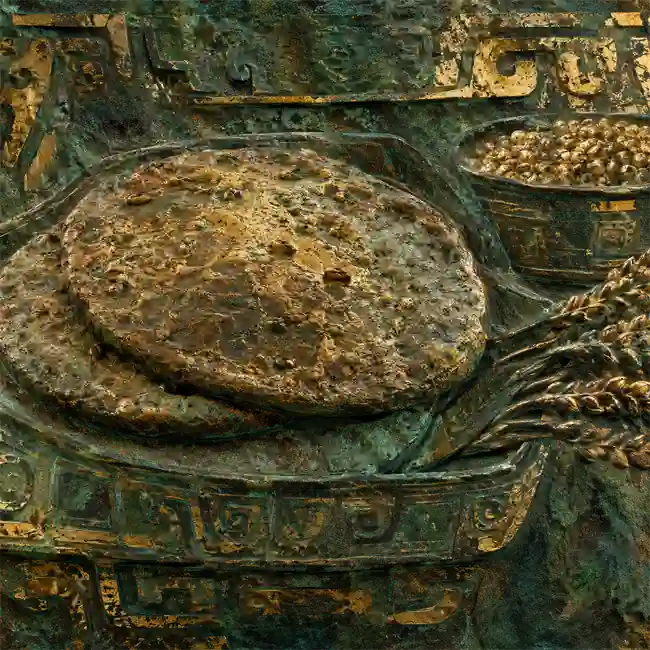
🍞 Recipe: Ancient Millet Hearth Flatbreads
🏺 Legends Behind This Excavated Secret
Picture the grain before it became flour.
It would have been harvested, dried and stored. At some point, someone would have needed to transform those hard grains into something easier to eat.
Grinding changed everything.
Once grain became meal or flour, it could be combined with water and transformed into something completely different.
A porridge could be made.
A steamed food could be prepared.
Or a rough dough could be shaped into a cake and cooked against intense heat.
This basic transformation appears again and again throughout ancient food history.
Archaeological discoveries from Xinjiang, for example, include ancient millet-based cakes and flat foods dating back thousands of years. Some were baked or roasted and retained visible grain particles, giving researchers clues about ancient processing techniques.
That evidence gives us a fascinating starting point.
Instead of imagining a perfectly smooth modern loaf, imagine something more rustic.
A little uneven.
Slightly smoky.
Dense but tender.
Full of the earthy aroma of toasted grain.
That is the spirit behind these flatbreads.
🌾 Ingredients & The Noble Pantry
🌿 The Ancestral Staples
For our reconstruction, the pantry is deliberately simple.
The goal is not to create a modern gourmet flatbread.
The goal is to get closer to the feeling of a basic ancient grain cake while still making something enjoyable in a modern kitchen.
Core ingredients:
• Millet flour — 200 grams
• Warm water — approximately 120–140 milliliters
• Rice flour — 30 grams
• Fine salt — 2 grams
• Sesame seeds — 10 grams, optional
• Neutral cooking oil — 1 teaspoon, optional for the modern pan
Millet flour provides the earthy foundation.
Rice flour helps create a slightly lighter texture and gives the finished bread a pleasant crispness around the edges.
Salt is a modern practical addition rather than something that should automatically be attributed to a specific Sanxingdui recipe.
Sesame seeds are optional and should be treated as a modern variation rather than an authenticated archaeological ingredient.
🔄 Modern Substitutes
Ancient cooks worked with whatever their local environment provided.
Modern cooks have the opposite problem: we have too many choices.
If millet flour is difficult to find, you can still make this recipe.
• Millet flour: substitute finely ground sorghum flour for a different ancient-grain character.
• Rice flour: use additional millet flour if necessary, although the texture will become denser.
• Sesame seeds: simply leave them out.
• Warm water: ordinary clean water works perfectly.
• Cooking oil: omit it if using a well-seasoned cast-iron or nonstick pan.
• Stone-ground millet flour: excellent if available because it creates a more rustic texture.
• Commercial millet flour: perfectly practical for a home kitchen.
For the closest rustic experience, avoid making the mixture extremely smooth.
A little texture is part of the charm.
⚖️ Ancient Proportions
Because no authenticated Sanxingdui recipe gives us exact measurements, these are reconstruction ratios, not archaeological measurements.
• Millet flour — about 6 parts
• Rice flour — about 1 part
• Water — about 3½–4 parts, adjusted gradually
• Salt — about 1/16 part
• Sesame seeds — up to 1/3 part, optional
• Oil — a very small amount, only if needed for modern cooking
The most important ratio is flour to water.
Start with less water.
Ancient-style grain cakes are easier to rescue when they are slightly dry than when the dough becomes overly wet.
🔥 The Chef’s Ancient Ritual
🥡 Step 1: Awaken the Grain
Place the millet flour and rice flour into a mixing bowl.
Add the salt.
Mix everything together.
Now slowly pour in the warm water.
Do not dump it in all at once.
Ancient cooks working without standardized measurements would have relied heavily on texture. We can imitate that approach.
Stir until the mixture begins forming a rough dough.
✋ Step 2: Bring the Dough Together
Use your hands to knead the dough gently.
It should feel soft but not sticky.
If it breaks apart immediately, add another teaspoon of water.
If it feels wet and sticky, add a little more millet flour.
You are looking for a dough that can be shaped without spreading across your hands.
Let it rest for about 10 minutes.
This is a modern convenience rather than a documented ancient ritual, but it gives the flour time to absorb moisture.
🔥 Step 3: Shape the Hearth Cakes
Divide the dough into approximately six portions.
Roll each portion into a ball.
Flatten each one with your palm.
Aim for a thickness of roughly 5–7 millimeters.
Do not worry about perfect circles.
In fact, slightly irregular edges make the finished flatbreads look much more rustic.
If using sesame seeds, gently press a few into the surface.
🏺 Step 4: Meet the Fire
Heat a heavy skillet over medium heat.
A cast-iron pan works particularly well.
Place one flatbread onto the dry surface.
Cook for approximately 2–3 minutes on the first side.
Turn it over.
Cook for another 2–3 minutes.
Continue turning occasionally until the surface develops toasted brown spots and the center feels firm.
If the outside becomes dark before the center cooks, lower the heat.
Ancient hearth cooking was all about controlling distance from the fire.
Your modern stove simply gives you a more predictable version of the same challenge.
🌾 Step 5: Listen to the Bread
This may sound strange, but the flatbread tells you when it is nearly ready.
The surface becomes drier.
The aroma changes from raw grain to toasted cereal.
The edges firm up.
You may hear tiny crackling sounds as moisture escapes.
That is your signal.
Remove the flatbread and let it rest for a minute.
Then taste it while warm.
🔥 Secrets of the Ancestral Hearth
🌡️ Secret 1: Do Not Rush the Heat
One of the biggest mistakes is using extremely high heat.
You might get attractive dark spots, but the inside can remain unpleasantly dense.
Medium heat gives the grain time to cook.
Think of the hearth rather than a fast-food griddle.
💧 Secret 2: Water Is Your Real Measurement
Do not obsess over the exact water number.
Different millet flours absorb water differently.
Humidity also changes dough texture.
Add water gradually until the dough holds together.
That approach is actually closer to how pre-modern cooks would have worked.
🌾 Secret 3: Rustic Texture Is a Feature
Do not expect wheat bread.
Millet contains no gluten, so the flatbread will not stretch like wheat dough.
The finished texture is more compact and crumbly.
That is not a failure.
It is part of the identity of the grain.
🔥 Secret 4: Avoid Burning the Grain
Millet can develop a wonderful toasted aroma.
But there is a thin line between toasted and burnt.
If your flatbread becomes black within the first minute, reduce the heat.
A deep golden-brown surface is usually much more pleasant.
🌋 Secret 5: Thin Cakes Cook More Easily
If this is your first attempt, make thinner flatbreads.
Around 5 millimeters is a good starting point.
Thicker versions can become dense in the middle.
Once you understand the dough, you can experiment with thicker cakes.
❌ Common Mistake: Adding Too Much Water
Wet dough creates difficult-to-handle flatbreads.
The surface may stick to your hands and pan.
Add water slowly.
❌ Common Mistake: Expecting Modern Bread
This is perhaps the biggest mistake.
Do not compare a millet hearth cake with a soft wheat sandwich loaf.
Ancient grain foods had different textures because the available grains and processing technologies were different.
The point is not to reproduce modern bread.
The point is to experience another possibility.
🏟️🏺 Ancient Civilization Origins FAQ
Q1.Are these really 5,000-year-old Sanxingdui flatbreads?
Not as an authenticated archaeological recipe.
The title uses “5000-Year” as an evocative historical framing, but the recipe itself is a modern reconstruction inspired by ancient Chinese millet food traditions. There is no known Sanxingdui recipe tablet establishing these exact ingredients and proportions.
Q2.What grains were important in ancient China?
Millet was especially important in several prehistoric northern Chinese agricultural traditions, while rice played a major role in southern China. Archaeological evidence also shows that wheat and barley entered China through long-distance movements from western regions.
Q3.Did ancient Chinese people really make flat cakes from millet?
Yes, archaeological evidence provides examples of ancient millet-based shaped foods and cakes. Discoveries from Xinjiang include millet cakes dating back more than 3,000 years, demonstrating that grain could be processed into baked or roasted foods.
Q4.Why use millet in this reconstruction?
Millet gives the recipe a stronger connection to documented prehistoric grain traditions than simply using modern wheat flour. It also creates an earthy, toasted flavor that feels very different from contemporary wheat bread.
🏺 The Taste of Archaeology
So what does the finished flatbread taste like?
The first impression is earthy.
Then comes a gentle toasted-grain flavor.
The outside can become slightly crisp while the center remains dense and tender.
There is no dramatic sauce.
No complicated filling.
No elaborate decoration.
And that is exactly what makes the experience interesting.
You are tasting the grain itself.
Imagine tearing a warm piece apart with your fingers.
The aroma is nutty.
The texture is rustic.
The flavor is mild enough to accompany other foods but distinctive enough to stand alone.
It feels less like modern bakery bread and more like a simple survival food transformed by human skill.
And perhaps that is the real culinary secret.
Ancient cooking did not always depend on complexity.
Sometimes civilization was expressed through the ability to take something as humble as grain and turn it into food that could nourish a family.
🍽️ Final Thoughts: Bringing Antiquity to Your Modern Table
Cooking an ancient-inspired recipe at home does not require pretending that we know everything about the past.
In fact, the opposite is more interesting.
We know some things.
We do not know others.
Archaeology gives us fragments: grains, pottery, grinding stones, cooking surfaces, residues and shaped food remains.
From those fragments, historians and food researchers can build interpretations.
Our kitchen reconstruction takes that idea one step further.
You can make these millet flatbreads on an ordinary evening.
Use a heavy skillet.
Mix the flour by hand.
Shape the dough roughly.
Listen to the surface as it cooks.
Then sit down and taste something inspired by food traditions that existed thousands of years ago.
You are not literally eating a preserved Sanxingdui recipe.
You are doing something more honest.
You are allowing archaeology to inspire your cooking.
And that distinction is important when exploring ancient food.
The past deserves imagination—but it also deserves accuracy.
If you want to make the experience even more atmospheric, serve the flatbreads warm beside simple grains, vegetables or other historically inspired dishes.
Keep everything uncomplicated.
Let the toasted grain remain the star.
🏮 The Golden Hook: The Sacred Union
Every ancient food tradition begins with something surprisingly human.
Someone grew the grain.
Someone harvested it.
Someone stored it.
Someone ground it.
Someone discovered that heat transformed it.
And someone taught another person how to repeat the process.
That chain of knowledge is the real culinary treasure.
Across thousands of years, countless recipes disappeared because they were never written down.
Others survived because people kept making them.
Today, we have the extraordinary opportunity to bring some of those ancient food ideas back into our kitchens—not by inventing historical facts, but by carefully connecting archaeological evidence with responsible modern reconstruction.
That is how ancient culinary heritage stays alive.
So make a batch.
Share it with your family.
Tell someone where the inspiration came from.
Talk about the ancient grains.
Talk about archaeology.
Talk about the people behind the artifacts.
Because preserving food heritage is not only about preserving recipes.
It is about preserving curiosity.
And sometimes, one humble flatbread is enough to start that conversation.
🏺 Credit to the Keepers of the Culture: The Legacy
This recipe should be understood as a modern culinary reconstruction inspired by archaeological evidence from ancient China, rather than as a directly excavated Sanxingdui recipe.
Ancient food research depends on archaeologists, archaeobotanists, historians, museums, local communities and cultural institutions that preserve evidence from the past. Archaeological discoveries of ancient grains and shaped foods provide valuable clues, but they do not always reveal the complete cooking process or original ingredient proportions.
A responsible adaptation should therefore clearly separate documented evidence from culinary interpretation.
Heritage Note:
“This recipe is inspired by archaeological evidence for ancient Chinese grain foods and millet-based cakes. The measurements have been adapted for modern kitchens, while the recipe is presented as a respectful culinary reconstruction rather than an authenticated Sanxingdui recipe.”
The ancient world left us fragments.
A grain.
A cooking vessel.
A grinding stone.
A burned food residue.
A carefully preserved archaeological layer.
We may never recover every recipe.
But by studying those fragments responsibly, we can still listen to the culinary echoes of the people who came before us.
And perhaps that is the most beautiful secret of all:
The recipe may be lost, but the story does not have to be.
| 🏯 🏛️🌾 < Back |