
🏠 Home > 🗺️ Recipes > 🏛️🍖 Hearth-Roasted Mains > 🏰 Proto-Nordic Tribes: Hearth-Roasted Mains Recipes
🏰 🏛️🍖 Proto-Nordic Tribes: Hearth-Roasted Mains Recipes
Published by Supakorn | Updated: October 2026
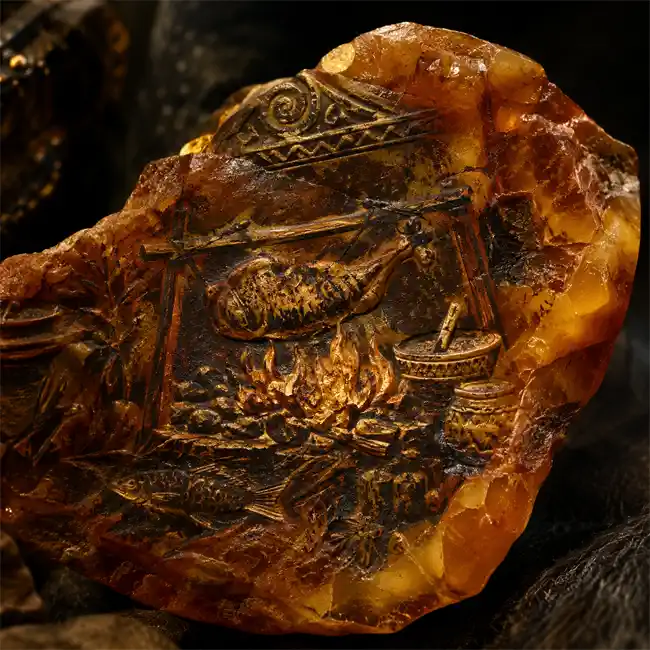
Historical note: The phrase “Proto-Nordic Tribes” is useful as a thematic label, but it should not be treated as the literal name of a single 5,000-year-old people. The Proto-Norse language belongs much later, roughly the 2nd–8th centuries CE. Around 5,000–6,000 years ago, Scandinavia was home to several prehistoric cultural traditions, including the Funnel Beaker and Pitted Ware cultures. This article therefore explores the ancestral foodways that later became part of the broader Nordic culinary landscape, rather than claiming that written Proto-Nordic recipes existed in 3000 BCE.
⛓️📜 The Storyteller’s Intro: 5,000 Years of Ancestral Flavors
Imagine standing beside a prehistoric Scandinavian hearth nearly 5,000 years ago.
There is no modern kitchen. No oven with temperature controls. No cookbook sitting on a shelf. No neatly measured recipe telling you how many minutes a piece of meat should cook.
Instead, there is fire.
A heavy stone-lined hearth glows in the darkness. Smoke rises into the cold northern air. Around it, people prepare food using tools made from stone, wood, bone, and eventually copper. Someone tends the embers. Someone else cuts meat. Others prepare gathered plants, cereals, fish, or dairy foods.
This is the world behind the evocative idea of Proto-Nordic hearth-roasted mains.
But the historical story is even more fascinating when we step away from the romantic image of a single “Nordic tribe.”
Around 4000 BCE, farming communities associated with the Funnel Beaker Culture spread into southern Scandinavia and introduced domesticated cattle, pigs, sheep, and crops. At the same time, older hunting, fishing, and gathering traditions remained deeply important.
Then came different regional developments.
The Pitted Ware Culture, emerging around 3400 BCE, was particularly connected with coastal and maritime lifeways. Archaeological evidence suggests that many communities continued to depend heavily on hunting, fishing, and gathering, even while small-scale cultivation also appeared in some places.
So when we talk about ancient Scandinavian hearth food, we're really looking at a long conversation between farming, hunting, fishing, gathering, seasonal movement, and communal feasting.
🕯️ From Mesolithic Hearths to Neolithic Food Traditions
The story did not begin exactly 5,000 years ago.
Scandinavian food traditions stretch much further back into the Mesolithic period, when hunter-gatherer communities relied heavily on wild resources.
The Ertebølle tradition, for example, belongs to the later Mesolithic, before the arrival of farming communities. By approximately 4000 BCE, the Funnel Beaker horizon marked a major transformation as agriculture and domesticated animals became established in parts of Scandinavia.
That transition did not mean that people suddenly stopped eating wild foods.
Quite the opposite.
Archaeological evidence shows a mixed world in which:
• Wild game remained important.
• Fish and marine resources remained central in coastal regions.
• Cattle, pigs, sheep, and other domestic animals became part of food production.
• Cereals gradually entered everyday and ceremonial food systems.
• Dairy products were already being consumed in Neolithic Scandinavia.
• Gathered plants continued to supplement cultivated foods.
Evidence from Neolithic pottery has even revealed traces associated with dairying, demonstrating that animal products were not limited to meat alone.
That makes the ancient Scandinavian hearth much more interesting than simply a place where meat was roasted.
It was the center of an entire food system.
🔥 Why the Hearth Mattered So Much
A hearth was not simply a cooking appliance.
It was a practical center of daily life.
Fire could transform tough meat into something edible, heat water, process plants, dry food, provide warmth, and create a gathering place for families or communities.
For larger animals, direct roasting would have required considerable skill. Meat could be positioned near hot embers, suspended above a fire, placed on heated stones, or prepared through other forms of controlled heat.
The exact techniques varied, and archaeology rarely gives us a complete cooking instruction manual.
That is precisely why the surviving evidence is so valuable.
Charred food remains, animal bones, pottery residues, hearths, tools, and chemical traces can collectively reveal pieces of the ancient menu.
We don't always know the original name of a dish.
But we can often identify the ingredients, environment, cooking technology, and social setting in which food was consumed.
📜 Iconic Excavated Menus: Archaeological Names Behind the Hearth
One of the most important things to understand about prehistoric Scandinavian cuisine is that archaeologists generally do not possess written menu names from 5,000 years ago.
There were no surviving restaurant menus saying “Hearth-Roasted Deer” or “Ancient Nordic Pork Feast.”
Instead, modern researchers reconstruct food categories from archaeological evidence.
So the names below are archaeological or descriptive modern labels, not claims that prehistoric cooks called them these exact names.
🦌 1. Hearth-Roasted Red Deer
Red deer were among the wild animals represented in Scandinavian archaeological assemblages.
Their bones tell stories about hunting, butchery, marrow extraction, feasting, and waste.
A modern descriptive name such as Hearth-Roasted Red Deer therefore captures one plausible culinary interpretation of the evidence.
The important point is not the modern recipe name.
It is the relationship between:
• Hunting
• Seasonal landscapes
• Large-game processing
• Fire-based cooking
• Communal consumption
Red deer could provide meat, fat, marrow, hides, antler, and bone.
For prehistoric communities, an animal was far more than a single meal.
🐗 2. Wild Boar and Pig Hearth Mains
Wild boar appears in archaeological evidence from prehistoric Scandinavia, while domesticated pigs became part of Neolithic farming systems.
This creates an interesting overlap between wild hunting and managed livestock.
The idea of a prehistoric pork-centered hearth meal is therefore archaeologically plausible in appropriate contexts, although the exact preparation remains uncertain.
Some Neolithic evidence even connects cereal use with pork during ritual feasting contexts, suggesting that meat and emerging agricultural foods could meet at the same communal table.
🐂 3. Neolithic Cattle Hearth Roast
Cattle were among the major domestic animals introduced with farming in southern Scandinavia.
They were valuable animals.
They provided:
• Meat
• Milk
• Hide
• Bone
• Labor in later agricultural development
• Social and economic value
Archaeological evidence shows that cattle, pigs, and sheep/goats were present in Neolithic Scandinavian communities, although their relative importance differed between regions.
A reconstructed Neolithic Cattle Hearth Roast should therefore be understood as a modern descriptive title inspired by archaeological evidence, rather than a recovered ancient recipe.
🐑 4. Sheep and Caprine Feasting Meat
Sheep were also part of the Neolithic livestock economy.
Interestingly, modern scientific analysis can sometimes identify animal remains more precisely than earlier archaeology could.
ZooMS research on Funnel Beaker sites in Sweden, for example, identified numerous samples as sheep while finding no confirmed goat among the tested material.
This reminds us that even apparently simple categories such as “sheep and goat” can change as archaeological science becomes more sophisticated.
🦌 5. Red Deer, Elk, and Boar Hunting Assemblages
Some archaeological sites contain unusual concentrations of wild animal remains.
At Kainsbakke in Denmark, for example, researchers identified substantial remains including bear, red deer, European elk, and boar, with evidence suggesting connections between communities across the Scandinavian region.
These discoveries are particularly fascinating because they can point beyond ordinary household meals.
They may reflect:
• Hunting events
• Community gatherings
• Exchange
• Ritual activity
• Special feasts
• Social relationships between distant groups
In other words, an ancient “main course” could sometimes be part of a much larger social event.
🐟 6. Fish-Based Hearth and Pot Foods
Not every ancient main meal revolved around large terrestrial animals.
For coastal communities, fish and marine resources could be fundamental.
Archaeological research on Pitted Ware communities shows strong connections with maritime subsistence, including fishing and hunting marine animals.
This creates another side of prehistoric Scandinavian cuisine:
the hearth was connected to the sea.
Fish could be cooked, processed, dried, or combined with other available ingredients.
Some archaeological pottery residues have even provided evidence for fish-based food preparations, showing that ancient Scandinavian cooking was not limited to roasting.
🗺️ From Hearth to Homeland: Living, Eating, and Traveling Through Ancient Scandinavia
To understand ancient food, you have to understand the landscape.
The people of prehistoric Scandinavia did not experience food as something separated from geography.
The landscape itself was the pantry.
Forest.
Coast.
Wetland.
Meadow.
River.
Lake.
Farm.
Each environment offered different resources.
🌲 Forest Communities and Seasonal Food
Forests provided wild animals, berries, nuts, roots, plants, timber, and fuel.
For hunters, the forest was also a source of game.
For farming communities, woodland was gradually transformed through land management, grazing, cultivation, and the collection of firewood.
This meant that ancient food was strongly seasonal.
A community's diet could change dramatically throughout the year.
🏡 Longhouses, Farms, and the Shared Hearth
The emergence of farming introduced a different relationship with food.
Instead of relying exclusively on wild resources, communities could manage livestock and cultivate crops.
Archaeological evidence indicates that farming was established in southern Scandinavia during the Early Neolithic, alongside domesticated animals and cereal cultivation.
The household therefore became increasingly connected to:
• Livestock management
• Crop cultivation
• Food storage
• Cooking
• Dairy production
• Seasonal labor
• Communal eating
The hearth was part of that system.
🪔 Monumental Landscapes and Feasting
Perhaps one of the most mysterious aspects of Neolithic Scandinavia is the relationship between food and monumental architecture.
Funnel Beaker communities built impressive megalithic tombs and other monumental structures.
These places were not simply construction projects.
They were social landscapes.
Food may have played an important role in gatherings connected with monuments, burial traditions, and communal identity.
Archaeological research increasingly considers feasting and the mobilization of food resources when studying Neolithic monumentality and social organization.
That gives the humble roasted meal a much larger meaning.
It could represent hospitality.
Community.
Memory.
Status.
Ritual.
Belonging.
🌊 The Ancient Scandinavian Waters: Food Along the Baltic and Kattegat
The ancient Nordic food story cannot be separated from water.
The Baltic Sea, Kattegat, Danish straits, lakes, rivers, and coastal wetlands formed major ecological corridors.
The Pitted Ware Culture is particularly important here.
Emerging around 3400 BCE, Pitted Ware communities were strongly associated with coastal areas and maritime subsistence. Archaeological research indicates continued reliance on hunting, fishing, and gathering, even though cereal cultivation was also present in some regions.
This means that the ancient Scandinavian kitchen was never simply a “meat kitchen.”
It was a flexible system.
Depending on where people lived and the season, a meal might draw from:
• Fish
• Seal and other marine resources
• Wild game
• Domestic animals
• Cereals
• Dairy products
• Wild plants
• Nuts and gathered foods
The exact balance changed from place to place.
That regional diversity is one of the most important lessons from the archaeology.
🧭 Ancient Nordic Food Tourism: Following the Hearth Across Scandinavia
If you want to imagine a modern journey through the archaeological landscape of ancient Scandinavian food, think less about finding one “Proto-Nordic palace.”
There were no Viking castles waiting in the landscape 5,000 years ago.
Instead, imagine following a network of prehistoric landscapes.
🌟 🇩🇰 Denmark: Funnel Beaker Landscapes
Denmark is essential for understanding the early agricultural transformation of Scandinavia.
Here, Funnel Beaker communities left behind pottery, settlements, monuments, animal remains, cereals, and other evidence of changing food practices.
The landscape provides a remarkable opportunity to explore how farming, hunting, livestock, and monumental traditions became intertwined.
🌟 🇸🇪 Sweden: Megaliths, Farms, and Maritime Communities
Sweden provides another fascinating route.
Sites associated with Funnel Beaker and Pitted Ware traditions reveal very different relationships with food.
In some regions, agriculture became increasingly important.
In others, maritime hunting and gathering remained central.
This contrast is one reason prehistoric Scandinavian cuisine should never be treated as a single uniform tradition.
🌊 The Kattegat Connection
The waters between Denmark and Sweden were not necessarily barriers.
Archaeological research has identified evidence for movement and interaction across the Kattegat during the Middle Neolithic.
That means food traditions could travel with people, animals, pottery, technologies, and ideas.
The ancient Scandinavian world was interconnected long before modern borders existed.
🏛️ What Archaeology Really Tells Us About Ancient Hearth-Roasted Mains
The phrase “ancient recipe” can sometimes be misleading.
A 5,000-year-old archaeological site rarely gives us everything needed to reproduce an exact dish.
Instead, researchers work with fragments.
A bone.
A charred grain.
A residue inside pottery.
A cooking vessel.
A hearth.
A butchered animal.
A chemical signature.
A settlement layer.
A burial context.
Each clue contributes to the larger story.
🔥 The Strongest Evidence
For ancient Scandinavian hearth cuisine, particularly useful evidence includes:
• Animal bones showing which species were consumed.
• Cut marks revealing butchery practices.
• Burn marks indicating exposure to fire.
• Split bones suggesting marrow extraction.
• Charred cereals revealing crop use.
• Pottery residues revealing what vessels once contained.
• Lipid analysis revealing animal fats and dairy products.
• Isotopic studies helping reconstruct diets.
• Hearth remains showing where cooking and heating took place.
Modern archaeology can therefore reconstruct ancient food systems without pretending that every detail is known.
And that distinction matters.
It is better to say “archaeological evidence suggests” than to invent a recipe and present it as historical fact.
⚔️❓ Ancient Civilization FAQ: Unlocking Prehistoric Scandinavian Food Mysteries
Q1:Was there really a Proto-Nordic tribe 5,000 years ago?
Not in the strict historical or linguistic sense.
The term Proto-Norse refers to a much later Germanic language stage, broadly associated with the first millennium CE.
Around 5,000 years ago, Scandinavia contained different Neolithic cultural communities, including Funnel Beaker and Pitted Ware traditions.
For that reason, “Proto-Nordic” is best used here as a modern umbrella concept for ancestral Scandinavian foodways, not as the archaeological name of one unified tribe.
Q2:Did ancient Scandinavians really roast whole animals over a hearth?
Fire-based cooking and the consumption of hunted and domesticated animals are strongly supported by archaeological evidence.
However, archaeology does not always preserve enough information to determine the exact cooking technique for every individual animal.
So “hearth-roasted” is a reasonable reconstruction for some food contexts, but it should not be presented as the confirmed cooking method for every archaeological find.
Q3:What meat did Neolithic Scandinavians eat?
The answer depended heavily on region and period.
Archaeological evidence includes domestic cattle, pigs, sheep, and wild animals such as red deer, boar, elk, and other game. Coastal groups also relied heavily on aquatic resources.
Q4:Did they eat cereals 5,000 years ago?
Yes.
Funnel Beaker communities cultivated cereals, and archaeological evidence also shows cereal use among some Pitted Ware communities.
Research from Sweden and the Åland Islands has identified barley and wheat dating to around 3300 BCE, while the broader Neolithic farming tradition in Scandinavia began earlier.
This is one of the reasons ancient Nordic food should not be imagined as nothing but roasted meat.
🧠 Final Thoughts: The Timeless Allure of Antique Gastronomy
There is something deeply compelling about an ancient hearth.
Perhaps it is because fire makes the past feel almost tangible.
We can imagine the smoke.
We can imagine the crackling wood.
We can imagine people gathering after a long day of hunting, farming, fishing, or building.
But the real magic of prehistoric Scandinavian cuisine is not simply the idea of eating meat beside a fire.
It is the relationship between food and landscape.
A deer connected people to the forest.
A fish connected them to the sea.
Cattle connected them to farming.
Cereals connected them to cultivated land.
Dairy connected them to livestock management.
A communal feast connected individuals to one another.
And the hearth brought many of those worlds together.
The archaeological record also teaches us to be careful with the word “recipe.”
There are no surviving 5,000-year-old Scandinavian cookbooks giving us exact ingredient quantities and cooking times.
What we have is arguably more fascinating:
evidence.
Bones.
Pottery.
Charred grains.
Hearths.
Tools.
Residues.
Settlements.
Monuments.
Burials.
Together, these fragments allow us to reconstruct the atmosphere of an ancient food culture without pretending to know what cannot be known.
That is where the true mystery of Proto-Nordic Hearth-Roasted Mains begins.
The full recipes can come later.
For now, we are standing beside the fire, looking backward through thousands of years of northern European history.
And the hearth is still glowing.
🏛️ Credit to the Keepers of the Culture: The Legacy
The ancient food traditions discussed here belong to the deep archaeological heritage of Scandinavia and northern Europe, not to a modern restaurant, invented dynasty, or single “Proto-Nordic” kingdom.
Respect should be given to:
• The prehistoric communities whose everyday lives created these food traditions.
• Archaeologists who excavate fragile evidence from settlements, wetlands, graves, and ancient landscapes.
• Zooarchaeologists who reconstruct animal use from bones.
• Archaeobotanists who identify ancient crops and wild plants.
• Researchers using residue, lipid, isotope, and DNA analysis to reveal prehistoric lifeways.
• Museums and archaeological institutions that preserve these discoveries for future generations.
• Modern Scandinavian communities who continue to engage with their deep regional heritage.
Most importantly, ancient cuisine should be approached with curiosity rather than certainty.
Where the evidence is strong, we can tell the story confidently.
Where the evidence is incomplete, we should leave room for mystery.
That balance is what makes the study of ancient food so exciting.
The hearth may be ancient—but the questions it raises are still alive today.
🏛️🍖 A Nordic Hearth-Roasted Fish Inspired by Ancient Coastal Kitchens
👉 Savor Proto-Nordic Tribes' Hearth-Roasted Mains
| 🌐 🏛️🍖 < Back | 🏰 🌾 < Previous | Next > 🍲 🏰 |