
🏠 Home > 🗺️ Recipes > 🏛️🍲 Clay-Pot Broths & Stews > 🗿 Olmec: Clay-Pot Broths & Stews Recipes > 🏛️🍲 1.The Jade Hearth Broth — Olmec Clay-Pot Maize, Bean and Cacao Caldo
🏛️🍲 The Broth That Built Mesoamerica's First Civilization — And How to Cook It Again
Published by Supakorn | Updated: October 2026
🛎️🐆 Ancient Civilization Origins: The Olmec Heartland of the Mexican Gulf Coast
📜 The Storyteller's Intro: Three Thousand Years of Ancestral Flavors
Picture this. It's somewhere around 1200 BCE, and you're standing in a clearing in what we now call Veracruz, Mexico. The air is thick — the kind of humid heat that sits on your skin like a wet cloth. Somewhere behind you, a river moves slow and brown through the jungle. And in front of you, half-buried in a bed of glowing coals, sits a round-bellied clay pot the color of dried blood.
Inside that pot, something has been murmuring away since before dawn.
That's not a metaphor, by the way. Low-simmering broth in a thick clay vessel makes an actual sound — a soft, irregular tok... tok... tok as bubbles release against the walls. The people tending that fire heard it every single day of their lives. It was the background noise of their civilization, the way traffic is the background noise of ours.
These were the Olmec. Mesoamerica's "mother culture." The people who carved those seventeen colossal basalt heads, some weighing more than twenty tons, hauled over sixty miles of swamp without a single wheel or draft animal. They built the first true cities in the Americas. They worked jade like no one before them. And historians love to talk about all of that — the monuments, the ballgame, the were-jaguar iconography.
Almost nobody talks about what they ate.
Which is strange, honestly, because you don't move a twenty-ton stone head on an empty stomach. Everything the Olmec achieved was powered by something — and increasingly, archaeology points at a humble, endlessly-simmering pot of maize-and-bean broth as the fuel that made it possible.
🌍 The Global Value of Antique Heritage
Here's the thing that makes this recipe genuinely important rather than just a fun curiosity.
The Olmec didn't just cook maize. They figured out how to unlock it. Sometime in the deep past — the exact date is still argued over, but the technique was certainly in place across Mesoamerica by Olmec times — someone discovered that if you soak dried maize kernels in water mixed with wood ash or powdered limestone, then cook them, something remarkable happens. The tough outer skin slips off. The grain softens. It smells different, sweeter, almost floral.
We call that process nixtamalization, from the Nahuatl words for ashes and maize dough. And what it actually does, chemically, is make the niacin (vitamin B3) in maize bioavailable to the human body, while boosting usable calcium and improving the protein profile.
Why does that matter? Because maize-dependent populations that skipped this step later in history — in parts of Europe and the American South after maize crossed the Atlantic — suffered devastating outbreaks of pellagra, a niacin-deficiency disease that causes dermatitis, diarrhea, dementia and death. Mesoamerica, which ate maize as its absolute staple for thousands of years, largely avoided this.
Think about that for a second. A food-processing technique, developed with no microscopes and no chemistry, protected millions of people across three millennia. It is, by any reasonable measure, one of the most important culinary discoveries in human history — and it was passed down through clay pots and grandmothers, not textbooks.
🔥 The Culinary Resurrection
So why did the broth itself vanish?
Partly because broths don't fossilize. A stone head survives three thousand years. A pot of soup survives about four days. What archaeologists actually recover are the containers — and here the Olmec sites are generous. Excavations at San Lorenzo and La Venta have produced enormous quantities of ceramic vessels, many of them thick-walled, round-bottomed cooking pots blackened with soot on the outside and scaled with residue on the inside.
Modern residue analysis is where it gets exciting. Scientists can now scrape the microscopic pores of ancient ceramics and identify starch grains, phytoliths and chemical markers left behind by what was cooked in them. Across Olmec and Olmec-adjacent sites, the same signatures keep appearing: maize, beans, chile, squash, and — famously — theobromine, the chemical fingerprint of cacao.
Yes. Cacao. In cooking pots, not just ceremonial cups.
So the recipe below isn't a transcription of an ancient manuscript — the Olmec left us a script we still cannot fully read. It's a reconstruction: built from residue science, from the surviving pot shapes, from what grew in that specific wet lowland environment, and from the living traditions of Gulf Coast and Oaxacan cooks who are still making startlingly similar things today. That last source matters most. This food never fully died. It just stopped being written about.
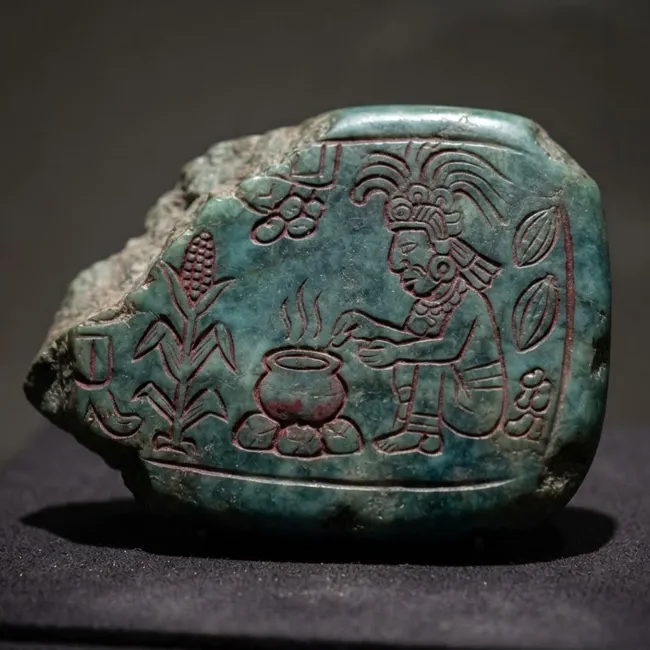
🍲 Recipe: The Jade Hearth Broth — Olmec Clay-Pot Maize, Bean and Cacao Caldo
🗿 Legends Behind This Excavated Secret
There's a shape that shows up again and again in Olmec art: a figure seated cross-legged, slightly hunched, holding a shallow bowl in both hands and staring down into it. Scholars debate what it means — ritual offering, transformation, communion with something.
I'm not an archaeologist, and I won't pretend to settle that. But I'll offer this: anyone who has ever held a bowl of hot broth in both hands on a cold morning knows that posture instinctively. You don't need a PhD to recognize it.
What we can say with confidence is that in Mesoamerica, the line between food and sacred object was never drawn where we draw it. Maize wasn't a crop, it was an ancestor — later Maya texts describe humanity itself as being formed from maize dough after earlier attempts out of mud and wood failed. Cacao wasn't a treat, it was currency and offering, buried with the dead and poured for the gods. Chile wasn't seasoning, it was a kind of heat-magic, used in medicine and ceremony alike.
So a pot containing maize, beans, chile and cacao at once was not casual cooking. It was, in a very literal sense, a bowl containing the civilization's entire cosmology. You were eating the world.
The local nickname I use for it — the Jade Hearth Broth — comes from the thin, faintly green-gold sheen that forms on the surface when ground squash seeds and chile oil separate out over long heat. It catches the light exactly like polished Olmec jade. Whether they noticed that too, I like to think they did.
🌽 Ingredients & The Noble Pantry
🚩 The Ancestral Staples
Everything in this pot came from within a few days' walk of the fire. Maize, nixtamalized in ash water, provided the backbone and the body. Black beans — domesticated in Mesoamerica for thousands of years — brought protein and that dark, almost mineral depth. Squash contributed sweetness and flesh, while its seeds, toasted and ground, acted as a thickener long before anyone in the Old World had heard of a roux. Chiles delivered heat, preservation and vitamin C. Tomatoes and tomatillos, both native to this region, supplied acid. Avocado leaves and epazote, two herbs almost unknown outside Mexico, gave the broth an anise-and-petrol perfume that is genuinely like nothing else on earth. And cacao, used unsweetened and in small amounts, added bitterness, body and a deep reddish-brown color.
No dairy. No wheat. No onions, no garlic, no black pepper, no citrus, no chicken as we know it — all of those arrived much later. That absence is the point. This is a flavor system built entirely on its own logic.
🚩 Modern Substitutes
Realistically, most of you aren't going to nixtamalize maize in wood ash on a Tuesday night. Here's how to get there anyway:
• Nixtamalized maize → canned or dried hominy (sold as maíz pozolero or mote blanco) is the exact same product, already processed. This is the single easiest swap and it loses almost nothing.
• Fresh ground masa → masa harina (Maseca or similar) whisked with cold water. Use it only as a thickener, never as the main grain.
• Epazote → a mix of fresh oregano plus a few fennel fronds. Not identical, but it hits the same bright-herbal-anise register. Dried epazote is widely available online and is far better.
• Avocado leaves → a bay leaf plus a tiny pinch of anise seed. Mexican avocado leaves (the toastable kind) are the real thing; Californian varieties are not recommended.
• Dried chilhuacle or pasilla mixe chiles → ancho for sweetness and body, guajillo for brightness, chipotle for smoke. A blend of ancho and guajillo gets you remarkably close.
• Ceremonial cacao paste → 100 percent unsweetened cacao or cocoa mass, chopped. Not cocoa powder with sugar. Not chocolate chips.
• Toasted ground squash seeds → raw pepitas, toasted dry in a pan until they pop, then ground. Easy and worth it.
• Wild turkey or venison → turkey thigh is the most faithful choice and is easy to find. Pork shoulder works. For a fully plant-based pot, skip the meat entirely and double the beans — this was almost certainly an everyday Olmec reality anyway.
• Clay pot → a Dutch oven is fine. A Mexican olla de barro or a Spanish cazuela, properly seasoned, is noticeably better. More on why below.
🚩 Ancient Proportions
Scaled for a family-sized pot, serving six to eight people generously:
• Hominy, drained and rinsed — 3 cups (about 500 grams)
• Black beans, dried and soaked overnight — 1 and 1/2 cups (about 300 grams)
• Turkey thigh or pork shoulder, cut into large chunks — 700 grams, optional
• Water or unsalted stock — 3 liters, plus more as it reduces
• Dried ancho chiles, stemmed and seeded — 4 large
• Dried guajillo chiles, stemmed and seeded — 3 large
• Ripe tomatoes, roasted whole — 400 grams
• Tomatillos, husked and roasted — 200 grams
• Pepitas, toasted and ground to a coarse flour — 1/2 cup (about 70 grams)
• Unsweetened cacao mass, chopped — 20 grams, roughly 2 level tablespoons
• Winter squash or calabaza, cubed — 400 grams
• Fresh epazote — 1 generous sprig, added at the very end
• Avocado leaves, lightly toasted — 2 leaves
• Allspice berries, crushed — 4
• Sea salt — begin with 2 teaspoons, correct at the end
• Masa harina slurry, if more body is wanted — 2 tablespoons whisked into 1/2 cup cold water
Ratio shortcut if you want to scale freely: 2 parts maize to 1 part beans by volume, with liquid at roughly four times the combined weight of the solids. Cacao should never exceed one percent of the total weight of the pot — past that it turns aggressively bitter and dominates everything.
🔥 The Chef's Ancient Ritual
✦ Step one — Wake the beans. Drain your soaked beans, cover with fresh cold water, and set them on the lowest possible heat with one toasted avocado leaf. No salt yet. Let them go gently for about 60 to 90 minutes, until the skins are tender but the beans still hold their shape. Keep the dark cooking liquid. That liquid is flavor, not waste.
✦ Step two — Toast the chiles. Dry pan, medium heat, about 20 to 30 seconds per side. You're looking for a shift in aroma — nutty, sweet, slightly smoky. The instant you smell anything sharp or acrid, you've burned them, and burned chile will poison the whole pot with bitterness. Start over. It's worth it. Soak the toasted chiles in hot water for 20 minutes.
✦ Step three — Char the fruit. Roast the tomatoes and tomatillos directly over a flame or under a hot broiler until blistered and blackened in patches. This is the closest you'll get to the smoke of an open Olmec hearth in a modern kitchen.
✦ Step four — Build the foundation. Blend the drained chiles with the roasted tomatoes and tomatillos and just enough soaking water to move the blades. Strain through a sieve. You want it smooth and glossy, somewhere between a sauce and a thick juice.
✦ Step five — Fry the base. This is the one step people skip and shouldn't. Heat a spoonful of fat in your clay pot or Dutch oven, pour in the strained chile mixture, and let it sizzle and darken for 8 to 10 minutes, stirring often. The color deepens from bright red to brick. The smell changes completely. This is where raw becomes cooked.
✦ Step six — The long marriage. Add the meat if using, the hominy, the beans with their dark liquid, the crushed allspice, the second avocado leaf, and all the water. Bring it barely to a simmer — surface trembling, not rolling — and hold it there for at least two hours. Three is better.
✦ Step seven — Thicken and deepen. Stir in the ground pepitas and the chopped cacao. Both need a good 20 minutes to integrate. The broth will thicken slightly and take on a darker, rounder character. Add the squash now so it has time to soften without dissolving.
✦ Step eight — The final breath. Salt properly. Tear in the fresh epazote, cover, and pull the pot off the heat entirely. Let it rest for 10 minutes. The herb perfumes the broth without cooking out. Then serve in wide shallow bowls, held in both hands, exactly the way that seated figure does.
🪔 Secrets of the Ancestral Hearth
◦ Clay genuinely cooks differently. It heats slowly and unevenly, creating gentle convection currents that circulate the pot's contents without the violent agitation of a boil. The walls also breathe slightly, concentrating flavor. If you buy one, season it first: soak overnight, rub the inside with a cut garlic clove or a little fat, then heat it empty and slowly before its first real use.
◦ Never shock a clay pot. No cold liquid into a hot vessel, no hot vessel onto a cold counter. It will crack, usually at the worst moment. Always start low and raise the heat gradually.
◦ Salt the beans late, always. Salting early tightens the skins and you'll be simmering gravel for hours. Wait until they're tender.
◦ The number one mistake is too much cacao. People hear "chocolate in soup," get excited, and dump in a whole bar. The result is chalky and bitter. Stay under one percent of the pot's total weight. It should register as depth, not as chocolate.
◦ The number two mistake is boiling. A hard boil emulsifies fat into the broth and turns it cloudy and muddy. Hold it at a bare tremble. Patience is the technique.
◦ Don't discard bean liquid. That dark broth carries soluble starches and color. Pouring it away is throwing away half the body of the dish.
◦ Toast your pepitas properly. Dry pan, constant motion, remove the moment they start popping and smelling nutty. Under-toasted seeds taste green and raw in the finished broth.
◦ It is better on day two. Significantly. Make it ahead if you can — the maize continues releasing starch overnight and everything settles into itself.
◦ Add epazote off the heat. Cooked for twenty minutes it goes flat and medicinal. Added at the end, it's electric.
◦ Taste before you add acid. The tomatillos usually provide enough. If it still tastes heavy, a small squeeze of lime at the table — technically an Old World addition, but universally used in Mexico today — lifts it instantly.
🗿❓ Ancient Civilization Origins FAQ
Q1.Is this an authentic Olmec recipe?
It's an honest reconstruction, not a transcription. No Olmec recipe text survives in readable form. What we have is residue analysis from excavated cooking vessels, the archaeobotanical record of what grew in the Gulf lowlands, the physical shape of the pots themselves, and the living culinary traditions of the region's descendants. Everything here is built on those four pillars. I'd rather tell you that plainly than oversell it.
Q2.Did the Olmec really put cacao in savory food?
Chemical traces of theobromine have been recovered from Mesoamerican ceramic vessels dating back well over three thousand years, including from the Olmec sphere — making it among the oldest evidence of cacao use anywhere in the world. Cacao was consumed primarily as a drink, often unsweetened and spiced with chile. Its appearance in savory cooking is well established across later Mesoamerican traditions, and mole remains the living proof. Small amounts in a broth are entirely consistent with the evidence.
Q3.Can I make this without a clay pot?
Absolutely. A heavy Dutch oven gives you about 85 percent of the result. The clay adds a subtle earthy roundness and that gentler heat curve, but the recipe doesn't depend on it. Start with what you own.
Q4.Is it spicy?
Not particularly, as written. Ancho and guajillo are flavor chiles, not punishing ones — think raisin, dried fruit and mild smoke rather than searing heat. If you want fire, add one dried chile de árbol to the blend. If you want less, remove every seed and vein.
🏛️ The Taste of Archeology
So what does it actually taste like?
The first spoonful is more savory than you expect — a deep, rounded, almost meaty quality even in the vegetarian version, which comes from the toasted seeds and the long-cooked chile. Then the maize arrives, soft and faintly sweet, with that unmistakable nixtamal perfume that smells a little like fresh tortillas and a little like rain on limestone.
The cacao doesn't announce itself. It works from underneath, lengthening everything, adding a dry bitterness at the back of the throat that keeps the whole bowl from feeling heavy. And then the epazote cuts across the top, green and strange and sharp.
It tastes old. I don't know how else to put it. It tastes like a flavor system that developed completely independently of everything you've eaten before — no butter, no stock cubes, no caramelized onion, none of the usual European scaffolding. It's built from a different set of rules, and for the first few spoonfuls your palate keeps reaching for a handle that isn't there.
Then it clicks. And you understand why people built pyramids on this.
🏡 Final Thoughts: Bringing Antiquity to Your Modern Table
Here's what I'd say to anyone on the fence about trying this.
You don't need a clay pot. You don't need to source chilhuacle chiles from Oaxaca. You don't need a weekend. Start with canned hominy, canned black beans, two ancho chiles, a can of fire-roasted tomatoes and a square of unsweetened baking chocolate — all of which exist in a normal supermarket — and you can have a legitimately moving version of this on the table in about ninety minutes.
Then, if it grabs you, go deeper. Order the epazote. Find the avocado leaves. Buy the clay pot. Try nixtamalizing your own maize with food-grade calcium hydroxide, which is genuinely fascinating and smells incredible.
But start somewhere. These recipes didn't survive three thousand years because they were difficult. They survived because they were good, and because they fed people reliably, cheaply and well. That's a kind of genius we tend to undervalue because it doesn't look like a pyramid.
The pot on your stove tonight is doing the same job it did in Veracruz in 1200 BCE. That's not nothing.
🤝 The Golden Hook (The Sacred Union)
Every time one of these recipes gets cooked in a new kitchen, it gets a little harder to lose.
That's not sentimentality, it's just how food heritage actually works. Techniques survive in hands, not in archives. The reason nixtamalization made it across three thousand years isn't that someone wrote it down — it's that somebody made it, and somebody watched, and then they made it too.
So here's the invitation. Cook it. Photograph it badly. Tell someone about the cacao. Argue with your family about how much chile is correct. Get it wrong the first time and better the second. Pass it on to someone who's never heard of the Olmec and watch them get curious about a civilization they didn't know existed.
If you make it, I'd genuinely love to hear how it went — what you substituted, what you couldn't find, what surprised you. Every version adds to the record. And if you know a dish from your own family that's older than anyone can explain, tell me about that too. Those are exactly the recipes that vanish quietly, and they shouldn't.
🙏 Credit to the Keepers of the Culture (The Legacy)
This recipe belongs to Mexico — and more precisely, to the Indigenous peoples of the Gulf Coast, Oaxaca and the broader Mesoamerican world, whose ancestors developed every single technique described above.
Nixtamalization, the domestication of maize, beans, squash, chile, tomato and cacao, the entire architecture of clay-pot cooking: none of it is mine, and none of it is lost knowledge in the communities that still practice it daily. The Mixe and Zoque peoples, whose languages are the strongest living link to what the Olmec likely spoke, are still here. So are the Totonac, the Nahua, the Zapotec, the Mixtec and dozens of others, cooking versions of this food right now without needing any of it explained to them.
Gratitude is also owed to the archaeologists and archaeobotanists working at San Lorenzo, La Venta and Tres Zapotes, whose residue analysis and paleoethnobotanical work transformed what we know about ancient Mesoamerican diet from speculation into evidence — and to the Mexican cooks, market vendors, and food writers who have spent decades insisting that this cuisine deserves to be studied as seriously as any in Europe. UNESCO agreed in 2010, inscribing traditional Mexican cuisine on its Representative List of the Intangible Cultural Heritage of Humanity.
I'm a guest at this table. If anything here is imprecise, I welcome the correction — and I'd rather be corrected by the people who own this knowledge than be confidently wrong on their behalf.
Cook it well. Say where it came from. That's the whole deal.
| 🗿 🏛️🍲 < Back |