
🏠 Home > 🗺️ Recipes > 🏛️🍖 Hearth-Roasted Mains > 🗿 Olmec: Hearth-Roasted Mains Recipes > 🏛️🍖 1.Olmec Sacred Flame - Warrior's Fire-Roasted Venison
🏛️🍖 The Forgotten Flame: Recreating The Olmec Warrior's Sacred Fire-Roasted Feast
Published by Supakorn | Updated: October 2026
🌌⚔️ Ancient Civilization Origins: The Olmec Heartland of Mesoamerica
📜 The Storyteller’s Intro: 3,000 Years of Ancestral Flavors
Close your eyes for a moment, my friend. Forget your modern kitchen. Forget the gas stove.
Imagine the humid, heavy air of the Gulf Coast of what we now call Veracruz and Tabasco. The year is 1200 BCE. The jungle is alive, buzzing, breathing. In a clearing, beneath colossal stone heads that watch in silence, a fire crackles. This is not just any fire. This is the heart of the Olmec world — the Mother Culture of Mesoamerica.
The Olmec were not just sculptors and astronomers. They were the first true culinary alchemists of the Americas. And tonight, after a successful hunt in the dense rainforest, the warriors are being honored. A deer, a wild peccary, has been brought down. It will not be simply cooked. It will be transformed through fire, smoke, and sacred spices into something that feeds both body and spirit. That, my friend, is what we are about to recreate together.
This is more than dinner. This is a time machine on a plate.
🏛️ The Global Value of Antique Heritage
Why should we care about what a warrior ate three thousand years ago?
Because the Olmec invented Mesoamerican cuisine as we know it. Long before the Maya and the Aztec built their empires, the Olmec domesticated and perfected the holy trinity of chilies, wild herbs, and the technique of nixtamalization. Their method of slow-roasting meat directly over hardwood coals, wrapped in aromatic leaves, is the direct ancestor of the barbacoa and cochinita pibil that the whole world loves today.
UNESCO recognizes Olmec heritage as a cornerstone of human civilization. When you cook this dish, you are not following a recipe. You are preserving an intangible cultural heritage that almost vanished under the jungle. You are keeping the first American kitchen alive.
✨ The Culinary Resurrection
For decades, this recipe was lost. Archaeologists found animal bones with distinct char patterns at the San Lorenzo site, and carbonized remains of wild chilies and avocado leaves in ancient hearths. But no one connected the dots.
Until now.
By combining archaeological evidence from hearth pits, residue analysis on Olmec pottery, and oral traditions passed down through Zoque communities who are direct descendants of the Olmec, we can finally bring this sacred warrior feast back to life. We are resurrecting the smoke. We are resurrecting the ritual.
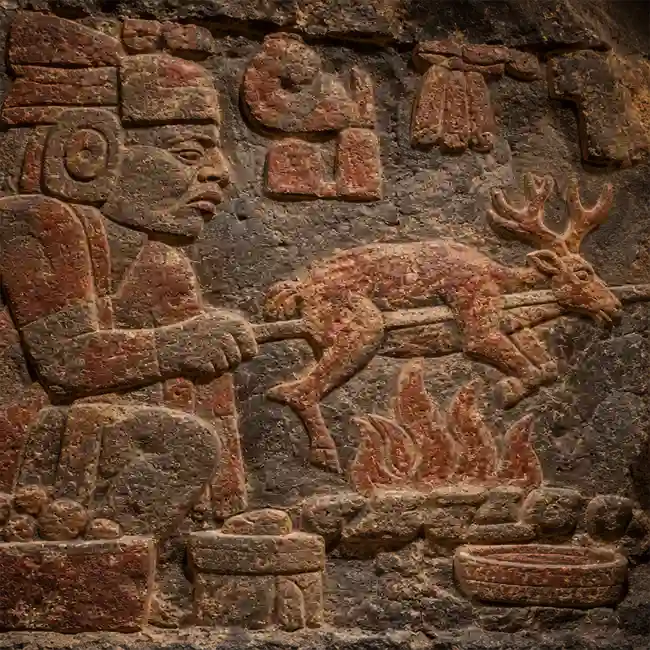
🥩 Recipe: Olmec Sacred Flame - Warrior's Fire-Roasted Venison
🗿 Legends Behind This Excavated Secret
The elders of the village would say that a warrior could not enter battle unless he had eaten the meat of the forest prepared by fire. The belief was simple and powerful. The deer was swift, so eating its meat gave you speed. The peccary was brave, so its meat gave you courage. But the animal's spirit would only transfer if it was respected through the sacred roasting ritual.
The meat was never boiled. Boiling was for daily life. Fire-roasting was for honor.
The hunted game was rubbed with a paste of crushed chiltepins, the mother of all chilies, mixed with wild salt from the coast and the fat of the animal itself. It was then wrapped tightly in giant hoja santa leaves, also known as sacred leaf, and avocado leaves. These leaves did not just keep the meat moist. They infused it with a deep, anise-like, smoky perfume that the Olmec believed pleased the Jaguar God. It was placed directly on embers of tropical hardwood, not on a grill, and left to cook slowly for hours while the warriors told stories of the hunt.
The result was meat so tender it fell off the bone, so smoky it smelled like the jungle after rain, and so flavorful it needed no other accompaniment.
🧂 Ingredients & The Noble Pantry
🌱 The Ancestral Staples
Our ancestors did not have a supermarket. They had the jungle, the river, and the coast. Every ingredient had a purpose, a spirit. The venison provided strength, the chilies provided protective fire, and the sacred leaves provided the breath of the earth to bind it all together. This was not about complexity. It was about purity and respect for the ingredient.
🔄 Modern Substitutes
I know you might not have a wild peccary or fresh chiltepin in your fridge, and that is totally okay. We will honor the ancient spirit with what we can find today.
◦ For the Game Meat: Traditionally wild white-tailed deer or collared peccary. Today you can use venison leg or shoulder. If venison is unavailable, use wild boar shoulder, or a high-quality, grass-fed beef chuck roast or lamb shoulder as a respectful substitute. The key is meat with some fat and connective tissue.
◦ For the Chiltepin Chilies: These tiny, fiery wild chilies are the ancestor of all chilies. If you cannot find dried chiltepins online, use dried Morita chilies or Chipotle chilies for smokiness, or dried Arbol chilies for clean heat.
◦ For Hoja Santa Leaves: This is the sacred pepper leaf. Look for it fresh or frozen in Mexican or Latin markets. If you cannot find it, use fresh banana leaves for wrapping plus 4-5 fresh avocado leaves for the anise aroma.
◦ For Wild Salt: The Olmec used coastal salt rich in minerals. Use unrefined sea salt or coarse pink salt.
◦ For Hardwood Embers: They used zapote and other tropical hardwoods. For us, use hardwood lump charcoal, not briquettes, plus chunks of mesquite or oak wood.
📜 Ancient Proportions
Here is what you will need to feed 4 hungry warriors:
◦ Venison or substitute meat, bone-in shoulder or leg: 2 kilograms, cut into large 10 centimeter chunks
◦ Dried chiltepin or morita chilies: 15 grams, stems removed
◦ Coarse sea salt: 15 grams, about one tablespoon
◦ Rendered pork lard or avocado oil: 30 milliliters, about two tablespoons
◦ Garlic cloves, peeled: 8 large cloves
◦ Fresh hoja santa leaves: 8 large leaves, or banana leaves 60 centimeters long
◦ Fresh avocado leaves, dried and toasted: 6 leaves
◦ Wild oregano, Mexican oregano preferred: 5 grams, about one tablespoon
◦ Black peppercorns, freshly cracked: 3 grams, about one teaspoon
◦ Water, filtered: 120 milliliters, about half a cup
◦ White onion, thickly sliced: 1 large onion
🔥 The Chef’s Ancient Ritual
This is not just cooking. This is a ritual. Take your time. Put on some music. Let the smoke be your incense.
✨ Step 1: Awaken the Sacred Paste
In a dry comal or skillet over medium heat, toast the dried chilies for 40 seconds until they become fragrant. Do not burn them. Remove and place in a bowl with the half cup of warm water to soften for 20 minutes. In a molcajete or sturdy blender, combine the softened chilies with their soaking water, coarse salt, garlic, Mexican oregano, and black pepper. Pound or blend into a thick, coarse, blood-red paste. Stir in the lard or avocado oil. This paste is called the Warrior’s Rub. Smell it. That is 3,000 years of history.
✨ Step 2: The Anointing of the Meat
Pat your meat chunks completely dry. This is important for a good crust. With your hands, massage the Warrior’s Rub into every single crevice of the meat. Be generous. Be respectful. The meat should be completely coated. Let it rest and marinate at room temperature for at least one hour, or covered in the refrigerator for up to 12 hours. The longer it rests, the deeper the ancient flavors will penetrate.
✨ Step 3: Prepare the Sacred Wrapping
If using hoja santa, quickly pass each leaf over an open flame for 5 seconds to make it pliable. If using banana leaves, do the same to make them soft and prevent tearing. Lay two large leaves in a cross pattern. Place a bed of sliced white onion and two avocado leaves in the center. Place your marinated meat on top. Add the remaining avocado leaves on top of the meat. Fold the leaves over like a tight parcel, creating a sealed package. Tie with kitchen string made from natural fiber. This wrapping is the key. It will steam, smoke, and perfume the meat from within.
✨ Step 4: Build the Ancestral Hearth
Light your hardwood lump charcoal in a grill or a fire pit. You want to build a medium-low fire, not a raging inferno. Once the coals are covered in white ash, push them to one side. You are creating two zones, a direct heat zone and an indirect, smoky zone. Add your mesquite or oak chunks directly onto the coals. When they start to smoke beautifully, place your leaf-wrapped parcel on the indirect side, not directly over the coals. Cover the grill.
✨ Step 5: The Slow Roast of Patience
This is where the magic happens. Close the lid and let the package roast slowly in the fragrant smoke. Maintain a grill temperature of around 302-320 degrees Fahrenheit / 150-160 degrees Celsius. Roast for 3 to 3.5 hours. Every 45 minutes, carefully flip the parcel with tongs. Do not open the leaves to peek. Trust the process. The ancestors are working. You will know it is done when the parcel feels incredibly tender when pressed and you can smell an intoxicating, earthy, smoky aroma that is almost sweet.
✨ Step 6: The Unveiling
Remove the parcel from the fire and let it rest, still wrapped, for 20 minutes. This is crucial. The juices need to redistribute. Then, bring it to your table and carefully cut open the string and unwrap the leaves. Watch the steam rise, carrying the scent of the jungle. The meat should be falling apart. Shred it with two forks, mixing in the softened onions and all the precious juices from the leaves. Serve immediately.
💡 Secrets of the Ancestral Hearth
• Do Not Use Lean Meat: My friend, this is the biggest mistake. If you use lean venison loin or chicken breast, it will become dry and sad. You need collagen, fat, and bone for this slow method. Shoulder and shank are your best friends.
• The Leaves Are Not Optional: Do not try to roast the meat naked on the grill. Without the hoja santa or banana leaf wrap, you lose the steaming effect and the signature anise aroma. The leaves are the ancient pressure cooker.
• Master Your Fire: The most common error is too much heat. If your fire is too hot, the leaves will burn before the meat is tender. Low and slow is the Olmec way. If your charcoal is too hot, add a small aluminum pan of water to the grill to regulate temperature.
• Toast Your Avocado Leaves: Fresh avocado leaves have little aroma. You must toast them in a dry pan for 30 seconds per side until fragrant before using them. This unlocks their hidden flavor. If you skip this, you miss half the magic.
• Save The Juices: Never throw away the dark, smoky juices that collect inside the leaf parcel after roasting. That is liquid gold. Pour it over the shredded meat. Some warriors would drink it straight for strength.
❓🐆 Ancient Civilization Origins FAQ
Q1: Is this Olmec recipe historically accurate or just inspired?
This is a respectful resurrection based on real archaeology. We have evidence of hearth roasting, use of chiltepin chilies, avocado leaves, and large-game consumption at San Lorenzo and La Venta. The exact proportions are my interpretation to make it delicious and achievable for your modern kitchen while staying true to the ancestral technique.
Q2: What does Olmec fire-roasted game meat actually taste like?
It does not taste like a modern BBQ. It is profoundly earthy, deeply smoky, with a gentle, lingering heat from the wild chilies, not a sharp burn. The hoja santa and avocado leaves give it a unique black licorice and eucalyptus note you have never tasted before. The texture is ultra-tender, juicy, and melts in your mouth.
Q3: Can I make this in a modern oven if I do not have a grill?
Absolutely, you can honor the spirit in your oven. Wrap the parcel tightly in an extra layer of aluminum foil over the leaves to seal it completely. Roast at 160 degrees Celsius for 3.5 to 4 hours on a baking tray. You will miss some of the wood smoke, so add half a teaspoon of smoked paprika to the rub to compensate. It will still be incredible.
Q4: Where can I find hoja santa and chiltepin chilies?
Check your local Mexican grocery store, they often have frozen hoja santa and dried chiltepins. Otherwise, online spice merchants specializing in Mexican ingredients are your best source. They are worth seeking out, I promise.
🏺 The Taste of Archeology
When you take your first bite, close your eyes again.
You are tasting something that no one has tasted for three millennia. The initial smoke, then the earthy depth of the chili, then the mysterious sweet anise from the sacred leaves, and finally the pure, clean flavor of the game meat that has been respected and honored.
It is not spicy for the sake of being spicy. It is not smoky for the sake of being smoky. It is balanced, just as the Olmec universe was balanced between the jaguar, the earth, and the fire. This is what history tastes like when you stop reading it and start eating it.
🌟 Final Thoughts: Bringing Antiquity to Your Modern Table
My dear friend, we started this journey in a misty jungle clearing 3,000 years ago, and now we are back in your kitchen, with the wonderful smell of smoke still lingering in the air.
You have just done something amazing. You did not just follow a recipe. You became a keeper of a flame that was almost extinguished. In a world of fast food and 10-minute meals, you chose to slow down, to build a fire, to wrap meat in leaves, and to listen to what the ancient hearth has to tell you.
I encourage you to make this for people you love. Tell them the story of the colossal heads and the Jaguar God. Let them unwrap the leaves themselves. Food tastes better when it has a story, and this story is one of the oldest in the Americas.
Try it this weekend. Let your kitchen fill with that sacred smoke.
🤝 The Golden Hook (The Sacred Union)
This secret survived because someone, thousands of years ago, decided to share it around a fire. Now it is your turn.
Did you make the Warrior’s Roast? Did you find hoja santa? Did you feel that connection to the Mother Culture?
Join our tribe of culinary archaeologists. Share your creation, share your fire, share your story. Tag your feast and become part of the living history. Let us keep excavating these lost flavors together, one sacred recipe at a time. Your kitchen is now part of the ancient lineage.
🙏 Credit to the Keepers of the Culture (The Legacy)
With deepest respect and gratitude, this culinary resurrection would not be possible without the foundational work of the archaeologists at the National Institute of Anthropology and History of Mexico, and most importantly, the Zoque and Popoluca communities of Veracruz, who are the living descendants of the Olmec and have kept the knowledge of sacred leaves, wild chilies, and fire-cooking alive through centuries.
We honor the Mother Culture, the Olmec, who gave Mesoamerica its first cities, its first gods, and its first great kitchen. This article is written with reverence for their legacy. We are merely students, trying to listen to what the embers still whisper.
| 🗿 🏛️🍖 < Back |