
🏠 Home > 🗺️ Recipes > 🏛️🌾 Primitive Grains & Flatbreads > 🏟️ Mycenaean Greek: Primitive Grains & Flatbreads Recipes > 🏛️🌾 1.Mycenaean Greek Fig Barley Bread
🏛️🌾 The Bronze Age Bread That Fueled Mycenaean Kings
Published by Supakorn | Updated: September 2026
🛎️🏺 Ancient Civilization Origins: Mycenaean Greece
📜 The Storyteller’s Intro: 3,400 Years of Ancestral Flavors
Hey friend, close your eyes for a second.
It is late summer, around 1400 BCE. The sun is hammering the citadel of Mycenae. Inside the thick cyclopean walls, you can hear bronze swords clanging in the courtyard, you can smell olive wood smoke curling from the great hearth, and from the palace kitchens, something sweet, earthy, and deeply comforting is baking.
This is not your everyday bread.
The Mycenaeans, the fierce, seafaring warriors Homer would later immortalize in the Iliad, were not just fighters. They were master organizers, traders, and keepers of the pantry. On their famous Linear B clay tablets, the world's first Greek writing, scribes meticulously listed their most prized foods: barley, figs, honey, and olive oil. Not for peasants. For kings, priests, and athletes preparing for sacred games.
What we are about to bake today is a loaf that was found, not in a cookbook, but in the ground. Archaeologists working in the Peloponnese found charred storage jars filled with carbonized figs and barley, and hearths with traces of this exact combination. This is survival food elevated to sacred food. Dense, chewy, naturally sweet, and built to last.
🌍 The Global Value of Antique Heritage
Why should you care about a 3,400-year-old bread in a world of sourdough influencers?
Because this loaf is a time machine. Long before white flour existed, long before sugar was traded, ancient people had already mastered the art of flavor pairing. The Mycenaean Fig Barley Bread is one of the earliest examples in human history of using fruit as both sweetener and preservative. The fig, sacred to Demeter, goddess of the harvest, was the ancient world's candy, medicine, and energy bar all in one.
When we recreate this, we are not just baking. We are preserving a piece of intangible human heritage that almost disappeared. The UN recognizes Mycenae as a World Heritage Site for its architecture, but its true legacy might be in its kitchens. This bread connects us directly to the warriors who fought at Troy.
✨ The Culinary Resurrection
For decades, this recipe was lost. Scholars could read the words for barley and figs on the tablets, but no one knew the proportions, the technique, the soul of it.
This resurrection comes from combining three sources: the Linear B ration lists, ethnographic baking still done by old women in mountain villages in Crete and Arcadia who use the same stone mills, and experimental archaeology from the University of Cincinnati's excavations at Pylos, the Palace of Nestor.
We have stripped away modern yeast, white sugar, and butter. What is left is pure, powerful, and surprisingly delicious. It is dense like a power bar, fragrant like a honey cake, and it stays fresh for days, just like it needed to for a Mycenaean soldier on campaign. Let's bring it back to life in your kitchen.
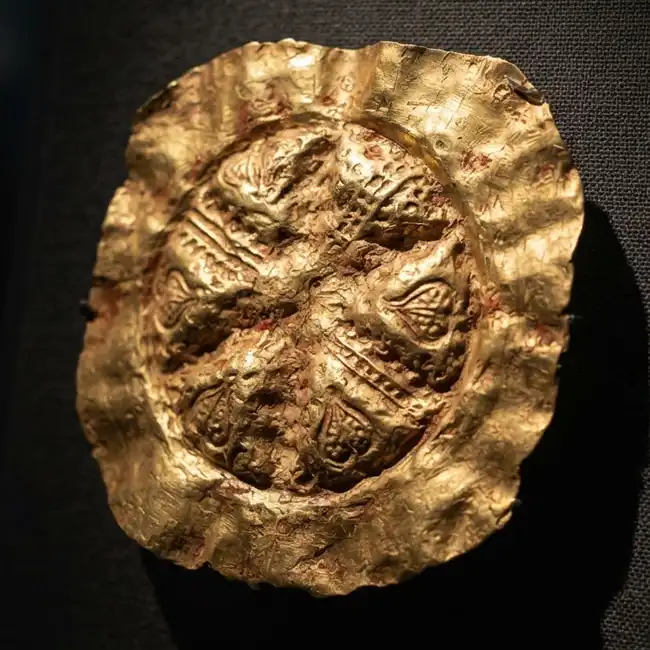
🔥 Recipe: Mycenaean Greek Fig Barley Bread
🏛️ Legends Behind This Excavated Secret
The legend says the palace baker of Mycenae, known as the artokopos, would bake this bread only twice a year, at the end of the fig harvest. The figs were dried on the flat roofs of the citadel under the fierce sun for seven days, then stored in large pithoi jars sealed with olive oil.
The bread was never for daily eating. It was a sacred offering, placed on altars for the gods, and a ration of honor given to rowers before a long voyage and to messengers who had to run for days across the mountains. The sweetness of the fig was believed to carry prayers to the heavens faster. The barley was believed to give the strength of the earth itself. Eating it was a ritual, broken by hand, never cut with a knife.
Today, we will bake it with our hands, just as they did.
🧺 Ingredients & The Noble Pantry
💥 The Ancestral Staples
Forget everything you know about fluffy white bread. Our ancestors worked with what the Mediterranean gave them, and it gave them warriors' grains. Barley, or krithe in ancient Greek, was the true staple of the Bronze Age, far more common than wheat. It is nutty, slightly smoky, and incredibly satisfying. It does not rise like modern wheat because it is low in gluten, which is exactly why this bread is dense, hearty, and honest. Figs were the honey of the poor and the delight of the rich. When dried, their sugars caramelize and become deep, almost like molasses. The honey we use is not just a sweetener, it was liquid gold, a gift from the gods, used to bind and preserve.
💥 Modern Substitutes
I want you to be able to make this anywhere in the world, so here is how to stay authentic while being practical. For the barley, look for whole barley flour, not pearl barley flour. If you absolutely cannot find it, you can grind raw barley groats in a strong blender, or use a mix of 70 percent whole wheat flour and 30 percent rye flour to mimic the earthy flavor. For the figs, use dried Smyrna or Calimyrna figs if you can find them, they are closest to ancient varieties. Black Mission figs work beautifully too. If your dried figs are very hard, just soak them. For the sweetener, use a dark, raw wildflower honey. The darker the better. In ancient times, it would have been thyme honey from the mountains of the Peloponnese.
💥 Ancient Proportions
Here is your sacred list, measured as the Mycenaeans would have understood it, but with modern precision for your success.
• Barley flour, whole grain and finely milled, 2 and one half cups, about 300 grams
• Warm water, filtered, 1 cup plus 2 tablespoons, about 270 ml
• Dried figs, stems removed and finely chopped, 1 and one quarter cups, about 180 grams
• Dark raw honey, plus extra for brushing, one quarter cup, about 85 grams
• Extra virgin olive oil, cold pressed, 3 tablespoons, about 45 ml
• Sea salt, coarse and unrefined, 1 teaspoon, about 6 grams
• Ground coriander seed, freshly ground if possible, 1 teaspoon, about 2 grams
• Ground anise seed or fennel seed, 1 half teaspoon, about 1 gram
• Toasted sesame seeds, for coating, 3 tablespoons, about 27 grams
👑 The Chef’s Ancient Ritual
This is not about kneading for 10 minutes. This is slow, intentional, meditative. Treat it like a ritual.
✦ Step 1: Awaken the Figs
Place your chopped dried figs in a small bowl. Pour half a cup of your warm water over them, the warmest from your measure. Add one tablespoon of your honey into the water and stir. Let this sit for at least 45 minutes, or up to 2 hours. The figs will swell, soften, and create a thick, sweet syrup. This is ancient magic. Do not throw the soaking water away, that is your flavor.
✦ Step 2: The Binding of the Dough
In a large earthenware or glass bowl, combine your barley flour, sea salt, ground coriander, and ground anise. Mix with your hand. The smell should already transport you. In the center, make a well. Pour in the remaining warm water, the olive oil, the rest of the honey, and the entire fig mixture including all its soaking liquid. Mix with a wooden spoon at first, then with your hands. The dough will be sticky, rough, and dense. This is correct. Barley does not form a smooth elastic ball. Knead gently inside the bowl for just 3 to 4 minutes, folding it over itself. You are not developing gluten, you are bringing the family together.
✦ Step 3: The First Rest Under the Sun
Cover the bowl with a clean damp linen cloth. Let it rest in a warm place in your kitchen for 90 minutes. It will not double in size like modern bread. It will relax, swell slightly by about 20 percent, and the barley will fully hydrate. The Mycenaeans would have left it near the hearth or in the afternoon sun.
✦ Step 4: Shaping the Warrior’s Loaf
Lightly oil your hands with olive oil. Turn the dough out onto a surface lightly dusted with barley flour. Divide it into two equal oval loaves, like small shields. Each loaf should be about 6 inches long and 2 inches thick. This flat shape ensures it bakes evenly in a wood-fired oven. Brush the tops lightly with a little extra olive oil and then roll the tops in your toasted sesame seeds, pressing gently. Place them on a baking sheet lined with parchment and sprinkled with a little barley flour.
✦ Step 5: The Hearth Baking
Preheat your oven to 375 degrees Fahrenheit, which is 190 degrees Celsius. Place a small empty pan on the bottom rack. When the oven is ready, place your loaves on the middle rack and quickly pour half a cup of hot water into the empty pan below to create steam. This mimics the ancient wood oven. Bake for 25 minutes. Then reduce the temperature to 350 degrees Fahrenheit, 175 degrees Celsius, and bake for another 20 to 25 minutes. The bread is done when it is deep brown, feels firm and heavy, and sounds hollow when tapped on the bottom. It should smell like toasted nuts and caramelized honey.
✦ Step 6: The Honey Anointing
This is the secret step. While the bread is still screaming hot from the oven, immediately brush the crust with a thin layer of raw honey. Just a little. It will sizzle and sink in, creating a beautiful sheen and sealing the crust. Let the loaves cool completely on a wire rack for at least 2 hours. If you cut it too soon, it will be gummy. Patience is the final ingredient.
🔮 Secrets of the Ancestral Hearth
• Do not use instant yeast. I know it is tempting. But authentic Mycenaean bread was unleavened or only slightly fermented with wild yeasts from the air and the figs themselves. Adding commercial yeast will make it puffy and ruin the dense, historic texture. Trust the process.
• Your figs are too dry? If your figs are rock hard, do not skip the soaking step and soak them overnight in the fridge. If you chop them too big, they will burn. Aim for pieces the size of a small pea.
• The bread cracks on top? Perfect. That is exactly what ancient barley bread does. It is not a flaw, it is a signature of a low gluten grain. Embrace the rustic cracks.
• It tastes slightly bitter? You probably toasted your barley flour or used too much coriander. Barley flour should be raw, not toasted, and spices should be fresh but subtle. They are meant to whisper, not shout.
• How to store like a Mycenaean? Once completely cool, wrap tightly in linen or cotton cloth, then place in a sealed clay pot or container. Do not use plastic. It will keep at room temperature for 4 days and its flavor will actually improve on day two. For longer storage, slice and freeze it. Toast slices directly from frozen.
• Make it softer for modern taste? If you find pure barley too dense for your family, you can replace half a cup of the barley flour with all purpose flour. It will be less authentic but more familiar. I recommend trying the pure version first.
🕍 Ancient Civilization Origins FAQ
Q1: Was barley really more important than wheat in Mycenaean Greece?
Absolutely. While wheat was known and prized, barley was the workhorse grain. Linear B tablets from Pylos show barley rations were three times more common than wheat. Barley grows better in poor, rocky, dry soil of Greece and is more resilient. Wheat was for elites, barley was for everyone and for the army.
Q2: Can I make this recipe gluten free?
Pure barley flour is not gluten free, it contains gluten, though less than wheat. This specific ancient recipe cannot be made gluten free while staying authentic, because barley is its soul. If you need gluten free, you would need to use a completely different ancient grain like sorghum, but then it would no longer be Mycenaean.
Q3: Why figs and not raisins or dates?
Figs were native and abundant in Bronze Age Greece. The fig tree grows wild all over the Peloponnese. Dates had to be imported from the Near East and were extremely expensive, only for kings. Raisins existed but figs provided much more bulk, sugar, and binding power for bread. The fig was the true sweetener of Mycenae.
Q4: What did they eat this bread with?
On its own, or dipped in olive oil and honey. Sometimes crumbled into barley stew or goat milk. For a warrior, it was often eaten with hard cheese, olives, and a handful of onions. It was never eaten plain without purpose, every bite was energy.
🏺 The Taste of Archeology
Take a bite. What do you taste?
First, the crunch of toasted sesame, then the deep, almost coffee like nuttiness of the barley. Then, the chewiness hits, and the figs explode, jammy, sweet, with a little honeyed smokiness. The coriander and anise stay in the background, like a distant incense from a Mycenaean shrine, warm and mysterious.
It is not sweet like cake. It is sweet like nature is sweet. It is filling in a way modern bread never is. One small slice keeps you full for hours. You can feel why this could fuel a man to row a warship or build a massive lion gate. This is not just flavor, this is history you can digest.
🌿 Final Thoughts: Bringing Antiquity to Your Modern Table
My friend, thank you for baking with me across 3,400 years.
In our world of instant everything, there is something profoundly grounding about making a bread that requires no machines, no commercial yeast, no refined sugar. Just grain, fruit, earth, and fire. The Mycenaeans believed that when you share bread, you share your soul.
Bake this on a quiet weekend morning. Let your kitchen smell like a Bronze Age palace. Serve it warm, broken by hand, with good olive oil, a little more honey, and strong black tea. Tell your family or friends the story of where it came from. You will find that food tastes better when it has a story.
You have not just baked a loaf. You have kept a fire alive that was almost extinguished.
I would love to hear how your loaf turned out. Did you stick to pure barley, or did you add a little wheat?
🔗 The Golden Hook (The Sacred Union)
This is more than a recipe. This is a rescue mission.
Every time someone bakes a forgotten bread like this Mycenaean Fig Barley Bread, shares it, and talks about it, we save another thread of human culinary wisdom from disappearing forever. The big food corporations want us to forget these resilient, healthy, simple foods.
Become a Keeper of the Secret.
Bake it, photograph it, and share your creation with the hashtag AncientFoodSecrets. Teach one friend how to make it. In doing so, you join a small, global community of modern people who are rebuilding the bridge to our ancient ancestors, one loaf at a time. The past is not gone, it is just waiting in the pantry.
Are you ready to join the sacred union?
🙏 Credit to the Keepers of the Culture (The Legacy)
This recipe resurrection would not be possible without deep respect for those who came before us.
Our deepest gratitude to the archaeologists and epigraphers who deciphered Linear B, especially Michael Ventris and John Chadwick, who gave a voice back to the Mycenaeans. To the archaeological teams at Mycenae, Pylos, and Tiryns, and the Hellenic Ministry of Culture for preserving these sacred sites. To the experimental archaeology labs that test ancient foodways with scientific rigor. And to the village bakers, the yiayiades, the grandmothers of the Greek mountains, who never stopped baking with barley, figs, and stone, keeping the unbroken chain alive.
All historical interpretation is done with respect. Any errors in this modern adaptation are my own.
| 🏟️ 🏛️🌾 < Back |