
🏠 Home > 🗺️ Recipes > 🏛️🍲 Clay-Pot Broths & Stews > 🛕 Mohenjo-Daro: Clay-Pot Broths & Stews Recipes
🛕 🏛️🍲 Mohenjo-Daro: Clay-Pot Broths & Stews Recipes
Published by Supakorn | Updated: July 2026
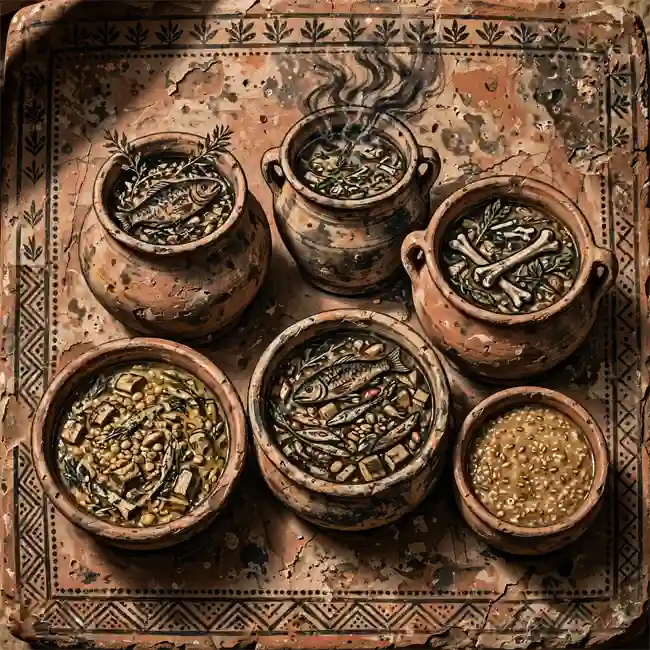
🛕 📜 The Storyteller's Intro: 5,000 Years of Ancestral Flavors
Imagine standing on a sunlit street nearly five thousand years ago, where carefully planned brick homes line wide avenues, merchants gather beneath shaded courtyards, and fragrant aromas drift from clay kitchens. Welcome to Mohenjo-Daro, one of humanity's greatest ancient cities and a remarkable jewel of the Indus Valley Civilization.
Long before modern recipes were written in cookbooks, families here were already mastering the art of slow cooking. Clay pots simmered gently over charcoal hearths, transforming grains, vegetables, herbs, legumes, and carefully prepared meats into nourishing broths and hearty stews that sustained one of the world's earliest urban societies.
Unlike many ancient civilizations known for kings and monumental inscriptions, the Indus Valley Civilization remains beautifully mysterious. Its writing system has not yet been fully deciphered, leaving archaeologists to reconstruct daily life through excavated kitchens, cooking vessels, charred seeds, animal bones, storage jars, grinding stones, ovens, and household remains.
This mystery makes Mohenjo-Daro even more fascinating.
Rather than reading ancient cookbooks, researchers become detectives, piecing together culinary traditions from thousands of archaeological clues.
The story stretches across several important periods:
• 🌾 Early Farming Communities (around 7000–5500 BCE)
• 🏺 Early Harappan Development (3300–2600 BCE)
• 🏙️ Mature Harappan Civilization (2600–1900 BCE)
• 🌅 Late Harappan Transition (1900–1300 BCE)
The Mature Harappan period represents the golden age of Mohenjo-Daro, when impressive urban planning, advanced sanitation systems, standardized weights, thriving trade networks, and sophisticated agriculture created one of the most remarkable civilizations of the Bronze Age.
Food played a central role in everyday life.
Instead of elaborate royal banquets dominating society, cooking reflected community, family, agriculture, and seasonal abundance. Clay-pot broths were practical, nutritious, and efficient, allowing ingredients to cook slowly while preserving moisture and flavor.
These meals likely changed with the harvest.
Some stews emphasized lentils and barley after harvest seasons.
Others combined vegetables with pulses gathered from nearby fields.
Occasionally, fish from the Indus River or carefully prepared livestock enriched communal meals.
The beauty of Mohenjo-Daro's cuisine lies in its balance between simplicity and sophistication. Every ingredient had a purpose. Every meal reflected the rhythms of the land.
Today, archaeologists continue uncovering fragments of this culinary story, revealing that food was every bit as important to civilization as architecture, trade, and craftsmanship.
📜 Iconic Excavated Menus: From Ancient Excavations to Lost Kitchens
Unlike Egypt or Mesopotamia, no complete recipe texts have been discovered in Mohenjo-Daro. Instead, historians reconstruct probable dishes through archaeological evidence, botanical analysis, residue studies, and comparisons with surviving regional food traditions.
Some of the most celebrated reconstructed culinary traditions include:
• 🍲 Sacred Riverbank Herbal Broth
• 🍲 Harappan Clay-Pot Lentil Stew
• 🍲 Barley & Sesame Hearth Porridge
• 🍲 Ancient Chickpea Garden Stew
• 🍲 Indus River Fish Clay-Pot Broth
• 🍲 Slow-Simmered Goat & Barley Pot
• 🍲 Wild Mustard Leaf Vegetable Stew
• 🍲 Clay Oven Root Vegetable Medley
• 🍲 Split Pea Hearth Broth
• 🍲 Bronze Age Mixed Grain Stew
• 🍲 River Herb Harvest Soup
• 🍲 Seasonal Bean & Millet Pot
These names are modern scholarly reconstructions inspired by archaeological findings rather than direct translations from ancient texts.
Excavations have revealed:
• Large cooking jars
• Thick clay cauldrons
• Hearth fireplaces
• Grain storage bins
• Grinding stones
• Mortars and pestles
• Fire-blackened cooking vessels
• Carbonized wheat and barley
• Lentils and peas
• Sesame remains
• Mustard seeds
• Date pits
• Animal bones
• Fish remains
Together, these discoveries paint an increasingly vivid picture of everyday cooking in one of the world's earliest cities.
🗺️ Ancient Culinary Tourism: Walking Through the Lost City of Mohenjo-Daro
Visiting Mohenjo-Daro today is like stepping inside an open-air history book.
Every brick street whispers stories of ordinary families preparing meals thousands of years ago.
Highlights for culinary history enthusiasts include:
• 🏛️ Residential neighborhoods with preserved household kitchens.
• 🔥 Ancient hearth areas where clay pots once simmered throughout the day.
• 🏺 Storage rooms that once protected valuable grains from seasonal floods.
• 🚿 Sophisticated drainage systems that demonstrate exceptional urban hygiene.
• 🌾 Agricultural surroundings that supported large populations.
• 🚶 Carefully planned streets designed for organized community living.
• 🧱 Brick architecture that reflects standardized engineering unlike most contemporary civilizations.
Nearby regions also help visitors appreciate the broader Harappan world.
Exploring archaeological museums allows travelers to see:
• Original cooking vessels
• Grinding stones
• Storage jars
• Terracotta figurines
• Agricultural tools
• Ancient trade artifacts
• Replica kitchens
• Food preparation equipment
Rather than imagining lavish royal feasts, visitors discover something arguably more remarkable—the daily meals of ordinary people whose innovations shaped urban civilization itself.
This perspective offers a refreshing form of culinary tourism, celebrating everyday resilience rather than luxury.
🚣 The Indus River Civilization: Lifeblood of Ancient Agriculture
The Indus River was the heartbeat of Mohenjo-Daro.
Unlike civilizations dependent solely on seasonal rainfall, communities here benefited from fertile floodplains that enriched the soil year after year.
Agriculture flourished because of:
• 🌊 Seasonal river flooding
• 🌾 Rich alluvial soils
• 🌱 Crop rotation
• 🐂 Animal-powered farming
• 🌿 Diverse cultivated plants
• 🌤️ Favorable growing conditions
Common agricultural products likely included:
• Wheat
• Barley
• Lentils
• Chickpeas
• Field peas
• Sesame
• Mustard
• Dates
• Melons
• Cucumbers
• Various leafy vegetables
• Herbs
Livestock also contributed to daily life:
• Cattle
• Water buffalo
• Sheep
• Goats
Meanwhile, the nearby river supplied:
• Freshwater fish
• Turtles
• Aquatic resources
This abundance explains why clay-pot cooking became so practical.
Families could combine harvested grains with vegetables and legumes into nourishing one-pot meals that stretched ingredients efficiently while producing comforting flavors.
The Indus floodplain was not merely farmland.
It was the culinary foundation upon which one of humanity's greatest civilizations was built.
🏜️ Ancient Trade Networks: Caravan Routes and Culinary Exchange
Although Mohenjo-Daro was not surrounded by vast deserts like parts of Egypt or Arabia, it stood at the crossroads of extraordinary trade networks that connected South Asia with distant civilizations.
Merchants traveled remarkable distances.
Trade likely linked Mohenjo-Daro with:
• Mesopotamia
• The Persian Gulf
• Ancient Iran
• Central Asia
• Coastal Arabian ports
Archaeological discoveries include imported materials such as:
• Lapis lazuli
• Carnelian
• Copper
• Tin
• Marine shells
• Precious stones
Trade probably influenced culinary traditions as well.
Ideas often travel alongside merchants.
New spices, unfamiliar grains, different cooking methods, and innovative preservation techniques may have gradually entered Harappan kitchens through centuries of cultural exchange.
Markets likely bustled with activity.
Families purchased fresh produce, grains, pulses, oils, and seasonal foods while craftsmen, traders, and farmers exchanged goods from across the region.
Food became another language of international connection.
Long before globalization became a modern concept, ancient trade routes quietly connected kitchens across continents.
🏛️ Ancient Civilization FAQ: Unlocking Palace Kitchen Mysteries
Q1.Did Mohenjo-Daro really have clay-pot stews?
Yes. Archaeological evidence strongly supports widespread use of clay cooking vessels. While exact recipes remain unknown, slow-cooked broths and stews are considered highly plausible based on excavated cookware, botanical remains, and cooking technologies.
Q2.What ingredients were most common?
Researchers frequently identify wheat, barley, lentils, peas, chickpeas, sesame, mustard, dates, vegetables, herbs, fish, goat, sheep, cattle, and dairy products among the foods associated with the Indus Valley Civilization.
Q3.Why were clay pots so important?
Clay distributes heat gently and evenly, making it ideal for slow cooking. It was durable, widely available, and perfectly suited for preparing nourishing family meals over charcoal hearths.
Q4.Why are so many Mohenjo-Daro recipes reconstructed instead of translated?
The Indus script has not yet been conclusively deciphered. Because no readable recipe texts have been confirmed, historians rely on archaeology, archaeobotany, residue analysis, and comparisons with traditional regional cooking to reconstruct likely dishes.
🧠 Final Thoughts: The Timeless Allure of Antique Gastronomy
Mohenjo-Daro reminds us that extraordinary civilizations were built not only by engineers, merchants, and craftsmen, but also by everyday cooks tending humble clay pots over glowing hearths.
Although the exact recipes have faded into history, the spirit of those meals continues to inspire modern culinary exploration. Every excavated cooking vessel, charred grain, and ancient hearth offers another clue to a food culture that valued nourishment, sustainability, and harmony with the natural world.
The story of Mohenjo-Daro's clay-pot broths and stews is far from complete. New archaeological discoveries continue to reshape our understanding of Bronze Age kitchens, bringing us closer to the flavors that once filled one of the world's first great cities.
In the next chapter, we'll move beyond history and archaeology to explore carefully reconstructed recipes inspired by these remarkable discoveries—bringing the ancient hearth back to life for modern kitchens.
🏛️ Credit to the Keepers of the Culture (The Legacy)
This article is inspired by decades of archaeological research conducted by historians, archaeologists, archaeobotanists, conservation specialists, and heritage organizations dedicated to preserving the legacy of the Indus Valley Civilization.
Their careful excavation of Mohenjo-Daro has revealed not only magnificent urban planning and engineering but also invaluable insights into everyday food traditions, agriculture, cooking practices, and community life. Every pottery fragment, hearth, storage jar, seed, and cooking vessel contributes another piece to the remarkable story of one of humanity's earliest urban civilizations.
While many culinary details remain subjects of ongoing research, these discoveries continue to deepen our appreciation for the ingenuity of Bronze Age societies. By honoring the evidence and respecting the people who safeguarded this heritage, we help ensure that the legacy of Mohenjo-Daro endures for future generations—inviting readers around the world to celebrate the timeless connection between history, culture, and the shared experience of a warm meal prepared in a humble clay pot.
🏛️🍲 5,000-Year-Old Mohenjo-Daro Slow-Simmered Heritage Potage
👉 Unlock Mohenjo-Daro Clay-Pot Stews
| 🌐 🏛️🍲 < Back | 🛕 🍖 < Previous | Next > 🍯 🛕 |