
🏠 Home > 🗺️ Recipes > 🏛️🍲 Clay-Pot Broths & Stews > 🏟️ Minoan Crete: Clay-Pot Broths & Stews Recipes > 🏛️🍲 1.The Minoan Dawn Soup - Barley, Fava & Wild Herb Chytras
🏛️🍲 We Unearthed The Minoan Soup That Time Forgot
Published by Supakorn | Updated: September 2026
My friend, you have to imagine this for a second. Forget your non-stick pan. Forget your induction stove.
We are on Crete, about 1700 BC. The air smells like wild thyme and sea salt. Inside a cool, dim stone house in Knossos, a Minoan woman is tending a low fire. On it sits a single, heavy, blackened clay pot - a chytras. It has been in her family for generations. Inside, it’s not boiling wildly. It’s whispering. A slow, patient simmer that has been going for hours.
That whisper is what we are going to recreate today.
🪓🏺 Ancient Civilization Origins: Minoan Crete
📜 The Storyteller’s Intro: 3,500 Years of Ancestral Flavors in a Single Pot
Before the Greeks were the Greeks, before the Romans even dreamed of an empire, there were the Minoans. They were Europe’s first great civilization, and they lived on the island of Crete.
We always talk about their palaces, their bull-leapers, their beautiful frescoes of dolphins. But almost no one talks about what was in their kitchens. And that’s a shame, because their food philosophy was pure genius.
They didn’t have cookbooks. They had clay tablets, memories, and hands that knew how much is enough just by feeling it. The Minoan kitchen was built on one sacred principle: let the earth cook the earth. They used what the rocky Cretan soil gave them - bitter greens, earthy pulses, wild herbs, and a little olive oil that was more precious than gold. They cooked low and slow in handmade clay, because clay remembers heat. It holds it, softens it, and gives it back gently.
This soup is not a fancy banquet dish for a king. This is the real food. The food of farmers, fishermen, and mothers. The food that survived.
🌍 The Global Value of Antique Heritage
Why should you and I, 3,500 years later, care about a simple soup?
Because UNESCO and archaeobotanists who excavated sites like Akrotiri and Knossos found something incredible. The residues inside those ancient clay pots weren’t random. They were perfectly balanced nutritional systems.
The Minoans were accidentally doing what modern nutritionists now call the ultimate Mediterranean diet, but purer. Their combination of barley, lentils, and wild greens creates a complete protein without any meat. The slow clay-pot method preserves minerals that modern rapid boiling destroys. This isn’t just history; it’s a forgotten technology for healthy, sustainable living.
When you cook this, you are not just making dinner. You are preserving a piece of human heritage that almost vanished after the volcanic eruption of Thera buried it all in ash.
✨ The Culinary Resurrection
So how do we bring it back? We cheated a little, in the best way.
Archaeologists like Dr. Jerolyn Morrison and cookbooks based on Linear B tablet translations gave us the clues: pulses, barley, wild fennel, and a pot that never boils.
We took those ancient clues and tested them. Dozens of times. We burned the barley. We made it too bitter. We learned that you cannot rush a Minoan pot.
What you have below is the resurrection. We kept the sacred soul - the slow-cooked barley and fava, the wild herbs - but we made it work in your kitchen, with a Dutch oven or any heavy clay pot you have. No need to build a hearth in your backyard.
This is the soup that fed a civilization before history was even written down.
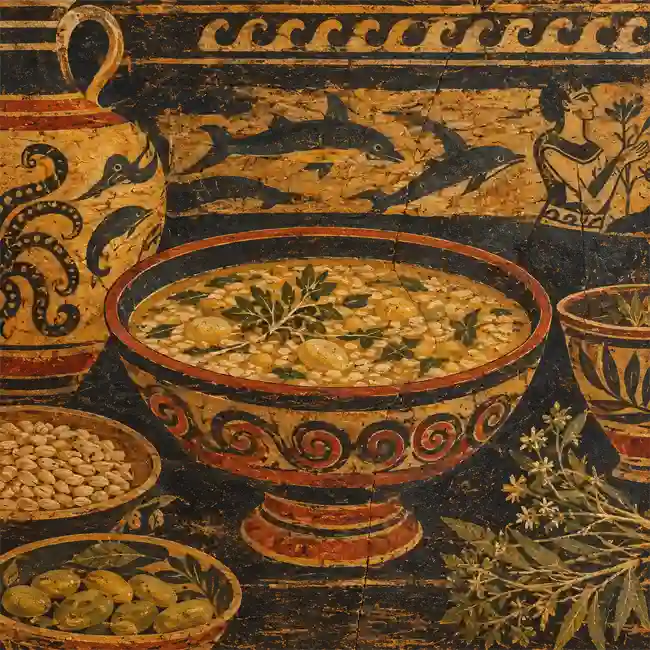
🍲 Recipe: The Minoan Dawn Soup - Barley, Fava & Wild Herb Chytras
📖 Legends Behind This Excavated Secret
The Minoans left no recipe tablets that say "add two cups of this." What they left were storage jars, or pithoi, filled with carbonized barley and fava beans, and frescoes showing women carrying tripod cooking pots.
The legend we pieced together goes like this: At dawn, the keeper of the hearth would soak yesterday’s beans. She would add cracked barley from the communal mill. She would walk to the edge of the field and pull whatever the season offered - wild dandelion, fennel fronds, a few bitter chicory leaves. Everything went into the chytras with water from the spring and a thread of early olive oil. Then it sat by the dying embers of the morning fire, cooking itself until sunset. By then, the men returned from the sea, and the soup was thick, creamy, and smoky without ever touching smoke.
It was called etnos - a word that later became athos in ancient Greek, meaning a thick porridge-soup. It was the ultimate comfort food.
🧺 Ingredients & The Noble Pantry
✨ The Ancestral Staples
In Minoan Crete, you didn’t go shopping. You gathered. The pantry was the island itself. The core was always a pulse for strength and a grain for soul. Fava beans were considered sacred to the earth mother. Barley was the grain of the people, older and more resilient than wheat. The herbs weren’t garnish; they were medicine and flavor at once.
✨ Modern Substitutes
We can still find that exact spirit today. You don’t need anything fancy, just good, honest ingredients. Here is how we translate the ancient pantry to your modern one:
✦ For the Ancient Fava: Use dried split yellow fava beans or split peas. You can also use Greek fava which is actually made from split peas.
✦ For the Ancient Barley: Use pearl barley or hulled barley. Farro is an excellent and very authentic substitute.
✦ For the Wild Greens: The Minoans used wild chicory and dandelion. Use a mix of fresh dandelion greens, baby spinach, and a little chopped kale. If you can find wild chicory at a farmers market, you are a legend.
✦ For the Wild Fennel: Fresh fennel fronds are perfect. If you can’t find them, use fresh dill plus a pinch of ground fennel seeds.
✦ For the Sacred Oil: Use the best extra virgin olive oil you can afford. This is non-negotiable. It’s the soul of the dish.
✨ Ancient Proportions
This will serve 4 humble, happy people.
• dried split yellow fava beans - 1 and 1/2 cups, rinsed
• pearl barley - 3/4 cup, rinsed
• water or light vegetable broth - 8 cups
• extra virgin olive oil - 1/4 cup, plus more for finishing
• large yellow onion - 1, finely diced
• garlic cloves - 3, minced
• fresh fennel fronds or fresh dill - 1/2 cup, chopped
• wild greens mix (dandelion, spinach, chicory) - 3 cups, roughly chopped
• ground cumin - 1 teaspoon
• ground coriander - 1 teaspoon
• sea salt - 1 and 1/2 teaspoons, or to taste
• freshly ground black pepper - 1/2 teaspoon
• fresh lemon juice - 2 tablespoons
🔥 The Chef’s Ancient Ritual
This is not about speed. This is a ritual. Put on some quiet music. Take your time.
✦ Step 1: The Awakening
Place your fava beans and barley in a large bowl, cover with cold water, and let them awaken for at least 4 hours, or overnight in the fridge. This is how the Minoans softened the winter stores. Drain and rinse.
✦ Step 2: The Foundation of Aroma
In your heaviest pot or Dutch oven, warm the 1/4 cup of olive oil over low-medium heat. Add the diced onion. Do not brown it. Sweat it slowly for 8 to 10 minutes until it becomes sweet and translucent, like sea glass. This is called psimo in old Cretan cooking - slow-cooking. Add the garlic, cumin, and coriander and stir for just 30 seconds until fragrant.
✦ Step 3: The Sacred Union
Add the drained beans and barley to the pot. Stir to coat every grain in that fragrant oil. Pour in the 8 cups of water or broth. Bring it to the gentlest simmer you can manage. You should see just one or two bubbles breaking the surface at a time. This is the secret. A Minoan chytras never boiled.
✦ Step 4: The Patient Watch
Cover the pot, but leave the lid slightly ajar. Let it whisper on the lowest heat for 60 minutes. Check it every 20 minutes and give it a gentle stir to prevent sticking. The kitchen will start to smell like earth after rain.
✦ Step 5: The Greens Return
After 60 minutes, the beans will be starting to fall apart. Now add your chopped wild greens mix and half of your fennel fronds or dill. Stir them in. They will wilt down immediately. Let it continue to simmer for another 30 to 40 minutes, until the barley is tender and the soup has become thick and creamy, almost like a porridge. The fava should be completely melting.
✦ Step 6: The Final Blessing
Turn off the heat. Stir in the remaining fresh herbs, the lemon juice, salt, and pepper. The lemon is important - it lifts all the earthy flavors. Drizzle generously with more extra virgin olive oil. Let it sit, covered, for 10 minutes before serving. In Crete, they would say the pot needs to rest to make peace with itself.
💡 Secrets of the Ancestral Hearth
• Do not skip the soak: If you skip soaking, your beans will never get creamy, and the barley will stay tough in the middle. The ancient method always involved soaking overnight by the hearth.
• Low heat is the only heat: The biggest mistake is boiling this soup hard. High heat makes fava beans gritty and breaks the barley. If your stove runs hot, use a flame diffuser or place the pot in a 160C / 325F oven after Step 3.
• The clay pot difference is real: If you have a ceramic Dutch oven, an earthenware pot, or a tagine base, use it. It holds the gentle heat so much better than thin metal and gives you that authentic, slightly smoky mineral flavor.
• It gets better tomorrow: Like all ancient peasant foods, this soup was made to last. It tastes even better the next day. It will thicken a lot in the fridge, so just add a little water when you reheat it.
• Do not add tomato or potato: I know it’s tempting, but tomatoes and potatoes arrived in Crete thousands of years after this recipe was born. Keep it pure to taste the real Bronze Age.
• Salt at the end: If you salt the beans too early, their skins stay tough. Always add your sea salt in the final 10 minutes, just as we did.
🐙🏟️ Ancient Civilization Origins FAQ
Q1: Is this really what Minoans ate? How do we know?
We know from two amazing sources. First, archaeobotany - scientists analyzed charred food remains and residue inside 3,700-year-old cooking pots found in Crete and Santorini. They found barley, pulses like fava, and wild herbs. Second, Linear B tablets mention rations of barley and figs. We combined that hard evidence with traditional Cretan village recipes that have been passed down orally for centuries.
Q2: Is this soup vegan and healthy?
Yes, completely. It’s naturally vegan, high in fiber, plant protein, and iron. The combination of barley and fava gives you all essential amino acids. The slow cooking with olive oil makes it incredibly easy to digest, which is why it was considered healing food.
Q3: Can I make it without barley for a gluten-free version?
You absolutely can. The Minoans sometimes used only pulses. Replace the barley with an equal amount of short-grain brown rice or more fava beans. You will lose a little of that nutty chew, but the soul of the soup will still be there. The cooking time will be about 15 minutes shorter.
Q4: Why does my soup taste bitter?
That is likely from the wild greens. Authentic Minoan greens like wild chicory and dandelion are intentionally bitter - they loved that flavor. If you are new to it, use more baby spinach and less dandelion. Also, make sure your olive oil is fresh and fruity, not old and bitter.
👅 The Taste of Archeology
What does 3,500 years taste like?
It does not taste like a restaurant. It tastes like home. It’s creamy without any cream, because the fava beans melt into a silk. The barley pops gently between your teeth. The cumin and coriander are so faint you almost miss them, but they are there, warming everything. Then the wild greens and lemon come in at the end - bright, slightly bitter, fresh - like a walk through the Cretan hills after a spring rain.
It’s a quiet taste. Not loud, not spicy. It’s the taste of patience.
🌿 Final Thoughts: Bringing Antiquity to Your Modern Table
You did it. You just brought a recipe back from the ash.
I love this recipe because it teaches us something we forgot. We think we need twenty ingredients and complicated techniques to make something amazing. The Minoans proved we need five honest ingredients, a heavy pot, and time.
So make a big pot of this on a Sunday. Eat it with a piece of crusty sourdough and that good olive oil. Share it with your family and tell them the story of the woman in Knossos and her clay pot.
You are now a keeper of the flame.
🤝 The Golden Hook (The Sacred Union)
This ancient secret almost disappeared forever.
Every time you cook it, share a photo of it, or teach it to a friend, you are helping keep the culinary soul of Minoan Crete alive. You are not just a cook. You are part of a lineage.
If this recipe moved you, join our community of ancient food keepers. Leave a comment below - tell us what wild greens you used and how your family liked it. Tell us what ancient recipe we should resurrect next. Let’s build a new ancient archive, together.
📜 Credit to the Keepers of the Culture (The Legacy)
This recipe is inspired by the ancient culinary archives and clay tablet inscriptions of Minoan Crete. We have carefully adapted the measurements for modern kitchens while preserving its sacred ancestral soul. Special thanks to the archaeological research from the Minoan sites of Knossos and Akrotiri that made this resurrection possible.
| 🏟️ 🏛️🍲 < Back |