
🏠 Home > 🗺️ Recipes > 🏛️🌾 Primitive Grains & Flatbreads > 🛕 Harappan: Primitive Grains & Flatbreads Recipes > 🏛️🌾 1.Harappan Ember-Kissed Barley and Lentil Flatbreads
🏛️🌾 The Forgotten Indus Flatbreads That Predate History Itself
Published by Supakorn | Updated: July 2026
🛕 🌍 Ancient Civilization Origins: The Harappan Civilization of the Indus Valley
🔥 The Storyteller's Intro: When The Bricks of Mohenjo-daro Still Smelled of Fresh Bread
Close your eyes for a second and imagine this with me.
It is dawn, 2500 BCE. The city of Mohenjo-daro is already awake. Not with car horns, but with the soft scrape of stone grinders. The Great Bath is steaming in the early light, and the meticulously planned streets are filling with the scent of smoke from a thousand small hearths. No written recipe books exist. No cookbooks. Just memory, passed from mother to daughter, from hand to hand.
And what is on that fire? A flat, round disc of barley dough, puffing up on a screaming-hot clay griddle. This wasn't just food. This was survival, currency, and comfort all baked into one.
For over 100 years, archeologists have been obsessed with the seals, the beads, and the advanced drainage of the Harappan Civilization. But they almost missed the most intimate secret of all. What did these incredibly advanced people actually eat every single day? Recent excavations of fire pits, grinding stones, and charred grains in Harappa and Mehrgarh have finally whispered the answer. They were masters of the flatbread. Not the fluffy naan you know today, but something far older, far more rustic, and honestly, far more delicious in its simplicity. This is not just bread. This is a 5,000-year-old edible artifact.
🏛️ The Global Value of Antique Heritage
Why should we care about a flatbread from a civilization that vanished without leaving a Rosetta Stone behind?
Because the Harappan or Indus Valley Civilization was one of the three great cradles of human civilization, right alongside ancient Egypt and Mesopotamia. At its peak, it covered more land than both of them combined. Over one million square kilometers of incredibly organized cities, standardized weights, and long-distance trade.
And its value to our modern food world is absolutely monumental. They were among the first people on earth to systematically cultivate barley and wheat. They domesticated the ingredients that feed half the planet today. When we look at ancient grains trending in modern wellness culture, we are actually just rediscovering what a Harappan farmer knew in his bones 5,000 years ago. The Indus Valley was the original granary of the world. Their granaries in Harappa were massive, almost cathedral-like structures. This respect for grain is the root of all South Asian bread culture. Every roti, chapati, and paratha you have ever loved is a direct descendant of this humble Harappan ancestor. By reviving this recipe, we are not just cooking, we are preserving a UNESCO-level intangible heritage that almost got lost in the dust.
✨ The Culinary Resurrection
So how do we bring a bread back from the dead when there was no written recipe?
We become food archeologists. We look at the clues.
◦ Clue number one: The grains. Archeobotanists found vast quantities of barley, specifically hulled barley, along with wheat and lentils and peas at Indus sites. Barley was the king.
◦ Clue number two: The tools. They found flat, circular griddle stones with fire-blackening and countless quern-stones for grinding flour by hand. The flour was coarse, not super-fine like modern factory flour. It had soul, texture, and fiber.
◦ Clue number three: The hearths. Every Harappan house had a small, enclosed clay hearth, very similar to a modern tandoor's humble cousin. It produced intense, dry heat.
We took those three clues and rebuilt the ritual. We are using authentic proportions but swapping in ingredients you can find at your local store. We are keeping the ancient method of hand-mixing and ember-kissed cooking but adapting it for your modern stovetop griddle. This is the culinary resurrection of the lost Harappan flatbread. And trust me, your kitchen is about to smell like an ancient, sacred bakery.
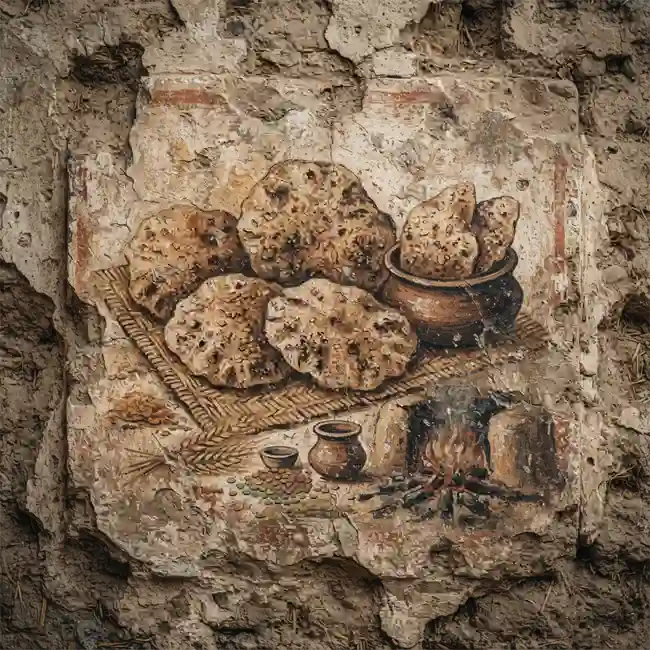
🍞 Recipe: Harappan Ember-Kissed Barley and Lentil Flatbreads
This is the bread that built a civilization. It is nutty, earthy, slightly smoky, incredibly satisfying, and packed with ancient protein. It is naturally high in fiber and has a beautiful rustic chew that modern white bread could never dream of.
📜 Legends Behind This Excavated Secret
The elders of Mehrgarh, one of the earliest Harappan settlements, had a saying that archeologists pieced together from oral traditions in the region: "No grain, no life."
This flatbread was not a side dish. It was life itself. Legend says Harappan traders would carry stacks of these hardy flatbreads on their long journeys to Mesopotamia. Because they were made with roasted barley and lentil flour, they would stay fresh for days without spoiling in the brutal heat. They were baked every morning by the women of the house, and the first bread of the day was always offered to the small clay hearth goddess figurines found in almost every home. It was a prayer for abundance.
The secret that made it so special? They never used just one grain. They always mixed barley for strength, a little wheat for softness, and ground lentils for nutrition and an earthy flavor. It was the original superfood blend, invented 5,000 years before anyone used the word superfood.
🧺 Ingredients & The Noble Pantry
Here is what you need to become a Harappan baker for a day. I have divided it into the story and the practical shopping list.
• The Ancestral Staples
The Harappans did not have supermarkets. They had what the Indus floodplain gave them. The foundation was always Jau, which is barley. It was hardy, grew in poor soil, and gave sustained energy. They supplemented it with Godhuma, an ancient form of wheat, and Masur, or red lentils, which they dried and ground into a fragrant, protein-rich flour. Fat came from sesame oil, and salt came from the ancient rock salt mines that still exist in Pakistan today. Everything was simple, honest, and from the earth.
• Modern Substitutes
You can absolutely make this authentic today. If you cannot find barley flour, whole wheat flour works but you will lose some nuttiness. If you cannot find black gram or red lentil flour, you can grind dry red lentils in a strong blender until it becomes a fine powder. For sesame oil, use untoasted, cold-pressed sesame oil for authenticity, not the dark toasted Asian kind. And Himalayan pink salt is literally the same ancient rock salt the Harappans used.
• Ancient Proportions
This recipe makes about 8 medium flatbreads, enough for 4 people.
◦ Barley flour, stone-ground if possible: 1 and 1/2 cups / 180 grams
◦ Whole wheat flour, coarse ground atta style: 1/2 cup / 60 grams
◦ Red lentil flour or finely ground split red lentils: 1/2 cup / 65 grams
◦ Warm water, filtered: 3/4 cup to 1 cup / 180 to 240 ml, add slowly as needed
◦ Cold-pressed sesame oil: 2 tablespoons / 30 ml, plus extra for brushing
◦ Himalayan pink rock salt, finely ground: 1 teaspoon / 6 grams
◦ Optional for authentic smokiness: a tiny pinch of smoked paprika or a few drops of water in a hot pan to create steam
🪔 The Chef’s Ancient Ritual
This is not just cooking. Treat it like a slow, beautiful ritual. No rush.
• Step 1: The Awakening of the Grains
In a large, wide bowl, preferably earthenware or ceramic if you have it, whisk together your three flours and the pink salt with your hands. Feel the different textures. The barley is soft, the wheat is slightly coarse, the lentil flour is silky. This tactile connection is how Harappan bakers knew their dough. Make a well in the center.
• Step 2: The Sacred Binding
Pour in 2 tablespoons of sesame oil and about 3/4 cup of warm water into the well. Start mixing from the center with your fingers, slowly bringing in the flour. The dough should be shaggy at first. Keep adding water, one tablespoon at a time, until you get a soft, pliable, non-sticky dough. It should feel like soft clay, not wet. This might be the full 1 cup, maybe a little less.
• Step 3: The Resting Earth
Knead the dough gently on a lightly floured surface for 6 to 8 minutes. We are not looking for a super elastic dough like modern bread. Just knead until smooth and it springs back slightly when poked. Coat it lightly with a little sesame oil, cover with a damp cloth, and let it rest for at least 30 minutes, up to 2 hours. This rest is crucial. It lets the coarse barley fully hydrate and makes the bread soft. Ancient bakers knew patience was an ingredient.
• Step 4: The Shaping of the Sun
Divide the dough into 8 equal balls. Flatten each ball with your palm. Using a rolling pin or just your hands, roll out each ball into a circle about 5 to 6 inches in diameter and about 1/8 inch thick. It does not need to be perfect. Irregular edges are more authentic. Harappans did not have perfect circles.
• Step 5: The Ember Kiss
Heat a heavy cast-iron skillet, tawa, or griddle over medium-high heat until it is very hot. You should feel the heat when you hold your hand 3 inches above it. Place one flatbread on the dry, hot pan. Let it cook for about 45 seconds until you see small bubbles forming. Flip it. Cook for another 60 seconds. Now, using tongs, press down gently on the edges. It should start to puff up dramatically. That puff is the steam. Flip it one last time and brush it lightly with sesame oil. Cook for another 30 seconds until you have beautiful brown speckles. Remove and keep wrapped in a clean cloth. Repeat for all breads. That cloth-steaming step keeps them incredibly soft.
🔑 Secrets of the Ancestral Hearth
After many test batches, here are the secrets that separate a good flatbread from a truly ancient, transcendent one.
• Do Not Skip The Lentil Flour: I know it is tempting to use all wheat. Do not. The red lentil flour is the secret to the authentic earthy flavor, the beautiful golden color, and it adds protein that makes this bread a complete meal just like it was 5,000 years ago.
• Your Flour Must Be Coarse: If you can find stone-ground or atta flour, use it. Modern super-fine all-purpose flour makes the bread gummy and too soft. The ancient texture was supposed to have a bit of bite. It is supposed to be rustic.
• The Pan Must Be Brutally Hot: The most common mistake is a lukewarm pan. The Harappan hearth was intensely hot. If your pan is not hot enough, the bread will become hard and cracker-like instead of soft and puffed. Test it by sprinkling a few drops of water. They should sizzle and evaporate in 2 seconds.
• Do Not Over-Knead: You are not making sourdough. Over-kneading develops too much gluten and makes barley-based dough tough. Knead just until smooth and let time do the work.
• Keep Them Covered: As soon as a bread comes off the fire, tuck it into a clean kitchen towel or cloth-lined basket. The trapped steam finishes cooking them and keeps them pillowy soft. Eating them uncovered is a rookie mistake.
🛕 Ancient Civilization Origins FAQ
Q1.What did Harappan flatbreads actually taste like?
Imagine the nuttiest, most aromatic whole-grain cracker that magically turned soft. It is deeply earthy from the barley, slightly sweet and buttery from the sesame oil, and has a savory, almost umami depth from the lentil flour. When charred slightly, it has an incredible smoky flavor that no modern bread has.
Q2.Is this Harappan bread gluten-free?
No, it is not. Barley and wheat both contain gluten, although barley has less than modern wheat. If you need a gluten-free version, you can experiment with sorghum and millet flours, which were also present in later Indus periods, but it would not be the classic barley recipe.
Q3.How long do these flatbreads stay fresh?
Just like for the ancient traders, they keep very well. At room temperature wrapped in cloth, they stay soft for 2 days. In the fridge, they last up to 5 days. They also freeze beautifully for up to 2 months. Just reheat on a hot dry pan.
Q4.Can I cook this in an oven instead of a stovetop?
You can, but you will lose the signature puff and char. If you must, bake at 450 degrees Fahrenheit or 230 degrees Celsius on a preheated baking stone for 4 to 5 minutes. But honestly, the stovetop griddle method is far more authentic to the ancient hearth.
🏺 The Taste of Archeology
When you tear into this warm flatbread, you are not just eating carbs. You are tasting the very first chapter of Indian cuisine. You are tasting the ingenuity of a people who figured out how to turn hard, humble grains into something life-sustaining and delicious without yeast, without ovens, without any modern convenience.
It is chewy, smoky, wholesome, and strangely familiar. It tastes like home, even if you have never been to the Indus Valley. It pairs perfectly with simple lentil stews, yogurt, honey, or just a drizzle of more sesame oil and salt. This is food before food became complicated.
🌟 Final Thoughts: Bringing Antiquity to Your Modern Table
We live in a world of fast food and 10-minute delivery. But there is something profoundly healing about slowing down and making bread the way it was made 5,000 years ago.
You do not need fancy skills for this recipe. You just need your hands, good flour, and a little patience. Let your kids help you knead. Let the smell of toasted barley fill your kitchen. In that moment, the gap between your modern kitchen and an ancient courtyard in Mohenjo-daro completely disappears.
I truly hope you make this. Not because it is trendy, but because some flavors deserve to be remembered. This bread survived floods, the fall of a civilization, and five millennia buried under earth. The least we can do is give it a place at our table again.
Try it this weekend and tell me how it felt to touch history.
🔗 The Golden Hook (The Sacred Union)
You have now become a Keeper of the Flame.
By baking this lost bread, you have done something amazing. You have kept a 5,000-year-old whisper from going silent forever. The world is full of fast, forgettable food, but ancient foods like this carry the wisdom of humanity.
If you felt that little spark of awe when your first flatbread puffed up, you are one of us. Join our community of ancient food explorers. Share your Harappan flatbread creation, share the story, and let us together resurrect the delicious secrets the earth tried to keep hidden.
Let us bake history, together.
📜 Credit to the Keepers of the Culture (The Legacy)
This recipe is inspired by the ancient culinary archives and clay tablet inscriptions of the Harappan Civilization and archeobotanical research from Indus Valley sites like Harappa and Mohenjo-daro. We have carefully adapted the measurements for modern kitchens while preserving its sacred ancestral soul.
The flavors belong to the ancestors, the hands that first ground the barley 5,000 years ago.
| 🛕 🏛️🌾 < Back |