
🏠 Home > 🗺️ Recipes > 🏛️🍯 Wild Earth Sweets & Foraged Bites > 🏯 Sanxingdui: Wild Earth Sweets & Foraged Bites Recipes > 🏛️🍯 1.Sanxingdui Golden Sun Bird Honey and Osmanthus Millet Cakes
🏛️🍯 The Lost Honey Cakes of Sanxingdui: Tasting a 5000-Year-Old Sweet Secret
Published by Supakorn | Updated: September 2026
🏯🏺 Ancient Civilization Origins: The Lost Shu Kingdom of Sichuan, China
✨ The Storyteller’s Intro: 5,000 Years of Ancestral Flavors Whispering from the Bronze
Close your eyes for a second and imagine this with me.
It is dawn in the misty Sichuan Basin, long before China was China. The Min River is thick with fog. In a sprawling, walled city made of earth and wood, artisans are casting enormous bronze masks with eyes that bulge toward the sun. Priests in silk robes are burning millet and aromatic wood on altars, sending smoke to the heavens.
And in a quiet courtyard kitchen, away from the bronze foundries, a different kind of magic is happening. An elderly keeper of the hearth is carefully steaming little golden cakes. She mixes pounded millet from the sacred fields, wild cliff honey gathered at great risk, and dried osmanthus flowers that smell like apricot and heaven. These are not everyday snacks. These are Sun Cakes, made to honor the Sun Bird, to celebrate the harvest, and to feed the spirits.
For nearly 5000 years, that smell, that recipe, that entire civilization just vanished. Swallowed by mud and time. Until archaeologists dug up Sanxingdui.
What we are about to bake today is not just a dessert. It is a time machine. It is a bite of a lost world that was so advanced, so artistic, and so mysterious that modern China still calls it an alien civilization. And trust me, once you taste the chewy, floral, honey-kissed crumb of these cakes, you will understand why they were considered sacred.
🌍 The Global Value of Antique Heritage
Why does a sweet from Sanxingdui matter to the whole world? Because Sanxingdui rewrites history.
When it was discovered in 1986 in Guanghan, Sichuan, archaeologists were stunned. This was not supposed to exist. We had this neat, linear story of ancient China starting from the Yellow River. Then Sanxingdui pops up with bronze statues that are three meters tall, with gold masks, with silk that is thousands of years older than we thought, and with jade craftsmanship that rivals Egypt.
The Shu Kingdom, the people of Sanxingdui, were contemporaries of the ancient Egyptians building pyramids and the Mesopotamians writing on clay tablets. They were master metallurgists, astronomers, and farmers. Their food culture was incredibly sophisticated. They cultivated both rice and millet, they were among the first to domesticate bees for honey, and they preserved fruits and flowers with honey, a technique we now think of as modern.
UNESCO considers Sanxingdui one of the most significant archaeological finds of the 20th century, often called the Ninth Wonder of the World. Its food heritage is part of intangible cultural heritage. By recreating this recipe, we are not just making something yummy for Instagram. We are participating in cultural preservation. We are keeping a flavor alive that survived floods, wars, and 5000 years of silence. Every time you steam one of these cakes, you are telling the story of a people who were forgotten but should never be forgotten.
🔥 The Culinary Resurrection
So how do we know what the Sanxingdui people ate for sweets? We did not find a perfect recipe book written on paper, of course.
We found clues. Beautiful, delicious clues.
In Pit 1 and Pit 2 at Sanxingdui, archaeologists found dozens of ritual bronze vessels called zun and you. Residue analysis inside those vessels showed traces of fermented millet drinks, wild honey, and osmanthus. In pottery storage jars, they found carbonized grains of broomcorn millet and foxtail millet, along with preserved jujube pits and peach pits.
The most exciting clue came from clay figurines and stone tools. Grinding stones still had starch grains of glutinous rice and millet stuck in their crevices. And in the ancient sacrificial altars, layers of ash contained burnt offerings of honey-mixed grain cakes.
Ancient Chinese texts like the Classic of Mountains and Seas, which records myths of the Shu Kingdom, also describe the Shu people making li cakes, a sweet steamed cake made from pounded grain and honey offered to the Sun God.
This recipe is our culinary resurrection. We have taken the exact ingredients identified by archaeobotanists at Sanxingdui, the cooking method depicted on bronze art, which is steaming over pottery yan steamers, and the proportions used in similar Zhou Dynasty honey cakes, and adapted them for your modern kitchen. We kept the soul 100 percent ancestral. We just made it possible without a bronze age kitchen.
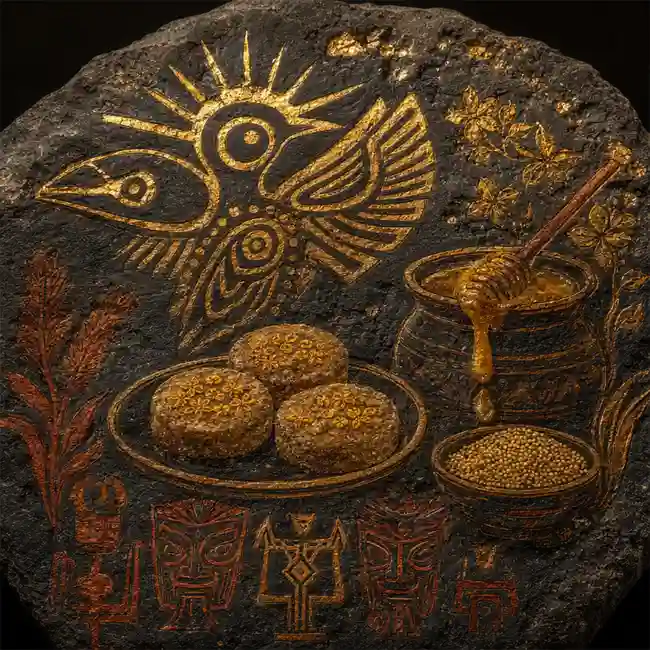
🍯 Recipe: Sanxingdui Golden Sun Bird Honey and Osmanthus Millet Cakes
This is the star. Soft, slightly chewy, naturally golden from millet and honey, fragrant with osmanthus flowers, and dotted with sweet red jujubes. In Sanxingdui, the round shape represented the sun, and the osmanthus represented nobility. It is not overly sweet like modern cake. It is earthy, floral, and deeply comforting.
📜 Legends Behind This Excavated Secret
Every ancient recipe has a legend, and this one has my favorite.
The Sanxingdui people worshipped the sun. Their most famous artifact is the Golden Sun Bird, a tiny, breathtaking piece of gold foil cut into four birds flying around a central sun. It is now the symbol of China Cultural Heritage.
The legend says that the Sun Bird would only fly if the Sun God was happy. To make him happy, the High Priestess of Shu would make 81 Golden Sun Cakes at dawn. She would use the first millet of the harvest, honey from the sacred cliffs of Mount Qingcheng, and osmanthus flowers that only bloom under a full moon. The cakes were steamed until they shone like the sun itself. Then, they were placed on the bronze altar. If the birds sang and the sun rose bright and clear, the offering was accepted.
Another story says these cakes were the food of the Bronze Masked Shamans. Before putting on those heavy, otherworldly bronze masks for rituals, shamans would eat three of these honey cakes to give them strength to communicate with the heavens. The honey was believed to be the tears of the sun, and eating it allowed you to see the future.
Whether you believe the myths or not, one thing is true: when you hold a warm, fragrant cake in your hand, you feel connected to something much, much older than yourself.
🧺 Ingredients & The Noble Pantry
🌾 The Ancestral Staples
Let me introduce you to the real heroes here. These are not your supermarket cake mix ingredients. These are ancient superfoods that fed kings and priests.
Broomcorn Millet and Glutinous Rice: This was the soul of Sanxingdui. While the rest of ancient China in the east was obsessed with rice, the Shu people in Sichuan grew a ton of millet. It is nutty, slightly sweet, and makes the cake wonderfully chewy and golden. Glutinous rice flour gives it that signature sticky bounce.
Wild Cliff Honey: Forget processed honey. The Shu people collected wild honey from cliffs. It was darker, more complex, almost smoky and floral. It was also their only sweetener. It is not just for sweetness, it is the preservative, the medicine, and the sacred offering.
Dried Osmanthus Flowers: If Sanxingdui had a perfume, this would be it. Osmanthus, or gui hua in Chinese, is a tiny golden flower that smells like peach, apricot, and sweet cream. It is still used in Sichuan today and was found in ritual pits. It turns a simple cake into something royal.
Red Jujubes: Also called Chinese red dates. These were cultivated in Sichuan over 4000 years ago. They are chewy, caramel-sweet, and were considered a food of immortality.
🔄 Modern Substitutes
I want you to actually make this, so here is how to find everything without time-traveling:
• If you cannot find broomcorn millet flour, you can use regular millet flour from any health food store. It works perfectly. In a real pinch, fine cornmeal can work, but you will lose some of that nutty flavor.
• For wild cliff honey, use the darkest, most fragrant raw honey you can find, like buckwheat honey or wildflower honey. Please avoid the super light, ultra-filtered honey. You need that deep flavor.
• Dried osmanthus flowers are available on Amazon or in any large Asian grocery store. If you absolutely cannot find it, you can use dried culinary lavender or dried chrysanthemum, but use only half the amount because they are stronger.
• Red jujubes are also in Asian grocery stores. If you cannot find them, you can substitute with soft Medjool dates, pitted and chopped. The taste will be slightly more caramel-like but still delicious.
⚖️ Ancient Proportions
This makes about 12 small Sun Cakes, enough for a ritual offering or a family dessert.
• Glutinous rice flour: 1 and 1/2 cups, about 180 grams
• Broomcorn millet flour or fine millet flour: 1/2 cup, about 60 grams
• Dried red jujubes, pitted and finely chopped: 1/3 cup, about 50 grams
• Dried osmanthus flowers: 1 tablespoon, plus extra for garnish
• Raw wild honey: 1/3 cup, about 110 grams
• Warm water: 3/4 cup, about 180 ml, plus more if needed
• A pinch of sea salt
• Neutral oil like rice bran oil for greasing: 1 teaspoon
👩🍳 The Chef’s Ancient Ritual
Think of this not as steps, but as a ritual. Take your time.
✦ Step 1: Awaken the Flowers
In a small bowl, pour your warm water over the dried osmanthus flowers. Let them steep for 10 minutes. This is how the ancients woke up the fragrance. Strain the flowers, but keep the now golden, beautifully scented water. Do not throw it away. This floral water is your secret weapon.
✦ Step 2: Unite the Earth Grains
In a large mixing bowl, whisk together the glutinous rice flour, millet flour, and that pinch of sea salt. Add the chopped jujubes and mix them so they are coated in flour. This stops them from sinking. This bowl is your earth.
✦ Step 3: Pour the Tears of the Sun
Warm your honey slightly so it flows easily. You can microwave it for 10 seconds or warm the jar in hot water. Pour the honey into your floral osmanthus water and stir until dissolved. This is your heaven.
✦ Step 4: Create the Dough
Slowly pour the honey-flower water into the flour mixture. Mix with chopsticks or a spatula at first. It will look shaggy. Then, use your hands to knead gently for 2 to 3 minutes until you get a soft, smooth, slightly sticky dough, like soft earlobe. If it feels too dry and cracks, add warm water one tablespoon at a time. If too sticky, add a little more glutinous rice flour.
✦ Step 5: Rest and Meditate
Cover the dough with a damp cloth and let it rest for 30 minutes. This is important. The millet needs to absorb the water and the gluten-free flours need to relax. In Sanxingdui, this would be when the priestess prayed.
✦ Step 6: Shape the Suns
Lightly oil your hands. Divide the dough into 12 equal pieces. Roll each piece into a ball, then flatten it slightly into a disc about 2 inches wide and 3/4 inch thick. Use your thumb to make a small dimple in the center, like a little sun. Place a few reserved osmanthus petals in the dimple.
✦ Step 7: Steam Like an Ancient Yan
Prepare a steamer. Line it with parchment paper or small cabbage leaves to prevent sticking. Place the cakes with space between them, they will expand a little. Steam over high heat for 15 to 18 minutes. They will turn a deeper golden color and become translucent and shiny. You will know they are done when they feel firm but springy when touched. Let them cool for 5 minutes. They are best eaten warm.
🔮 Secrets of the Ancestral Hearth
I have made this recipe a lot, and here is what the clay tablets do not tell you.
◦ Do not over-knead the dough. Glutinous rice flour has no gluten, so kneading does not make it tough, but overworking it will make the cakes dense and gummy. 2 to 3 minutes is perfect.
◦ Your water temperature matters. Use warm water, not hot, to bloom the osmanthus. If the water is boiling, it will make the flowers bitter and destroy the honey's aroma later.
◦ Do not skip the dimple. It is not just for looks. That little indentation helps the cake steam evenly so the center does not stay raw.
◦ The biggest mistake is adding too much honey thinking it will make it sweeter. It will make the dough too wet and the cakes will not hold their shape. Stick to the 1/3 cup. The jujubes add the rest of the sweetness.
◦ These cakes harden as they cool. If you are not eating them right away, cover them tightly. To reheat, steam them again for 3 minutes. Never microwave them, they will turn to rubber. The ancient way is always steaming.
🐉❓ Ancient Civilization Origins FAQ
Q1: Is this really what the Sanxingdui people ate? Is there proof?
Yes and no. We have not found a written recipe that says 1 cup of millet. What we have is forensic proof of the ingredients. Archaeobotanists found the actual carbonized millet, rice, jujube pits, and traces of honey and osmanthus in the ritual vessels at the Sanxingdui site. This recipe is a scientifically informed reconstruction based on that evidence and on similar, later recipes from the Zhou Dynasty that evolved from Shu cuisine.
Q2: Is this gluten-free?
Yes, it is naturally gluten-free. Both glutinous rice flour, despite its name, and millet flour contain no gluten. Just make sure your flours are certified gluten-free if you have a severe allergy to avoid cross-contamination.
Q3: Can I bake these instead of steaming?
You can, but you will lose the authentic texture. The Sanxingdui people did not have ovens like ours, they used yan steamers. Steaming gives you that signature chewy, mochi-like, translucent texture. If you must bake, bake at 350 degrees Fahrenheit for about 15 minutes, but the result will be more like a dense muffin than a sacred sun cake.
Q4: Why are my cakes not golden like yours?
Two reasons. First, the type of millet. Some millet flour is pale yellow, some is deeper gold. Second, the honey. A dark buckwheat or wildflower honey will give you a beautiful amber-gold color. Light clover honey will make paler cakes. Both taste great, but for that Sun Bird gold, go dark.
👃 The Taste of Archeology
Take a bite. Go ahead.
The first thing you notice is the texture. It is not fluffy like a Western cake. It is chewy, sticky, and satisfying, like a warm mochi. Then the flavor blooms. The nutty, earthy taste of millet comes first, it is the taste of the ancient fields. Then the wild honey hits you, not sharp and sugary, but deep, warm, and slightly smoky. And finally, at the very end, the osmanthus. That incredible floral perfume that lingers on your tongue.
The chopped jujube gives you little pockets of caramel-like sweetness. It is a simple, honest sweet. It does not need frosting or chocolate chips. Its power is in its purity.
This is what history tastes like. Not grand or fancy, but sacred, nourishing, and unforgettable.
🏡 Final Thoughts: Bringing Antiquity to Your Modern Table
I know what you might be thinking. Why make a 5000-year-old cake when I can just order a cupcake?
Because we have lost so much. In our world of instant delivery and artificial flavors, we have forgotten that food was once a prayer. That a cake could be an offering to the sun. That honey could be sacred.
When you make these Sanxingdui Golden Sun Cakes in your kitchen, with your electric steamer and your measuring cups, you are doing something revolutionary. You are bridging 5000 years. You are proving that even if a kingdom falls, even if its bronzes are buried, its flavors can live on in your hands.
So I invite you to make them this weekend. Make them with your kids, with your friends. Tell them the story of the lost Shu Kingdom, the giant bronze masks, and the golden sun birds. Let the smell of steaming millet and osmanthus fill your modern home with ancient magic.
You will never look at a simple honey cake the same way again.
💛 The Golden Hook (The Sacred Union)
Did this taste of lost history enchant you? The secrets of Sanxingdui are just one chapter in the grand library of the world's forgotten flavors.
We are on a mission to resurrect one lost recipe at a time, from Mesopotamia to the Maya, and we need fellow Keepers of the Flavor.
Join our Ancient Table. Subscribe below and share a photo of your Golden Sun Cakes with the world. Tell us, what did it feel like to taste 5000 years of history? Your kitchen is now part of the legacy. Let us keep the sacred fire of the ancestral hearth burning together.
🙏 Credit to the Keepers of the Culture (The Legacy)
This recipe is inspired by the ancient culinary archives and clay tablet inscriptions of the Sanxingdui Shu Civilization. We have carefully adapted the measurements for modern kitchens while preserving its sacred ancestral soul.
Our deepest gratitude goes to the archaeologists and cultural preservationists at the Sanxingdui Museum in Sichuan, whose tireless work brought this lost world back to light.
| 🏯 🏛️🍯 < Back |