
🏠 Home > 🗺️ Recipes > 🏛️🧪 Sacred Infusions & Botanical Tonics > 🗿 Pre-Classic Maya: Sacred Infusions & Botanical Tonics Recipes > 🏛️🧪 1.Sacred Dawn Elixir — Frothed White Maize and Cacao Ritual Drink
🏛️🧪 The 2,000-Year-Old Maya Elixir Archaeologists Found in a Clay Cup — and How to Brew It Today
Published by Supakorn | Updated: October 2026
Okay, so picture this. A team of archaeologists is crouched in the humid dirt of a Pre-Classic Maya site, brushing centuries of soil off a spouted clay vessel. It looks like a teapot designed by someone who had never seen a teapot. They scrape the dark residue crusted inside, send it to a lab, and weeks later the results come back: cacao. Maize. Chili traces. Something that was poured, sipped, and offered before the sun came up — roughly two thousand years before anyone in the room was born.
That's not a movie plot. That's basically how we learned what the earliest Maya were actually drinking, and today I'm going to walk you through recreating it in your own kitchen with a blender and about twenty minutes of patience. No archaeology degree required. Let's go dig.
🗿🏛️ Ancient Civilization Origins: The Maya Lowlands of Mesoamerica
📜 The Storyteller's Intro: 3,000 Years of Ancestral Flavors
Long before stone pyramids pierced the jungle canopy, before the glyph-carvers and the star-watchers, there were villages of thatch and smoke scattered across what we now call Guatemala, Belize, Honduras, and the southern states of Mexico. This is the Pre-Classic period — roughly 1800 BCE to 250 CE — and it is the deep, quiet root of everything the Maya would later become.
Imagine the hour before dawn in a settlement near the Mirador Basin. Mist sits low over the milpa fields. A woman kneels at a grinding stone that her grandmother knelt at before her, and the sound of stone on stone is the first sound of the day — a rhythm so old it predates the calendar itself. Beside her, a clay pot sits over coals. Inside it, white maize simmers in water touched with wood ash.
She is not making breakfast. She is making an offering. And the drink she pours into that spouted cup is the same drink that will one day be lifted by kings, painted onto tomb walls, and buried beside the dead so they would not go thirsty on the road beyond.
That drink is what we are making today. 🌽
🌍 The Global Value of Antique Heritage
Here's the thing people usually miss about Maya cuisine: it didn't just feed a civilization, it rewired the planet's palate.
Cacao — the seed at the heart of our recipe — was domesticated and ritualized in Mesoamerica thousands of years before it reached a European tongue. The word cacao itself descends from Mesoamerican languages. Every chocolate bar, every hot cocoa on a winter night, every overpriced café mocha traces its lineage back to a Maya household grinding seeds on a stone.
And maize? Maize is arguably the most consequential plant humans ever domesticated. The Maya didn't treat it as a crop. In the Popol Vuh, the sacred narrative of the K'iche' Maya, human beings are literally made of maize dough. Think about that for a second. Their creation story isn't about clay or fire — it's about corn. Food wasn't a category separate from the sacred. Food was the sacred.
Then there's nixtamalization — the technique of cooking maize in an alkaline solution. It sounds technical, but it is one of the great unsung inventions of the ancient world. It unlocks niacin, boosts calcium, improves protein quality, and makes maize dough stick together. Civilizations that adopted maize without this knowledge suffered nutritional collapse. The Maya figured it out, and that single piece of kitchen chemistry quietly held up an entire civilization for millennia.
So when I say this recipe has global value, I'm not being poetic. You're handling three world-changing technologies in one cup.🪔
🔥 The Culinary Resurrection
For a long stretch of history, this knowledge went dark. Colonization reshaped diets, sugar flooded in, cacao got sweetened and Europeanized, and the ritual version — thin, unsweetened, frothed, spiced — faded from the world's memory into village practice and ceremony.
But it never actually died. 🌱
Highland Maya communities kept brewing ceremonial maize and cacao drinks continuously, generation to generation, through everything. What archaeology did was confirm, with chemistry, how astonishingly old those living traditions really are. The residue in the pot matched the drink still being made in kitchens a few hundred kilometres away.
That's not a resurrection from the dead. That's a reunion. And you're invited.
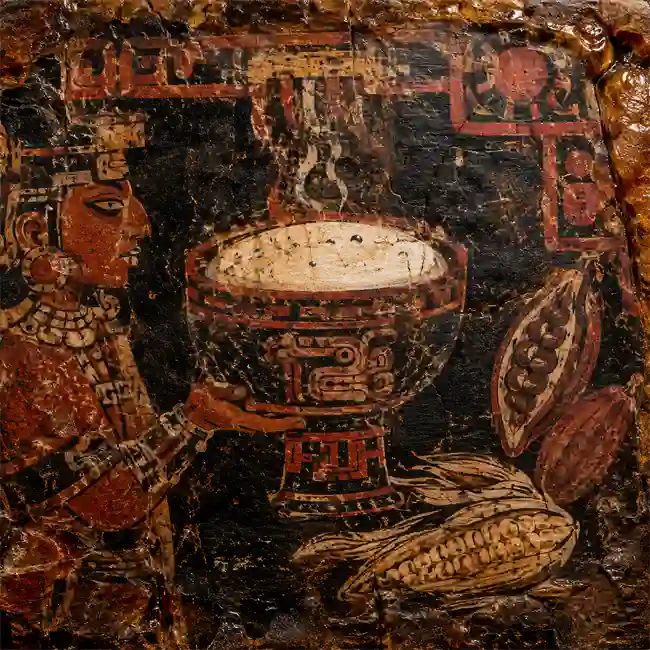
🍫 Recipe: Sacred Dawn Elixir — Frothed White Maize and Cacao Ritual Drink
🗿 Legends Behind This Excavated Secret
Maya storytelling holds that cacao was not casually discovered — it was given. In several traditions, the gods revealed the seed to humanity as a gift of strength and clarity, which is why it sat at the centre of birth rites, marriage negotiations, healing ceremonies, and the long goodbye of a funeral.
The oldest physical proof of this lives in those spouted vessels. Chemical testing on Pre-Classic ceramics has turned up cacao markers that push the practice back far earlier than scholars once believed. And the design of the vessels tells its own story — tall, narrow, built for pouring from a height so the liquid crashes into a second pot and raises a thick cap of foam.
That foam mattered enormously. Later Maya and Aztec sources treat it as the best part of the drink, the fragrant soul of it, the portion worthy of a ruler. Pouring was not a step. Pouring was performance.
Cacao seeds were also currency. Real, countable, spendable money. There are records of counterfeiters hollowing out shells and stuffing them with dirt — the ancient world's version of a fake banknote. So when a household ground cacao into a drink, they were, in a very literal sense, pouring their savings into a cup and offering it to the dawn.
That is the drink we're making. Not a dessert. A declaration.
🥣 Ingredients & The Noble Pantry
🌾 The Ancestral Staples
The Pre-Classic pantry was small, local, and devastatingly effective. White maize from the family plot. Cacao traded up from the lowland groves. Wood ash from last night's fire. Chili from the garden. Wild honey when the season allowed, and often not at all. Annatto seeds for that deep ceremonial red. Vanilla pods from a climbing orchid that grew wild in the forest.
No dairy. No cane sugar. No wheat. Nothing imported from across an ocean, because there was no across-the-ocean yet. Every single element in this cup came from within a few days' walk. That constraint is exactly why the flavour is so clean and so strange to a modern mouth — there is nothing hiding in it.
🛒 Modern Substitutes
Here's where I make your life easy. You can source every one of these at a supermarket or online.
• Whole white maize kernels, nixtamalized at home → use plain white masa harina (the kind labelled for tortillas). This is the single biggest shortcut and it costs you almost nothing in flavour. Already nixtamalized, already ground.
• Wood ash or slaked lime (cal) → skip entirely if using masa harina. If you insist on whole kernels, use food-grade calcium hydroxide sold as cal or pickling lime. Never use ash from a barbecue or treated wood.
• Stone-ground ceremonial cacao paste → 100 percent unsweetened cacao or cacao paste discs. Raw cacao powder works too, though it froths a little less generously.
• Fresh ground chili from the garden → cayenne, chile de árbol, or a pinch of ancho powder for something smokier and gentler.
• Wild honey → regular honey, or a small amount of agave or maple syrup. Traditional ritual versions are often completely unsweetened, so start low.
• Annatto (achiote) seeds → ground annatto powder, or a small pinch of paprika purely for colour.
• Fresh vanilla pods → a tiny splash of pure vanilla extract. Use less than you think.
• Allspice berries (pimienta gorda) → ground allspice, or a whisper of cinnamon and clove together.
• Metate grinding stone → a blender. I'm sorry, ancestors. It really does work.
• Spouted clay vessel → two sturdy jugs or a tall pitcher plus a wide mug, so you can pour between them.
⚖️ Ancient Proportions
Measured for two ceremonial cups, roughly 600 ml total. Keep the ratios and you can scale this to feed a village.
• Water — 600 ml, soft and filtered if your tap water is heavy
• Masa harina — 3 tablespoons, around 30 grams
• Unsweetened cacao paste or 100 percent cacao — 40 grams, chopped fine
• Ground chili — 1/4 teaspoon, adjust upward only after tasting
• Ground allspice — 1/8 teaspoon
• Ground annatto — 1/4 teaspoon, mostly for the sacred red colour
• Vanilla extract — 1/4 teaspoon
• Honey — 1 to 2 teaspoons, optional and genuinely optional
• Fine sea salt — 1 small pinch, around 1 gram
• Masa-to-water ratio — 1 part masa to roughly 20 parts water by weight
• Cacao-to-liquid ratio — around 1 part cacao to 15 parts water for a strong ritual pour
If you want the everyday village version rather than the ceremonial one, cut the cacao in half and double the masa. That's closer to what ordinary people drank daily, and it's hearty enough to carry you through a morning of fieldwork.
🪔 The Chef's Ancient Ritual
Slow down for this part. The method is the meaning.
1.Wake the maize. Whisk the masa harina into 200 ml of cool water until not a single lump survives. Lumps are the enemy. Let it sit five minutes while the flour drinks.
2.Call the fire. Pour the remaining 400 ml of water into a heavy pot over medium heat. Bring it to the edge of a simmer — small bubbles at the rim, no rolling boil.
3.Marry them. Pour the masa slurry into the hot water in a thin steady stream, whisking without stopping. Keep whisking for six to eight minutes until it thickens into something between a thin soup and heavy cream. It should coat the back of a spoon lightly.
4.Offer the cacao. Lower the heat. Add the chopped cacao and stir slowly in one direction until it fully dissolves. One direction is traditional in many Mesoamerican kitchens — honour it or don't, but it does keep the texture smoother.
5.Awaken the spirits of the garden. Add chili, allspice, annatto, vanilla, and the pinch of salt. Stir for another two minutes. Taste. Now add honey if you want it, a half teaspoon at a time.
6.Raise the foam. This is the sacred part. Pour the hot liquid from one vessel into another from as high as you can safely manage — thirty to forty centimetres. Catch it, raise it, pour again. Do this five to eight times until a thick, fragrant cap of foam sits on top.
7.Serve the first cup to the day. Traditionally the first portion goes to the ancestors, the fire, or the earth. Pour a small amount outside or onto a plant. Then drink yours warm, slowly, before the foam collapses. ✨
🔥 Secrets of the Ancestral Hearth
◦ Never boil the cacao hard. High heat turns it bitter and grainy and splits the emulsion. Gentle simmer only, always.
◦ Lumpy masa is unforgivable and unfixable later. Mix it into cold water first, never hot. If lumps appear anyway, blitz the whole thing with a stick blender before the cacao goes in.
◦ Salt is not optional, it's structural. That one small pinch is what makes the cacao taste like cacao instead of tasting like dust. Don't skip it.
◦ Pour from height or you will have no foam. A timid pour makes no bubbles. The drama is the technique.
◦ Start with half the chili you think you want. Chili blooms as it sits in hot liquid. A drink that's perfect at minute one can be brutal at minute six.
◦ Don't buy sweetened drinking chocolate and hope for the best. Sugar changes the entire character and you'll end up with hot cocoa wearing a costume.
◦ Serve it immediately. This drink waits for nobody. The foam dies, the masa settles, and reheating never quite restores it.
◦ If it thickens too far, thin it with hot water, not cold. Cold water shocks the masa and makes it gluey.
◦ Only ever use food-grade pickling lime if you nixtamalize from scratch. Garden lime and fireplace ash are not food. When in doubt, use masa harina.
◦ Toast your whole spices in a dry pan for thirty seconds before grinding. It's a tiny step with an outsized payoff.
🌌❓ Ancient Civilization Origins FAQ
Q1.Did the Pre-Classic Maya really drink this cold, or hot?
Both, depending on the occasion and the region. Evidence and later accounts point to warm ceremonial servings as well as cool refreshing versions for daily work. Try it hot first, then chill the leftovers and compare — the cold version is shockingly good on a hot afternoon.
Q2.Is this the same thing as hot chocolate?
Not even close. There's no milk, no cane sugar, and no cream. The body comes from maize, the richness comes from cacao fat, and the finish is savoury and spiced. It's closer to a thin, aromatic porridge than to a dessert drink.
Q3.Can I make it without any cacao at all?
Absolutely, and historically most people did most days. A maize-only version — essentially the drink known in Maya communities as saka' — is a legitimate ancient recipe in its own right and is still prepared ceremonially today. Just omit the cacao and keep everything else.
Q4.Why is there salt and chili in a chocolate drink?
Because the Maya never filed cacao under "sweets." It was a stimulant, a medicine, a currency, and a sacred substance. Salt and chili sharpen it. Sugar only arrived in the Americas much later and softened the whole tradition into something else entirely.
🏺 The Taste of Archeology
I won't oversell this. The first sip is going to confuse you.
It's earthy. It's a little savoury. There's a warmth from the chili that arrives late, at the back of the throat, like the drink is clearing its throat before speaking. The maize gives it a soft, almost silky body that coats your mouth in a way no water-based drink should. And the cacao sits underneath all of it — deep, roasted, faintly fruity, completely unsweet.
Give it three sips. By the third, something clicks. 🤯
You stop comparing it to hot chocolate and start tasting it on its own terms, and what you taste is a landscape — ash and fire and corn and jungle seed. It tastes like a place. It tastes like a morning two thousand years ago.
That's what archaeology tastes like when you let it out of the display case.
🌅 Final Thoughts: Bringing Antiquity to Your Modern Table
Here's my honest pitch to you. Make this on a quiet morning when nobody's rushing you. Put your phone face-down. Do the pouring part properly, from a ridiculous height, even though you'll probably splash the counter the first time. Everyone does.
Because the real reward isn't the drink, as good as it is. It's the twenty minutes you spend doing something almost exactly the way a human being did it before the Colosseum existed, before paper existed, before most of the world's current borders were even an idea. Your hands are repeating a motion that has been repeated millions of times across three thousand years.
That's a rare thing to get from a kitchen. Most recipes feed you. This one connects you. 💛
🤝 The Golden Hook (The Sacred Union)
So here's where you come in.
Every ancient recipe that survives today survives because somebody bothered to make it, taste it, and tell someone else about it. Cookbooks don't preserve food cultures — people do. The moment a recipe stops being cooked, it becomes a museum label.
You can be a link in that chain this week. Brew the Sacred Dawn Elixir once. Serve it to somebody and tell them where it came from, who made it first, and why the foam matters. Let a friend taste the Pre-Classic for the first time in their life.
Then pass it on. Share the recipe, teach the pour, tell the story of the spouted cup and the counterfeit cacao beans. 🌎
Ancient kitchens don't need monuments. They need somebody standing at a stove, whisking, remembering. That can be you, and honestly, it should be.
🙏 Credit to the Keepers of the Culture (The Legacy)
This recipe does not belong to me, and it does not belong to the internet. It belongs to the Maya peoples — Yucatec, K'iche', Q'eqchi', Tzotzil, Mam, Kaqchikel, Mopan, and many more — who number in the millions and who are very much here, now, today.
This is not a dead civilization. It never was. The pyramids got quiet, but the kitchens never did. The reason we can reconstruct this drink at all is that Maya grandmothers, mothers, ritual specialists, and daykeepers kept making it through conquest, through upheaval, through centuries that tried very hard to erase it. Archaeology confirmed what those communities already knew.
So the credit belongs to them. To the women at the grinding stones. To the cacao growers of the lowland groves. To the elders who still pour the first cup to the earth before anyone drinks. To the scholars and Maya researchers working together to read the residue and the glyphs with care rather than conquest.
Cook this with respect. Say where it came from. And if you ever have the chance to taste the real thing, prepared by the people whose ancestors invented it — go, pay them properly, and listen more than you talk. 🌽🕯️
| 🗿 🏛️🧪 < Back |