
🏠 Home > 🗺️ Recipes > 🏛️🌾 Primitive Grains & Flatbreads > 🏟️ Minoan Crete: Primitive Grains & Flatbreads Recipes
🏟️ 🏛️🌾 Minoan Crete: Primitive Grains & Flatbreads Recipes
Published by Supakorn | Updated: September 2026
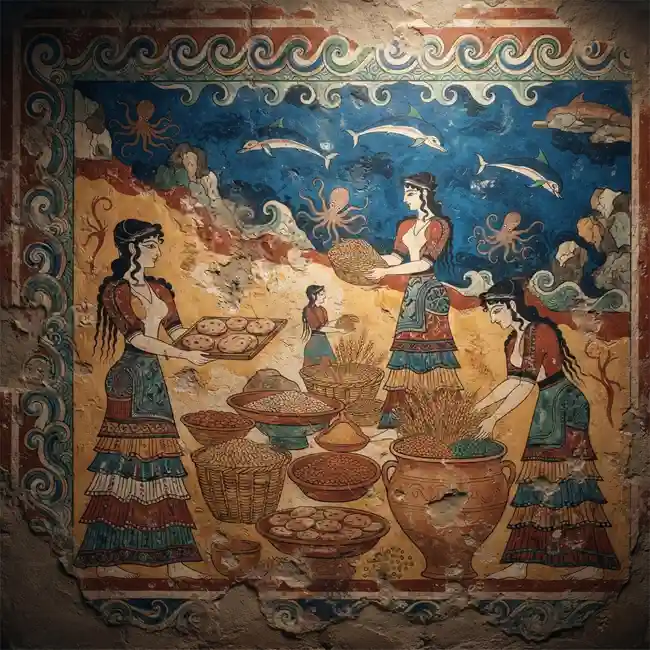
🏟️📜 The Storyteller’s Intro: 5,000 Years of Ancestral Flavors
Imagine standing on the island of Crete thousands of years ago.
There is no modern bakery. No supermarket shelf filled with sliced bread. No printed recipe book waiting on a kitchen table.
Instead, there is a small community surrounded by mountains, rocky hills, fertile valleys, and the sea. Farmers work with cereals that have been cultivated for generations. Grain is harvested, cleaned, stored, ground, and transformed into something wonderfully simple: a meal made from flour, water, heat, and patience.
This is the world behind Minoan Crete: Primitive Grains & Flatbreads.
When people talk about Minoan civilization, they often imagine magnificent palaces, colorful frescoes, mysterious scripts, sacred landscapes, and the legendary world associated with Knossos. But everyday food tells another story—one that is quieter, more practical, and surprisingly intimate.
The Minoan relationship with grains stretches far beyond the famous palace period. Archaeobotanical evidence from Crete shows that cereal cultivation has extremely deep roots, reaching back into the Neolithic occupation of the island. At Knossos, researchers have identified cereals including emmer, einkorn, several forms of barley, and free-threshing wheat in early agricultural contexts.
So, although the Minoan civilization is usually placed within the Bronze Age, the agricultural traditions that eventually supported Minoan society had much older foundations.
The broad chronological story is usually divided into three major Minoan phases:
✨ Early Minoan: roughly 3000–2100 BCE
✨ Middle Minoan: roughly 2100–1600 BCE
✨ Late Minoan: roughly 1600–1100 BCE
Another archaeological framework divides Minoan history according to palace development into Prepalatial, Protopalatial, Neopalatial, and Postpalatial periods. These categories are useful, but modern archaeology recognizes that the development of Crete was more complicated than a simple straight-line sequence.
This matters when we talk about bread.
There probably was not one single “Minoan bread.”
Different communities had access to different crops, landscapes, technologies, and traditions. The grain eaten by a household in one part of Crete may not have been identical to grain stored in a major palace complex.
That is what makes ancient cereal culture so fascinating.
A humble grain can reveal trade, agriculture, storage, labor, climate, technology, and social organization—all from tiny fragments recovered centuries later.
And that is where our story begins.
🌾 From Ancient Grain to the Minoan Table
Grain was more than an ingredient.
It was a foundation of food security.
Archaeobotanical studies of prehistoric Crete have identified several cereal crops, including emmer wheat, einkorn wheat, free-threshing wheat, hulled barley, and naked barley. Researchers have also found evidence of pulses such as lentils and other legumes, showing that cereal agriculture existed within a wider food system rather than in isolation.
Among these grains, barley and wheat are especially important when reconstructing ancient Cretan foodways.
Barley could be productive under challenging Mediterranean conditions, while certain wheat varieties offered useful characteristics for grinding and bread-making. Emmer, meanwhile, appears repeatedly in archaeological assemblages from Bronze Age Crete.
At Knossos, archaeologists have even found concentrations of stored cereals, including emmer and hulled barley, suggesting that grain was not simply consumed immediately after harvesting. It could be deliberately stored and managed as an important household or institutional resource.
Think about what that means.
Before a flatbread ever reached the cooking surface, an entire chain of human work had already happened:
• Seeds had to be selected.
• Fields had to be prepared.
• Crops had to be cultivated.
• Plants had to be harvested.
• Grain had to be separated from chaff.
• Grain had to be cleaned and stored.
• Some of it had to be processed into meal or flour.
• Finally, the flour could become a cooked food.
A simple piece of bread was therefore the final stage of a much larger agricultural system.
🏺 Palace, Village, and Granary: Who Ate the Grain?
The word “Minoan” can sometimes make ancient Crete sound like a single royal kingdom with everyone living the same way.
Reality was more complicated.
Crete contained settlements, agricultural communities, ceremonial places, wealthy residences, palatial centers, workshops, and rural landscapes. The great palaces—especially Knossos, Phaistos, Malia, and Zakros—were major centers within this wider society.
Knossos became one of the most important centers of Minoan civilization. Archaeological evidence shows extensive habitation at the site from the Neolithic period onward, with major palatial construction during the Bronze Age.
Inside such complex societies, food was connected to organization.
Storage mattered.
Measurement mattered.
Distribution mattered.
And writing eventually became part of the administrative world.
The Minoans used Linear A, an undeciphered script, alongside other forms of writing. The surviving documents are largely administrative rather than recipe books. Later Linear B records from Knossos belong to a Mycenaean administrative context and provide evidence for the management of commodities and offerings, but they still do not give us a surviving Minoan cookbook.
That distinction is important.
We can reconstruct ingredients and food practices from archaeological evidence, but we should be careful about pretending that we possess exact ancient recipes when we do not.
The mystery is part of the story.
🏺 Iconic Excavated Menus: The Ancient Grain List
This section is intentionally different from a modern recipe collection.
The following names describe archaeologically attested ingredients, food forms, or modern descriptive categories used to discuss reconstructed Minoan foodways. They should not be treated as preserved Minoan recipe titles unless direct textual evidence exists.
🌾 1. Ancient Emmer Grain Flatbread
A rustic flatbread inspired by the ancient emmer wheat found in archaeological contexts on Crete. Its simple character reflects a time when grain was ground by hand and transformed into practical everyday food.
🌾 2. Minoan-Style Barley Flatbread
Inspired by archaeological evidence for hulled and naked barley on Bronze Age Crete, this hearty flatbread represents the importance of barley in ancient Mediterranean agriculture and everyday food culture.
🌾 3. Einkorn Heritage Grain Cake
Inspired by ancient einkorn wheat identified in prehistoric Cretan contexts, this rustic grain cake evokes an early agricultural tradition long before modern commercial wheat varieties.
🍪 4. Stone-Ground Emmer Bread
A historically inspired bread centered on emmer grain and traditional hand-grinding techniques. Its coarse texture reflects the labor-intensive process of turning ancient cereals into edible flour.
🌾 5. Bronze Age Mixed-Grain Flatbread
A reconstruction inspired by the diverse cereal remains discovered across prehistoric Crete. Combining the idea of ancient wheat and barley traditions, it represents the practical versatility of Bronze Age grain foods.
🏺 6. Knossos Grain Hearth Bread
A modern archaeological reconstruction inspired by cereal evidence from the wider Knossos landscape. The name evokes the connection between stored grain, household preparation, and cooking around a simple ancient hearth.
🌾 7. Ancient Barley Meal Flatbread
Inspired by barley cultivation and processing in Bronze Age Crete, this rustic bread emphasizes the earthy character of barley meal and the practical food traditions of ancient agricultural communities.
🏺 8. Minoan Heritage Grain Loaf
A historically inspired loaf drawing from the variety of cereals documented in ancient Cretan archaeological research. It celebrates the diversity of grains that supported communities across the island.
🌾 9. Neolithic Crete Primitive Grain Bread
Inspired by the much older agricultural foundations of Crete, this bread connects the later Minoan food world with cereal cultivation that began thousands of years before the great Bronze Age palaces.
🥖 10. Ancient Cretan Coarse-Grain Flatbread
A rustic reconstruction designed around the idea of minimally processed ancient cereal flour. Its coarse character reflects the difference between prehistoric grain preparation and the finely milled flour familiar today.
🏛️ 11. Palace-Era Grain Hearth Cake
Inspired by the agricultural and storage systems associated with Minoan palatial society, this simple grain cake represents the humble food foundations beneath the grandeur of places such as Knossos.
🌾 12. Emmer & Barley Heritage Flatbread
A historically inspired combination reflecting two important cereal traditions documented in ancient Cretan archaeology. It captures the agricultural diversity behind the everyday grain foods of Bronze Age Crete.
⚱️ 13. Minoan Agricultural Hearth Bread
Inspired by the close relationship between farming, grain storage, household labor, and food preparation in ancient Crete, this rustic bread celebrates the agricultural foundations of Minoan life.
🌾 14. Ancient Cretan Einkorn Flatbread
A simple flatbread concept inspired by einkorn, one of the ancient wheat varieties associated with prehistoric agriculture on Crete. It offers a glimpse into the cereal diversity that existed long before modern bread culture.
🥮 15. Primitive Stone-Ground Grain Cake
Inspired by prehistoric grain-processing technology, this rustic cake focuses on the transformation of whole ancient cereals into coarse meal using traditional grinding methods.
🏡 How Did Minoans Eat and Live?
The everyday food experience of ancient Crete was probably much less theatrical than the palace frescoes suggest.
A household needed food that could support work.
Agriculture was physically demanding. Grain needed to be harvested, processed, transported, and stored. Meals therefore had to fit into a rhythm of farming, craft production, household work, and seasonal activity.
A cereal-based food could be particularly practical because grain was storable.
This is one reason archaeologists pay so much attention to storage deposits.
A storage room full of grain is not merely evidence of food.
It can reveal planning.
It can reveal surplus.
It can reveal risk management.
And in palatial settings, it can reveal administration.
Archaeological evidence from Late Minoan Knossos includes carefully concentrated cereal stores, with different deposits dominated by different crops.
Meanwhile, evidence from domestic contexts such as Late Minoan Gypsades provides clues about cereal preparation. Microbotanical research suggests that cereals were cleaned before storage and consumption, with evidence consistent with processes such as sieving and winnowing.
That is an extraordinary reminder that ancient food preparation was already technically sophisticated.
There was nothing “primitive” about understanding how to preserve grain.
The tools were ancient.
The knowledge was not.
🏛️ The Palace Kitchen Mystery: More Than Just Bread
When we picture Knossos, it is tempting to imagine a giant palace kitchen filled with chefs preparing elaborate meals for a royal court.
But archaeological evidence requires a more careful interpretation.
The Minoan palaces were multifunctional centers. They were associated with administration, storage, craft activity, ritual, and elite life. The exact organization of food preparation would have varied across buildings and periods.
What we can say with greater confidence is that food resources were deeply connected with the broader palatial economy.
The development of writing itself appears to have been connected to administrative needs. At Minoan palaces, written documents include records rather than culinary instructions.
So instead of imagining an ancient cookbook hidden somewhere beneath Knossos, it is more accurate to imagine an administrative world where food commodities were part of a larger system of production, storage, allocation, and ritual.
That makes the surviving evidence even more fascinating.
The missing recipe is not a failure.
It is the mystery.
🗺️ Following the Minoan Table Across Crete
If you want to understand ancient Minoan food culture, Crete itself is part of the evidence.
The island is not simply a backdrop.
Its mountains, valleys, coastal plains, caves, agricultural zones, and harbors shaped how communities lived.
Knossos, for example, had access to both the Cretan interior and the sea, helping make it an important center of economic and cultural interaction. The city maintained connections with other communities around the eastern Mediterranean.
That makes a food journey through Minoan Crete particularly rewarding.
🏛️ Knossos
Knossos is the essential starting point for anyone interested in Minoan civilization.
Today, visitors can explore the archaeological site and encounter the remains of one of the most important centers of Minoan Crete.
The site was continuously inhabited from the Neolithic period into later historical eras, while the major palace phases belong to the Bronze Age.
For food history, Knossos is especially valuable because archaeobotanical and administrative evidence can be connected to the wider question of how food was produced and managed.
🏛️ Phaistos
Phaistos provides another perspective on the Minoan palace world.
Located in southern Crete, it helps broaden the story beyond Knossos and reminds us that Minoan civilization was not centered on one site alone.
The landscape around the settlement is essential to understanding how agriculture, settlement, storage, and regional interaction could work together.
🏛️ Malia
Malia adds another important palatial center to the picture.
Together, Knossos, Phaistos, Malia, and Zakros demonstrate that Minoan Crete contained several major centers rather than one isolated capital.
For anyone researching ancient grain culture, this wider geographical perspective matters.
Different regions could produce different agricultural combinations.
🏺 Zakros and Eastern Crete
Eastern Crete offers another window into the island's Bronze Age world.
Its position also highlights the importance of maritime connections and the eastern Mediterranean environment.
A journey through Minoan food history therefore becomes a journey through geography.
The grain on the table began with the land.
🚣 Minoan Crete and the Bronze Age Mediterranean Routes
Crete was an island, but it was not isolated.
Minoan Crete participated in wider Mediterranean networks, and archaeological evidence demonstrates connections with other regions around the sea.
For grain culture, this raises fascinating questions.
Did particular crops spread through contact?
Did agricultural knowledge travel?
Were new cereal varieties introduced or adopted?
Did merchants transport processed foods, or mainly raw agricultural commodities?
Archaeology can answer some of these questions, but not all of them.
That uncertainty is important.
It is easy to tell a dramatic story in which every ancient ingredient has a single origin and every food tradition moved neatly from one civilization to another.
Real history is usually messier.
Seeds, people, technologies, and ideas could move through many different routes over long periods.
Crete's position in the Mediterranean made it a natural meeting point for these processes.
🔥 What Might Ancient Minoan Flatbread Have Been Like?
This is where we need to separate evidence from reconstruction.
We have strong archaeological evidence for cereals.
We have evidence for cereal processing.
We have evidence for storage.
We have a broader Aegean context in which processed cereals could become foods.
But we do not possess a surviving Minoan recipe that tells us exactly how to make a specific “Minoan flatbread.”
That means modern recreations should be presented as historical reconstructions rather than guaranteed replicas.
A reconstructed ancient-style flatbread might reasonably focus on:
• Ancient cereal varieties
• Coarsely processed grain
• Simple flour or meal
• Water
• Basic shaping
• Direct heat
• Minimal ingredients
• Rustic texture
But the precise proportions remain a matter for experimental archaeology and culinary reconstruction.
This distinction actually makes the subject more exciting.
Instead of simply copying a recipe, we can ask:
What would an ancient grain feel like between the fingers?
How coarse was the flour?
How thin could the dough be made?
What kind of heat was available?
Was the food intended for immediate eating or transport?
These questions turn a simple flatbread into an archaeological experiment.
🛎️❓ Ancient Civilization FAQ: Unlocking Palace Kitchen Mysteries
Q1.Did the Minoans really eat bread?
Archaeobotanical evidence strongly supports extensive cereal cultivation and processing on Bronze Age Crete, including wheat and barley. Bread-like foods are a reasonable reconstruction within this cereal-based food system, but the exact recipes and forms of individual breads are not preserved.
Q2.What grains did the ancient Minoans grow?
Archaeological research identifies several cereals, including emmer, einkorn, free-threshing wheat, hulled barley, and naked barley. Their frequency varied by site and period.
Q3.Is there an actual Minoan recipe book?
No surviving Minoan cookbook is known.
Linear A remains undeciphered, while the surviving Linear A records are largely administrative or related to other functions. Later Linear B records from Knossos belong to a Mycenaean administrative context. These documents are valuable evidence, but they should not be treated as culinary recipe books.
Q4.Why is Knossos so important for ancient food history?
Knossos was a major center of Minoan Crete and preserves evidence spanning from the Neolithic period through later historical periods. Archaeological research there has produced important evidence for cereals, storage, administration, and settlement life, making it one of the key places for understanding ancient Cretan food systems.
🧠 Final Thoughts: The Timeless Allure of Antique Gastronomy
There is something wonderfully humbling about ancient grain.
It does not look glamorous.
It is small.
It is hard.
It needs work.
Yet this simple seed helped support communities for thousands of years.
In Minoan Crete, cereals connected the farmer to the household, the household to storage, storage to administration, and administration to the larger social world.
From emmer and einkorn to barley and other wheat varieties, the archaeological record gives us fragments of a much larger culinary story.
And those fragments are enough to make us curious.
What did the flour look like?
What did the first flatbreads taste like?
How smoky was the cooking fire?
How dense was the finished bread?
Was it eaten warm beside a meal, carried into the fields, or saved for later?
We may never know every answer.
But that is exactly why ancient gastronomy remains so captivating.
Minoan Crete does not give us a perfectly preserved cookbook.
It gives us something more mysterious: seeds, storage deposits, tools, buildings, written records, landscapes, and traces of human activity.
From those fragments, archaeologists reconstruct a world.
And from that world, we can begin to imagine the humble flatbread that once sat on an ancient Cretan table.
The full recipe journey can come later.
For now, the real treasure is understanding where the food began.
It began with the land.
It began with grain.
And it began thousands of years before the modern idea of “ancient cuisine” ever existed.
🏛️ Credit to the Keepers of the Culture (The Legacy)
The story of Minoan food belongs first to the people who cultivated the land, processed the grain, prepared meals, built settlements, and passed agricultural knowledge from one generation to another.
Modern readers encounter only fragments of that world.
Archaeologists recover seeds.
Researchers analyze charred grains.
Historians study ancient scripts.
Museums preserve artifacts.
Local communities protect archaeological landscapes.
And modern Crete continues to live among the remains of this extraordinary past.
The most respectful way to explore ancient cuisine is therefore not to pretend that every mystery has been solved.
It is to distinguish evidence from reconstruction, acknowledge uncertainty, and appreciate the people whose everyday knowledge made ancient food culture possible.
Minoan Crete's grain traditions are more than a story about bread.
They are a story about agriculture, survival, landscape, technology, community, and memory.
And somewhere between an ancient field and a warm cooking surface, one of humanity's oldest food traditions took shape:
grain transformed by human hands into food.
That timeless idea is still with us today.
🏛️🌾 I Baked a 5,000-Year-Old Minoan Flatbread — and Crete Tasted Like This
👉 Explore Minoan Crete: Primitive Grains & Flatbreads
| 🌐 🏛️🌾 < Back | Next > 🍖 🏟️ |