
🏠 Home > 🗺️ Recipes > 🏛️🍖 Hearth-Roasted Mains > 🏟️ Minoan Crete: Hearth-Roasted Mains Recipes > 🏛️🍖 1.Minoan Hearth Roast Beef
🏛️🍖 Minoan Hearth Roast Beef: A Bronze Age Feast Reimagined
Published by Supakorn | Updated: September 2026
🐂🏺 Ancient Civilization Origins: Minoan Crete
🔥 The Storyteller’s Intro: Beneath the Smoke of a Bronze Age Hearth
Imagine stepping into Crete roughly 5,000 years ago.
The air is warm, the stone beneath your feet has been heated by the Mediterranean sun, and somewhere nearby a simple hearth is glowing with charcoal. Olive trees stretch across the hills. Wild herbs release their fragrance when crushed between the fingers. Grain, figs, honey, onions, and pulses are stored for everyday meals, while precious cuts of meat are reserved for occasions when food means more than simply filling the stomach.
This is the world that inspires our Minoan Hearth Roast Beef.
The Minoans flourished on Crete during the Bronze Age, particularly from the third to the second millennium BCE. Their civilization is associated with impressive palaces, elaborate frescoes, sophisticated craft traditions, maritime connections, and a rich agricultural landscape.
When we imagine their food, however, it is important to separate archaeological evidence from modern storytelling.
There is no surviving ancient Minoan cookbook giving us a precise recipe for roast beef with modern measurements. Instead, archaeologists reconstruct aspects of ancient food culture from pottery, botanical remains, animal bones, storage vessels, artistic representations, and other archaeological evidence.
So this recipe is best understood as a culinary reconstruction inspired by the ingredients, landscape, and hearth traditions of Bronze Age Crete.
And honestly, that makes the cooking even more interesting.
You are not simply following a modern roast recipe. You are using a modern kitchen to explore what a rustic Minoan-inspired feast might have felt like.
🌿 The Global Value of Antique Heritage
Ancient food heritage has a remarkable ability to connect everyday life with archaeology.
A palace may tell us about rulers and political power, but food tells us about ordinary human experiences: gathering, planting, hunting, raising animals, preparing meals, sharing bread, and sitting together around a fire.
Crete offers a particularly fascinating setting because its landscape naturally supplied many ingredients associated with ancient Mediterranean cooking.
Olives and olive oil became deeply important to Cretan agriculture. Grains provided everyday nourishment. Legumes supplied valuable plant protein. Fruits such as figs could be eaten fresh or preserved. Aromatic plants and herbs added fragrance without requiring elaborate equipment.
Meat had another role.
Animal husbandry was part of the agricultural economy, while meat could carry social and ceremonial significance depending on the occasion. Archaeological animal remains can provide clues about which animals were consumed, although interpreting exactly how every cut was prepared is much more difficult.
That uncertainty is worth respecting.
Ancient cuisine should not be presented as a fantasy disguised as fact. Instead, it can be approached as a conversation between archaeology and culinary imagination.
That is exactly where this recipe lives.
🏛️ The Culinary Resurrection
The idea behind this dish is simple:
Take the atmosphere of an ancient Cretan hearth and bring it into a modern home kitchen.
Instead of pretending that we possess a lost Minoan recipe book, we reconstruct a flavor profile using ingredients strongly associated with the ancient Mediterranean and cooking methods that make sense for a hearth-centered meal.
The result is a roast built around:
• Beef as the centerpiece
• Olive oil for richness
• Garlic and onion for savory depth
• Mediterranean herbs for aroma
• Crushed coriander for warm spice
• Honey for a subtle ancient-style sweetness
• Figs for a fruity counterpoint
• Coarse salt for seasoning
• Slow heat for tenderness
The goal is not restaurant-style complexity.
It is rustic, earthy, aromatic cooking.
The kind of dish that feels like it belongs beside a stone hearth rather than beneath a silver serving dome.
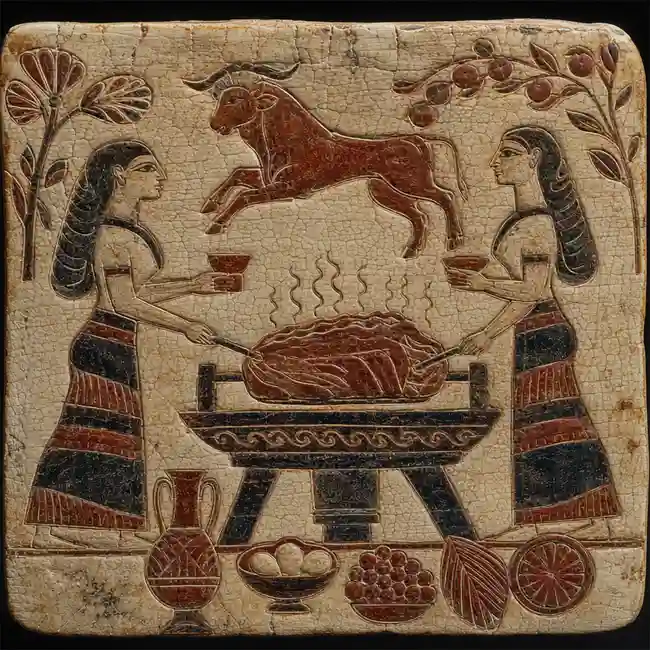
🔥 Recipe: Minoan Hearth Roast Beef
🏺 Legends Behind This Excavated Secret
There is no verified archaeological tablet or surviving Minoan manuscript that records this exact roast.
That detail matters.
The phrase “lost ancient recipe” in this context refers to the broader culinary world that has largely disappeared, rather than claiming that archaeologists literally excavated a complete roast beef recipe.
Instead, this dish draws inspiration from what we know about Bronze Age Crete and the wider eastern Mediterranean food environment.
Picture a communal feast after a long day of agricultural work.
A large piece of meat is seasoned simply. Olive oil is rubbed into its surface. Herbs are crushed by hand. The meat is placed close enough to the hearth to develop a deep roasted crust while the center remains moist.
There are no electric ovens.
No instant-read thermometer.
No packaged spice blends.
No perfectly measured supermarket sauces.
The flavor comes from fire, patience, quality ingredients, and careful observation.
That is the spirit we are bringing back.
🔄 Ingredients & The Noble Pantry
🌾 The Ancestral Staples
The ingredients in this recipe are deliberately uncomplicated.
Ancient cooks did not need dozens of ingredients to make food memorable. They worked with what their landscape provided and allowed heat, time, and natural flavors to do much of the work.
For the roast:
• 1.2 kilograms beef roasting joint, preferably a well-marbled cut
• 4 tablespoons extra-virgin olive oil
• 5 garlic cloves, lightly crushed
• 1 medium onion, roughly sliced
• 2 teaspoons coarse sea salt
• 1 teaspoon freshly ground black pepper
• 2 teaspoons crushed coriander seed
• 1 teaspoon dried thyme
• 1 teaspoon dried oregano
• 1 teaspoon crushed fennel seed
• 1 tablespoon honey
• 5–6 dried figs, roughly chopped
• 2 bay leaves
• 150 milliliters water or unsalted stock
For the aromatic hearth bed:
• 1 additional onion, sliced
• 3 garlic cloves
• 1 tablespoon olive oil
• A small handful of fresh thyme or oregano
• 1 teaspoon crushed coriander seed
The ingredient list is intentionally rustic.
There is no need to bury the beef under a complicated marinade.
The philosophy is closer to ancient hearth cooking: good meat, good oil, aromatic plants, salt, fire, and time.
🏺 Modern Substitutes
Not everyone has access to ingredients that resemble those available in Bronze Age Crete, and some ancient ingredients cannot be identified with absolute certainty.
Modern substitutions make the recipe practical.
◦ Extra-virgin olive oil: Use a fruity Mediterranean olive oil. A mild olive oil works if you prefer a softer flavor.
◦ Coriander seed: Ground coriander can be substituted, but crushed whole seeds provide a more interesting texture.
◦ Fresh herbs: Use dried thyme or oregano when fresh herbs are unavailable.
◦ Figs: Dried figs provide concentrated sweetness. Fresh figs can be used when in season, although they will behave differently during roasting.
◦ Honey: Any natural honey works. Floral Mediterranean-style honey creates a particularly fitting flavor.
◦ Beef roasting joint: A chuck roast can work for a slower, more rustic preparation, while a top round or sirloin roast creates a leaner result.
◦ Coarse sea salt: Regular sea salt is perfectly acceptable.
◦ Wood-fired cooking: A conventional oven can reproduce the slow-roasting concept without requiring an open hearth.
The most important substitution is actually the cooking equipment.
A modern oven is completely acceptable.
The purpose is to recreate the cooking principle, not pretend that your kitchen is literally a Bronze Age palace.
⚖️ Ancient Proportions
For approximately 1.2 kilograms of beef:
◦ Beef — 1.2 kilograms
◦ Olive oil — 4 tablespoons
◦ Garlic — 5 cloves
◦ Onion — 1 medium
◦ Coarse sea salt — 2 teaspoons
◦ Crushed coriander seed — 2 teaspoons
◦ Dried thyme — 1 teaspoon
◦ Dried oregano — 1 teaspoon
◦ Crushed fennel seed — 1 teaspoon
◦ Honey — 1 tablespoon
◦ Dried figs — 5–6
◦ Bay leaves — 2
◦ Water or unsalted stock — 150 milliliters
For a larger roast, maintain approximately the same balance rather than simply adding every ingredient randomly.
The key relationship is between olive oil, salt, aromatic herbs, and the size of the meat.
🔥 The Chef’s Ancient Ritual
🪔 Step 1: Prepare the Hearth Spirit
Preheat your oven to 320 degrees Fahrenheit / 160 degrees Celsius.
If you have a heavy roasting dish or cast-iron pot, use it.
The heavier the cooking vessel, the better it can retain and distribute heat.
Place sliced onion, garlic, herbs, and olive oil across the bottom.
This becomes the aromatic foundation beneath the meat.
🌿 Step 2: Crush the Ancient Aromatics
Combine the salt, coriander seed, thyme, oregano, and fennel seed.
Crush them gently using a mortar and pestle if available.
You do not need to create a perfectly fine powder.
A slightly coarse mixture gives the roast more texture and releases aromatic oils gradually during cooking.
This small step is one of the most enjoyable parts of the recipe.
It slows you down.
And that is exactly what we want.
🥩 Step 3: Anoint the Beef
Pat the beef dry.
Rub it generously with olive oil.
Press the herb and spice mixture into every surface.
Then lightly coat the exterior with honey.
Do not use too much honey.
The purpose is not to make the roast sweet. It simply creates a subtle caramelized note that balances the earthy herbs and savory meat.
Place the beef on top of the aromatic onion mixture.
Scatter the dried figs around the sides.
🔥 Step 4: Enter the Hearth
Pour approximately 150 milliliters of water or unsalted stock into the bottom of the roasting dish.
Cover the dish with a lid or tightly sealed foil.
Place it into the oven.
Roast slowly for approximately 2 to 2½ hours, depending on the cut and desired tenderness.
The covered environment helps prevent the meat from drying while the onions, figs, herbs, and juices gradually combine.
🌞 Step 5: Release the Smoke-Kissed Surface
Remove the cover.
Increase the oven temperature to approximately 410 degrees Fahrenheit / 210 degrees Celsius.
Continue roasting for another 15–25 minutes, watching the surface carefully.
You want a deep roasted exterior rather than a burnt crust.
If the honey begins to darken too quickly, reduce the temperature slightly.
🏺 Step 6: Let the Feast Rest
Remove the beef from the oven.
Let it rest for at least 15–20 minutes before slicing.
This is not a step to rush.
Cutting immediately allows too much moisture to escape.
Resting gives the meat time to settle, making each slice more succulent.
Slice against the grain.
Spoon some of the roasted onion, fig, and herb juices over the meat.
Now the ancient-inspired feast is ready.
🔥 Secrets of the Ancestral Hearth
🌿 Secret 1: Do Not Overcomplicate the Flavor
One of the easiest mistakes is adding too many spices.
The Minoan-inspired character of this recipe comes from restraint.
Olive oil, herbs, coriander, fennel, garlic, honey, and salt already create a layered flavor profile.
Adding ten more spices can bury the identity of the dish.
🌋 Secret 2: Treat the Fire as an Ingredient
Ancient hearth cooking depended on heat management.
The cook had to understand the difference between intense heat and gentle heat.
You can imitate that principle in a modern oven.
Start slowly to develop tenderness, then finish with stronger heat to build the exterior.
Think of it as two stages:
slow hearth → intense finishing heat
That simple rhythm makes a huge difference.
🥩 Secret 3: Choose the Right Cut
A lean cut and a heavily marbled cut behave differently.
For long roasting, connective tissue can be your friend.
Cuts such as chuck become increasingly tender when cooked slowly, while leaner cuts may require shorter cooking times.
If you use a different cut, adjust the cooking time rather than blindly following the clock.
🧈 Secret 4: Olive Oil Should Support, Not Dominate
Olive oil is one of the defining flavors of Mediterranean cooking, but more is not always better.
The goal is to coat the beef and create a flavorful roasting environment.
You do not want the meat swimming in oil.
🍯 Secret 5: Honey Needs Respect
Honey burns faster than meat.
Because this recipe uses honey on the exterior, keep an eye on the roast during the final high-temperature stage.
If the surface becomes too dark before the beef is ready, reduce the oven temperature.
🌿 Secret 6: Crush Herbs Just Before Cooking
Freshly crushed coriander and fennel release aromatic oils.
If you crush them immediately before seasoning, their fragrance is noticeably stronger.
This tiny detail gives the recipe a more vibrant character without requiring additional ingredients.
⚠️ Secret 7: Do Not Skip the Resting Period
A beautiful roast can be ruined by impatience.
Allow the meat to rest before slicing.
The juices redistribute, the texture becomes easier to cut, and the final dish feels much more luxurious.
🔥 Secret 8: Avoid Turning the Roast Too Often
Every time you open the oven, heat escapes.
Every time you move the meat unnecessarily, you disturb the roasting process.
Let the roast cook.
Check it when necessary, but avoid constant interference.
🏟️ Ancient Civilization Origins FAQ
Q1.Was this exact roast beef recipe really written by the Minoans?
No verified surviving Minoan source provides this exact recipe.
This dish is a modern culinary reconstruction inspired by Bronze Age Cretan ingredients, agricultural traditions, and hearth-style cooking.
Q2.Did ancient Minoans eat beef?
Animal remains recovered from archaeological sites provide evidence for cattle and animal consumption in the Bronze Age Aegean, although the exact frequency and social context of beef consumption varied and cannot always be reconstructed from the evidence.
Therefore, this recipe should not be presented as a proven everyday Minoan beef dish.
Q3.What makes this recipe Minoan-inspired?
The combination of Mediterranean ingredients, olive oil, herbs, figs, honey, grains-and-legume-era food culture, and hearth-style roasting creates a culinary profile inspired by ancient Crete.
It is the method and ingredient landscape that provide the inspiration.
Q4.Can I cook it without a traditional hearth?
Absolutely.
A modern oven, heavy roasting pan, and careful temperature control are enough.
The goal is to experience the flavor concept of ancient hearth cooking while using safe and practical modern equipment.
🏺 The Taste of Archeology
The first thing you notice is the aroma.
Olive oil rises from the roasting juices. Coriander brings a warm citrus-like fragrance. Fennel adds a gentle sweetness. Garlic and onion become soft and deeply savory.
Then comes the beef.
The exterior carries the darker flavor of roasting, while the interior remains rich and tender when the appropriate cut and cooking time are used.
The figs add another dimension.
Their sweetness is not supposed to turn the dish into dessert. Instead, they create a contrast against the salty meat and aromatic herbs.
Honey adds a faint caramel note.
The result is earthy rather than flashy.
It tastes like a meal designed around a fire.
And that is perhaps the most fascinating part.
Archaeology normally gives us objects: pottery, bones, tools, walls, storage vessels.
Food reconstruction gives those objects another dimension.
For a moment, you can imagine what those ingredients might have meant when they were transformed by heat and shared around a communal meal.
You are not literally tasting 5,000 years of history.
You are tasting a modern interpretation of an ancient culinary landscape.
And that distinction makes the experience more meaningful, not less.
🏺 Final Thoughts: Bringing Antiquity to Your Modern Table
You do not need a palace kitchen to explore ancient food.
You need a good piece of meat, a handful of simple ingredients, patience, and a willingness to cook a little differently.
That is what makes this Minoan-inspired hearth roast so enjoyable.
It does not rely on complicated restaurant techniques.
It does not require an enormous shopping list.
It asks you to slow down.
Crush the herbs.
Rub the olive oil into the meat.
Let the onions soften.
Give the roast time.
Then sit down and enjoy it.
If you are fascinated by lost ancient recipes, Bronze Age cuisine, ancient Mediterranean food, or the culinary traditions of Minoan Crete, this is a wonderful recipe to experiment with at home.
You can even make the experience more atmospheric by serving the roast with rustic bread, grains, roasted vegetables, figs, olives, or simple legumes.
Keep the presentation natural.
Let the food look abundant rather than overly polished.
After all, the beauty of ancient-inspired cooking is not perfection.
It is connection.
✨ The Golden Hook: The Sacred Union
Ancient food heritage belongs to more than museums and archaeological reports.
It lives whenever people become curious enough to recreate it, study it, question it, and pass the story forward.
Every ingredient tells a small part of that story.
Olive oil connects us to Mediterranean agriculture.
Figs connect us to ancient methods of preserving seasonal abundance.
Herbs connect us to landscapes where wild plants were part of everyday knowledge.
The hearth connects us to one of humanity's oldest cooking technologies.
And the shared table connects everything together.
So when you prepare this roast, think beyond the recipe.
Think about the thousands of generations of cooks who learned through observation rather than written instructions.
Think about the hands that gathered herbs.
The farmers who tended fields.
The people who raised animals.
The communities that built storage rooms and cooking spaces.
And the unknown cooks whose names disappeared even though their food traditions helped shape the Mediterranean world.
That is the real golden hook of ancient cuisine.
We are not simply recreating food. We are keeping curiosity about human culinary heritage alive.
🏛️ Credit to the Keepers of the Culture: The Legacy
This recipe is a modern culinary interpretation inspired by archaeological evidence and the food traditions of Bronze Age Minoan Crete. It draws on the ancient Mediterranean ingredient landscape, including olive oil, herbs, figs, honey, grains, legumes, and traditional hearth-style cooking.
Because no complete ancient Minoan recipe for this exact roast survives, the measurements and preparation method have been carefully adapted for modern kitchens.
The intention is to respect the distinction between archaeological evidence and culinary reconstruction while celebrating the food heritage of ancient Crete.
“This recipe is inspired by the archaeological record and culinary traditions of Bronze Age Minoan Crete. We have carefully adapted the ingredients, proportions, and cooking method for modern kitchens while preserving the spirit of its ancient Mediterranean heritage.”
Food disappears.
Recipes change.
Languages evolve.
Palaces become ruins.
But the simple act of gathering around a meal can survive for thousands of years.
And perhaps that is the most beautiful ancient recipe of all.
| 🏟️ 🏛️🍖 < Back |