
🏠 Home > 🗺️ Recipes > 🏛️🌾 Primitive Grains & Flatbreads > 🧱 Babylonian: Primitive Grains & Flatbreads Recipes > 🏛️🌾 1.Ninda & Bappir - Ancient Babylonian Barley Flatbreads with Toasted Sesame
🏛️🌾 We Baked History: Recreating Babylon's 5000-Year-Old Barley Flatbreads at Home
Published by Supakorn | Updated: July 2026
🧱 📜 The Storyteller’s Intro: 5,000 Years of Ancestral Flavors
Close your eyes for a second and imagine this with me.
It is dawn in ancient Babylon. The year is roughly 3000 BCE. The Euphrates River is cool and misty. You can hear the soft crackle of a domed clay tannur oven firing up behind a mud-brick house. The air does not smell like coffee or toast like our mornings do. It smells of earth, smoke, and something deeply nutty and warm. It is the smell of barley flour hitting a hot clay wall.
My friend, what we are about to make today is not just bread. This is the original bread. Long before sourdough became trendy on Instagram, long before white flour even existed, the Babylonians were masters of grains. They were not just building one of the greatest civilizations on earth with the Hanging Gardens and massive ziggurats, they were figuring out how to turn hard, humble grains into something soft, chewy, and life-giving. And the wildest part? They wrote the recipe down.
Not on paper. On clay tablets.
🏛️ The Global Value of Antique Heritage
Why should we care about a 5000-year-old flatbread today? Because this little round of barley is literally the foundation of everything we eat.
Historians now call the region of Babylon and Sumeria the Fertile Crescent for a reason. This is where humans first stopped just hunting and gathering and started farming. The ancient Mesopotamians domesticated emmer wheat and two-row barley. They invented the plow, irrigation, and yes, the oven.
According to the Yale Babylonian Collection, we have actual cuneiform tablets that list 20 different kinds of bread and over 300 different bread-related terms. Bread in Babylon was currency, it was religion, it was life itself. Workers building the great walls were paid in barley and bread rations. Offerings to the gods Marduk and Ishtar were always flatbreads drizzled with sesame oil.
When you bake this, you are not just following a recipe. You are touching the very first chapter of human culinary heritage. The UNESCO recognizes this Mesopotamian food system as the root of our global food culture. This is as antique and valuable as it gets.
✨ The Culinary Resurrection
For thousands of years, these recipes were silent. Buried under the sands of modern-day Iraq, baked into hard clay tablets that no one could read.
Then came the culinary archaeologists. Brilliant people like those at the British Museum started translating the famous Old Babylonian culinary tablets, dating back to around 1750 BCE. One of the most famous recipes was for a simple, everyday bread called Ninda, and a twice-baked, super-nutritious beer-bread called Bappir that could last for months on long journeys.
The tablets did not give exact measurements like our modern recipes. They said things like add enough water to make the dough as soft as an earlobe. I love that. So for the past few years, food historians and home bakers like us have been experimenting, testing, and finally resurrecting the perfect balance.
Today, we are bringing that resurrection into your kitchen. We have taken those cryptic ancient instructions and adapted them for your mixing bowl and modern oven, while keeping the soul of the ancient hearth 100 percent intact. No fancy machines needed.
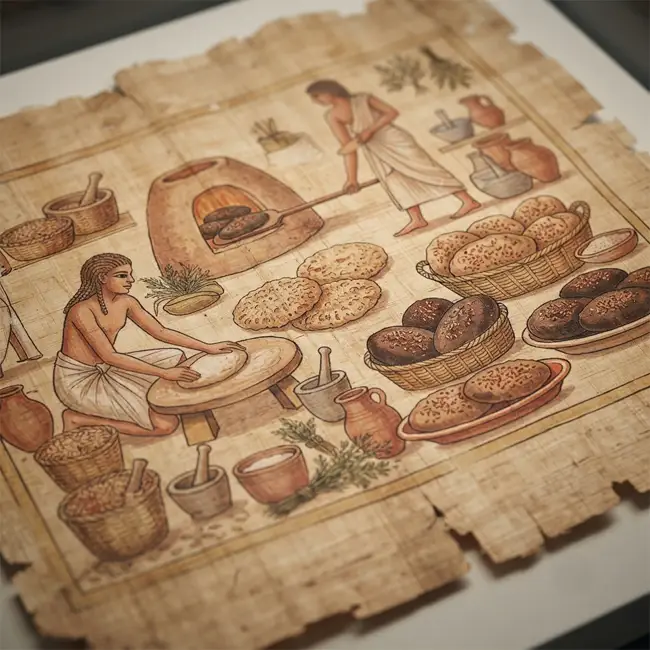
🍪 Recipe: Ninda & Bappir - Ancient Babylonian Barley Flatbreads with Toasted Sesame
🗿 Legends Behind This Excavated Secret
Every Babylonian family had their own version of Ninda. But the story carved into tablet YBC 4644 is my favorite.
The tablet tells of a temple baker who was tasked with making bread for both the workers and the gods. For the workers, he made Ninda, a soft, daily flatbread made from barley and a little emmer wheat, cooked quickly on the hot walls of the tannur so it puffed up. For long caravan trips across the desert and for the temple storehouses, he made Bappir. He would bake Ninda once, then break it up and bake it again until it was completely dry and hard. This ancient cracker-bread could last for months without spoiling. When travelers needed to eat, they just crumbled it into water or broth.
Legend says that the goddess of grain, Nisaba, herself whispered the secret to the baker: Do not rush the grain. Let it drink slowly, and let the fire kiss it, not burn it. That is exactly what we will do. Our recipe is a hybrid, the soft chewiness of daily Ninda with the incredible nutty depth of Bappir. It is hearty, slightly tangy, smoky, and unforgettable.
🧺 Ingredients & The Noble Pantry
Before we touch any flour, let's talk about what the Babylonians actually had in their pantry. This will change how you taste this bread.
• The Ancestral Staples
In 3000 BCE, there was no all-purpose white flour. The star was always barley. Ancient two-row barley was not the polished pearl barley you see in soups today. It was hulled barley, full of fiber, protein, and a deep, almost chocolatey, earthy flavor. They also used emmer, an ancient ancestor of wheat that is incredibly fragrant. The fat was never butter, it was always cold-pressed sesame oil, which Mesopotamians called ellu. They loved to press it themselves. And for a little sweetness and binding, they used date syrup, called silanu, which is like nature's caramel. Salt came from the dried marshes.
• Modern Substitutes
I get it, you probably do not have emmer growing in your backyard. Here is how we make this ancient pantry work perfectly today without hunting down specialty stores for a week.
For barley, use whole barley flour or sprouted barley flour from any health store. If you can only find pearl barley, you can grind it in a strong blender. For emmer, the best and easiest swap is spelt flour or whole wheat flour. Spelt is a direct descendant and tastes almost identical. For sesame oil, please do not use the dark toasted Asian sesame oil, it will be too strong. Use light, cold-pressed or untoasted sesame oil. And for date syrup, you can find it in Middle Eastern stores or just make a quick version by blending 4 soft Medjool dates with a little warm water. If you are allergic to sesame, a good quality extra virgin olive oil works too.
• Ancient Proportions
This will make 6 medium flatbreads, enough for 3 to 4 people. This is exactly how the Babylonians would have portioned it for a family.
◦ Whole barley flour: 2 cups, plus extra for dusting, about 240 grams
◦ Spelt flour or whole wheat flour: 1 cup, about 120 grams
◦ Lukewarm water: 1 and 1 quarter cups, about 300 ml, plus 2 tablespoons extra if needed
◦ Date syrup or blended Medjool dates: 2 tablespoons
◦ Light sesame oil: 3 tablespoons, plus extra for brushing
◦ Fine sea salt: 1 and 1 half teaspoons
◦ Instant dry yeast: 1 teaspoon - this is our modern helper, ancient Babylonians used wild sourdough starter
◦ Toasted white sesame seeds: 3 tablespoons for topping
🔥 The Chef’s Ancient Ritual
This is not just mixing. Think of this as a ritual. Take your time.
◦ Step 1: Awakening the Grains
In a large bowl, whisk together your barley flour, spelt flour, salt, and instant yeast. Barley flour has very little gluten, so it needs a friend, which is why we add spelt. Make a well in the center. In a separate jug, mix your lukewarm water, date syrup, and 2 tablespoons of sesame oil. The water should feel like a warm bath, not hot. Pour the wet into the dry. Mix with your hand or a wooden spoon until you get a shaggy, slightly sticky dough. It will feel rougher than normal bread dough, that is correct, that is the ancient barley talking.
◦ Step 2: The Slow Knead
Turn the dough out onto a surface dusted with barley flour. Now knead. But do not be aggressive. The Babylonian method is slow and respectful. Knead for about 8 to 10 minutes. Push, fold, turn. At first it will be crumbly, then it will become soft and pliable, just like an earlobe as the tablet says. If it feels too dry and cracks, add that extra tablespoon of water. If too sticky, add a pinch more barley flour. Place it in a bowl lightly oiled with sesame oil, cover with a damp cloth, and let it rest in a warm corner for 1 and 1 half to 2 hours, until it has grown by about 50 percent. Barley does not puff up like white bread, so do not expect it to double.
◦ Step 3: Shaping the Suns
Gently punch down the dough and divide it into 6 equal balls. Let them rest for 10 minutes, this makes them easier to shape. Now, with your fingertips, not a rolling pin, press each ball into a flat disc about 5 to 6 inches wide and about one quarter inch thick. Keep the center slightly thinner than the edges. The Babylonians believed the bread should look like the sun. Brush the top of each disc lightly with the remaining sesame oil and sprinkle generously with toasted sesame seeds. Press the seeds in gently.
◦ Step 4: The Hearth Kiss
This is the most important part. If you have a baking stone or steel, this is the time to use it. Place it in your oven and preheat your oven to its highest setting, 500 degrees Fahrenheit or 260 degrees Celsius, for at least 45 minutes. You want that stone screaming hot, just like the clay wall of a tannur. If you do not have a stone, turn a thick baking sheet upside down and preheat it. Slide one or two flatbreads at a time onto the hot stone using parchment paper. Bake for 4 to 6 minutes only. They will puff slightly, get dark brown spots, and smell incredible. Do not overbake or they will become hard like Bappir. You want soft with a chewy bite. Wrap the baked flatbreads immediately in a clean kitchen towel to keep them soft while you bake the rest.
💡 Secrets of the Ancestral Hearth
I have made this bread dozens of times, and here are the secrets I learned from my mistakes so you do not have to repeat them.
◦ Do Not Skip the Towel Trick: The moment your flatbread comes out, wrap it. Ancient bakers stacked hot breads and covered them with cloth. This traps the steam and makes the barley soft instead of crumbly. If you leave it in the open air, it will turn into a cracker in 10 minutes.
◦ The Barley Mistake: If your dough is too dense and heavy like a brick, you probably used 100 percent barley flour. Barley has almost no gluten to hold air. You must have that spelt or whole wheat flour mixed in for structure, at least 30 percent. That is how the Babylonians did it too, they mixed grains.
◦ Heat is Everything: A lukewarm oven will give you dry, pale, sad bread. You need violent, intense heat. That is what creates the signature charred bubbles on the bottom. If your oven does not go to 500 F, go as high as it will go and bake for 1 minute longer.
◦ Date Syrup is Not Just Sugar: Do not replace it with honey or white sugar if you can help it. Date syrup adds moisture, a deep caramel note, and that authentic Mesopotamian flavor that sugar cannot replicate. It also helps the bread stay soft longer.
◦ Best Day to Eat: This bread is best eaten the day it is made, warm, with a drizzle of sesame oil and maybe some hummus or lentil soup. If you want to keep it, you can turn leftovers into Bappir. Just slice thin and bake again at 300 F for 20 minutes until completely crisp. It will keep for weeks in a jar.
👋 Ancient Civilization Origins FAQ
Q1.What did Babylonian flatbread actually taste like?
Imagine a bread that is earthy, nutty, and slightly sweet, with a chewy center and smoky, crisp edges. It is much heartier and more flavorful than pita. The barley gives it a deep, almost coffee-like undertone, and the sesame oil and toasted seeds make it incredibly aromatic. It is savory, not sour.
Q2.Is this Babylonian recipe healthy?
Absolutely. This is one of the healthiest breads you can make. Whole barley flour is packed with beta-glucan fiber which is amazing for heart health and digestion, plus it has more protein and minerals than modern white flour. Using date syrup and sesame oil instead of refined sugar and butter keeps it wholesome and plant-based friendly. Ancient grains are naturally more nutrient-dense.
Q3.Can I make this without yeast like the ancient Babylonians did?
Yes, you can. The original Babylonians used a wild sourdough culture. If you have an active sourdough starter, you can replace the instant yeast with one half cup of active starter and reduce the water by one quarter cup. The rise will take much longer, about 4 to 6 hours for the first rise, but the flavor will be even more tangy and authentic. It is worth trying once.
Q4.What is the difference between Ninda and Bappir?
Great question. Ninda is the general Sumerian word for bread, but it usually refers to the soft, daily flatbread that everyone ate fresh. Bappir is a specific type of Ninda that was baked twice to remove all moisture. Think of Ninda as fresh bread and Bappir as a hardtack or biscotti for preservation. Our recipe today is a soft Ninda with the toasted flavor notes of Bappir.
🏺 The Taste of Archeology
Take a bite while it is still warm.
Do you taste it? That slight chew, that whisper of smoke, that nutty sweetness from the dates and sesame. That is not just flavor, my friend, that is 5000 years of human ingenuity. That is the taste of farmers who first tamed wild grass, of bakers who first figured out that fire plus flour equals life, of a civilization that believed bread was so sacred it belonged to both kings and gods.
When you make this, your kitchen stops being just a kitchen. For a moment, it becomes a small hearth on the banks of the Euphrates. It connects you directly to the hands that first shaped this same dough five millennia ago. There are very few recipes in the world that can do that.
🌟 Final Thoughts: Bringing Antiquity to Your Modern Table
I know ancient recipes can feel intimidating. You might think you need a clay oven or special tools. You do not.
All you need is barley, water, a little fire, and a bit of patience. The Babylonians proved that you do not need a hundred ingredients to create something timeless. You just need good grains and respect for the process.
So this weekend, try it. Turn off the TV, put on some music, and get your hands dusty with barley flour. Bake a batch of these Babylonian flatbreads. Tear them with your hands, dip them in olive oil or a hearty lentil stew, and share them with people you love. You will be sharing the oldest shared meal in human history.
If you bake it, please tell me how it went. Did your kitchen smell like ancient Babylon too?
🤝 The Golden Hook (The Sacred Union)
You are now officially a Keeper of the Grain.
By baking this bread, you have done something powerful. You have kept a 5000-year-old flame alive. Most ancient recipes are lost forever, their clay tablets broken, their secrets forgotten.
We are on a mission to find and resurrect them, one ancient civilization at a time, before they disappear. From Egyptian honey cakes to Roman legion bread, the world is full of sacred food secrets waiting to be baked again.
Join our community of history bakers and archeology food lovers. Subscribe to our newsletter, share your Babylonian flatbread creation, and let us know which lost civilization we should resurrect next. Let us bake history together, so the flavors of our ancestors never die.
📜 Credit to the Keepers of the Culture (The Legacy)
This recipe is inspired by the ancient culinary archives and clay tablet inscriptions of Mesopotamia, specifically the Old Babylonian culinary tablets from the Yale Babylonian Collection and the traditions of the Sumerian and Babylonian peoples. We have carefully adapted the measurements for modern kitchens while preserving its sacred ancestral soul. Deep gratitude to the archaeologists, translators, and cultural historians who work tirelessly to preserve the heritage of the Fertile Crescent.
| 🧱 🏛️🌾 < Back |