
🏠 Home > 🗺️ Recipes > 🧊🥩 Ice Age Ancestral Feast (Paleo Food) > ☀️ Southern African Coastal Caves: Ice Age Ancestral Feast (Paleo Food) Recipes
☀️ 🧊🥩 Southern African Coastal Caves: Ice Age Ancestral Feast (Paleo Food) Recipes
Published by Supakorn | Updated: November 2026
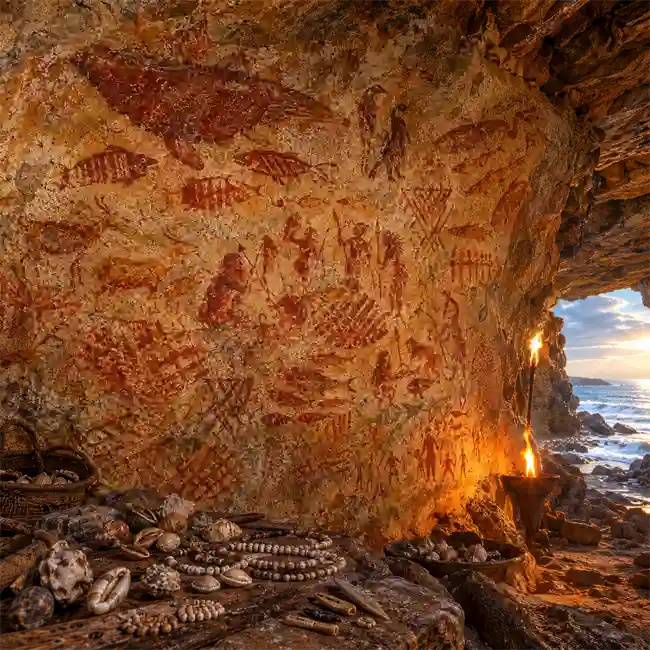
Imagine standing inside a wind-carved sea cave on the southern tip of Africa, 150,000 years ago. Outside, the Indian Ocean roars against limestone cliffs. Inside, a small fire crackles, casting light on ochre-stained walls. The smell of seared shellfish, smoky bone marrow, and wild herbs fills the air. This wasn't just survival. This was the first kitchen.
The Southern African Coastal Caves, from Blombos to Klasies River to Pinnacle Point, are where our species, Homo sapiens, learned how to truly feed ourselves. This is the untold story of the Ice Age Ancestral Feast, a Paleo food culture that lasted from 30,000 to 300,000 years ago and still whispers to us today.
🐘📜 The Ice Age Chronicles: 30,000 - 300,000 B.C.
The Southern African coastline wasn't always the sunny paradise we know now. During the Pleistocene, the planet breathed in deep, freezing cycles.
✦ The Big Chill Context: Between 300,000 and 30,000 years ago, sea levels rose and fell by over 100 meters. When the ice sheets grew, the coastline stretched out for kilometers, creating vast, fertile plains called the Paleo-Agulhas Plain. This was a hunter-gatherer supermarket.
✦ The Three Acts of the Old Stone Age: Our ancestors lived through three massive chapters. In the Lower Paleolithic, early humans first mastered fire. In the Middle Paleolithic, around 300,000 to 30,000 years ago, anatomically modern humans appeared in these caves, crafting sophisticated Still Bay and Howiesons Poort stone tools. In the Upper Paleolithic, symbolism and complex food processing exploded.
✦ Fire as Technology: Evidence from Wonderwerk Cave and Pinnacle Point shows controlled fire use as early as 1 million years ago, but by 164,000 years ago at Pinnacle Point, fire became a kitchen tool. They weren't just warming themselves; they were heat-treating silcrete stone to make sharper blades and using low, slow fires to open stubborn shellfish and render fat.
✦ The Tool Kit of a Chef: The cave floors are littered with more than handaxes. We find bone awls for extracting marrow, grinding stones stained with ochre and burnt fat, and razor-sharp microliths that were hafted onto wooden spears for hunting small, fast game like the rock hyrax.
✦ Why This Coast Mattered: Unlike the frozen interior of Europe, this coast was a refuge. Even in the harshest glacial maximum, the ocean provided a stable, protein-rich buffet. This reliability allowed humans to stay, think, create art, and develop complex food traditions instead of constantly moving.
🦴 Unearthed from the Ashes: The Paleolithic Menu of the Coastal Caves
Archaeologists don't find recipe books, but they find the leftovers. Burnt shells, cut-marked bones, charred seeds, and organic residue on grinding stones paint a vivid menu. Here are the most iconic, scientifically-documented ancestral meals and elixirs from this region.
🔥 The Fire-Roasted Proteins
• Pinnacle Point Brown Mussel Roast: Thousands of layers of Perna perna shells, blackened on one side, show they were placed directly on embers. This was fast food, high in iodine, selenium, and protein. The method was simple: gather at low tide, roast until the shell pops.
• Klasies River Giant Tortoise Bake: Fragments of carapaces with clear fire-cracking patterns suggest whole tortoises were placed upside-down on hot ashes, essentially steaming the meat inside its own shell. A fatty, calorie-dense feast.
• Blombos Cave Seal Flipper Char: Cut marks near the joints of Cape fur seal remains show how hunters detached flippers and seared them over fire. The skin was left on to trap the blubber, creating a crispy, high-energy food crucial for winter survival.
• Diepkloof Rock Hyrax Skewers: Tiny, precise burn marks on hyrax bones indicate they were skewered on wooden sticks and rotated over flame, much like a primitive kebab. A communal snack food.
• Eland and Giant Buffalo Marrow Extraction: Long bones were smashed with hammerstones to access the marrow. Some bones show evidence of being heated gently first to make the marrow melt and become drinkable. This was the Paleo equivalent of butter, pure energy and fat-soluble vitamins.
🌿 The Gathered and Ground Staples
• Border Cave Geophyte Mash: Charred remains of Hypoxis and other wild tubers and corms were found roasted in ash pits. Rich in carbohydrates, they were likely pounded on grinding stones with a little animal fat to make a smoky mash.
• Klasies River Wild Almond Crush: Evidence of Sideroxylon inerme seeds, cracked and ground, shows they were leaching out bitter tannins with water and then toasting the nut meat for safe eating.
• Seaweed and Kelp Wraps: Microscopic charcoal and seaweed residues on stones suggest kelp was dried over fire and used to wrap shellfish or tubers for slow-baking, trapping moisture and minerals.
• Fynbos Herbal Infusions: Pollen grains from buchu, wild sage, and honeybush found in hearth contexts indicate hot water infusions. Not for flavor alone, but for digestion, medicine, and warmth. These are the original non-alcoholic elixirs.
• Ostrich Eggshell Water Canteens and Porridge Bowls: Broken ostrich eggshells with engraved patterns were used to store water and also as vessels to cook a mix of crushed seeds, marrow, and hot stones, creating a thick, nutritious porridge.
❄️ Living Like the First Foragers: Paleolithic Survival & Cave Heritage
What did a day actually look like?
• A Division of Labor, A Unity of Feast: Archaeological evidence suggests a fluid teamwork model. Low-tide foraging for shellfish was often done by groups including women, children, and elders, while coordinated hunts for larger antelope involved small hunting parties using traps and drive tactics in the coastal valleys.
• The Cave as Pantry and Pharmacy: Caves were not dark, messy holes. Excavations show distinct zones: a sleeping area with grass bedding, a central hearth kitchen, a tool-making area near the light, and a midden or trash heap at the entrance. Food was preserved by smoking strips of meat on racks above the fire.
• Eating with the Seasons: Summer was the time of shellfish abundance and coastal foraging. Winter, when storms made the sea dangerous, meant moving slightly inland to hunt grazing animals on the exposed plains and gathering calorie-dense geophytes.
• Modern Pilgrimage: Where to Feel It Today: You can visit the cradle of this cuisine.
◦ Pinnacle Point Caves, Mossel Bay: Now a UNESCO World Heritage Site. You can walk the actual staircase down to Cave 13B where humans ate shellfish 164,000 years ago.
◦ Blombos Cave Museum: Home of the 100,000-year-old ochre processing kit, the first evidence of a recipe that combined ochre, bone marrow, charcoal, and a liquid binder.
◦ Klasies River Main Site: A powerful, windswept site where you can still see stratified layers of 120,000 years of continuous human dinners.
◦ Klipdrift Shelter: A lesser-known gem showcasing the Howiesons Poort innovation in tiny, precise tools used for delicate food processing.
🏔️ Taming the Frozen Wilderness: Glacial Valleys & Ice Epoch Trails
This food tradition is inseparable from its landscape.
◦ The Vanished Paleo-Agulhas Plain: During glacial periods, the ocean retreated, exposing a vast Serengeti-like plain where the sea is today. Imagine herds of now-extinct giant buffalo, giant zebra, and antelope migrating across this plain. The caves were lookouts over this hunting ground.
◦ The Trail of the Shell Middens: A coastal hiking trail linking Pinnacle Point to Blombos follows ancient foraging paths. The white piles of ancient shells you see eroding from the cliffs are literally 100,000-year-old kitchen waste.
◦ Cape Floral Kingdom as a Food Forest: The Fynbos biome is the smallest but richest floral kingdom on Earth. More than 9,000 plant species, many edible. Our ancestors were master botanists who knew exactly which bulbs to dig after a fire, which berries were safe, and which leaves could soothe a stomach.
◦ Ice Age Survival Tip for Modern Explorers: The ancestors ate fat first. In a cold, high-energy environment, fat was life. They prioritized marrow, brain, and blubber. It was not about lean protein; it was about sustained, slow-burning energy.
❄️❓ Paleolithic Mysteries FAQ: Unlocking Cave Kitchen Secrets
Q1: Is eating like a Southern African coastal cave ancestor the same as the modern commercial Paleo diet?
Not quite. The commercial Paleo diet often focuses on lots of lean meat. The real Ice Age ancestral feast was much more diverse and opportunistic. It was about 70% gathered foods, small game, shellfish, tubers, nuts, and seasonal fat loading. It was high in fiber from wild plants and high in minerals from shellfish, something many modern Paleo diets miss.
Q2: Why was bone marrow so important? What nutrients did it have?
Marrow was the ultimate survival food. It is rich in monounsaturated fats, collagen, vitamin A, vitamin K2, iron, and zinc. In an Ice Age context where carbohydrates could be scarce in winter, drinking warm liquid marrow provided instant calories and essential fat-soluble nutrients without needing to chew tough meat. Archaeologists call it a "fat factory" inside the bone.
Q3: How do we know they cooked and didn't just eat raw food?
We have three smoking guns: 1) Cut marks from stone tools overlaying burn marks, meaning meat was butchered then cooked. 2) Thermal fractures on bones and shells that only happen at specific cooking temperatures. 3) Microscopic lipid residues of heated animal fat soaked into grinding stones and pottery-like ostrich eggshells. Raw eating leaves none of these traces.
Q4: How did they make fire and keep it alive in damp coastal caves?
They used friction methods and iron pyrite strike-a-light, but the key was maintenance. Hearth evidence shows they kept a central, low-burning fire for weeks, feeding it with slow-burning fuel like animal dung and dense wood. They also carried fire in hollowed-out shells or fungi, similar to how some San communities still do today. Losing fire meant losing the ability to eat many foods safely.
🧠 Final Thoughts: The Untamed Soul of Primeval Gastronomy
The Southern African Coastal Caves teach us that cooking is not a modern invention. It is a 300,000-year-old love letter to survival. Every roasted mussel, every cracked marrow bone, every handful of wild herbs was a choice made by people who were as clever, curious, and hungry as we are.
This was food without additives, without plastic, without monoculture. It was slow food in the truest sense: food that required knowledge of tides, tracks, seasons, and stars. The smoky, salty, earthy flavors of this ancestral feast remind us that the best recipes are not written down, they are lived.
Stay tuned. In our upcoming full series, we will break down each of these iconic Ice Age dishes into a practical, modern kitchen-friendly version, using sustainably sourced ingredients that honor the original spirit.
🏛️ Credit to the Keepers of the Paleolithic Heritage
This historical overview is compiled from Paleolithic archaeological records, glacial ice-core studies, and prehistoric cave discoveries. We honor the resilience of our ancient ancestors and the dedicated researchers unearthing human history.
◦ Special gratitude to the research teams at the African Centre for Coastal Palaeoscience, Nelson Mandela University, and the SapienCE Centre of Excellence, University of Bergen.
◦ Deep respect to the curators and field archaeologists of Blombos Cave, Pinnacle Point, Klasies River, and Diepkloof Rock Shelter.
◦ And our profound respect to the indigenous knowledge holders of the Khoisan communities, whose continuous connection to this land and its foodways illuminates the deep past.
🧊🥩 The 120,000-Year-Old Seaside Feast: How Our Ancestors Cooked Shellfish at Klasies River
👉 Unearth Southern African Coastal Caves: Ice Age Ancestral Feast
| 🌐 🧊🥩 < Back | Next > 🍵 ☀️ |