
🏠 Home > 🗺️ Recipes > 🔥🧉 Primal Foraged Nectars (Raw Herbal Infusions) > 📜 Caucasus Foothills & Dmanisi: Primal Foraged Nectars (Raw Herbal Infusions) Recipes > 🔥🧉 1.Caucasus Deep-Time Spruce Needle Herbal Infusions
🔥🧉 The Forgotten Spruce Needle Tradition of the Ancient Caucasus
Published by Supakorn | Updated: August 2026
🔥 🧾 Prehistoric Ancestral Palate: Lower Paleolithic, Approximately 2.5 Million–300,000 Years Ago
Imagine standing beneath a cold Caucasus sky almost two million years ago.
There are no roads. No fields. No ceramic cooking pots. No metal knives. No neatly organized kitchen waiting nearby.
Instead, there are limestone slopes, open woodland, river valleys, animal tracks, scattered stones, edible plants, roots, seeds, and the constant search for enough food to make it through another day.
This is the world that gives the idea of Lost Lower Paleolithic Recipes its mysterious appeal.
But there is an important distinction to make right from the beginning: archaeology does not provide a surviving 1.8-million-year-old recipe card for spruce needle brew. The preparation presented here is a modern culinary reconstruction inspired by the Lower Paleolithic environment and early human food-gathering possibilities, rather than a proven archaeological recipe.
That distinction actually makes the story more fascinating.
Instead of pretending that we know exactly what an early hominin prepared, we can ask a more interesting question:
What could a simple, aromatic plant infusion have looked like when human food culture was still in its earliest stages?
The answer takes us into a world of stone, fire, plants, animal fat, mineral-rich landscapes, and extraordinary adaptability.
🔥 The Dawn of Fire & Stone: 300,000–2,500,000 Years of Early Hominid Survival
Long before the elaborate kitchens of later civilizations, early hominins lived within landscapes where every meal depended on observation.
Wind moved through mountain valleys. Smoke drifted around temporary camps. Stone struck stone with a sharp crack as tools were shaped. Animal remains could provide meat, marrow, connective tissue, and fat, while plants offered another layer of seasonal nourishment.
The Caucasus is particularly compelling in this story because the Dmanisi archaeological site in present-day Georgia preserves evidence of early Homo populations dating to roughly 1.8 million years ago.
That does not mean we can reconstruct their exact menu.
It does mean that the region provides a remarkable window into an extremely early chapter of human dispersal beyond Africa.
The imagined culinary scene therefore begins not with a "recipe" in the modern sense, but with resourcefulness.
A branch could become fuel.
A sharp stone could become a cutting tool.
A plant could become food, medicine, material, or simply remain untouched because someone had learned that it was unsuitable.
That last lesson was just as important as knowing what to eat.
🌿 The Primordial Genesis of Human Sustenance
The earliest human diet was almost certainly flexible rather than fixed.
Early hominins had to respond to whatever their environment provided. Seasonal fruits, underground storage organs, leaves, seeds, nuts, insects, animal tissues, and other available resources could all contribute to survival depending on location and time.
Spruce needles are especially interesting from a modern reconstruction perspective because evergreen trees offer something unusual in a seasonal landscape: aromatic foliage that remains available even when many other plants disappear.
The young green tips of spruce contain aromatic compounds and vitamin C, although their nutritional contribution should not be exaggerated. A small infusion is not a complete meal, and it should never be presented as a miracle survival food.
For this reconstruction, the spruce needle infusion is better understood as a small botanical preparation accompanying a larger ancestral-style meal.
That concept feels more believable.
The early human relationship with food was not about perfect recipes. It was about recognizing useful resources and transforming them with whatever technology was available.
🪓 The Lower Paleolithic Culinary Awakening
Lower Paleolithic food culture is often imagined as nothing more than raw meat and fire.
The reality was almost certainly more complicated.
Stone tools opened possibilities.
Breaking bones could expose marrow. Cutting animal tissue could make portions easier to handle. Heating food could change texture and perhaps improve digestibility. Plant materials could be crushed, bruised, warmed, or combined with other foods.
The famous Acheulean handaxe tradition emerged much later than the earliest stone tools and became an important part of Lower Paleolithic technological history. It represents something bigger than a single tool shape: the growing ability to manipulate stone deliberately and repeatedly.
Food preparation and toolmaking therefore belong to the same larger story.
The handaxe was not necessarily a "kitchen utensil," but the technological world that produced sophisticated stone tools also created new opportunities for processing food.
And somewhere within that broad story, a simple aromatic plant infusion becomes an intriguing culinary possibility.
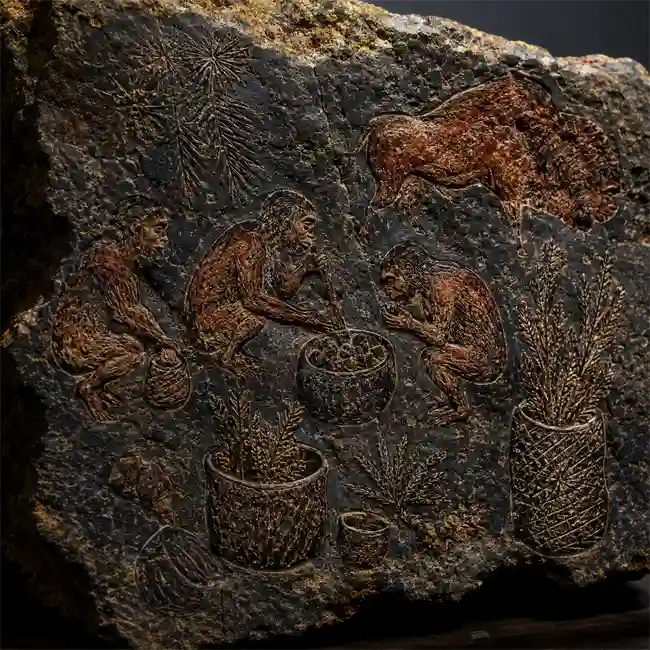
🍃 Recipe: Caucasus Deep-Time Spruce Needle Herbal Infusions
This recipe is a modern, safe culinary interpretation, not a verified 1.8-million-year-old preparation.
The goal is to recreate the sensory idea of an extremely simple Lower Paleolithic botanical infusion while using ingredients and equipment that are practical today.
Think of it as a culinary time-travel exercise:
spruce tips + clean water + gentle heat + patience.
No refined sweetener is necessary.
No synthetic flavoring is necessary.
And no elaborate equipment is required.
The resulting infusion should be light, resinous, fresh, slightly citrus-like, and distinctly woodland in character.
🏔️ Whispers from the Ancient Cave Wall
Archaeological evidence from Lower Paleolithic sites can reveal stone tools, animal remains, sediments, and environmental information, but it rarely tells us the exact sequence of actions that produced a particular meal.
That is why prehistoric food writing requires humility.
A scatter of broken bones can suggest carcass processing.
Burned material can indicate exposure to fire.
Stone artifacts can reveal technological behavior.
Plant remains, when preserved, can sometimes provide clues about vegetation and human activity.
But none of these automatically proves a specific recipe.
The Caucasus gives us a powerful setting because sites such as Dmanisi demonstrate that early Homo populations occupied this region remarkably early.
The spruce needle preparation in this article therefore belongs to the category of experimental ancestral cuisine.
It asks:
What would a simple woodland infusion taste like if we stripped away modern culinary complexity?
The answer begins with green needles, clean water, and a controlled source of heat.
🌲 Wild Savannah Treasures & The Hominid Larder
The imagined Lower Paleolithic pantry is not a pantry in the modern sense.
It is a landscape.
Every ingredient begins outside.
🦴 The Primitive Staples
• Large-animal meat — about 45% of the reconstructed meal: represented today by lean venison, elk, or another suitable red meat. The purpose is to provide the substantial protein component of the meal.
• Bone marrow — about 20%: represented by beef marrow bones. Marrow provides fat and a rich mouthfeel, making it useful for illustrating the importance of animal tissues in ancestral food reconstructions.
• Wild root vegetables — about 15%: modern equivalents can include parsnip, burdock root, or other properly identified edible roots.
• Seeds or nuts — about 10%: crushed hazelnuts or another appropriate edible seed can provide texture and additional energy.
• Spruce tips or young spruce needles — about 5%: used primarily for aroma and botanical character rather than as the principal source of calories.
• Clean water — about 5%: sufficient to create a concentrated but drinkable infusion alongside the reconstructed meal.
These percentages are culinary reconstruction proportions, not archaeological measurements.
🏠 Modern Kitchen Substitutes
If you want to recreate the experience without pretending that modern ingredients are identical to extinct animals or ancient plants, keep the substitutions straightforward:
• Ancient large game: 450 g venison or elk
• Alternative red meat: 450 g high-quality beef short rib
• Ancient marrow source: 200 g beef marrow bones
• Wild root component: 150 g parsnip or properly identified edible burdock root
• Ancient seeds: 75 g hazelnuts
• Spruce tips: 20–25 g young, correctly identified culinary spruce tips
• Water: 750 ml for the botanical infusion
• Optional modern herb: a very small amount of fresh wild mint if desired, although this is a modern addition rather than a historical claim
Only use spruce species that are positively identified as suitable for culinary use. Never collect conifer needles from an unknown tree.
📏 Paleolithic Proportions
For the spruce needle infusion itself, a practical modern ratio is:
• 750 ml clean water — 100% liquid base
• 20–25 g fresh young spruce tips — approximately 3% of the water's weight
• Optional crushed spruce tips — up to 5 g extra for stronger aroma
• No refined sweetener required
• Steeping time — approximately 8–12 minutes
• Heat — gentle, not a violent boil
The percentages here are intended to help modern cooks reproduce the flavor consistently. They are not evidence that Lower Paleolithic people measured ingredients by percentage.
🔥 The Handaxe Culinary Ritual
The first rule of this reconstruction is simple:
Do not try to reproduce prehistoric food preparation by creating unsafe conditions.
Modern sanitation and temperature control are part of the experience.
Begin with clean, correctly identified spruce tips. Rinse them gently under cool running water.
Place the water in a small saucepan and bring it close to a simmer.
Do not aggressively boil the spruce material for a long period. Excessive heat can flatten the delicate aromatic character and produce a harsher, more resinous flavor.
Add the spruce tips after the water has reached gentle heat.
Cover the vessel.
Let the infusion steep for roughly eight to twelve minutes.
The color should remain relatively light, depending on the plant material used. The aroma should be immediately recognizable as evergreen forest: fresh, resinous, green, and slightly citrus-like.
While the infusion rests, prepare the reconstructed food component.
For a modern ancestral-style meal, season the meat minimally. A little salt is enough if desired, although salt is a modern culinary addition rather than something we can confidently attribute to this particular ancient preparation.
Sear or roast the meat until it reaches a safe internal temperature appropriate for the specific cut.
For marrow, roast the bones until the marrow is thoroughly heated and soft.
Serve the marrow alongside the meat and roasted root vegetables.
The spruce infusion belongs beside the meal as a botanical element rather than as a substitute for food.
The result is intentionally simple.
Protein.
Fat.
Roots.
Seeds.
Evergreen aroma.
Heat.
That simplicity is the point.
🪔 Secrets of the Primordial Hearth
The most important lessons from prehistoric fire cooking are not about making food look primitive.
They are about heat management, patience, observation, and safety.
• Control the heat: A gentle simmer is far better for delicate spruce aromas than a prolonged rolling boil.
• Use correctly identified plants: Never experiment with an unidentified conifer. Some conifers are unsuitable for consumption, and yew in particular is highly poisonous.
• Avoid roadside or polluted collection areas: Culinary plant material should come from a clean, uncontaminated environment or a reputable food supplier.
• Use young spruce growth: Tender tips generally provide a fresher aroma than old, woody needles.
• Do not confuse historical inspiration with historical certainty: There is no surviving evidence proving that people at Dmanisi prepared this exact drink.
• Treat meat as a modern food-safety issue: Archaeological reconstruction should never mean eating undercooked meat.
• Keep raw and cooked foods separate: Stone Age storytelling does not require Stone Age sanitation.
• Use a modern thermometer: There is nothing historically wrong with using modern safety equipment when recreating ancient flavors.
• Let the infusion breathe: Covering the vessel during steeping helps retain volatile aromas.
• Avoid over-concentration: More needles do not automatically mean a better infusion. Too much can create an aggressively resinous taste.
• Do not claim medicinal powers: A spruce infusion can be an interesting botanical food experience without being marketed as a cure or treatment.
• Respect the landscape: The strongest ancestral lesson may not be what early humans consumed, but how carefully they had to observe their surroundings.
💬 ❓ Lower Paleolithic Wisdom & Secrets FAQ
Q1.What did Lower Paleolithic humans actually eat?
There was no single Lower Paleolithic diet.
Food varied according to geography, climate, season, animal availability, plant ecology, technology, and individual behavior. Archaeological evidence suggests that early Homo populations used animal resources, while plant foods and other resources likely contributed to diets in ways that are harder to preserve archaeologically.
Q2.Why is marrow important in prehistoric food reconstruction?
Marrow is energy-dense and occurs inside large animal bones. Broken bones found at archaeological sites can sometimes provide clues about carcass processing and access to marrow. It should not, however, be treated as proof that every ancient meal centered on marrow.
Q3.Was spruce needle brew definitely consumed 1.8 million years ago?
No.
That claim cannot currently be established from archaeological evidence. This recipe is a creative culinary reconstruction inspired by the Caucasus environment and early human resourcefulness. The exact spruce preparation described here should not be presented as an authenticated ancient recipe.
Q4.Can every wild plant be safely eaten?
Absolutely not.
Plant identification is one of the most important parts of responsible foraging. Some visually similar plants can be toxic. Modern cooks should use positively identified edible species and reliable botanical guidance rather than copying an archaeological-themed recipe literally.
🌌 The Untamed Soul of Primeval Flavor
There is something strangely powerful about tasting a food preparation built around almost nothing.
No elaborate sauce.
No complicated spice blend.
No long ingredient list.
Just the aroma of an evergreen tree, the warmth of water, the richness of animal food, and the earthy sweetness of roots.
The flavor is not necessarily "better" than modern cuisine.
It is simply different.
It reminds us that before food became a cultural performance, it was first a survival problem.
And before the kitchen became a room, the landscape itself was the kitchen.
The spruce infusion carries that feeling particularly well.
Its aroma suggests cold mountain air, crushed green foliage, wet stone, and forest after rain.
It is easy to imagine why evergreen plants would have attracted human attention in landscapes where seasonal resources constantly changed.
But imagination must remain separate from evidence.
That balance is what makes responsible prehistoric food reconstruction so compelling.
🔥 Final Thoughts: Unleashing the Lower Paleolithic Heritage in Your Modern Kitchen
The 1.8-million-year Caucasus spruce needle brew is less about claiming that we have discovered a lost recipe and more about recovering a lost way of thinking about food.
Early humans did not have supermarkets.
They did not have ingredient labels.
They did not have refrigeration, stainless-steel cookware, or digital thermometers.
They had landscapes.
They had memory.
They had observation.
They had stone.
And increasingly, they had the ability to use fire and tools to transform what the environment offered.
That is the heritage worth bringing into the modern kitchen.
You can prepare venison instead of extinct large game.
You can roast beef marrow instead of trying to imitate an ancient animal species.
You can use properly identified spruce tips rather than claiming access to a prehistoric forest.
You can use a modern saucepan instead of a stone-heated container.
The technology changes.
The curiosity remains.
When you prepare this reconstruction, slow down.
Smell the spruce.
Notice the difference between raw and heated ingredients.
Taste the roasted roots.
Pay attention to the richness of marrow.
Think about how dramatically food preparation has changed over millions of years.
Then remember the most important part:
This is a reconstruction, not a time capsule.
Its value comes from connecting modern culinary imagination with archaeological evidence while keeping the boundary between evidence and storytelling clear.
🗿 The Sacred Tribe (Claim Your Lower Paleolithic Heritage)
Welcome to the deeper side of ancestral food culture.
The people who explore Paleo-inspired cooking are not simply looking backward.
They are asking questions.
What did humans eat before agriculture transformed the landscape?
How did fire change food?
Why did stone tools matter?
How did early hominins recognize useful plants?
How much can archaeology really tell us about ancient meals?
And where does responsible culinary reconstruction begin?
Those questions turn a modern kitchen into something more interesting than a place for preparing dinner.
It becomes a laboratory for curiosity.
You do not need to pretend that you are living 1.8 million years ago.
You do not need to abandon modern food-safety practices.
You simply need to appreciate the extraordinary journey between the first human interactions with landscape, stone, fire, plants, and animal foods and the kitchens we use today.
So gather your ingredients.
Prepare the spruce.
Light the modern hearth.
And let the story begin.
The heritage is not about copying the past perfectly.
It is about remembering how inventive our ancestors had to be.
🏺 Credit to the Keepers of the Lower Paleolithic Legacy
This modern culinary reconstruction is inspired by the archaeological landscapes, stone-tool traditions, environmental evidence, and early Homo occupations associated with the Lower Paleolithic, including the remarkable Caucasus record represented by sites such as Dmanisi.
The spruce needle preparation itself is not presented as an authenticated 1.8-million-year-old recipe. It is an imaginative reconstruction designed to explore what an extremely simple botanical preparation might mean within an early human food narrative.
The ingredients have been adapted for contemporary kitchens, with modern food-safety standards replacing the unknown conditions of deep prehistory.
The spirit of the reconstruction belongs to a much larger story:
a world before agriculture,
before written recipes,
before permanent kitchens,
before familiar culinary traditions,
when food knowledge was carried through observation, experience, memory, and survival.
The Lower Paleolithic legacy is therefore not a single recipe.
It is a story of adaptation.
Stone by stone.
Fire by fire.
Season by season.
And perhaps, somewhere within that immense human journey, there was an evergreen branch crushed between ancient fingers, releasing its sharp forest fragrance into the cold air.
That is where this recipe begins.
| 📜 🔥🧉 < Back |