
🏠 Home > 🗺️ Recipes > 🧊🥩 Ice Age Ancestral Feast (Paleo Food) > ❄️ Altai-Siberian Wilderness: Ice Age Ancestral Feast (Paleo Food) Recipes > 🧊🥩 1.Siberian Woolly Rhino Steak — The Ice-Steppe Fire Roast
🧊🥩 Siberian Woolly Rhino Steak: A Lost Ice Age Feast Reimagined
Published by Supakorn | Updated: August 2026
❄️ Prehistoric Ancestral Palate: The Middle to Upper Pleistocene, Roughly 300,000–30,000 Years Ago
Imagine stepping outside a Siberian shelter on a bitter morning tens of thousands of years ago.
The landscape is enormous, white, and almost silent. Wind sweeps across the cold grassland. Snow gathers against rocks and cave entrances. Somewhere beyond the ridge, large Ice Age animals move slowly through the frozen steppe.
There are no supermarkets, ovens, refrigerators, or neatly labeled ingredients.
Food begins with observation.
A hunter watches the landscape, follows animal tracks, understands the weather, and knows which plants remain available through the cold season. Around the shelter, another member of the group tends the fire while stone tools, animal hides, bones, and gathered plants are prepared for the next meal.
This is the world behind the idea of Lost Prehistoric Recipes.
The exact recipe for a Siberian Woolly Rhino Steak has never been discovered. There is no ancient cookbook telling us how much salt, herbs, or firewood to use. What archaeology gives us instead are fragments of a much larger story: animal bones, cut marks, stone tools, hearths, charcoal, plant remains, and preserved environmental evidence.
Woolly rhinoceroses lived across the cold environments of northern Eurasia during the Pleistocene. Archaeological research also shows that Neanderthals hunted and butchered large mammals, with woolly rhinoceros among the animals represented in the archaeological record.
In Siberia, the prehistoric story becomes even more fascinating. Denisova Cave in the Altai contains evidence of hominin occupation extending across hundreds of thousands of years, including charcoal and animal and plant remains. Neanderthal presence in the Altai region is also archaeologically documented.
So rather than pretending we have recovered a literal ancient steak recipe, this article treats the dish as a carefully labeled modern culinary reconstruction inspired by Paleolithic evidence.
And honestly, that makes the story even more interesting.
🦏 The Pleistocene Chronicles: 300,000–30,000 Years of Glacial Survival
The Pleistocene was not one unchanging frozen world.
Climate shifted repeatedly. Glacial conditions expanded and retreated. Grasslands, steppe environments, woodland zones, and tundra-like landscapes changed across time and geography.
Yet for human communities living through these transformations, one thing remained constant: survival depended on knowing the landscape.
Picture the evening camp.
Cold wind presses against the entrance of a rock shelter. Snow blows across the open ground. Inside, glowing charcoal illuminates stone tools and rough animal hides. The smell of smoke clings to everything.
A large animal has been processed nearby.
The useful parts matter.
Meat provides protein. Fat supplies concentrated energy. Marrow becomes valuable food. Bones can be transformed into tools or worked for their grease. Plant foods, when seasonally available, add another layer to the diet.
Archaeological research has shown that Neanderthals were capable hunters of medium and large mammals and used sophisticated stone tools. Evidence from several European sites includes the processing of animals such as horse, bison, deer, and woolly rhinoceros.
Research from Siberian sites adds another dimension. At Denisova Cave, archaeological deposits preserve evidence of repeated hominin occupation, fire use, animal remains, and plant material across a remarkably long period.
The prehistoric kitchen was therefore not simply a place where meat was thrown onto flames.
It was a system.
Fire, stone, bone, plants, fat, smoke, weather, timing, and human cooperation all worked together.
🧬 The Primeval Legacy of Human Survival
The most fascinating part of Paleolithic food is not simply what people ate.
It is how intelligently they used what the landscape offered.
Large animals represented enormous resources. A successful hunt could provide food for multiple people, but processing a large carcass required organization, tools, time, and knowledge.
This helps explain why prehistoric food traditions cannot be reduced to the popular image of someone simply roasting meat over a fire.
The archaeological record suggests much more complexity.
At some Neanderthal sites, animal bones show intensive processing. Other evidence indicates that meat-heavy diets could vary according to local environments. At Spy Cave in Belgium, ancient dental calculus provided evidence associated with consumption of woolly rhinoceros and wild sheep, while Neanderthals at El Sidrón in Spain show evidence of plant-focused foods instead.
That difference is important.
There was no single “Stone Age diet.”
There were many local food traditions.
A Siberian hunter living beside a cold steppe would have had a different pantry from a Neanderthal living in a Mediterranean woodland. Seasonal availability shaped everything.
The true prehistoric culinary secret was adaptability.
🔥 The Paleolithic Resurrection
Modern kitchens can never perfectly recreate a Paleolithic meal.
We have stainless-steel pans, thermometers, refrigeration, cultivated herbs, domesticated livestock, and ingredients that prehistoric people could never have encountered.
So the goal of this reconstruction is not to pretend otherwise.
Instead, imagine taking the principles of ancient cooking and translating them into a safe modern kitchen.
The central idea is simple:
Use a large, lean cut of modern game or beef, keep the seasoning restrained, introduce earthy wild-herb notes, and let fire provide the dominant character.
The result becomes a symbolic resurrection of a prehistoric cooking tradition rather than a claim that this exact recipe was eaten 40,000 or 300,000 years ago.
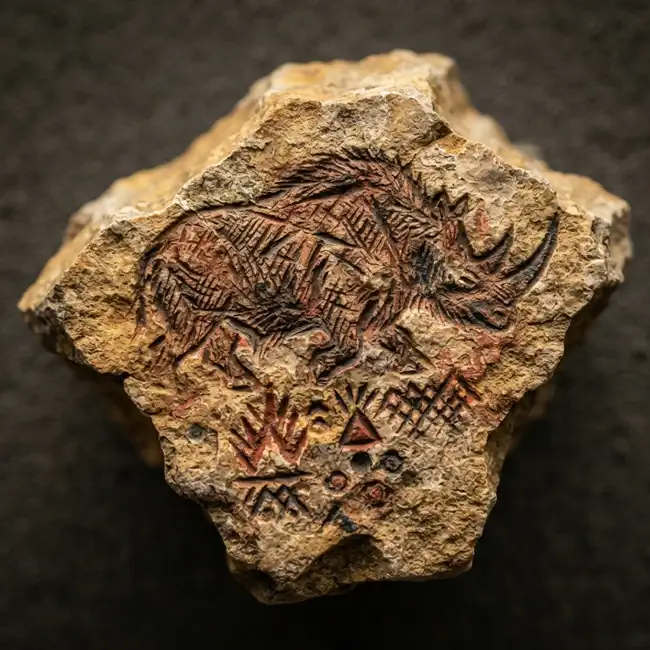
🦏 Recipe: Siberian Woolly Rhino Steak — The Ice-Steppe Fire Roast
This modern reconstruction imagines what a dramatic large-game preparation might feel like if inspired by the cold-steppe environments associated with woolly rhinoceros and Paleolithic hunting traditions.
Because woolly rhinoceros is extinct and is not an ingredient for a modern kitchen, the recipe uses modern beef or venison as a culinary substitute.
The flavor direction is intentionally simple:
Earthy. Smoky. Herbaceous. Savory.
Nothing should overpower the meat.
🧊 Echoes from the Glacial Ice
There is something powerful about the idea of an Ice Age meal being remembered through fragments.
A stone tool survives.
A hearth leaves charcoal.
A bone carries a cut mark.
A sediment layer preserves a tiny piece of an ancient environment.
Together, these fragments allow archaeologists to reconstruct parts of human behavior.
But they do not give us a handwritten recipe.
That distinction matters.
Archaeologists have found evidence of Neanderthal hunting and animal processing, including evidence connected with woolly rhinoceros.
Researchers have also demonstrated that Neanderthal hunting could involve close-range cooperation, with evidence from 120,000-year-old deposits at Neumark-Nord in Germany supporting the use of thrusting spears against deer.
The Woolly Rhino Steak presented here therefore belongs to the world of culinary reconstruction.
It takes archaeological inspiration and turns it into a modern food experience.
🌿 Wild Foraged Essentials & The Hunter’s Pantry
🥩 The Primitive Staples
A prehistoric-inspired pantry would focus on ingredients that echo the broad categories available to Ice Age communities.
• Large-game meat: the centerpiece, represented today by a thick beef steak or venison cut.
• Animal fat: historically important as a concentrated energy source; modern cooking can use a small amount of rendered beef fat.
• Wild aromatic plants: represented by hardy modern herbs such as juniper, thyme, rosemary, or sage.
• Root vegetables: modern parsnip, turnip, or celeriac can represent the earthy character of wild underground foods.
• Forest berries: small amounts of unsweetened berries can provide acidity and contrast.
• Mushrooms: edible cultivated mushrooms can add a woodland, earthy note.
• Coarse natural salt: used sparingly in the modern version rather than imagined as a guaranteed Paleolithic ingredient.
• Smoke: the most important flavor concept, representing the atmosphere of ancient fire cooking.
🏠 Modern Kitchen Substitutes
For a practical modern interpretation:
• Woolly rhinoceros → beef steak: use a thick-cut beef steak as the closest familiar culinary canvas.
• Woolly rhinoceros → venison: choose venison if you want a leaner, more game-like character.
• Ancient animal fat → beef tallow: use a very small amount for searing.
• Unknown Ice Age herbs → thyme and juniper: combine approximately 2 parts thyme with 1 part lightly crushed juniper.
• Wild roots → parsnip and turnip: use roughly equal portions.
• Wild berries → cranberries or blackberries: use a small amount for acidity rather than sweetness.
• Ancient smoke → hardwood smoke: use food-safe smoking methods rather than burning unknown materials.
• Stone-hearth cooking → heavy cast-iron pan: this provides the closest practical modern equivalent to intense retained heat.
📏 Paleolithic Proportions
For one large modern steak:
• 100%: thick-cut beef or venison steak as the main ingredient.
• 2–3%: beef fat or cooking fat relative to the meat weight.
• 1–1.5%: salt relative to meat weight.
• 1 part: crushed juniper.
• 2 parts: thyme.
• 1 part: finely chopped sage.
• 2 parts: mushrooms.
• 2 parts: roasted root vegetables.
• 1 part: tart berries.
• A small amount: wood smoke, used only as a controlled flavor element.
These are modern culinary proportions, not archaeological measurements.
🔥 The Primitive Culinary Ritual
Start with the atmosphere.
Place the thick steak on a clean surface and allow it to lose its refrigerator chill before cooking.
Pat the meat dry.
Lightly season it with salt and the crushed herb mixture.
In a prehistoric-inspired interpretation, seasoning would remain restrained. The goal is to let the character of the meat and fire dominate.
Heat a heavy cast-iron pan until it is thoroughly hot.
Add a small amount of cooking fat.
Place the steak into the pan and allow the surface to develop a deep browned crust.
Turn it only when the first side has developed a strong sear.
Add a few crushed herbs during the final stage so they perfume the cooking fat without burning aggressively.
For a modern, food-safe preparation, use a reliable kitchen thermometer and cook the meat according to current food-safety guidance for the specific cut and meat being used.
After cooking, rest the steak before slicing.
Serve it with roasted roots, mushrooms, and a small portion of tart berries.
The plate should look deliberately primitive without pretending to be an archaeological artifact.
Think dark meat.
Earthy vegetables.
Small green herbs.
Deep roasted aromas.
A suggestion of smoke.
That is the aesthetic of the Ice Age Fire Roast.
🔥 Secrets of the Ancestral Fire
The real lesson of ancient fire cooking is not simply “make it hotter.”
It is learning to control heat.
• Build heat before cooking: a heavy cooking surface should be thoroughly preheated.
• Separate direct and indirect heat: intense heat creates browning, while gentler heat allows the interior to cook without burning the exterior.
• Do not drown the meat in seasoning: prehistoric-inspired food works best when the ingredient remains recognizable.
• Treat fat as an ingredient: a little fat carries aromas and helps develop a rich crust.
• Watch herbs carefully: delicate herbs can burn quickly over intense heat.
• Use clean modern cookware: archaeological fire pits are inspiration, not a reason to cook directly on unknown stones or contaminated surfaces.
• Avoid unknown plants: a prehistoric plant may look edible without being safe.
• Avoid consuming raw or undercooked wild game: modern food safety matters more than historical theater.
• Use a thermometer: visual appearance alone cannot reliably establish safe cooking.
• Rest the meat: allowing the steak to rest improves texture and keeps the presentation closer to the hearty roasted-meat experience imagined here.
• Control smoke: use only food-safe smoking materials and proper ventilation.
• Remember the archaeology: fire was a technology requiring knowledge, not simply a decorative campfire.
The most important “ancestral secret” is therefore control.
Control the flame.
Control the heat.
Control the timing.
And let the ingredient speak.
🧠 Paleolithic Wisdom & Secrets FAQ
Q1.Was Woolly Rhino Steak actually a prehistoric recipe?
No known archaeological evidence records a specific “woolly rhino steak” recipe.
What researchers do have is evidence that woolly rhinoceros formed part of the animal landscape exploited by some Neanderthal groups, including evidence from archaeological sites and dietary research.
This article is therefore a modern reconstruction inspired by archaeological evidence.
Q2.Did Paleolithic people eat only meat?
Definitely not.
Paleolithic diets varied enormously according to geography, climate, season, and available resources.
Archaeological evidence shows that different Neanderthal communities consumed different combinations of animal and plant foods. Dental calculus evidence, for example, has revealed plant consumption in some populations and strong evidence of meat consumption in others.
The phrase “Stone Age diet” hides this diversity.
Q3.Why use beef or venison instead of woolly rhinoceros?
Woolly rhinoceros is extinct, so it is not an appropriate modern food ingredient.
Beef provides a familiar large-animal steak format, while venison offers a leaner game-like character.
The substitution allows the historical concept to become a practical modern recipe without pretending that an extinct animal is available as food.
Q4.What makes this recipe Paleo-inspired?
The inspiration comes from broad Paleolithic principles:
• large terrestrial animals
• simple seasoning
• wild aromatic plants
• roots and mushrooms
• controlled fire
• smoke
• efficient use of ingredients
• respect for the environment
It is a modern interpretation, not a scientifically verified ancient recipe.
🦴 The Taste of Primeval History
Take the first bite and the experience should feel deliberately uncomplicated.
The steak brings the central savory character.
The browned crust contributes roasted depth.
Juniper introduces a forest-like aroma.
Thyme adds green earthiness.
Mushrooms deepen the savory notes.
Roots bring sweetness and warmth.
Tart berries cut through the richness.
And smoke ties everything together.
This is not a dish designed around a long list of exotic ingredients.
It is designed around contrast.
Fire against cold.
Smoke against fresh herbs.
Richness against acidity.
Tender meat against roasted roots.
That contrast is what makes the dish feel ancient.
Of course, no modern recipe can literally reproduce an Ice Age meal.
The original environment is gone.
The original animals are gone.
The original people and their culinary knowledge cannot be interviewed.
What remains are archaeological clues.
And those clues are enough to inspire a fascinating culinary story.
🔥 Final Thoughts: Taming the Ice Age in Your Modern Kitchen
You do not need a Siberian cave to experience the spirit of prehistoric cooking.
You need curiosity.
A heavy pan.
A good modern ingredient.
A handful of earthy herbs.
And the patience to let fire do its work.
The idea behind Siberian Woolly Rhino Steak is bigger than the steak itself.
It is about imagining how food connected humans with an unpredictable landscape.
Every meal depended on knowledge.
Where animals traveled.
Where plants grew.
How weather changed.
How fire behaved.
How long food could be preserved.
How much of an animal could be used.
That was the real prehistoric kitchen.
Not luxury.
Not convenience.
Adaptation.
So when you prepare this modern reconstruction, think of it less as pretending to be a prehistoric hunter and more as taking a culinary journey backward through time.
Your modern kitchen becomes a small window into the Pleistocene.
The refrigerator becomes the cold steppe.
The cast-iron pan becomes the hearth.
The herbs become a reminder of ancient foraging.
And the steak becomes the centerpiece of an imagined meal beneath a sky filled with snow.
🪔 The Sacred Tribe: Claim Your Ancestral Heritage
There is something timeless about gathering around food.
Long before restaurants, supermarkets, recipe websites, and modern kitchens, human communities gathered around shared meals.
Food created cooperation.
Fire created warmth.
Hunting created stories.
Foraging created knowledge.
And cooking transformed survival into culture.
That legacy still speaks to us.
If you are fascinated by Lost Prehistoric Recipes, Stone Age Recipes, Hunter-Gatherer Food Traditions, and the mysteries of Ice Age cuisine, then this is more than a recipe collection.
It is an invitation to explore.
Explore the foods that shaped ancient communities.
Explore the landscapes that fed them.
Explore the archaeological discoveries that allow us to reconstruct fragments of their daily lives.
And most importantly, explore the boundary between what archaeology can prove and what culinary imagination can responsibly recreate.
That is where the most interesting prehistoric food stories begin.
Welcome to the imagined ancestral hearth.
🏛️ Credit to the Keepers of the Paleolithic Legacy
This modern recipe concept is inspired by archaeological research concerning Pleistocene hominin lifeways, large-mammal hunting, animal processing, fire use, and the environments of Ice Age Eurasia.
Evidence from Neanderthal sites indicates sophisticated hunting and butchery practices, while Siberian archaeological sites such as Denisova Cave preserve exceptionally long records of hominin occupation, fire use, animal remains, and plant evidence.
The presence of woolly rhinoceros in ancient diets is supported in specific archaeological contexts, but no surviving source provides the exact ingredients or preparation method for a dish called “Siberian Woolly Rhino Steak.”
For that reason, this recipe should be understood as a creative culinary reconstruction inspired by Paleolithic evidence, not as a recovered ancient recipe.
Our modern adaptation honors the ingenuity of Ice Age communities while keeping historical fact and imaginative reconstruction clearly separated.
The original recipe is lost.
The evidence remains.
And from those fragments, we can still tell the story of the ancient hearth.
| ❄️ 🧊🥩 < Back |