
🏠 Home > 🗺️ Recipes > 🍨 Desserts > 🇱🇨 Saint Lucia Desserts > 🍨 1.Saint Lucian Coconut Tart
🍨 Quick Saint Lucian Coconut Tart: A Weeknight Sweet the Whole Family Will Fight Over
Published by Supakorn | Updated: November 2026
🦜🌴 Introduction – Discover Saint Lucian Coconut Tart: Authentic Saint Lucian Traditional Dessert
Picture this. It's a Tuesday, everyone is tired, and somebody asks, "Is there anything sweet?" Instead of reaching for a packet of cookies, you pull out a tray of golden, flaky hand tarts. Inside is a warm, spiced coconut filling that smells like a vacation. That's the magic of the Saint Lucian coconut tart.
Saint Lucia is a lush volcanic island in the eastern Caribbean. It's known for the twin Pitons rising out of the sea, rainforest hikes, sulphur springs, and beaches that make you forget your inbox exists. Travelers come for the scenery and stay for the food. You'll find fresh fish, green fig, bananas, cocoa, and coconut everywhere. In bakeries, roadside stands, and market stalls, the coconut tart is a familiar and much-loved favorite. It's the kind of treat locals grab with a morning cup of tea or tuck into a lunch bag for later.
Here's the good news. You don't need a tropical island or a pastry degree to make one. This is the traditional style of Saint Lucian coconut tart, adapted so you can make it at home on a normal weeknight. The pastry is simple, the filling cooks in one small pot in about eight minutes, and the whole house will smell amazing while it bakes.
This recipe suits families. Kids can cut the circles and fold the edges, and grown-ups handle the oven. Nobody needs special equipment. If you're looking for easy weeknight desserts that feel like a small celebration, you're in the right place.
So grab your apron, put on some music, and let's bake together.
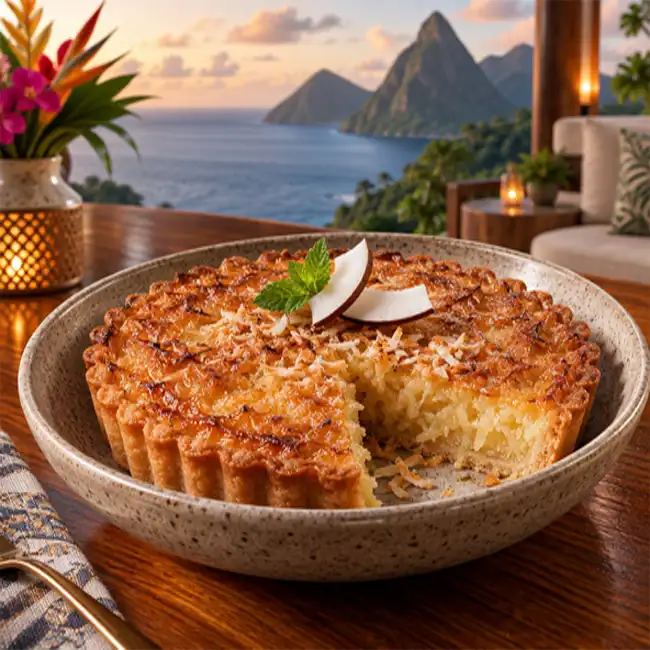
🥥 Authentic Saint Lucian Coconut Tart Recipe
🍯 Culinary Background & Flavor Profile
Think of a hand-held pie. The pastry is buttery and crisp at the edges, with a tender bite in the middle. Break one open and the steam carries cinnamon, nutmeg, and a hint of lime. The filling is soft and chewy, with that deep, toasty sweetness only coconut and brown sugar can make together.
The texture is half the fun. You get the snap of golden pastry, then the moist, almost jammy coconut inside. It isn't overly sweet, which is why it works for breakfast, an afternoon snack, or dessert. The warm spices are gentle and comforting rather than loud. A little lime zest brightens everything, so the richness never feels heavy.
Fresh coconut gives the best flavor, but good unsweetened shredded coconut works well too. I'll cover both in the tips below, so don't worry if you can't find fresh.
🧈 Essential Ingredients & Precise Measurements
This makes about 10 hand tarts, each around 4 inches (10 cm) across. Measurements are given in cups and grams so you can use whichever you prefer.
⭐ For the pastry:
◦ 2 cups (250 g) all-purpose flour, plus extra for dusting
◦ 1 tablespoon (12 g) granulated sugar
◦ 1/2 teaspoon fine salt
◦ 1/2 cup (113 g) cold unsalted butter, cut into small cubes
◦ 4 to 5 tablespoons (60 to 75 ml) ice-cold water, added a little at a time
⭐ For the spiced coconut filling:
◦ 2 1/2 cups (200 g) freshly grated coconut, or unsweetened shredded coconut
◦ 1/2 cup (100 g) packed light brown sugar
◦ 1/4 cup (60 ml) water
◦ 1 tablespoon (14 g) unsalted butter
◦ 1/2 teaspoon ground cinnamon
◦ 1/4 teaspoon freshly grated nutmeg
◦ 1/4 teaspoon ground ginger
◦ 1 teaspoon pure vanilla extract
◦ 1 teaspoon finely grated lime zest
◦ 1 small pinch of salt
⭐ For the egg wash and finishing:
◦ 1 large egg, beaten with 1 tablespoon (15 ml) milk
◦ 1 teaspoon coarse sugar for sprinkling (optional)
Ratio worth remembering: for the pastry, use 2 parts flour to 1 part butter by weight. For the filling, use 2 parts coconut to 1 part sugar. Once you know those two ratios, you can scale the recipe up or down easily.
👩🍳 Step-by-Step Cooking Instructions
1.Preheat the oven. Set it to 400°F (200°C) and line a large baking sheet with parchment paper.
2.Mix the dry pastry ingredients. In a large bowl, whisk the flour, sugar, and salt together.
3.Rub in the butter. Add the cold butter cubes. Use your fingertips to press and rub the butter into the flour until the mixture looks like coarse breadcrumbs with a few pea-sized pieces left. Work quickly so the butter stays cold.
4.Add the water. Sprinkle in 4 tablespoons of ice water and mix with a fork. Squeeze a little dough in your hand. If it holds together, you're done. If it's crumbly, add the last tablespoon, one teaspoon at a time.
5.Rest the dough. Gently press the dough into a flat disc, wrap it, and chill it for 15 minutes while you make the filling. This short rest relaxes the gluten and keeps the pastry tender.
6.Start the filling. Put the coconut, brown sugar, water, butter, cinnamon, nutmeg, ginger, and salt in a medium saucepan over medium-low heat.
7.Simmer gently. Stir often for 6 to 8 minutes. The sugar will melt, the coconut will soften, and the mixture will turn thick and glossy with very little liquid left.
8.Finish and cool. Take the pan off the heat and stir in the vanilla and lime zest. Spread the filling on a plate so it cools faster. It should be just warm or at room temperature before you fill the pastry.
9.Roll the dough. Lightly flour your counter and roll the dough to about 1/8 inch (3 mm) thick. Cut out circles with a 4-inch (10 cm) cutter or the rim of a bowl.
10.Fill the circles. Place about 2 tablespoons of filling in the center of each circle. Leave a clear border so the filling doesn't squeeze out.
11.Seal the tarts. Brush the edge with a little water, fold the dough over into a half-moon, and press the edges together. Crimp with a fork to seal well.
12.Reroll the scraps. Gather the leftover dough, roll it again, and cut more circles until you've used it all.
13.Add the egg wash. Move the tarts to the baking sheet. Brush the tops with egg wash, sprinkle with coarse sugar if you like, and poke a small steam hole in each one with a fork.
14.Bake. Bake for 20 to 25 minutes, until deep golden brown. Rotate the tray halfway through for even color.
15.Cool briefly. Let the tarts rest on a rack for 10 minutes. The filling stays molten at first, so this protects little mouths.
💡 Chef's Pro Tips & Common Mistakes to Avoid
Here's what I've learned from making these over and over.
⭐ Pro tips:
• Keep everything cold. Cold butter and ice water give you a flaky crust. If your kitchen is warm, chill the cut-out tarts for 10 minutes before baking.
• Use fresh coconut if you can. Freshly grated coconut gives the most natural sweetness and the best chew. If you use unsweetened shredded coconut, soak it in warm water for 5 minutes and squeeze it dry first.
• Grate the nutmeg yourself. Whole nutmeg has a warmer, rounder flavor than the pre-ground kind. A few strokes on a fine grater is plenty.
• Control the heat on the filling. Medium-low is your friend. High heat can scorch the sugar before the coconut softens, and burnt sugar tastes bitter.
• Cool the filling completely. Hot filling melts the butter in the pastry and makes the tarts soggy and hard to seal.
• Taste before you fill. Every coconut is different. If it tastes flat, add a tiny pinch of salt. If it's too sweet for your family, add a little more lime zest.
• Need a shortcut? Ready-made pie dough works well on a busy night. Roll it a little thinner and follow the same filling and baking steps.
• Make it your own. A tablespoon of raisins or finely chopped dried pineapple in the filling adds a fruity twist. For a nut-free version, leave out any add-ins that contain nuts.
⭐ Common mistakes to avoid:
• Overworking the dough. Handling it too much makes it tough instead of tender. Stop mixing as soon as it holds together.
• Adding too much water. Wet dough bakes up chewy rather than flaky. Add water slowly.
• Overfilling. Too much filling bursts through the seam. Two tablespoons is the sweet spot.
• Skipping the steam hole. Without it, steam can split the tarts open at the sides.
• Using a runny filling. If the mixture is soupy, the pastry turns soggy. Keep simmering until the liquid is nearly gone.
• Pulling them out too early. Pale tarts taste raw and floury. Wait for a rich golden color.
• Crowding the tray. Leave a little space between tarts so hot air can circulate and the bottoms crisp up.
🍵 Pairings & Serving Suggestions
Coconut tarts taste best warm, about 10 minutes out of the oven, when the pastry is still crisp and the filling is soft. Here are some easy ways to serve them:
• With a hot cup of tea. Black tea with a splash of milk is a classic match. A herbal tea such as ginger or lemongrass also works nicely.
• With cocoa. Saint Lucia is known for cocoa, so a mug of hot chocolate is a fun nod to the island. Kids love it.
• With cold milk. A simple glass of cold milk suits young eaters and picky ones.
• With fresh fruit. Slices of mango, pineapple, or banana add juicy freshness next to the rich filling.
• With ice cream. Put a warm tart next to a scoop of vanilla or coconut ice cream for a quick plated dessert.
• With a fruit punch. A chilled, non-fermented tropical punch made from pineapple, orange, and lime juice is refreshing and family friendly.
• As a lunchbox treat. Wrap a cooled tart in parchment and tuck it into a school bag or picnic basket. It travels well.
🌋❓ Frequently Asked Questions (FAQ)
Q1: How do I store leftover Saint Lucian coconut tarts?
Let them cool completely, then keep them in an airtight container at room temperature for up to 2 days. For longer storage, refrigerate them for up to 5 days. Warm them in a 325°F (160°C) oven for 5 to 8 minutes to bring back the crisp pastry.
Q2: Can I freeze coconut tarts?
Yes. Freeze unbaked tarts on a tray until solid, then move them to a freezer bag for up to 2 months. Bake straight from frozen at 400°F (200°C), adding 5 to 7 minutes to the baking time. Baked tarts also freeze well. Reheat them in the oven rather than the microwave.
Q3: Can I use desiccated coconut instead of fresh coconut?
Absolutely. Use unsweetened shredded or desiccated coconut, soak it briefly in warm water, and squeeze it dry before using. The flavor is slightly milder than fresh, but still delicious. If you use sweetened coconut, reduce the brown sugar to about 1/4 cup (50 g).
Q4: Can I make these dairy-free?
Yes. Swap the butter for a firm plant-based baking block in both the pastry and the filling. Replace the milk in the egg wash with a splash of plant milk. The texture will be a little different, but still good.
📋 Recipe Quick Summary
◦ Prep Time: 25 minutes (plus 15 minutes chilling)
◦ Cook Time: 30 minutes (8 minutes for the filling, 22 minutes for baking)
◦ Total Time: about 1 hour 10 minutes
◦ Servings: 10 hand tarts
◦ Difficulty: Easy
◦ Best for: weeknight dessert, snacks, lunchboxes, family baking
🌺 Final Thoughts & Kitchen Inspiration
If you've ever thought international baking was too fussy for a regular weeknight, I hope this recipe changes your mind. Saint Lucian coconut tarts use ordinary pantry ingredients and one small pot, and the steps are easy to follow. The result tastes like a place you want to visit.
Once you've made the recipe as written, make it yours. Add a little more cinnamon, use extra lime zest, or fold in a spoonful of raisins. Cut the circles into stars for a birthday or make them bite-sized for a party. The best family recipes grow with the people who cook them.
I'd love to hear how yours turned out. Leave a comment with your tweaks, tell me who ate the last tart, and share the recipe with a friend who needs an easy dessert idea. Happy baking!
🇱🇨 Culinary Heritage & Cultural Credit to Saint Lucia
Every recipe comes from somewhere, and this one deserves proper credit. The coconut tart belongs to the everyday baking tradition of Saint Lucia and the wider Caribbean. No single inventor is recorded for it. It grew out of generations of home bakers, village bakeries, and market vendors who turned local ingredients into something comforting. This version is a home-kitchen adaptation made with respect for that tradition.
Saint Lucia's food reflects a layered history. The island's first peoples, the Arawak and later the Kalinago, lived here long before European arrival. France and Britain then contested the island for generations, and it changed hands many times before Saint Lucia gained independence in 1979. The result is a culture where English is the official language and Kwéyòl, a French-based Creole, is widely spoken. That mix of influences, along with African, Indigenous, and later Indian culinary heritage, shapes the island's cooking. You can taste it in the way spices, tropical fruit, and simple baked goods come together.
Coconut, bananas, cocoa, and warm spices are part of daily life on the island. The coconut tart is one of many everyday baked treats that carry that heritage. Saint Lucians also celebrate their culture through events such as Jounen Kwéyòl (Creole Day), when music, traditional dress, and local dishes take center stage. Weekly street food gatherings, like the well-known Friday night events in Gros Islet and Anse La Raye, bring food and community together in a joyful way.
If you ever visit Saint Lucia, try the local version from a neighborhood bakery or market stall. Support small bakers, ask about their recipes, and enjoy the real thing. And when you bake this tart at home, take a moment to appreciate the people and the island that inspired it.
| 🇱🇨 🍨 < Back |